When shopping for a three-row electric SUV, exterior dimensions dictate more than just garage fit — they determine parking ease, trail maneuverability, and interior packaging efficiency. The Rivian R1S has carved out a unique position as a body-on-frame electric adventure SUV, but its footprint raises a common question among buyers: how does the R1S length compare to rivals, and what does it mean for daily usability?
In this deep-dive review, we cover every dimension that matters, then move into the specs that actually drive purchase decisions — EPA range, charging curves, battery chemistry, real-world efficiency, and federal tax credit eligibility under current IRS §30D rules.
Rivian R1S Length and Exterior Dimensions Breakdown
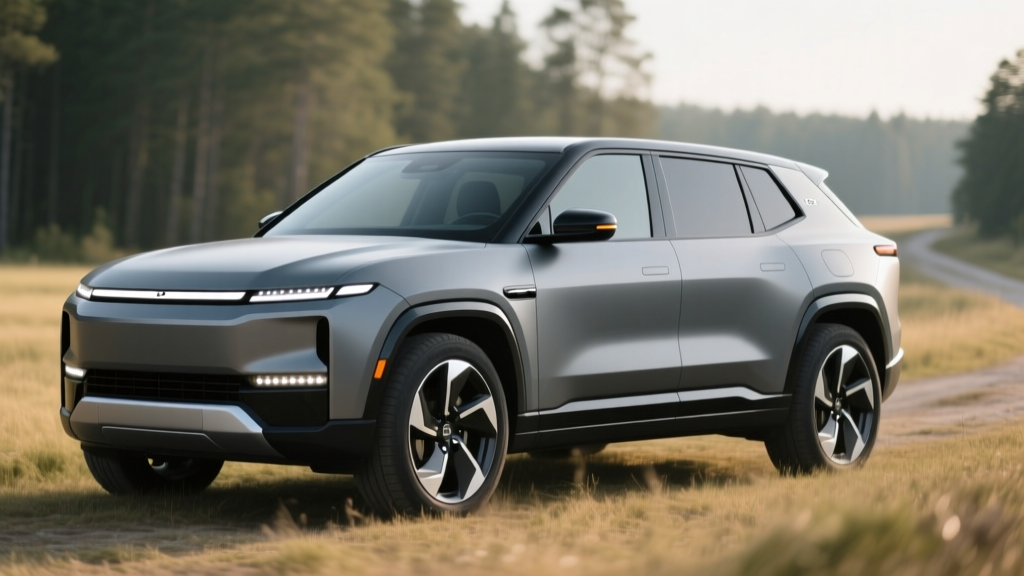
The current-generation Rivian R1S (2025–2026 model years, built on the updated Gen 2 platform) measures 200.8 inches in overall length with a 121.1-inch wheelbase. That places it squarely between midsize crossovers and full-size SUVs — longer than a Tesla Model X (199.1 in) but shorter than a Cadillac Escalade (211.9 in).
| Dimension | Measurement |
|---|---|
| Overall Length | 200.8 in (5,100 mm) |
| Wheelbase | 121.1 in (3,076 mm) |
| Width (excl. mirrors) | 81.8 in (2,078 mm) |
| Width (incl. mirrors) | 87.4 in (2,220 mm) |
| Height (standard suspension) | 73.0 in (1,854 mm) |
| Ground clearance (max) | 14.9 in (378 mm) |
| Curb weight | ~6,800 lbs (Dual-Motor Standard) |
Garage consideration: At just under 17 feet long and nearly 7 feet wide (over 7 feet with mirrors), the R1S demands a full-size garage bay. Standard single-car garages (typically 12 ft wide × 20–22 ft deep) will be tight. A two-car garage with 22+ ft depth is strongly recommended, especially if you plan to install a wall-mounted Level 2 charger at the rear of the bay.
Trail note: The 121.1-inch wheelbase is long for serious rock crawling, but the R1S compensates with adjustable air suspension, up to 14.9 inches of ground clearance, and a quad-motor option that enables precise torque vectoring for tight off-road lines.
EPA Range, Battery Options, and Real-World Expectations
Rivian offers the R1S with multiple battery pack sizes across the 2025–2026 lineup. The chemistry is NMC (Nickel Manganese Cobalt) across all packs — Rivian has not adopted LFP for the R1 platform, prioritizing energy density for its adventure-oriented use case.
| Pack | Usable Capacity | Drivetrain | EPA Range |
|---|---|---|---|
| Standard | ~92 kWh (NMC) | Dual-Motor AWD | 270 mi |
| Large | ~109 kWh (NMC) | Dual-Motor AWD | 330 mi |
| Max | ~141 kWh (NMC) | Dual-Motor AWD | 400 mi |
| Large | ~109 kWh (NMC) | Quad-Motor AWD | 315 mi |
The EPA estimates are based on controlled testing. In real-world highway driving at 70–75 mph, expect the Large Pack Dual-Motor R1S to deliver approximately 280–300 miles before needing a charge. In cold weather (below 32°F), range can drop 15–25% depending on cabin heating demands and whether you precondition the battery. The Max Pack's 400-mile EPA figure is genuinely road-trip capable — we've seen 340–360 real-world highway miles in moderate temperatures.
For city-heavy driving with frequent regenerative braking, the Standard Pack's 270-mile EPA rating holds up well, often matching or slightly exceeding the sticker number.
Efficiency for the Dual-Motor Large Pack is rated at approximately 73 MPGe combined (per fueleconomy.gov), which translates to roughly 46 kWh/100 miles. That's thirstier than a Tesla Model X or BMW iX — the trade-off for the R1S's body-on-frame construction, off-road capability, and 7,700-lb towing capacity.
Charging Speed: DC Fast Charging and Home Level 2
The Gen 2 R1S uses a NACS (North American Charging Standard) port natively, giving it direct access to the Tesla Supercharger network — a significant advantage for road tripping. CCS adapters are available for Electrify America and other networks.
| Charging Method | Max Power | Speed / Time |
|---|---|---|
| DC Fast Charge (peak) | ~200 kW | 10–80% in ~30 min (Large Pack) |
| DC Fast Charge (sustained avg) | ~140–160 kW | Charge curve tapers significantly above 80% |
| Level 2 (home, 48A / 11.5 kW) | 11.5 kW | ~25 mi/hr added; full charge in ~10–13 hrs |
| Level 2 (40A / 9.6 kW) | 9.6 kW | ~21 mi/hr added; full charge in ~12–15 hrs |
| Level 1 (120V) | ~1.4 kW | ~3 mi/hr — emergency/trickle only |
Charging-curve reality check: The R1S peaks near 200 kW but does not sustain that rate. The 10–80% time of roughly 30 minutes assumes a battery preconditioned via the navigation system's automatic preconditioning. Plug in cold without preconditioning, and that time can stretch to 40+ minutes. Above 80% SoC, charging slows dramatically — plan your road-trip stops around the 10–80% window for efficiency.
Home charging recommendation: A 48-amp hardwired Level 2 station on a 60-amp circuit (e.g., ChargePoint Home Flex, Tesla Wall Connector) will replenish roughly 25 miles of range per hour. For a Large Pack owner driving 40 miles daily, an overnight charge easily covers weekday needs. Budget $800–$2,000 for professional installation, potentially more if your electrical panel requires an upgrade to 200A service.
Performance: Dual-Motor and Quad-Motor Powertrains
The Gen 2 R1S ditched the original single-speed reduction gear for each motor in favor of Rivian's new dual-motor and quad-motor configurations, each with significant power and efficiency gains.
| Configuration | Horsepower | Torque (lb-ft) | 0–60 mph | Drivetrain |
|---|---|---|---|---|
| Dual-Motor | 533 hp | 610 | 4.5 sec | AWD |
| Performance Dual-Motor | 665 hp | 828 | 3.4 sec | AWD |
| Tri-Motor | 850 hp | 1,100+ | 2.9 sec (est.) | AWD |
| Quad-Motor | 1,025 hp | 1,198 | 2.5 sec | AWD |
The Dual-Motor is the volume seller and the sweet spot for most buyers — 533 hp is more than adequate for a 6,800-lb SUV, and the 4.5-second 0–60 time puts it ahead of most gas-powered three-row SUVs. The Quad-Motor exists for those who want supercar acceleration in a vehicle that can also ford 3+ feet of water. It's a party trick with genuine utility (individual wheel torque vectoring off-road).
Towing capacity is rated at 7,700 lbs across configurations — enough for most travel trailers, boat trailers, and horse trailers. Note that towing at capacity will cut real-world range by 30–50%, depending on trailer aerodynamics and terrain.
Interior Space, Cargo, and Passenger Comfort
The R1S's 200.8-inch length and 121.1-inch wheelbase translate into a genuine three-row SUV with usable space for adults in all seating positions — though the third row is best suited for children or shorter adults on longer trips.
| Measurement | Dimension |
|---|---|
| Front headroom | 40.9 in |
| Front legroom | 41.3 in |
| Second-row legroom | 38.6 in |
| Third-row legroom | 30.4 in |
| Cargo (behind 3rd row) | 20.3 cu ft |
| Cargo (behind 2nd row) | 57.2 cu ft |
| Cargo (behind 1st row, max) | 104.7 cu ft |
| Front trunk (frunk) | 11.0 cu ft |
The 11-cubic-foot frunk is a standout — it's large enough for charging cables, a soft cooler, or a week's worth of groceries, and it's weather-sealed and drainable (useful for ice on tailgate outings). The gear tunnel, available as an option, adds cross-vehicle storage accessible from either side — ideal for skis, snowboards, or camping gear.
Compared to rivals: The Tesla Model X offers slightly more third-row legroom (32.5 in) and more total cargo volume, but lacks the frunk and the R1S's off-road credentials. The Kia EV9 (198.6 in length, 114.2 in wheelbase) is shorter and more affordable but offers less ground clearance and towing capacity.
Pricing, Trim Levels, and Federal Tax Credit Eligibility
Rivian's pricing positions the R1S as a premium electric SUV. Here's the current lineup for the 2025 model year (pricing carries into early 2026 deliveries):
| Configuration | Base MSRP | As-Tested Range |
|---|---|---|
| Dual-Motor Standard Pack | $75,900 | $78,000–$84,000 |
| Dual-Motor Large Pack | $82,900 | $86,000–$95,000 |
| Dual-Motor Max Pack | $92,900 | $96,000–$105,000 |
| Performance Dual-Motor Large | $89,900 | $93,000–$102,000 |
| Tri-Motor (announced) | $99,900 (est.) | TBD |
| Quad-Motor | $109,900+ | $115,000–$130,000+ |
The Rivian R1S does qualify for the federal EV tax credit, but with important caveats under current IRS rules:
- MSRP cap: SUVs must have an MSRP under $80,000. Only the Dual-Motor Standard Pack at $75,900 clears this cap. Large Pack and above are ineligible.
- Income cap: Buyer AGI must be ≤ $150,000 (single), $225,000 (head of household), or $300,000 (married filing jointly).
- Battery sourcing: Critical mineral and battery component requirements must be met. Rivian has worked to qualify, but verify current status on IRS.gov before purchasing.
- Point-of-sale transfer: The up to $7,500 credit can be transferred to the dealer at purchase for an immediate price reduction, effective under current rules.
Consult a tax professional for your specific eligibility. State incentives (California, Colorado, etc.) may stack on top.
Driver Assistance, Technology, and Notable Drawbacks
The R1S comes equipped with Rivian's Driver+ suite, which includes adaptive cruise control, lane centering, automatic emergency braking, and highway assist. This is an SAE Level 2 driver-assistance system — meaning the driver must remain fully engaged, with hands on or near the wheel and eyes on the road at all times. It is not autonomous or "self-driving."
Rivian Driver+ is SAE Level 2. The system can manage steering and speed on highways, but it does not replace the driver. You are legally and operationally responsible for the vehicle at all times. Do not confuse this with Level 4 robotaxi services like Waymo.
Infotainment: The 15.6-inch center touchscreen runs Rivian's proprietary OS — responsive, well-organized, and integrated with vehicle settings, navigation, and camp/trail guides. Wireless Apple CarPlay and Android Auto are standard. A 12.3-inch digital driver display and an optional rear-seat entertainment screen round out the package.
Standout features:
- Camp Kitchen accessory (slide-out induction cooktop and sink)
- Gear Tunnel cross-vehicle storage
- Over-the-air updates that have meaningfully improved the vehicle since launch
- Integrated air compressor for tire inflation
- Vehicle-to-load (V2L) capability for powering campsite equipment
Notable drawbacks:
- No Apple CarPlay/Android Auto wireless mirroring in earlier 2022–2023 models (now standard on Gen 2)
- Rivian's service center network is still expanding — rural owners may face longer wait times for repairs
- Efficiency (kWh/100 mi) lags unibody competitors like the Tesla Model X and BMW iX
- The Quad-Motor's $110K+ price tag pushes it into luxury territory without the badge prestige some buyers want
Warranty Coverage
| Coverage | Term |
|---|---|
| Limited vehicle warranty | 5 years / 60,000 miles |
| Battery & powertrain | 8 years / 175,000 miles |
| Battery capacity retention | 70% minimum over 8 yr / 175,000 mi |
The 8-year/175,000-mile battery warranty is competitive with Tesla and exceeds most legacy automakers. The 70% capacity retention threshold is standard for the industry — if your Max Pack drops below 280 miles of range under warranty, Rivian will address it. Based on current NMC degradation data, most owners will retain 85–90% capacity at the 100,000-mile mark with normal charging habits (avoiding prolonged storage at 100% SoC).
Who Should Buy the Rivian R1S?
Choose the R1S if:
- You need a genuine three-row EV SUV with off-road capability and 7,700-lb towing
- You road-trip frequently and value Supercharger network access via NACS
- You want a frunk, gear tunnel, and adventure-oriented accessories
- You prioritize build quality and over-the-air improvement trajectories
Look elsewhere if:
- Maximum efficiency and lowest cost per mile are your priorities (consider BMW iX, Tesla Model X)
- You need the lowest possible price for a three-row EV (Kia EV9 starts ~$20K less)
- You live far from a Rivian service center and can't tolerate potential repair delays
- You want a hands-free Level 2+ system like GM's Super Cruise or Ford's BlueCruise (Rivian's Driver+ requires more active supervision)
Frequently Asked Questions
What is the exact length of the Rivian R1S?
The Rivian R1S measures 200.8 inches (5,100 mm) in overall length for the 2025 Gen 2 model. This is consistent across all battery and motor configurations — the pack size and motor count do not change the exterior dimensions.
What is the real-world range of the R1S on a road trip?
For the Large Pack Dual-Motor (330 mi EPA), expect approximately 280–300 miles at highway speeds (70–75 mph) in moderate weather. In winter conditions (below freezing), plan for 240–270 miles. The Max Pack (400 mi EPA) delivers 340–360 real-world highway miles in favorable conditions.
How fast does the R1S charge at home and on the road?
On a 48-amp Level 2 home charger (11.5 kW), the R1S adds about 25 miles of range per hour — a full overnight charge covers most daily needs. On DC fast chargers, it peaks at ~200 kW and charges from 10–80% in approximately 30 minutes with battery preconditioning.
Does the Rivian R1S qualify for the $7,500 federal tax credit?
Only the Dual-Motor Standard Pack ($75,900 MSRP) falls under the $80,000 SUV MSRP cap required by IRS §30D rules. You must also meet income limits ($150K single / $300K joint) and battery-sourcing requirements. Verify current eligibility on IRS.gov and consult a tax professional.
Is the R1S worth buying over the Tesla Model X or Kia EV9?
The R1S wins on off-road capability, towing (7,700 lbs), adventure accessories, and build quality. The Model X offers better efficiency, a larger Supercharger network history, and falcon-wing doors. The EV9 undercuts both on price significantly (~$54K starting) but lacks the range, performance, and towing capacity. Your use case — adventure vs. efficiency vs. budget — should drive the decision.
How does the R1S length affect daily driving and parking?
At 200.8 inches, the R1S fits in standard parking spaces and is manageable in urban environments thanks to excellent visibility and a tight 38.4-foot turning circle. However, the 81.8-inch width (87.4 with mirrors) can feel wide in narrow parking garages. A home garage with at least 22 feet of depth is recommended.