The Tesla Cybertruck's angular stainless-steel exoskeleton grabs headlines, but it's the Cybertruck dashboard — a minimalist, screen-dominated command center — that defines the daily ownership experience. After spending extended time behind the yoke-style steering wheel, we've mapped every pixel, every hidden menu, and every real-world quirk of Tesla's most polarizing interface. But a futuristic cabin means little if the truck can't deliver on range, charging speed, and utility. This review covers the dashboard and interior in depth, then grounds it all in the hard data that matters: EPA range versus real-world miles, DC fast-charge curves, Level 2 home charging, 0-60 performance, pricing, and federal tax credit eligibility under current IRS §30D rules.
The Cybertruck Dashboard: A 18.5-Inch Screen Runs the Show
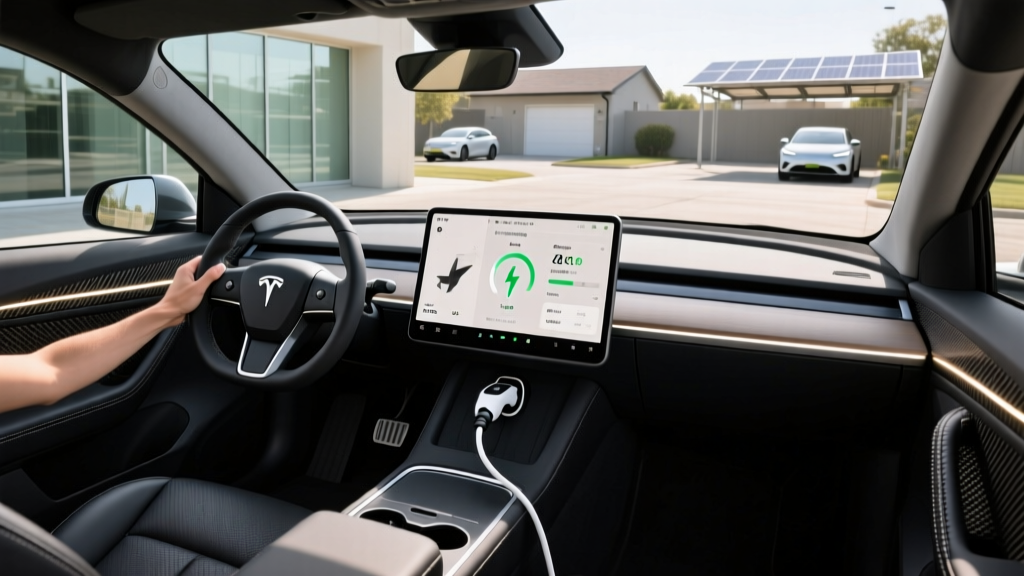
The Cybertruck dashboard eliminates nearly every physical control. A single 18.5-inch touchscreen (roughly 220 ppi) handles navigation, climate, media, vehicle settings, camera feeds, and even the glovebox release. There is no traditional instrument cluster; all driving information — speed, range, navigation prompts, Autopilot visualization — lives on the left third of the main display, directly in the driver's sightline.
Tesla has moved the gear selector to the overhead console (swipe up for Drive, down for Reverse, press for Park), and the turn signals are capacitive buttons on the yoke. This is the most screen-dependent Tesla interior yet, and it demands a learning curve. Expect the first week to feel clumsy — particularly the screen-based speedometer and the yoke-mounted blinkers, which require deliberate finger placement during turns.
For rear passengers, a 9.4-inch touchscreen mounted on the back of the center console handles climate, media, and gaming — a welcome addition that keeps rear occupants from needing to lean forward and tap the main display. The rear screen supports Bluetooth game controllers and streams from the truck's built-in LTE connection or a connected phone.
Spec Table: Cybertruck Range, Battery, Charging, and Performance
| Spec | AWD (Dual-Motor) | Cyberbeast (Tri-Motor) |
|---|---|---|
| EPA Range | 340 miles | 320 miles |
| Battery (usable) | ~123 kWh (estimated), NMC | ~123 kWh (estimated), NMC |
| Max DC Fast Charge | 350 kW (peak) | 350 kW (peak) |
| 10–80% DCFC Time | ~17 minutes (optimal) | ~17 minutes (optimal) |
| Level 2 Home Charging | 11.5 kW / ~44 mi/hr | 11.5 kW / ~44 mi/hr |
| 0–60 mph | 3.9 seconds | 2.6 seconds |
| Horsepower | 600 hp | 845 hp |
| Drivetrain | Dual-motor AWD | Tri-motor AWD |
| MPGe (combined) | ~70 MPGe | ~65 MPGe |
| Efficiency | ~48 kWh/100 mi | ~52 kWh/100 mi |
| Towing Capacity | 11,000 lbs | 11,000 lbs |
| Base MSRP | $79,990 | $99,990 |
Real-World Range: What the EPA Number Doesn't Tell You
Tesla's onboard range estimator is among the best in the industry, factoring in elevation, temperature, and driving style rather than relying solely on a simple kWh-remaining calculation. Still, the Cybertruck's mass (~6,800 lbs curb weight) and flat-panel stainless-steel body create a significant efficiency penalty compared to sleeker EVs. For context, the EPA's fueleconomy.gov listing shows the Cybertruck consuming roughly 48–52 kWh per 100 miles — nearly double what a Model Y uses over the same distance.
If your typical commute is under 50 miles round-trip with home Level 2 charging, the range shortfall is academic. If you're planning 400-mile road trips through the Mountain West in January, plan charging stops conservatively and use Tesla's trip planner, which accounts for Supercharger availability and battery preconditioning.
Charging Speed: 350 kW Peak, But the Curve Matters
| Level | Power | Miles Added/Hour | Notes |
|---|---|---|---|
| Level 1 (120V) | ~1.4 kW | ~3 mi/hr | Emergency/trickle only |
| Level 2 (240V, 48A) | 11.5 kW | ~44 mi/hr | Full overnight charge in ~12 hrs |
| DC Fast (V4 Supercharger) | Up to 350 kW | ~200+ mi in 15 min | 10–80% in ~17 min (preconditioned) |
The Cybertruck uses a NACS (North American Charging Standard) connector natively — no adapter needed for Tesla Superchargers. On V4 Supercharger cabinets capable of 350 kW, the Cybertruck can peak near its maximum rate, but as with all large-battery EVs, the charge curve tapers significantly above 60% state of charge. You'll see 300+ kW between 10–40% SoC, then a gradual ramp-down. The 10–80% claim of ~17 minutes assumes a preconditioned battery (the truck automatically heats the pack when you navigate to a Supercharger) and an available V4 cabinet.
At a typical 150 kW CCS station (via adapter), expect 10–80% in roughly 35–40 minutes. For home charging, a 48-amp Level 2 wall connector on a 60-amp circuit delivers 11.5 kW — enough to add ~44 miles of range per hour, or fully replenish the pack in about 12 hours. Given the Cybertruck's ~123 kWh usable battery, a 200-amp electrical panel is strongly recommended; many homes will need a panel upgrade ($1,500–$3,000) to support a dedicated 60-amp circuit. Always consult a licensed electrician for final specs.
Performance, Cargo, and Interior Space
The dual-motor AWD Cybertruck hits 60 mph in 3.9 seconds with 600 hp — quick for a 6,800-pound truck and quicker than any gas-powered F-150 or Silverado. The tri-motor Cyberbeast drops that to 2.6 seconds with 845 hp, placing it in supercar territory. Both trims feature adaptive air suspension with up to 16 inches of ground clearance in Off-Road mode and a self-leveling rear axle that maintains ride height under load.
Cargo space is generous but unconventional:
- Bed: 6.5 feet long (with tailgate down, extends to ~8 feet), ~74 cu ft volume. The motorized tonneau cover is lockable and supports 300 lbs.
- Frunk (front trunk): ~7.1 cu ft — fits a carry-on suitcase and a backpack.
- Interior cabin: Seating for five (bench-style rear). Rear legroom measures ~38.5 inches, adequate for adults but not class-leading versus the F-150 Lightning's ~41 inches.
- Rear under-seat storage: A hidden compartment beneath the rear bench adds ~3 cu ft for tools or gear.
The dashboard and cabin materials are vegan leather and hard plastics — durable and easy to clean, but at $80K–$100K, the interior feels more utilitarian than luxurious. There's no premium audio upgrade beyond the standard 15-speaker system (which is excellent), and no Apple CarPlay or Android Auto — Tesla's proprietary OS handles everything.
Pricing, Trims, and Federal Tax Credit Eligibility
| Trim | Base MSRP | §30D Credit Eligible? | Est. After-Credit Price |
|---|---|---|---|
| AWD (Dual-Motor) | $79,990 | No (exceeds $80K truck cap) | $79,990 |
| Cyberbeast (Tri-Motor) | $99,990 | No (exceeds $80K truck cap) | $99,990 |
Here's the critical tax credit detail: under IRS §30D rules, the federal EV tax credit for trucks, vans, and SUVs caps at an $80,000 MSRP. The Cybertruck AWD at $79,990 sits just under the line — but only if you stick to the base configuration. Adding the $3,000 Foundation Series package, $1,500 tow package, or other dealer-installed options pushes the MSRP over $80K, eliminating credit eligibility. The Cyberbeast at $99,990 is firmly ineligible regardless of options.
Even if MSRP qualifies, §30D imposes buyer income caps (adjusted gross income ≤ $150K single / $300K joint filers) and critical mineral + battery component sourcing requirements that change annually. The credit can now be transferred to the dealer at point of sale as a down-payment reduction, but only if all criteria are met. Consult a tax professional and verify current-year rules at irs.gov before assuming eligibility. As of 2026, most Cybertruck configurations do not qualify for the full $7,500 credit due to battery sourcing rules.
Driver Assistance: Autopilot and FSD (Supervised)
The Cybertruck's camera-only Tesla Vision system powers Autopilot, adaptive cruise control, automatic emergency braking, blind-spot monitoring, and the optional FSD package. The 18.5-inch dashboard screen renders a detailed real-time visualization of surrounding vehicles, pedestrians, and lane markings — one of the most informative ADAS displays available. However, the yoke steering wheel partially occludes the lower portion of the screen during hand-over-hand maneuvers, which can obscure the speedometer and ADAS status icons at critical moments.
Warranty and Long-Term Battery Outlook
Tesla covers the Cybertruck with:
- Basic vehicle warranty: 4 years / 50,000 miles
- Battery & drive unit: 8 years / 120,000 miles (whichever comes first), with a minimum 70% capacity retention guarantee over the warranty period
The Cybertruck is believed to use an NMC (nickel manganese cobalt) chemistry pack given its energy density requirements. NMC cells offer higher range per kilogram than LFP (lithium iron phosphate) but are more sensitive to sustained 100% state-of-charge storage. For daily driving, Tesla recommends charging to 80–90% and only hitting 100% before long trips. Based on Tesla's historical degradation data across the Model S/X/3/Y fleet, expect roughly 8–12% range loss over the first 100,000 miles, with degradation flattening significantly afterward. A full battery replacement outside warranty, should it ever be needed, is estimated at $15,000–$22,000 based on current pack pricing — though most owners will never need one.
Pros, Cons, and Who Should Buy the Cybertruck
✅ Pros
- Class-leading 11,000-lb towing capacity
- 350 kW DC fast charging (10–80% in ~17 min)
- Tri-motor Cyberbeast: 2.6-sec 0–60, 845 hp
- Stainless-steel body is dent- and corrosion-resistant
- Tesla Supercharger network (17,000+ stalls in North America)
- Air suspension with 16" ground clearance
- Excellent 15-speaker audio system
❌ Cons
- Real-world highway range 15–20% below EPA
- Largely ineligible for §30D federal tax credit
- Dashboard requires deep menu diving for basic controls
- Yoke turn signals are unintuitive in tight turns
- No Apple CarPlay / Android Auto
- High insurance premiums (avg. $3,500–$5,000/yr)
- Panel gaps and early build-quality inconsistencies
- Poor rear visibility; camera-dependent backing up
Who the Cybertruck Is For
Buy it if: You need a capable electric truck for towing, light off-roading, or job-site use, you have reliable home Level 2 charging, you're drawn to Tesla's Supercharger network for road trips, and you're comfortable with a screen-centric dashboard interface.
Look elsewhere if: You need maximum highway range (consider the F-150 Lightning Extended Range at 320 EPA miles and lower starting price), you want a traditional dashboard with physical controls, you rely on the federal tax credit to make the math work, or you frequently carry five adults (rear legroom is tight).
Frequently Asked Questions
What is the real-world range of the Tesla Cybertruck?
The AWD Cybertruck is EPA-rated at 340 miles, but expect 270–300 miles on the highway in moderate temperatures and 210–250 miles in cold weather. The Cyberbeast is rated at 320 miles EPA, with real-world highway range of 255–280 miles in fair conditions.
How fast does the Cybertruck charge at home and on the road?
On a V4 Supercharger, the Cybertruck peaks at 350 kW and charges from 10–80% in approximately 17 minutes with a preconditioned battery. At home on a 48-amp Level 2 charger (11.5 kW), it adds about 44 miles of range per hour, reaching a full charge in roughly 12 hours.
Does the Cybertruck qualify for the $7,500 federal EV tax credit?
Most configurations do not. The §30D credit caps truck MSRP at $80,000 — the AWD trim at $79,990 barely qualifies at base price, but any options push it over. The Cyberbeast at $99,990 is ineligible. Buyer income limits and battery-sourcing requirements further restrict eligibility. Verify current rules at irs.gov and consult a tax professional.
Is the Cybertruck worth buying versus the F-150 Lightning or Rivian R1T?
The Cybertruck wins on towing capacity (11,000 lbs vs. the Lightning's 10,000 lbs) and DC charging speed (350 kW vs. the Lightning's ~150 kW). The F-150 Lightning offers a lower starting price (~$55,000), tax credit eligibility, a more conventional interior, and better rear-seat space. The Rivian R1T excels in off-road capability and build quality but starts higher and has a smaller Supercharger-adjacent charging network. Your choice depends on whether you prioritize Tesla's charging infrastructure and performance or traditional truck ergonomics and credit eligibility.
How does the Cybertruck dashboard handle basic controls like climate and mirrors?
Everything runs through the 18.5-inch touchscreen. Climate, seat heaters, mirror adjustment, wiper settings, and even the glovebox are screen-controlled. Tesla offers customizable shortcut tiles and voice commands to reduce menu diving, but the learning curve is real — expect one to two weeks before muscle memory develops.
What is the Cybertruck's battery warranty?
Tesla covers the battery and drive unit for 8 years or 120,000 miles, whichever comes first, guaranteeing at least 70% capacity retention over that period. The basic vehicle warranty is 4 years / 50,000 miles.