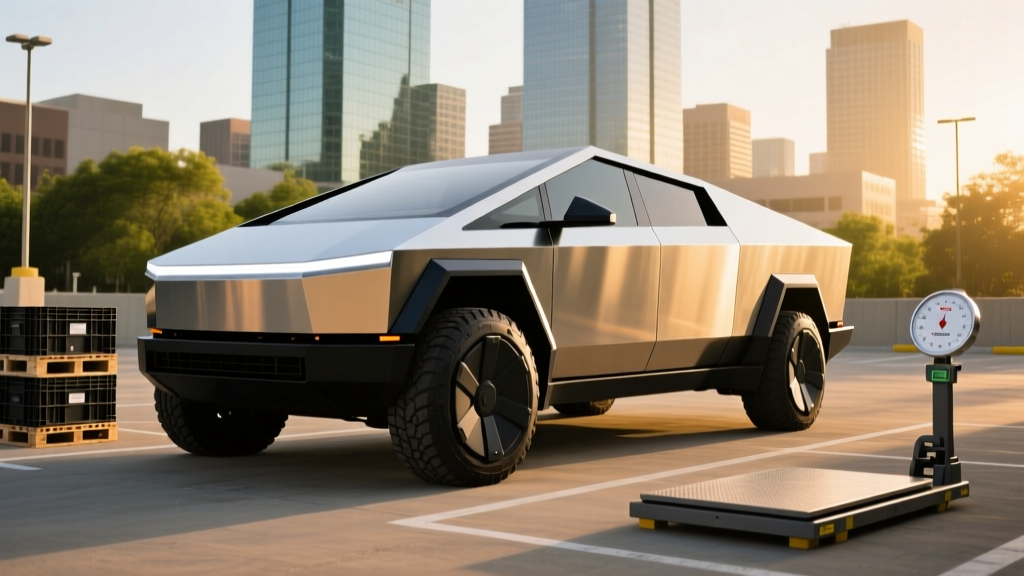
The Tesla Cybertruck is unlike anything else on the road — and a huge part of that story is written on the scale. Depending on the trim, the Cybertruck curb weight ranges from roughly 6,603 pounds for the Long Range AWD to 6,843 pounds for the Cyberbeast. That is nearly three and a half tons of stainless steel, battery cells, and electric motors, and it has direct, measurable consequences for range, efficiency, charging behavior, tire wear, and towing capability.
This review dissects the 2025/2026 Cybertruck lineup through the lens of its mass. If you are cross-shopping the Rivian R1T, Ford F-150 Lightning, or Chevrolet Silverado EV, understanding how curb weight shapes daily ownership will save you from surprises at the charger and the weigh station.
Cybertruck Curb Weight by Trim: The Numbers
Tesla publishes curb weights that include a full battery pack, standard equipment, and all fluids, but no occupants or cargo. Here is how the current lineup stacks up against key electric-truck rivals:
| Model | Curb Weight (lbs) | GVWR (lbs) | Payload Capacity (lbs) |
|---|---|---|---|
| Cybertruck Long Range AWD | 6,603 | 8,900 | ~2,300 |
| Cybertruck All-Wheel Drive | 6,743 | 8,900 | ~2,200 |
| Cybertruck Cyberbeast (Tri-Motor) | 6,843 | 8,900 | ~2,100 |
| Rivian R1T Dual-Motor (Standard) | ~6,800 | 8,532 | ~1,700 |
| Ford F-150 Lightning (Std Range) | ~6,171 | 8,550 | ~2,235 |
| Chevrolet Silverado EV 4WT | ~8,810 | 11,200 | ~2,400 |
The Cybertruck sits squarely in the middle of the electric-pickup weight spectrum. It is heavier than the F-150 Lightning but lighter than the Silverado EV, which carries a much larger battery. The stainless-steel exoskeleton, while visually striking, adds meaningful mass compared to the aluminum-bodied Ford or the composite-body Rivian.
How Weight Impacts Range: EPA vs. Real World
Mass is the enemy of efficiency. Every pound the Cybertruck carries requires more energy to accelerate, climb grades, and push through aerodynamic drag — and that angular stainless-steel body generates substantial drag at highway speeds. The EPA range ratings reflect this physics reality:
| Trim | EPA Range | Battery (kWh, usable est.) | MPGe (combined) | kWh/100 mi |
|---|---|---|---|---|
| Long Range AWD | 340 mi | ~123 kWh | 67 MPGe | ~50 |
| All-Wheel Drive | 318 mi | ~123 kWh | 63 MPGe | ~53 |
| Cyberbeast | 301 mi | ~123 kWh | 58 MPGe | ~58 |
Real-World Range Reality: The EPA sticker tells only part of the story. In independent highway testing at sustained 70–75 mph speeds, the Cybertruck AWD typically delivers between 260 and 280 miles before hitting a 10% state of charge. In cold weather (below 32°F), expect an additional 15–25% range reduction due to battery resistance and cabin heating demands. A 318-mile EPA rating can shrink to roughly 200–220 miles on a freezing interstate run. Plan charging stops accordingly.
The Cyberbeast's tri-motor setup and performance-oriented tuning add weight and parasitic drag from the third motor, explaining its 301-mile rating despite sharing the same battery pack. If maximum range is your priority, the Long Range AWD is the clear pick — its lighter curb weight and dual-motor configuration yield the best efficiency.
Charging Performance: DC Fast Charge and Home Level 2
The Cybertruck uses an 800-volt architecture, enabling high peak DC fast-charge rates. However, that massive battery pack means even fast charging takes meaningful time. Here is what to expect:
| Charging Level | Max Rate | Speed / Time | Notes |
|---|---|---|---|
| DC Fast Charge (V4 Supercharger) | ~350 kW peak | 10–80% in ~30 min | Sustained rate tapers significantly above 60% SoC |
| DC Fast Charge (250 kW V3 Supercharger) | ~250 kW peak | 10–80% in ~38 min | Most common public Tesla infrastructure |
| Level 2 Home (Tesla Wall Connector, 48A/11.5 kW) | 11.5 kW | ~30 mi/hr, full charge in ~11 hrs | Requires 60A dedicated circuit (NEMA 14-60 or hardwired) |
| Level 2 Home (32A / 7.7 kW) | 7.7 kW | ~20 mi/hr, full charge in ~16 hrs | Common for 40A circuit (NEMA 14-50) |
| Level 1 (120V, 12A) | ~1.4 kW | ~4 mi/hr | Emergency/trickle only — full charge takes days |
Charging-curve reality check: The Cybertruck's peak ~350 kW rate is only sustained for a short window between roughly 10–30% state of charge. Above 50%, the rate drops to around 150–180 kW, and above 80% it tapers to under 60 kW. This is normal for large NMC battery packs — thermal management limits sustained high-current input to protect cell longevity. On a road trip, plan for 30-minute stops at V4 Superchargers, not the 15-minute stops you might see in marketing materials.
For daily ownership, home Level 2 charging at 11.5 kW is the practical sweet spot. Plugging in overnight replenishes even a fully depleted pack by morning. The Cybertruck's onboard charger supports up to 11.5 kW (48 amps), so investing in a Tesla Wall Connector or a high-quality third-party J1772/NACS unit on a hardwired 60-amp circuit maximizes your home-charging convenience.
Performance and Powertrain Specs
Despite its heft, the Cybertruck delivers sports-car acceleration. Tesla's torque-vectoring motors and instant electric torque overcome the mass penalty in straight-line performance, though handling and braking physics still reflect that 6,800+ pound curb weight.
| Trim | Drivetrain | Horsepower | 0–60 mph | Top Speed | Towing Capacity |
|---|---|---|---|---|---|
| Long Range AWD | Dual-Motor AWD | ~600 hp | 4.1 sec | 112 mph | 11,000 lbs |
| All-Wheel Drive | Dual-Motor AWD | ~600 hp | 3.9 sec | 112 mph | 11,000 lbs |
| Cyberbeast | Tri-Motor AWD | ~845 hp | 2.6 sec | 130 mph | 11,000 lbs |
The Cyberbeast's 2.6-second 0–60 time is remarkable for a vehicle this heavy, but it comes at the cost of efficiency — those tri-motor power dumps consume energy rapidly under hard acceleration. For towing, the 11,000-pound rating is competitive, but expect range to drop by 40–50% when hauling near maximum capacity, especially at highway speeds or in hilly terrain. The Cybertruck's mass works in its favor for towing stability but against it for energy consumption.
Pricing, Trims, and Federal Tax Credit Eligibility
The Cybertruck's pricing has shifted since its 2023 debut. Here is the current lineup with federal tax credit considerations:
| Trim | Base MSRP (2025) | Federal §30D Credit | Effective Price (est.) |
|---|---|---|---|
| Long Range AWD | $79,990 | Not eligible (MSRP cap) | $79,990 |
| All-Wheel Drive | $79,990 | Not eligible (MSRP cap) | $79,990 |
| Cyberbeast | $99,990 | Not eligible (MSRP cap) | $99,990 |
IRS §30D Federal Tax Credit — Why the Cybertruck Does Not Qualify:
- The §30D credit caps eligible pickup truck MSRP at $80,000. The Cybertruck AWD and Long Range trims are listed at $79,990, which technically falls within the cap, but eligibility also depends on battery-component sourcing and critical-mineral requirements that shift periodically.
- Buyer income caps apply: $300,000 joint / $225,000 head of household / $150,000 individual (modified AGI).
- The point-of-sale transfer option allows eligible buyers to apply the credit at purchase rather than waiting for tax filing — but only if the vehicle qualifies.
- Always verify current eligibility on IRS.gov and fueleconomy.gov before purchasing. Rules change frequently based on battery-sourcing compliance.
As of early 2026, the Cybertruck's eligibility for the full $7,500 federal credit remains uncertain due to evolving battery-component and critical-mineral sourcing rules under the Inflation Reduction Act. Some buyers may qualify for partial credits depending on the manufacturing date and battery cell origin. Consult a tax professional and check the latest IRS guidance before counting on the credit in your purchase budget.
Cargo, Passenger Space, and Daily Practicality
The Cybertruck's angular design creates unique packaging advantages and limitations:
- Bed: 6-foot bed with a motorized retractable tonneau cover. Approximately 74 cu ft of cargo volume (with cover deployed). The bed floor is flat and wide between the wheel wells.
- Frunk (front trunk): ~7.1 cu ft — useful for groceries or a charging cable kit, but smaller than the F-150 Lightning's massive 14 cu ft frunk.
- Rear seats: Three-across seating with ~38 inches of rear legroom. The rear bench folds flat to extend cargo capacity into the cabin.
- Front trunk access: The powered frunk lid is a standout convenience feature for secure, weather-sealed storage.
- Vault (bed) storage: Under-bed storage compartments behind the rear wheels add roughly 3 cu ft of lockable space.
The stainless-steel bed is dent-resistant but can be slippery with certain cargo. The motorized tonneau cover is robust but its motorized mechanism is a potential long-term maintenance item. For families, the rear seat is adequate for children and teens but tighter than a full-size crew-cab truck for adults on long trips.
Technology, Driver Assistance, and Warranty
Infotainment: The Cybertruck features an 18.5-inch front touchscreen and a 9.4-inch rear touchscreen. The interface runs Tesla's proprietary OS with navigation, streaming, gaming, and over-the-air updates. There is no Apple CarPlay or Android Auto — a dealbreaker for some buyers accustomed to phone projection.
Driver Assistance: Tesla's Autopilot (adaptive cruise + lane centering) is standard. Full Self-Driving (Supervised) is available as an add-on purchase ($8,000) or subscription ($99/month). FSD provides automated lane changes, intersection navigation, and parking assist.
SAE Automation Level: Level 2. Despite the "Full Self-Driving" name, Tesla's FSD (Supervised) is a Level 2 driver-assistance system per SAE International standards. The driver must remain fully engaged, keep hands on the steering wheel (or demonstrate attentiveness via cabin camera), and be prepared to take over at any moment. This is not autonomous driving. Only Level 4 services like Waymo operate without a human driver.
What FSD Does NOT Do: FSD (Supervised) cannot navigate all road types reliably, may misread construction zones, can make unexpected lane changes, and requires constant driver attention. It is not a substitute for an alert driver. Treat it as an advanced cruise-control system, not a chauffeur.
Warranty:
- Vehicle: 4 years / 50,000 miles (bumper-to-bumper)
- Battery & Drive Units: 8 years / 120,000 miles (whichever comes first), with a minimum 70% capacity retention guarantee during the warranty period
- Rust-through (body): Tesla does not publish a separate corrosion warranty for the stainless-steel body, which is inherently corrosion-resistant
The 8-year/120,000-mile battery warranty is competitive with the industry standard for light-duty EVs. The 70% retention threshold means Tesla will repair or replace the battery if it degrades below that level within the warranty window. Given the Cybertruck's heavy curb weight and large battery, degradation management through proper charging habits (avoiding sustained 100% SoC, using preconditioning for fast charges) will help maximize long-term battery health.
Pros and Cons: The Honest Assessment
Pros
- Class-leading acceleration, especially the Cyberbeast at 2.6 sec 0–60
- 11,000-lb towing capacity rivals conventional half-ton trucks
- Stainless-steel exoskeleton is dent- and corrosion-resistant
- 800V architecture enables ~350 kW peak DC fast charging
- Access to the Tesla Supercharger network (20,000+ stalls in North America)
- Frunk + vault storage provides versatile cargo options
- Over-the-air updates continuously add features
Cons
- Heavy curb weight (6,603–6,843 lbs) reduces efficiency vs. lighter EVs
- Real-world highway range falls well short of EPA estimates, especially in cold weather
- No Apple CarPlay or Android Auto support
- FSD (Supervised) is Level 2 only — not self-driving despite the name
- Federal tax credit eligibility is uncertain due to MSRP caps and sourcing rules
- Stainless-steel body panels are difficult and expensive to repair after collision damage
- Rear-seat legroom is tight for full-size truck expectations
- High insurance premiums reported by many owners
Who Should Buy the Cybertruck?
The Cybertruck is best suited for buyers who prioritize performance, technology, and distinctive design over maximum efficiency or traditional truck utility. It works well as a high-performance daily driver that can tow a boat or camper on weekends, provided you plan charging stops carefully on long hauls.
It is less ideal for buyers who need maximum payload (the Silverado EV or a conventional diesel truck is better), those who rely on Apple CarPlay for daily navigation, or budget-conscious shoppers hoping to leverage the full $7,500 federal tax credit.
If your use case involves commuting with occasional towing, you have reliable home Level 2 charging, and you value the Supercharger network for road trips, the Cybertruck delivers an experience no other electric truck matches. If efficiency and real-world range are your top priorities, the Rivian R1T or F-150 Lightning may serve you better at a lower curb weight.
Frequently Asked Questions
What is the Tesla Cybertruck's curb weight?
The Cybertruck curb weight ranges from 6,603 lbs (Long Range AWD) to 6,843 lbs (Cyberbeast tri-motor). This places it between the lighter F-150 Lightning (~6,171 lbs) and the heavier Silverado EV (~8,810 lbs).
What is the real-world range of the Cybertruck?
While EPA estimates range from 301 to 340 miles depending on trim, real-world highway driving at 70–75 mph typically yields 260–280 miles. In cold weather below freezing, expect 200–220 miles due to battery resistance and heating loads.
How fast does the Cybertruck charge at home and on the road?
On a V4 Supercharger, the Cybertruck peaks at ~350 kW and charges 10–80% in about 30 minutes. At home on a 48A Level 2 Wall Connector (11.5 kW), it adds roughly 30 miles per hour, fully recharging overnight in about 11 hours.
Does the Cybertruck qualify for the federal EV tax credit?
Eligibility under IRS §30D is uncertain as of 2026. The $80,000 MSRP cap for pickups, buyer income limits, and evolving battery-sourcing requirements all affect qualification. Verify current status at IRS.gov before purchasing.
Is the Cybertruck worth buying vs. the Rivian R1T or F-150 Lightning?
Choose the Cybertruck if you want tri-motor performance, Supercharger access, and a stainless-steel design statement. Choose the R1T for better real-world efficiency, more refined interior quality, and a lighter curb weight. Choose the F-150 Lightning for lower pricing, a larger frunk, and potentially easier federal tax credit eligibility.
What battery chemistry does the Cybertruck use?
The Cybertruck uses NMC (nickel manganese cobalt) lithium-ion cells, consistent with Tesla's high-performance, long-range vehicles. NMC offers higher energy density than LFP (lithium iron phosphate), which is necessary given the Cybertruck's mass and range targets. NMC batteries benefit from avoiding sustained 100% state of charge for daily use.
How much does it cost to insure a Cybertruck?
Cybertruck insurance premiums are significantly higher than average, often 40–80% above comparable trucks. Factors include high repair costs for stainless-steel body panels, expensive parts, and the vehicle's performance capability. Get quotes from multiple insurers before purchasing.