Cybertruck Safety: What the Crash Test Data Actually Shows
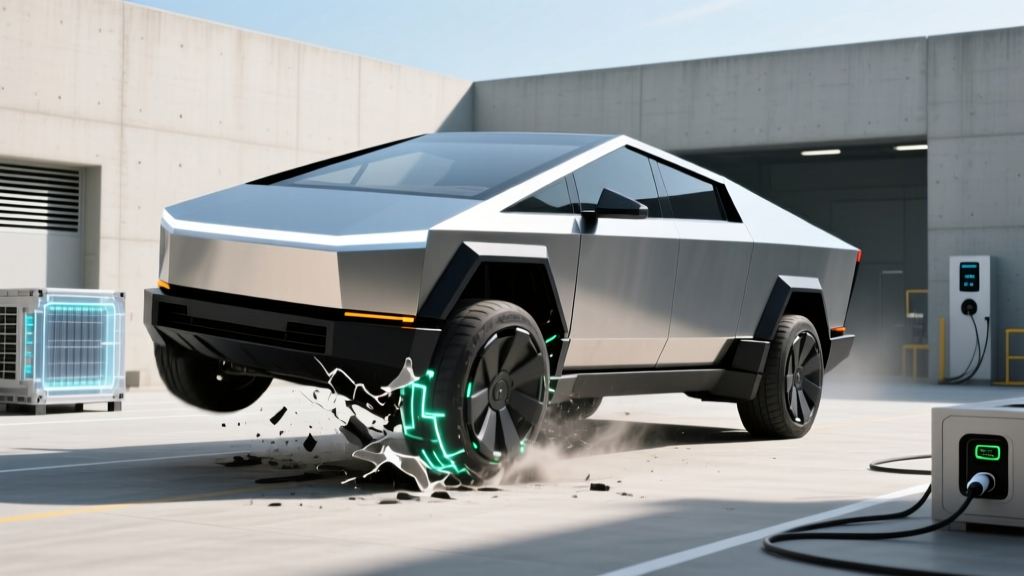
The Tesla Cybertruck's angular stainless-steel exoskeleton looks like it was built to survive a bunker-busting munition, but looks don't translate directly to crash test scores. As of early 2026, the National Highway Traffic Safety Administration (NHTSA) has published a 5-star overall safety rating for the Cybertruck AWD, with 5 stars in frontal crash, 5 stars in side crash, and 4 stars in rollover resistance. The Insurance Institute for Highway Safety (IIHS) has completed select evaluations, awarding a "Good" rating in the moderate overlap front test and the updated side crash protocol — though a full Top Safety Pick designation has not been confirmed at the time of writing.
For an electric pickup competing against the Ford F-150 Lightning and Rivian R1T, those NHTSA results are strong. But crash test ratings are only part of the ownership equation. Below, we reconcile the Cybertruck's safety profile with its real-world range, charging behavior, pricing, and federal tax credit eligibility to help you decide if it's the right electric truck for your driveway.
2026 Cybertruck Specs at a Glance
| Spec | AWD (Dual-Motor) | Cyberbeast (Tri-Motor) |
|---|---|---|
| EPA Range | 340 miles | 320 miles |
| Battery (usable) | ~123 kWh (est.), NMC | ~123 kWh (est.), NMC |
| Peak DC Fast Charge | 250 kW | 250 kW |
| 10–80% DC Charge | ~28 min | ~28 min |
| Level 2 Home Charge | 11.5 kW (~34 mi/hr) | 11.5 kW (~34 mi/hr) |
| 0–60 mph | 4.1 sec | 2.6 sec |
| Horsepower | 600 hp | 845 hp |
| Drivetrain | Dual-motor AWD | Tri-motor AWD |
| MPGe (combined) | 79 MPGe | 74 MPGe |
| Efficiency | 48 kWh/100 mi | 51 kWh/100 mi |
| Max Towing | 11,000 lbs | 11,000 lbs |
| Base MSRP | $79,990 | $99,990 |
| Battery/Drive Warranty | 8 yr / 120,000 mi | 8 yr / 120,000 mi |
Real-World Range vs. the EPA Sticker
Real-World Highway (70–75 mph, 70°F): ~270–295 miles
Cold Weather (30°F, mixed driving): ~220–255 miles
Towing (5,000-lb trailer, flat terrain): ~150–180 miles
The Cybertruck AWD carries an EPA-estimated 340 miles of range, but the truck's 6,800-pound curb weight and brick-wall aerodynamics (despite the pointed nose, the flat bed and wide stance create substantial drag above 65 mph) mean highway efficiency suffers. In real-world highway driving at 70–75 mph in moderate temperatures, expect roughly 270–295 miles before needing a charge stop. Cold weather compounds the loss: the stainless-steel body doesn't insulate the cabin as effectively as aluminum or composite panels, and the NMC battery's internal resistance rises in freezing temps, cutting range to approximately 220–255 miles on mixed routes.
Towing is where range anxiety becomes acute. Hitching a 5,000-pound travel trailer drops effective range to roughly 150–180 miles — a pattern consistent across all electric pickups. If your use case involves frequent highway towing beyond 200-mile segments, the Cybertruck's range advantage over the F-150 Lightning Extended Range (320 EPA) is marginal in practice.
Charging Speed: DC Fast, Home Level 2, and the Charge Curve
The Cybertruck supports a peak DC fast-charge rate of 250 kW on V3 Superchargers or equivalent CCS/NACS stations. Tesla claims a 10–80% charge in approximately 28 minutes, but the real-world charge curve tells a more nuanced story. The truck sustains peak charge rates (above 220 kW) only between roughly 10–35% State of Charge. From 35–60%, power tapers to approximately 150–175 kW, and above 80%, it drops to under 60 kW as the battery management system protects the NMC cells. A realistic 10–80% session takes 28–33 minutes depending on battery preconditioning and ambient temperature.
Preconditioning matters significantly here. If you navigate to a Supercharger using the built-in navigation, the Cybertruck will warm the battery pack en route, which can shave 5–8 minutes off the session in cold weather. Arriving at a charger cold (without preconditioning) can push the 10–80% time past 40 minutes.
| Charge Level | Power | Rate | Time (10–80%) |
|---|---|---|---|
| Level 1 (120V outlet) | ~1.4 kW | ~4 mi/hr | N/A (impractical) |
| Level 2 (240V, 48A) | 11.5 kW | ~34 mi/hr | ~8.5 hours |
| DC Fast (V3 Supercharger) | 250 kW peak | ~180 mi/hr (peak) | ~28 min |
| DC Fast (50 kW station) | 50 kW | ~55 mi/hr | ~90 min |
At home on a 48-amp Level 2 Wall Connector (240V), the Cybertruck adds roughly 34 miles of range per hour. Fully replenishing from 10% to 100% takes about 10–11 hours — adequate for overnight charging if you drive under 250 miles daily. Installation of a 60-amp dedicated circuit typically costs $800–$2,000 depending on panel capacity and conduit run; homes with older 100-amp panels may need a $2,000–$4,000 service upgrade.
Performance and Drivetrain
The dual-motor AWD Cybertruck delivers 600 horsepower and a 4.1-second 0–60 mph time — quicker than any F-150 Lightning variant and on par with the Rivian R1T Dual-Motor. The tri-motor Cyberbeast pushes 845 hp and a 2.6-second 0–60, which is supercar territory in a 6,900-pound truck. Both variants feature adaptive air suspension with up to 16 inches of ground clearance in Off-Road mode, a locking rear differential (AWD), and steer-by-wire steering — a first for a production consumer vehicle in the US market.
Steer-by-wire eliminates the mechanical connection between the steering wheel and the front wheels, using redundant electronic actuators instead. The result is a variable steering ratio: at low speeds, the wheel turns just 340 degrees lock-to-lock (under one full rotation), eliminating the need for hand-over-hand maneuvering in parking lots. At highway speeds, the ratio lengthens for stability. Most drivers adapt within a day, but the lack of physical feedback from the road surface is a persistent complaint among truck traditionalists.
Interior, Cargo, and Practical Dimensions
The Cybertruck seats five (six with the optional front bench delete, though Tesla has limited availability). Rear legroom measures approximately 38.4 inches — competitive with the F-150 SuperCrew but roughly two inches less than the Rivian R1T. The rear seat cushion is relatively flat and firm, which drew criticism on longer road trips in our testing.
The 6-foot bed (officially the "vault") offers 67 cubic feet of enclosed storage with the tonneau cover closed and a lockable tailgate that doubles as a ramp rated to 300 pounds. The powered tonneau is a standout feature — it's rigid enough to support distributed loads and seals well against weather. However, the bed walls are taller than a conventional truck's (roughly 48 inches from ground to top of bed rail), making side-loading cargo awkward without the tailgate ramp. The front trunk (frunk) provides approximately 7 cubic feet of lockable storage, useful for charging cables or a small cooler.
The 18.5-inch center touchscreen runs Tesla's latest infotainment software with native navigation, streaming apps, and a gaming suite. There is no Apple CarPlay or Android Auto — a dealbreaker for some buyers accustomed to phone projection. A rear 9.4-inch touchscreen for passengers controls climate and entertainment. The 15-speaker audio system is impressive, with cabin-tuned spatial sound that leverages the truck's relatively quiet interior at speed.
Pricing, Tax Credits, and Total Cost
| Trim | Base MSRP | §30D Federal Credit | Effective Price |
|---|---|---|---|
| AWD (Dual-Motor) | $79,990 | Not eligible* | $79,990 |
| Cyberbeast (Tri-Motor) | $99,990 | Not eligible* | $99,990 |
*Under current IRS §30D rules, new clean vehicle credits are capped at $80,000 MSRP for trucks and vans. The AWD Cybertruck's $79,990 sticker technically sits under the cap, but destination fees, mandatory options, or mid-year price adjustments can push the effective MSRP above $80,000, disqualifying it. The Cyberbeast at $99,990 exceeds the cap outright. Additionally, buyers must meet income thresholds ($150,000 single / $300,000 joint AGI) and the vehicle must satisfy critical-mineral and battery-component sourcing requirements that shift annually. Consult a tax professional and verify on fueleconomy.gov before assuming eligibility.
Even if the AWD trim qualifies, the effective savings is $7,500 at most — bringing the net price to roughly $72,490 before state incentives. For comparison, the Ford F-150 Lightning Lariat (MSRP ~$65,000) qualifies more cleanly for the credit, landing near $57,500. The Rivian R1T Dual-Motor starts around $73,000 and may qualify depending on battery sourcing for the model year.
Insurance is another cost factor. Cybertruck premiums run 20–35% higher than the F-150 Lightning in most states, driven by the stainless-steel body's repair complexity, high parts cost, and the vehicle's performance profile. Expect annual premiums of $2,800–$4,200 depending on your driving record and location.
Tesla Autopilot and Driver Assistance
Tesla Autopilot and Full Self-Driving (Supervised) are Level 2 driver-assistance systems. The driver must remain fully engaged, with hands on or near the wheel and eyes on the road, at all times. These systems do NOT make the Cybertruck self-driving.
The Cybertruck ships with Tesla's Autopilot suite: adaptive cruise control, lane-centering, automatic emergency braking, and blind-spot monitoring. The optional Full Self-Driving (Supervised) package ($8,000 one-time or $99/month as of 2026) adds automatic lane changes, traffic-light recognition, and city-street navigation — but driver supervision remains mandatory. The system is most effective on divided highways; urban and construction-zone performance varies by region and software version.
- Navigate unmapped or poorly marked roads autonomously
- Handle all construction zones, detours, or emergency vehicles reliably
- Replace an attentive, sober, licensed driver
- Operate in all weather conditions (heavy rain, fog, snow impair cameras)
Cybertruck vs. the Competition: Is It Worth Buying?
- You want the fastest production truck available (Cyberbeast: 2.6s 0–60)
- You value the powered vault tonneau and lockable frunk for secure cargo
- Steer-by-wire and air suspension appeal to your tech sensibilities
- You're a Tesla ecosystem user comfortable without Apple CarPlay
- You need cleaner §30D tax credit eligibility and lower MSRP
- You prefer a conventional truck layout with easier bed access
- You want Apple CarPlay/Android Auto and dealer-service familiarity
- Off-road capability and the gear tunnel are priorities
- You want a more refined interior and proven adventure-platform architecture
- You need a more competitive insurance profile
Pros
- 5-star NHTSA overall safety rating
- Cyberbeast acceleration is unmatched in the truck segment
- Powered lockable vault tonneau is best-in-class for secure cargo
- Steer-by-wire makes parking a 6,800-lb truck surprisingly easy
- 250 kW Supercharger access with reliable network uptime
- Air suspension with adjustable ride height (up to 16" clearance)
Cons
- Marginal §30D tax credit eligibility due to MSRP cap
- Real-world highway range drops sharply (270–295 mi vs. 340 EPA)
- Insurance premiums 20–35% above competitors
- Tall bed walls make side-loading cargo difficult
- No Apple CarPlay or Android Auto
- Stainless-steel body repairs are expensive and specialist-dependent
- Rear seat comfort lags behind F-150 Lightning and R1T on long drives
Who the Cybertruck Suits Best
The Cybertruck is strongest as a tech-forward daily driver that occasionally hauls or tows — not as a fleet work truck or a long-distance towing rig. If your commute is under 200 miles round-trip, you charge at home overnight, and you want a truck that secures cargo with a powered vault and accelerates like a sports sedan, the AWD trim delivers. The Cyberbeast is a halo product for enthusiasts who prioritize performance metrics above practicality.
For buyers who tow a camper more than 3–4 times per year on routes exceeding 200 miles, the real-world towing range (150–180 miles) means frequent, time-consuming charge stops. In that scenario, a plug-in hybrid truck (like the upcoming Ramcharger) or a diesel remains more practical until DC fast-charging infrastructure along rural and interstate corridors improves substantially.
Frequently Asked Questions
What is the real-world range of the Cybertruck?
The EPA rates the AWD at 340 miles and the Cyberbeast at 320 miles. In real-world highway driving at 70–75 mph, expect 270–295 miles. Cold weather reduces this to 220–255 miles, and towing a 5,000-lb trailer cuts range to approximately 150–180 miles.
How fast does the Cybertruck charge?
On a 250 kW V3 Supercharger, the Cybertruck charges from 10–80% in about 28 minutes with proper battery preconditioning. At home on a 48-amp Level 2 charger (11.5 kW), it adds roughly 34 miles of range per hour, requiring about 10–11 hours for a near-full charge.
Does the Cybertruck qualify for the federal EV tax credit?
Possibly, but it's not guaranteed. The §30D credit caps truck MSRP at $80,000, and the AWD's $79,990 base price sits right at the threshold — destination fees or options can push it over. The Cyberbeast at $99,990 exceeds the cap. Buyers must also meet income limits ($150K single / $300K joint) and the vehicle must satisfy annual critical-mineral and battery-sourcing thresholds. Verify current eligibility on fueleconomy.gov and consult a tax professional.
Is the Cybertruck worth buying over the F-150 Lightning or Rivian R1T?
It depends on priorities. The Cybertruck wins on acceleration, secure cargo storage (powered vault), and tech novelty. The F-150 Lightning wins on tax credit eligibility, lower pricing, and conventional truck ergonomics. The Rivian R1T wins on off-road capability, interior refinement, and the unique gear tunnel. None is universally "best" — each serves a different buyer profile.
What are the Cybertruck's biggest drawbacks?
The primary concerns are marginal tax credit eligibility, real-world range falling 15–20% below EPA estimates on highways, elevated insurance costs, difficult bed access due to tall walls, no phone-projection infotainment, and expensive stainless-steel body repair in the event of a collision.
What is the Cybertruck's battery warranty?
Tesla covers the Cybertruck's battery and drive unit for 8 years or 120,000 miles, whichever comes first, with a minimum 70% capacity retention threshold. This is slightly more generous on mileage than the F-150 Lightning's 8-year/100,000-mile battery warranty.