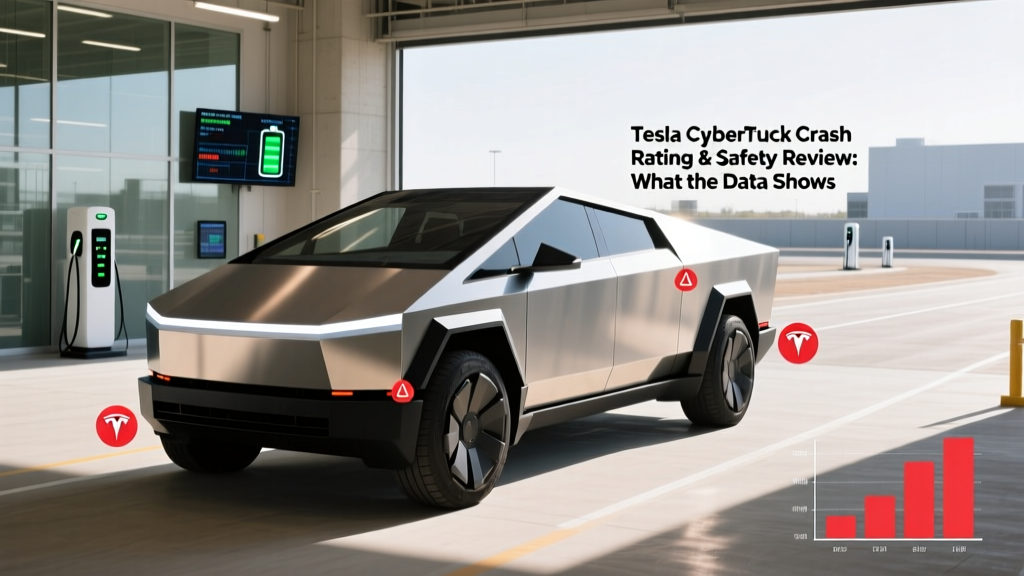
The Tesla Cybertruck's angular stainless-steel exoskeleton was marketed as nearly indestructible, but for buyers considering a $80,000+ electric pickup, the question isn't about bullet resistance — it's about crashworthiness. The Cybertruck crash rating picture in 2026 is nuanced: official NHTSA star ratings remain limited, IIHS testing has been selective, and the truck's unconventional geometry creates unique safety considerations that standard sedans and crossovers don't face.
This review covers everything you need to evaluate the Cybertruck as a daily driver and family hauler — from safety data and real-world range to charging speed, pricing after federal tax credits, and whether it outguns the Rivian R1T and Ford F-150 Lightning where it matters most.
Cybertruck Crash Rating: NHTSA and IIHS Results Explained
As of early 2026, the NHTSA has not published a full 5-star safety rating for the Cybertruck across all crash-test categories. The agency's testing pipeline for low-volume, unconventional vehicles has historically lagged behind mainstream models. What is available:
- Rollover resistance: The Cybertruck's low center of gravity (battery pack mounted beneath the floor) gives it a strong static stability factor. Tesla claims a low rollover risk, consistent with other heavy BEV platforms.
- Frontal and side crash: NHTSA full frontal and side-barrier results have not been publicly posted for the Cybertruck as of this writing. Buyers should monitor nhtsa.gov/ratings for updates.
The IIHS has similarly not completed a full Top Safety Pick evaluation for the Cybertruck. The truck's sharp front-end geometry and stainless-steel panels pose challenges for standard small-overlap and pedestrian-safety test protocols. This doesn't mean the Cybertruck is unsafe — it means independent crash data is incomplete, and buyers are relying heavily on Tesla's internal engineering claims and the inherent advantages of a 6,800+ lb BEV platform in multi-vehicle collisions.
Range, Battery, and Real-World Efficiency
The 2026 Cybertruck is offered in three trims, all using a 123 kWh (usable) battery pack with NMC (nickel manganese cobalt) chemistry — chosen for its higher energy density, which is critical in a heavy truck application.
| Spec | AWD | Cyberbeast |
|---|---|---|
| EPA Range | 320 miles | 300 miles |
| Battery (usable) | 123 kWh, NMC | 123 kWh, NMC |
| Drivetrain | Dual-motor AWD | Tri-motor AWD |
| Horsepower | 600 hp | 845 hp |
| 0–60 mph | 3.9 sec | 2.6 sec |
| MPGe (combined) | 67 MPGe | 63 MPGe |
| Efficiency | 50 kWh/100 mi | 53 kWh/100 mi |
| Max Tow Capacity | 11,000 lbs | 11,000 lbs |
| Base MSRP | $79,990 | $99,990 |
At 50–53 kWh per 100 miles, the Cybertruck is one of the least efficient EVs on the road — but that's the trade-off for 6,800+ lbs of stainless steel, a 6.5-foot bed, and 845 horsepower in Cyberbeast trim. For context, a Tesla Model Y uses roughly 28 kWh/100 mi. If your electricity costs $0.15/kWh, "fueling" the Cybertruck runs about $0.075–$0.08 per mile at home — still cheaper than a gas F-150 at current fuel prices, but noticeably more than lighter EVs.
Charging Speed: DC Fast Charging and Home Level 2
The Cybertruck supports an 800-volt electrical architecture, enabling peak DC fast-charge rates up to 350 kW at compatible V4 Superchargers and third-party CCS/NACS stations. However, peak rate is not sustained rate — the charge curve tapers significantly above 50% state of charge.
| Charging Level | Power (kW) | Speed | Notes |
|---|---|---|---|
| Level 1 (120V household) | ~1.4 kW | ~3 mi/hr | Emergency/trickle only |
| Level 2 (240V, 48A) | 11.5 kW | ~25 mi/hr | Full charge in ~12 hours |
| DC Fast Charge (peak) | 350 kW | ~150+ mi in 15 min | At V4 Supercharger; tapers above 50% |
| DC Fast 10–80% | — | ~18–22 minutes | With battery preconditioning |
For home charging, a Level 2 wall connector on a 60-amp circuit (48A continuous) will add roughly 25 miles of range per hour, meaning a full 0–100% charge takes about 12 hours. Most owners who plug in nightly will never need a full charge from empty — a typical 50-mile daily commute replenishes in roughly 2 hours on Level 2.
Preconditioning matters: When navigating to a Supercharger, the Cybertruck's thermal management system automatically warms the battery to optimize charge acceptance. Skipping preconditioning (e.g., arriving at a charger without navigation routing) can add 5–8 minutes to your 10–80% time, especially in cold weather.
Pricing, Trims, and Federal Tax Credit Eligibility
The 2026 Cybertruck lineup starts at $79,990 for the dual-motor AWD and climbs to $99,990 for the tri-motor Cyberbeast. The once-promised rear-wheel-drive base model (originally teased at $60,990) has been discontinued, with Tesla focusing on higher-margin AWD and tri-motor configurations.
| Trim | MSRP | §30D Credit Eligible? | Effective Price (if eligible) |
|---|---|---|---|
| AWD | $79,990 | Yes (under $80K truck cap) | ~$72,490 |
| Cyberbeast | $99,990 | No (exceeds $80K truck MSRP cap) | $99,990 |
- MSRP cap for trucks/vans/SUVs: $80,000 — the AWD Cybertruck at $79,990 just qualifies; Cyberbeast does not.
- Buyer income cap: Modified AGI ≤ $300,000 (joint), $225,000 (head of household), $150,000 (single).
- Battery sourcing: Critical minerals and battery components must meet escalating domestic-content thresholds. Verify current-year compliance at irs.gov or through the dealer's point-of-sale transfer system.
- Point-of-sale transfer: Eligible buyers can apply the credit as an immediate purchase-price reduction at the dealer (effective 2024+).
- Final assembly: Must occur in North America (Cybertruck is built in Austin, TX — qualifies).
Safety Features, Driver Assistance, and Technology
The Cybertruck ships with Tesla's latest Hardware 4.0 suite, including:
- 8 cameras (no ultrasonic sensors — Tesla relies on Tesla Vision, its camera-only perception system)
- Automatic emergency braking (front and rear), forward collision warning, lane-departure warning, and blind-spot monitoring via cameras
- Autopilot (standard): adaptive cruise control + lane-keeping on marked roads
- FSD (Supervised) ($8,000 option or $99/month): city-street navigation, traffic-light recognition, autosteer on highways — requires continuous driver supervision
On the infotainment side, the Cybertruck features an 18.5-inch center touchscreen, a rear 9.4-inch touchscreen for back-seat passengers, a 15-speaker premium audio system, and over-the-air software updates. The yoke-style steering wheel (now optional alongside a round wheel after significant owner feedback) remains polarizing. The truck also includes a powered tonneau cover, 120V and 240V bed outlets (up to 9.6 kW exportable power), and an air-suspension system with 12 inches of adjustable ride height.
Cargo, Passenger Space, and Practicality
The Cybertruck is a full-size crew-cab pickup, but its angular design creates some unusual interior trade-offs:
- Bed: 6.5 feet long, ~4 feet wide between wheel wells. The powered stainless-steel tonneau cover is standard and lockable. Bed volume: approximately 67 cu ft.
- Front trunk (frunk): ~7 cu ft — useful for charging cables and groceries, but smaller than the F-150 Lightning's 14.1 cu ft frunk.
- Rear-seat legroom: ~38 inches — adequate for adults on shorter trips but tighter than the Rivian R1T (~41 inches) and F-150 Lightning (~43 inches).
- Roof: Tesla claims a 500-lb dynamic roof-load capacity, but no factory roof rack was available at launch. Aftermarket solutions exist.
Towing capacity peaks at 11,000 lbs (AWD and Cyberbeast), competitive with the F-150 Lightning (10,000 lbs) and exceeding the Rivian R1T quad-motor (11,000 lbs). However, towing near max capacity cuts range roughly in half — expect ~150–170 miles when hauling 10,000+ lbs, based on real-world tests by EV reviewers.
Cybertruck vs. Rivian R1T vs. Ford F-150 Lightning
| Attribute | Cybertruck AWD | Rivian R1T Dual-Motor | F-150 Lightning Lariat |
|---|---|---|---|
| EPA Range | 320 mi | 352 mi (Max Pack) | 320 mi (Ext. Range) |
| 0–60 mph | 3.9 sec | 4.5 sec | ~4.0 sec |
| Max Tow | 11,000 lbs | 11,000 lbs | 10,000 lbs |
| Max DC Charge | 350 kW | 220 kW | 150 kW |
| Base MSRP | $79,990 | $79,900 | $69,995 |
| NHTSA Crash Rating | Not yet published | Not yet published | Not tested (Lightning) |
The Cybertruck wins on DC fast-charging speed (350 kW vs. 220 kW for Rivian, 150 kW for Ford), which matters significantly for road-trip downtime. The F-150 Lightning wins on rear-seat space, traditional truck ergonomics, and price. The Rivian R1T offers the most versatile adventure-oriented features (gear tunnel, camp kitchen option, available Max Pack range). None of these electric pickups currently carry published NHTSA star ratings, which is a frustration across the segment.
Warranty and Battery Longevity
Tesla provides the following coverage for the 2026 Cybertruck:
- Basic vehicle: 4 years / 50,000 miles
- Battery & drive units: 8 years / 120,000 miles (whichever comes first), with a minimum 70% capacity retention threshold over the warranty period
- Roadside assistance: 4 years / 50,000 miles
The NMC chemistry in the Cybertruck is well-proven across Tesla's Model S/X/3/Y fleet. Based on long-term fleet data, Tesla NMC packs typically retain ~90% capacity at 100,000 miles under normal use. The 123 kWh pack's large size provides a buffer — even at 80% state of health after 150,000+ miles, you'd still have ~250+ miles of range. Full battery replacement (out of warranty) would likely cost $15,000–$25,000 based on current Tesla service pricing, though prices are expected to decline as cell costs drop.
Pros, Cons, and Who Should Buy the Cybertruck
Pros
- Class-leading 350 kW DC fast charging (10–80% in ~18–22 min)
- Exhilarating performance: 2.6-sec 0–60 in Cyberbeast trim
- 11,000-lb towing capacity
- 9.6 kW power export (bed outlets) for job-site or camping use
- Stainless-steel body is dent- and corrosion-resistant
- AWD trim qualifies for $7,500 §30D tax credit (under $80K cap)
- Access to Tesla Supercharger network (17,000+ NACS stalls in North America)
Cons
- No published NHTSA or IIHS crash ratings as of 2026
- Poor efficiency: 50–53 kWh/100 mi (highest among EV pickups)
- Real-world highway range falls well short of EPA estimate
- Tight rear-seat legroom vs. F-150 Lightning and R1T
- Cyberbeast trim ($99,990) does not qualify for federal tax credit
- Polarizing design limits resale appeal in some markets
- Camera-only driver-assist system lacks ultrasonic sensor redundancy
- No factory roof-rack option at launch
- Choose the Cybertruck AWD if: You want a fast-charging electric truck for road trips and job-site use, value Supercharger network access, and want to capture the $7,500 federal credit.
- Choose the F-150 Lightning if: Rear-seat space, traditional truck ergonomics, lower starting price, and dealer-service familiarity matter more than peak charging speed.
- Choose the Rivian R1T if: You prioritize adventure versatility (gear tunnel, camp kitchen), available Max Pack range (352 mi), and don't mind slower DC charging.
Frequently Asked Questions
What is the real-world range of the Tesla Cybertruck?
The AWD trim carries an EPA estimate of 320 miles. In real-world highway driving at 75 mph, expect 260–285 miles. In cold weather (below freezing), range can drop to approximately 200–230 miles due to battery chemistry limitations and increased cabin-heating demand.
How fast does the Cybertruck charge?
On a V4 Supercharger or 350 kW-capable DC station, the Cybertruck charges from 10–80% in approximately 18–22 minutes with battery preconditioning active. At home on a 240V Level 2 charger (11.5 kW), it adds roughly 25 miles of range per hour, with a full charge taking about 12 hours.
Does the Cybertruck qualify for the $7,500 federal EV tax credit?
The AWD trim at $79,990 MSRP falls under the $80,000 MSRP cap for trucks and qualifies — provided the buyer meets income limits ($300K joint / $150K single) and battery-sourcing requirements are met for the current tax year. The Cyberbeast at $99,990 does not qualify. Verify eligibility at irs.gov.
Has the Cybertruck received a crash rating from NHTSA or IIHS?
As of early 2026, neither NHTSA nor IIHS has published full crash-test ratings for the Cybertruck. NHTSA has not completed its testing cycle, and IIHS has not evaluated the truck for Top Safety Pick designation. The truck's low center of gravity (heavy battery pack under the floor) provides inherent rollover resistance, but independent crash data remains unavailable.
Is the Cybertruck worth buying vs. the Rivian R1T or F-150 Lightning?
If fast DC charging (350 kW), raw acceleration, and Supercharger network access are your top priorities, the Cybertruck is the strongest choice. If rear-seat space, traditional truck usability, and lower cost matter more, the F-150 Lightning is the more practical option. The Rivian R1T sits in between, offering the best adventure-oriented features and the longest available EPA range (352 mi with Max Pack) but slower charging.
What is the Cybertruck's towing range impact?
Towing near the 11,000-lb maximum cuts range roughly in half. Expect approximately 150–170 miles of range when pulling a heavy trailer. This is consistent with all electric pickups — the Rivian R1T and F-150 Lightning see similar reductions under heavy tow loads.