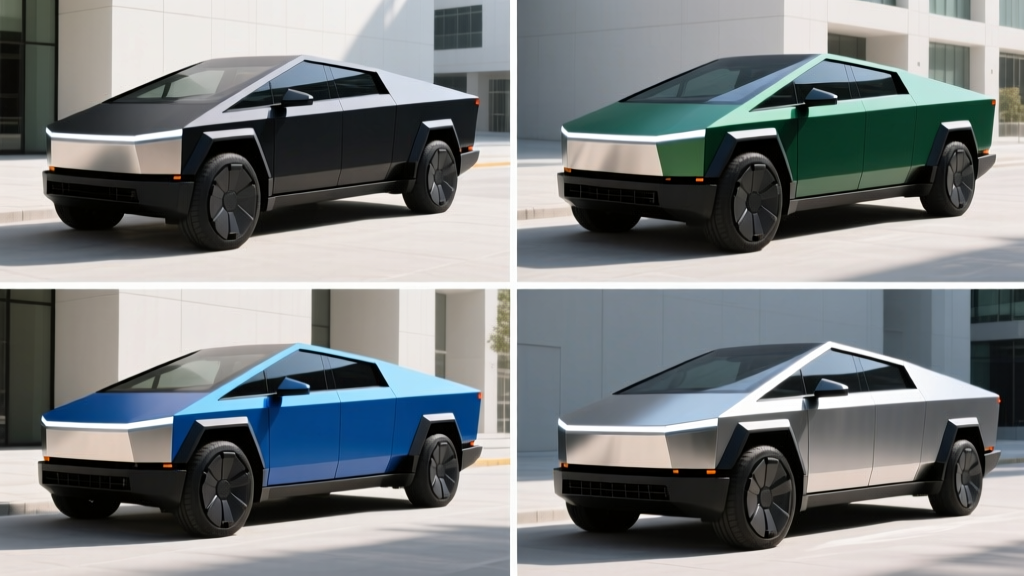
The Tesla Cybertruck has never been a conventional pickup, and its approach to exterior color is just as unconventional. Unlike traditional trucks that offer a dozen factory paint options, the Cybertruck's stainless-steel exoskeleton was originally designed to go unpainted — a decision that sparked both admiration and frustration among buyers. As of the 2026 model year, Tesla has expanded the Cybertruck's aesthetic options, but understanding what's available, what it costs, and how color choices might affect real-world ownership requires a closer look.
This review covers every Cybertruck color option currently available, the science behind how exterior finish affects thermal management and range, and the full ownership picture: EPA range, charging speed, pricing, tax credit eligibility, and how the Cybertruck stacks up against the Ford F-150 Lightning and Rivian R1T.
Every Cybertruck Color Option Explained
Tesla currently offers the Cybertruck in a limited palette compared to competitors. Here's what's available for the 2026 model year:
- Stainless Steel (Raw/Unpainted): The default and most iconic Cybertruck look. The cold-rolled ultra-hard 30X stainless steel body panels are left bare, giving the truck its signature brushed-metallic appearance. No additional cost.
- Satin Stainless Steel: A slightly subdued, matte-like finish achieved through a factory satin treatment of the bare steel. Offers a less reflective surface while maintaining the metallic character. Typically a no-cost or low-cost option.
- Painted Options (Factory): Tesla has periodically offered limited factory-painted Cybertruck variants. As of early 2026, availability of painted options (such as a Stealth Grey or Matte Black) remains limited and is often tied to specific configurations or special order windows. Pricing for factory paint typically adds $2,500–$3,000 to the MSRP.
- Aftermarket Wraps and Paint Protection Film (PPF): Because the stainless steel body is difficult to repaint conventionally, the vast majority of Cybertruck owners who want color turn to vinyl wraps. A full-body color wrap from a reputable installer typically runs $3,500–$6,000 depending on material quality and complexity. PPF (clear or colored) adds protection against the fine scratches that raw stainless steel is prone to accumulating.
The Cybertruck's stainless steel panels cannot be repainted using conventional automotive body-shop methods — the steel is too hard and the panel-bending process is unique. This means if you want color, a vinyl wrap is practically the only viable route. Several Cybertruck owners we've spoken with report spending $4,500–$5,500 on a high-quality color-change wrap, with an expected lifespan of 5–7 years before replacement.
Does Cybertruck Color Affect Range and Efficiency?
This is a question EV buyers increasingly ask, and the answer involves real thermal physics — not just aesthetics.
Thermal Absorption and Cabin Cooling
Dark-colored or bare stainless steel surfaces absorb significantly more solar radiation than white or light-colored finishes. On a bare stainless steel Cybertruck parked in direct summer sunlight, surface panel temperatures can exceed 160°F (71°C). This increases the thermal load on the cabin HVAC system, particularly the heat pump, which must work harder to maintain a comfortable interior temperature.
In practical terms, the range impact is modest but measurable:
- A dark or bare-steel Cybertruck in hot, sunny climates (Arizona, Texas, Southern California) may see 1–3% additional range loss from increased cabin cooling demand compared to a white-wrapped equivalent.
- In cold climates, the effect reverses slightly — darker surfaces absorb marginally more solar warmth, but the impact on battery thermal management is negligible compared to ambient temperature effects.
Stainless Steel vs. Painted/Wrapped Surfaces
Bare stainless steel has a higher thermal emissivity than painted aluminum or steel, meaning it radiates heat differently. However, Tesla's active thermal management system — which includes a heat pump and battery preconditioning — largely compensates for these differences. The bottom line: your choice of Cybertruck color will not meaningfully change your EPA-rated range, but in extreme heat, a lighter wrap may slightly reduce cabin cooling energy draw over long, hot days.
Cybertruck Full Spec Sheet: Range, Battery, Charging, and Performance
| Specification | Detail |
|---|---|
| EPA Estimated Range | 340 miles (AWD) / 320 miles (Cyberbeast) |
| Battery Capacity | ~123 kWh usable (NMC chemistry, 4680 cells) |
| Max DC Fast Charge Rate | 250 kW peak (V3 Supercharger) |
| 10–80% DC Fast Charge Time | ~28 minutes (with preconditioning) |
| Level 2 Home Charging Rate | 11.5 kW (44 mi/hr added) |
| 0–60 mph | 4.1 sec (AWD) / 2.6 sec (Cyberbeast) |
| Horsepower | 600 hp (AWD) / 845 hp (Cyberbeast) |
| Drivetrain | Dual-motor AWD / Tri-motor AWD (Cyberbeast) |
| Efficiency | 67 MPGe combined / 50 kWh/100mi |
| Towing Capacity | 11,000 lbs (max rated) |
| Cargo Volume (Bed) | ~67 cu ft (6-ft composite bed with tonneau) |
| Frunk Volume | ~7 cu ft |
| Battery/Powertrain Warranty | 8 years / 120,000 miles (min 70% retention) |
The Cybertruck AWD carries an EPA estimate of 340 miles. In real-world highway driving at 70–75 mph, expect approximately 270–295 miles of usable range. In cold weather (below 32°F), range can drop to 230–260 miles due to battery resistance and cabin heating demands. The Cybertruck's angular, flat-panel design creates a higher drag coefficient (~0.34 Cd) than more aerodynamic EVs, which disproportionately impacts highway efficiency. Towing near max capacity can cut range by 40–50%.
Charging the Cybertruck: Speed, Networks, and Home Setup
DC Fast Charging
The Cybertruck supports up to 250 kW on Tesla's V3 Supercharger network using the native NACS connector. Tesla's 4680 battery cells enable a relatively flat charge curve compared to older 2170-cell packs, but peak rate is still not sustained throughout the session. Here's what a typical session looks like:
- 10–50% SoC: Sustains near peak ~230–250 kW
- 50–70% SoC: Tapers to ~170–200 kW
- 70–80% SoC: Further taper to ~100–130 kW
- 80%+ SoC: Drops sharply; charging above 80% is significantly slower and generally not recommended for routine road-trip stops
Preconditioning the battery (initiated automatically when navigating to a Supercharger) is critical for achieving peak charge rates, particularly in cold weather. Without preconditioning, initial charge rates can be 50% or more below peak.
Home Level 2 Charging
The Cybertruck accepts up to 11.5 kW on Level 2 AC charging via a Tesla Wall Connector on a 60-amp circuit. This adds approximately 44 miles of range per hour of charging. A full overnight charge (8–10 hours) easily replenishes the battery from near-empty to full. For most owners who charge at home nightly, DC fast charging is only needed for road trips.
Installation of a Tesla Wall Connector with a dedicated 60A circuit typically costs $800–$2,500 depending on your electrical panel capacity and the distance from panel to charger location. Homes with older 100A service panels may require a panel upgrade ($1,500–$3,000 additional).
2026 Cybertruck Pricing, Trims, and Federal Tax Credit Eligibility
| Trim | Base MSRP | Drivetrain | §30D Tax Credit Eligible? |
|---|---|---|---|
| AWD (Dual Motor) | $79,990 | Dual-motor AWD | No (exceeds $80,000 truck MSRP cap) |
| Cyberbeast (Tri Motor) | $99,990 | Tri-motor AWD | No (exceeds $80,000 truck MSRP cap) |
Under IRS §30D rules, the federal EV tax credit has an MSRP cap of $80,000 for trucks, SUVs, and vans. The 2026 Cybertruck AWD starts at $79,990 — right at the threshold — but once any factory options, destination fees, or paint upgrades push the total above $80,000, it loses eligibility. In practice, nearly all Cybertruck configurations exceed the cap. Additionally, buyers must meet income limits ($150K single / $300K joint MAGI) and the vehicle must meet critical-mineral and battery-component sourcing requirements. Always verify current eligibility on IRS.gov and consult a tax professional before purchase.
For buyers who cannot claim the federal credit, some state-level incentives may still apply (e.g., California's CVRP, Colorado's state EV credit), but these vary significantly by jurisdiction and are subject to change. Check your state's energy or DMV website for current programs.
Who Should Buy the Cybertruck — and Who Shouldn't?
The Cybertruck Suits You If:
- You want a full-size electric pickup with genuine towing capability (11,000 lbs) and off-road ground clearance
- You're a Tesla ecosystem loyalist who values Supercharger network access, OTA updates, and the Tesla app experience
- You appreciate the stainless-steel exterior as a design statement and don't mind the maintenance quirks (fingerprint smudges, fine scratching)
- You have reliable home charging and primarily drive in urban/suburban settings with occasional road trips
- Performance matters — the Cyberbeast's 2.6-second 0–60 time is supercar territory in a 6,800-lb truck
Look Elsewhere If:
- You need a proven fleet/work truck with established service infrastructure and conventional body repair options
- Maximum range is your priority — the F-150 Lightning Extended Range offers competitive range with a more conventional form factor
- You want factory paint color options without aftermarket wrapping
- Federal tax credit eligibility is a dealbreaker for your budget
- You frequently tow near max capacity on long highway routes (range drops dramatically under load)
Pros and Cons
Pros
- Stainless steel body is dent-resistant and corrosion-proof
- Tri-motor Cyberbeast offers unmatched pickup performance (845 hp, 2.6s 0–60)
- 11,000-lb towing capacity is class-competitive
- Tesla Supercharger network remains the most reliable DC fast-charging ecosystem
- Unique design guarantees attention; strong resale interest
- Over-the-air updates continuously add features
Cons
- Stainless steel shows fingerprints, smudges, and fine scratches readily
- Color options extremely limited — wraps required for any color ($3,500–$6,000)
- Real-world highway range significantly below EPA (270–295 mi vs 340 mi)
- Does not qualify for $7,500 federal tax credit in most configurations
- Angular design creates high drag — towing range is poor
- Body repair options are limited and expensive due to unique steel fabrication
- Rear visibility is compromised; reliance on cameras for backing up
How the Cybertruck Compares to Key Rivals
| Spec | Tesla Cybertruck AWD | Ford F-150 Lightning (Ext. Range) | Rivian R1T (Dual Max) |
|---|---|---|---|
| EPA Range | 340 mi | 320 mi | 410 mi |
| Battery | ~123 kWh (NMC, 4680) | ~131 kWh (NMC) | ~149 kWh (NMC) |
| Peak DC Charge | 250 kW | 150 kW | 220 kW |
| 0–60 mph | 4.1 sec | 3.8 sec | 3.5 sec |
| Towing | 11,000 lbs | 10,000 lbs | 11,000 lbs |
| Base MSRP | $79,990 | ~$69,995 | ~$87,000 |
| §30D Credit Eligible | No (MSRP cap) | Yes (select trims) | No (MSRP cap) |
| Color Options | Raw steel / limited paint | 8+ factory colors | 5+ factory colors |
Frequently Asked Questions
What is the real-world range of the Cybertruck?
The EPA rates the Cybertruck AWD at 340 miles. In real-world highway driving at 70–75 mph, expect 270–295 miles. Cold weather (below freezing) can reduce that to 230–260 miles. Towing at or near the 11,000-lb maximum can cut range roughly in half.
How fast does the Cybertruck charge?
On a Tesla V3 Supercharger, the Cybertruck peaks at 250 kW and charges from 10–80% in approximately 28 minutes with proper battery preconditioning. At home on a Level 2 Tesla Wall Connector (11.5 kW), it adds about 44 miles of range per hour, fully recharging overnight.
Does the Cybertruck qualify for the federal EV tax credit?
In most configurations, no. The IRS §30D tax credit caps eligible trucks at $80,000 MSRP. The Cybertruck AWD starts at $79,990 but any options, destination fees, or paint push it above the cap. The Cyberbeast at $99,990 is well above the limit. Additionally, buyers must meet income caps ($150K single / $300K joint) and the vehicle must satisfy battery-sourcing requirements. Verify on IRS.gov.
Can I get a white or black Cybertruck from the factory?
Tesla has offered limited factory-painted Cybertruck options intermittently, but availability is inconsistent. The most reliable way to get a specific color is through a professional vinyl wrap, which costs $3,500–$6,000 and lasts 5–7 years. Raw stainless steel is the standard, no-cost option.
Is the Cybertruck worth buying over the F-150 Lightning or Rivian R1T?
It depends on priorities. The Cybertruck excels in performance (especially the Cyberbeast), offers the Tesla Supercharger network advantage, and has a unique stainless-steel body that resists dents and corrosion. However, the F-150 Lightning offers more conventional truck utility, more color options, and potential tax credit eligibility at a lower starting price. The Rivian R1T leads in real-world range (410 mi EPA) and has a more refined interior, but costs more and also misses the tax credit cap. Choose the Cybertruck if performance and the Tesla ecosystem matter most; choose the Lightning for value and work-truck practicality; choose the R1T for adventure-focused range and build quality.
Does wrapping a Cybertruck void the warranty?
A professionally installed vinyl wrap generally does not void Tesla's vehicle warranty. However, if wrap removal damages the stainless steel surface or if an installer damages sensors or trim during application, those specific repairs would not be covered. Tesla's battery and powertrain warranty (8 years/120,000 miles) is unaffected by exterior wraps.