The Viral Question: Does the Cybertruck Catch Fire More Than Other EVs?
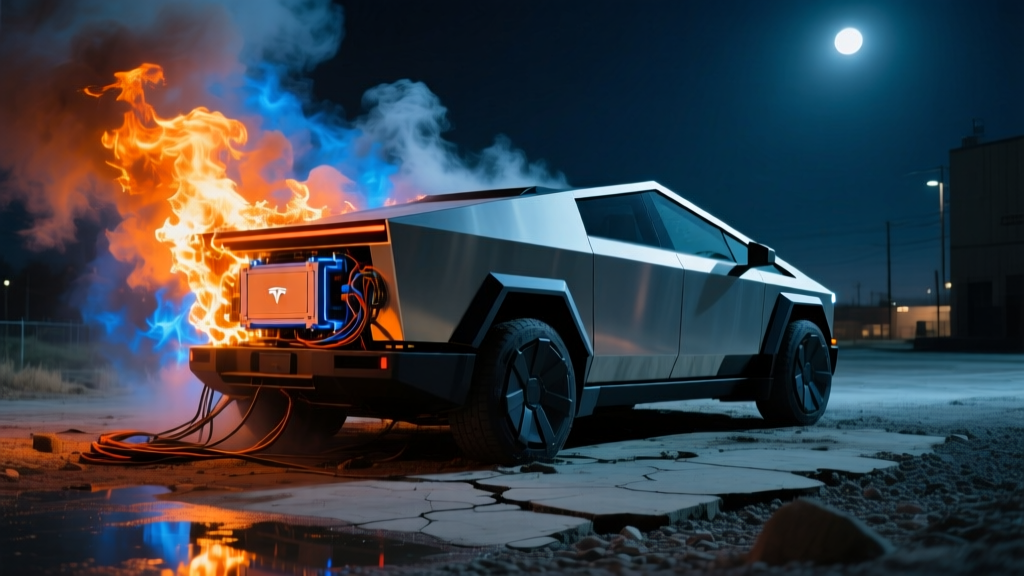
If you've scrolled social media in the past year, you've likely seen at least one video of a Cybertruck catching fire — whether on a highway shoulder, in a driveway, or after a collision. These incidents are dramatic, shareable, and understandably alarming for anyone considering Tesla's polarizing electric pickup. But what's actually happening when a Cybertruck catches fire, and how does the risk compare to other EVs or gasoline trucks?
This review examines the Tesla Cybertruck's battery architecture, safety data, real-world range, charging performance, and ownership economics — with the kind of spec-driven honesty buyers need before committing $80,000+ to an electric pickup.
| Spec | AWD (Dual-Motor) | Cyberbeast (Tri-Motor) |
|---|---|---|
| EPA Range | 340 miles | 320 miles |
| Battery (usable) | ~123 kWh (est.) | ~123 kWh (est.) |
| Cell Chemistry | NMC (4680 cells) | NMC (4680 cells) |
| 0-60 mph | 4.1 seconds | 2.6 seconds |
| Horsepower | 600 hp | 845 hp |
| Drivetrain | Dual-Motor AWD | Tri-Motor AWD |
| Peak DC Fast Charge | ~250 kW | ~250 kW |
| 10-80% Charge Time | ~28 min | ~28 min |
| Level 2 Home Charge | 11.5 kW (~34 mi/hr) | 11.5 kW (~34 mi/hr) |
| MPGe (combined) | 79 MPGe | 76 MPGe |
| Towing Capacity | 11,000 lbs | 11,000 lbs |
| Base MSRP | $79,990 | $99,990 |
Battery Architecture: Why the 4680 Cells Matter for Fire Risk
The Cybertruck uses Tesla's in-house 4680 cylindrical cells — larger than the 2170 cells in the Model Y and Model 3. These are nickel-manganese-cobalt (NMC) chemistry, chosen for high energy density and power delivery. The structural battery pack serves as a stressed member of the vehicle's frame, bonded directly to the stainless-steel exoskeleton.
When any EV battery catches fire, the root cause is typically thermal runaway — a chain reaction where one overheated cell transfers heat to its neighbors. NMC chemistry has a lower thermal runaway threshold (~210°C / 410°F) compared to LFP (lithium iron phosphate, ~270°C / 518°F). Tesla mitigates this with a proprietary cooling system and cell-to-cell barriers, but physics is physics: a 123 kWh pack contains a significant amount of stored energy, and a severe impact or manufacturing defect can breach the pack.
For context: the Ford F-150 Lightning uses larger-format NMC pouch cells from SK On, while the Rivian R1T uses 2170 cylindrical Samsung cells. All are susceptible to thermal runaway under extreme conditions. Gasoline trucks carry 26+ gallons of highly flammable liquid fuel — yet EV fires receive disproportionate media attention because they burn hotter, longer, and are harder to extinguish.
Real-World Range: What the EPA Sticker Doesn't Tell You
Real-World Expectation: ~260-290 miles highway at 70 mph; ~200-230 miles in sub-30°F cold weather with cabin heating. Towing at max capacity drops range to approximately 130-160 miles.
The Cybertruck's angular stainless-steel body has a drag coefficient significantly worse than a Tesla Model Y. On highway road trips at sustained 70-80 mph speeds, expect efficiency to drop to roughly 2.4-2.6 kWh/mile, which translates to 260-290 miles of usable range before you need to find a Supercharger.
Cold weather is the bigger concern for northern-state buyers. At 20°F, lithium-ion cells slow their chemical reactions, cabin heating draws 3-5 kW continuously, and regenerative braking is limited until the pack warms. Combined, these factors can reduce range by 30-40% — meaning a Cyberbeast owner in Minnesota might see just 200 miles of practical winter range.
For comparison, the EPA's official fueleconomy.gov listing confirms the AWD Cybertruck at 79 MPGe combined (2.55 kWh/mile). That's respectable for a 6,800-lb stainless-steel truck, but it's no Model Y Long Range (122 MPGe).
Charging Speed: Supercharger Network Advantage, With Caveats
| Charging Level | Power (kW) | Miles Added per Hour | Notes |
|---|---|---|---|
| Level 1 (120V household) | 1.4 kW | ~3-4 mi/hr | Emergency/trickle only |
| Level 2 (240V home) | 11.5 kW | ~34 mi/hr | Full charge in ~11 hours |
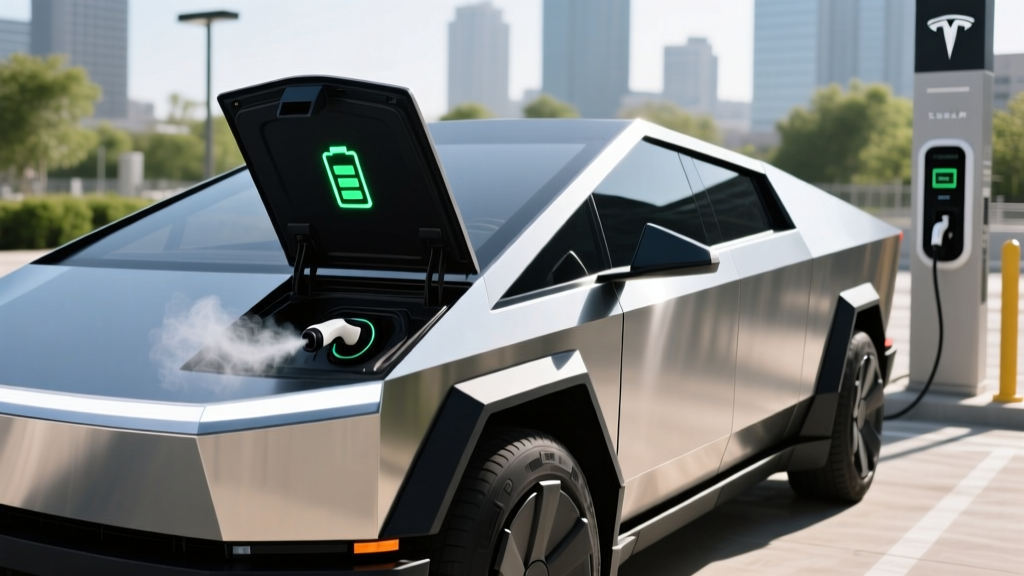
| DC Fast (Tesla Supercharger V3) | Peak ~250 kW | ~200 mi in 15 min | 10-80% in ~28 min |
| DC Fast (Non-Tesla 350 kW charger) | ~250 kW (vehicle-limited) | Similar to above | NACS connector standard |
The Cybertruck's 4680 cells were designed for faster charging than the older 2170 format, but real-world DC fast charging tells a more nuanced story. The truck peaks around 250 kW at low state-of-charge (SoC), but the charge curve tapers significantly above 60%. That 10-80% time of approximately 28 minutes assumes you arrive at the charger with a preconditioned battery — meaning you've navigated to the Supercharger using the vehicle's built-in routing, which warms the pack en route.
Without preconditioning (for example, at a non-Tesla charger you pulled into spontaneously), expect 10-80% to take 35-40+ minutes, particularly in cold weather. This is a critical ownership reality that spec sheets gloss over.
At home on a 48-amp Level 2 circuit (requiring a 60-amp breaker), the Cybertruck accepts 11.5 kW and adds roughly 34 miles of range per hour. A full overnight charge from 20% to 100% takes about 9-10 hours. Home charging installation typically runs $800-$2,500 depending on your electrical panel capacity and run length — factor this into your purchase budget.
Safety Record: Context for the Fire Headlines
As of early 2026, documented Cybertruck fire incidents remain rare relative to the number of vehicles delivered. NHTSA has not issued a recall specifically for battery fire risk on the Cybertruck, though Tesla has issued service bulletins for various build-quality issues.
The incidents that have gone viral typically share common factors: high-speed collisions with fixed objects, undercarriage impacts with road debris, or (in at least one case) electrical faults in aftermarket modifications. Lithium battery fires burn at extreme temperatures (~2,000°F+) and can reignite hours after initial extinguishment — a challenge for first responders trained primarily on gasoline fires.
For perspective, the National Fire Protection Association reports that gasoline vehicles catch fire at a rate of roughly 1,529 fires per 100,000 vehicles annually, compared to approximately 25 fires per 100,000 for EVs (based on NHTSA and insurance industry data). EVs catch fire far less frequently — but when they do, the fires are more difficult to manage.
Pricing, Tax Credits, and Total Cost of Ownership
| Trim | Base MSRP | As-Tested (typical) | §30D Federal Credit | Effective Price |
|---|---|---|---|---|
| AWD (Dual-Motor) | $79,990 | $84,000-$88,000 | Varies — see below | ~$72,490-$80,500 |
| Cyberbeast (Tri-Motor) | $99,990 | $105,000-$112,000 | Varies — see below | ~$92,490-$104,500 |
The Cybertruck's eligibility for the IRS §30D federal tax credit is not guaranteed for every buyer. Current rules impose several requirements:
- MSRP Cap: Trucks/vans/SUVs must have an MSRP at or below $80,000. The AWD trim at $79,990 qualifies; the Cyberbeast at $99,990 exceeds the cap and is ineligible.
- Buyer Income Cap: Modified adjusted gross income must not exceed $150,000 (single), $225,000 (head of household), or $300,000 (joint).
- Battery Sourcing: Critical minerals and battery components must meet escalating domestic-content thresholds. Tesla's 4680 cells use materials sourced from various global suppliers, and the exact credit amount ($3,750 or $7,500) depends on current-year sourcing compliance.
- Point-of-Sale Transfer: Eligible buyers can transfer the credit to the dealer at purchase, reducing the out-of-pocket price immediately.
Consult a tax professional and verify current eligibility on irs.gov before assuming you'll receive the full $7,500. Rules change annually, and battery-sourcing compliance is re-evaluated each model year.
Who Should Buy the Cybertruck — And Who Shouldn't
- You need 11,000 lbs of towing capacity with an electric powertrain
- You value the stainless-steel exoskeleton's dent resistance for work-site use
- You have reliable home Level 2 charging and drive in a region with Supercharger coverage
- You want a tri-motor performance truck (Cyberbeast does 0-60 in 2.6 seconds — supercar territory)
- Your primary use case is highway commuting (the Rivian R1T or Ford F-150 Lightning offer better ride comfort and quieter cabins)
- You live in extreme cold climates without access to a heated garage (range loss is significant)
- You need a proven, long-term reliability track record (the Cybertruck is still early in its lifecycle with documented build-quality issues)
- Budget is a primary concern (the F-150 Lightning starts significantly lower)
Pros and Cons: An Honest Assessment
- Towing capacity of 11,000 lbs leads the EV pickup segment
- Tri-motor Cyberbeast delivers 845 hp and 2.6-second 0-60
- Stainless-steel exoskeleton is dent- and corrosion-resistant
- Access to Tesla Supercharger network (most reliable DC fast-charging in North America)
- Standard air suspension with adjustable ride height
- 6-foot bed with powered tonneau cover and integrated ramps
- Real-world highway range falls 15-25% below EPA estimates
- Cold-weather range loss is substantial (30-40% in sub-freezing temps)
- Build quality inconsistent — panel gaps, trim issues documented
- NMC battery chemistry has lower thermal runaway threshold than LFP alternatives
- No Apple CarPlay or Android Auto — Tesla's closed ecosystem only
- Rear visibility is poor; relies heavily on camera system
- Insurance premiums are among the highest in the EV segment
- Only the AWD trim qualifies for the federal tax credit (and only with income/sourcing compliance)
Frequently Asked Questions
What is the real-world range of the Cybertruck?
The EPA rates the AWD Cybertruck at 340 miles and the Cyberbeast at 320 miles. In real-world highway driving at 70 mph, expect 260-290 miles. In cold weather below 30°F, that drops to roughly 200-230 miles. Towing at max capacity reduces range to approximately 130-160 miles.
How fast does the Cybertruck charge?
On a Tesla Supercharger V3, the Cybertruck peaks at approximately 250 kW and charges from 10-80% in about 28 minutes with a preconditioned battery. At home on a 240V Level 2 charger (11.5 kW), it adds roughly 34 miles per hour, taking about 11 hours for a full charge.
How much does the Cybertruck cost after tax credits?
The AWD trim starts at $79,990 and may qualify for up to $7,500 in federal tax credits if you meet income caps and battery-sourcing requirements — bringing the effective price to approximately $72,490. The Cyberbeast at $99,990 exceeds the IRS MSRP cap for trucks and does not qualify for the federal credit.
Is the Cybertruck worth buying vs. the F-150 Lightning or Rivian R1T?
The Cybertruck wins on towing capacity (11,000 lbs) and performance (Cyberbeast's 2.6-second 0-60). The Ford F-150 Lightning is significantly cheaper, more conventional in design, and better suited for fleet or budget-conscious buyers. The Rivian R1T offers superior interior quality, ride comfort, and adventure features. Your choice depends on whether you prioritize performance and capability (Cybertruck), value (Lightning), or refinement (R1T).
Does the Cybertruck qualify for the federal EV tax credit?
The AWD trim at $79,990 is under the $80,000 MSRP cap for trucks and may qualify, subject to buyer income limits ($150K single / $300K joint) and battery-sourcing requirements. The Cyberbeast at $99,990 does not qualify. Verify current-year rules on irs.gov and consult a tax professional.
What causes a Cybertruck to catch fire?
Documented Cybertruck fire incidents have typically involved high-speed collisions, severe undercarriage impacts, or aftermarket electrical modifications. The NMC 4680 cells can enter thermal runaway if physically damaged or subjected to manufacturing defects. Tesla's battery pack includes thermal barriers and active cooling, but no lithium-ion battery is immune to fire under extreme conditions.