The Tesla Cybertruck remains one of the most polarizing electric vehicles on the road, but beneath the angular stainless-steel exoskeleton sits a serious full-size pickup with legitimate capability. For 2026, Tesla continues to offer the Cybertruck in AWD and Cyberbeast trims, with the long-promised RWD variant expected later in the year. Whether you are researching the Cybertruck's controversial Car Wash Mode, its real-world highway range, or its 800-volt charging architecture, this profile covers the exact numbers you need before putting down a deposit.
Range, Efficiency, and the Real-World Reality
Real-World Expectation: Plan for ~270-290 miles at sustained highway speeds (70-80 mph). In freezing temperatures with cabin heating, expect a further 15-25% reduction, dropping effective range to roughly 210-250 miles. The tonneau cover and flatbed design help aerodynamics relative to conventional trucks, but the Cybertruck's 6,800+ lb curb weight works against efficiency.
The Cybertruck AWD uses a ~123 kWh usable battery pack (approximately 150 kWh gross), built on Tesla's 4680 cell architecture with a structural battery pack that serves as a stressed chassis member. The chemistry is NMC (nickel manganese cobalt), which provides higher energy density than LFP but requires more careful long-term state-of-charge management — Tesla recommends daily charging to 80-90% and 100% only for trips.
Efficiency lands at approximately 2.0 kWh/mile (50 MPGe combined per fueleconomy.gov). That is thirstier than a Model Y but competitive for a full-size electric truck. The key takeaway: if your commute is under 100 miles round-trip and you can charge at home, the EPA range is more than adequate. If you regularly tow or drive rural highway routes in winter, the effective range shrinkage is a genuine planning factor.
Charging: 800V Architecture, Speeds, and Home Setup
The Cybertruck uses an 800-volt electrical architecture — a significant technical advantage that allows faster DC charging and more efficient power delivery. Tesla rates the peak DC fast-charge rate at 350 kW at V4 Superchargers, though sustained rates taper as the battery warms and fills.
| Charging Level | Power / Rate | Speed / Time |
|---|---|---|
| DC Fast Charge (V4 Supercharger) | Peak 350 kW | 10-80% in ~25-30 minutes (sustained ~170-200 kW average) |
| DC Fast Charge (150 kW CCS adapter) | Up to 150 kW | 10-80% in ~45-55 minutes |
| Level 2 Home (Tesla Wall Connector, 48A) | 11.5 kW | ~37 miles of range per hour; full charge in ~11 hours |
| Level 2 Home (32A mobile connector) | 7.7 kW | ~25 miles of range per hour; full charge in ~16 hours |
| Level 1 (120V standard outlet) | ~1.4 kW | ~4-5 miles per hour (emergency/top-up only) |
The 10-80% charge time on a V4 Supercharger is competitive with the best in the segment. However, the charge curve tapers sharply above 85%, so plan your stops around 80% for optimal throughput. At home, a 48-amp Tesla Wall Connector on a 60-amp circuit is the sweet spot — expect $800-$1,500 for professional installation depending on panel proximity. The Cybertruck ships with a NACS (North American Charging Standard) port natively, giving you full access to Tesla's Supercharger network. A CCS adapter is available for non-Tesla networks like Electrify America.
Performance: Cyberbeast vs. AWD Numbers
| Spec | AWD (Dual Motor) | Cyberbeast (Tri-Motor) |
|---|---|---|
| Horsepower | 600 hp | 845 hp |
| 0-60 mph | 3.9 seconds | 2.6 seconds |
| Top Speed | 112 mph | 130 mph |
| Drivetrain | Dual-motor AWD | Tri-motor AWD (torque vectoring rear) |
| Max Towing | 11,000 lbs | 11,000 lbs |
| Payload | 2,500 lbs | 2,500 lbs |
The Cyberbeast's 2.6-second 0-60 time makes it the quickest production pickup ever built. The tri-motor setup uses two rear motors with torque vectoring for sharper cornering — a meaningful advantage on twisty back roads, not just a spec-sheet flex. The AWD dual-motor is the volume seller and is genuinely fast at 3.9 seconds. Both trims include adaptive air suspension with up to 17 inches of ground clearance in Extract Mode, useful for light off-road work or steep driveway approaches.
Car Wash Mode and Other Standout Tech
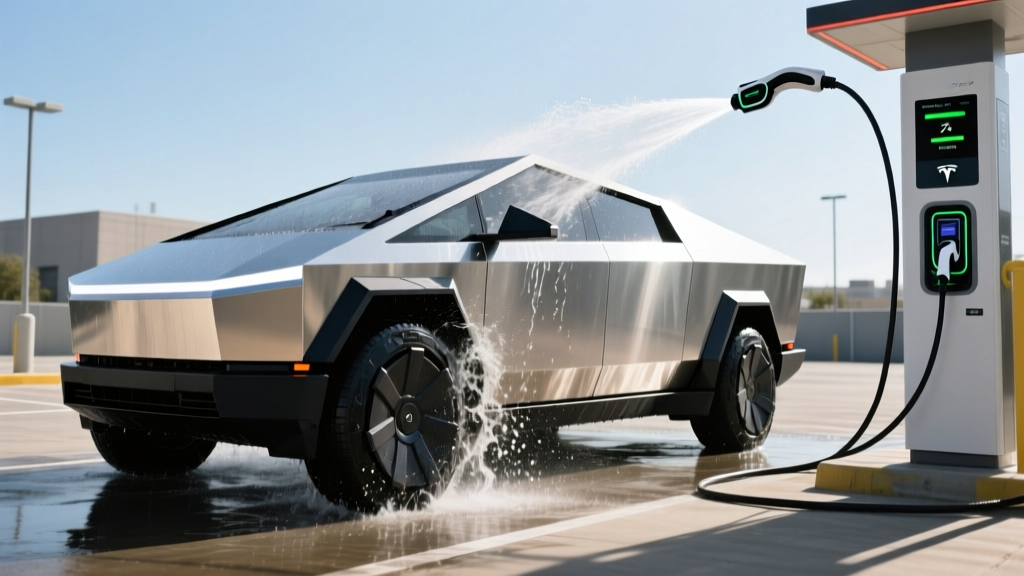
The Cybertruck's Car Wash Mode is one of those features that sounds niche until you need it. When activated from the touchscreen (Controls > Service > Car Wash Mode), the truck:
- Closes all windows and the powered tonneau cover
- Locks the charge port door
- Disables automatic wipers (prevents wiper activation from brush contact)
- Disables walk-away auto-lock
- Disables the powered frunk and bed-sensor auto-close
- Sets climate to recirculate
- Folds mirrors (if selected)
This matters because the Cybertruck has numerous sensors, motorized panels, and a powered retractable tonneau that could be damaged or triggered unintentionally by high-pressure brushes and automatic bay equipment. Tesla added this mode after early owners reported issues at automated car washes. For touchless washes, it is still good practice to enable it. For hand washing, it prevents accidental wiper activation.
Beyond Car Wash Mode, the Cybertruck features:
- Steer-by-wire: No physical steering column connection — a 48-volt system with variable ratio. At low speeds, the yoke requires less than one full turn lock-to-lock. At highway speeds, the ratio lengthens for stability. It takes adaptation but works well once muscle memory develops.
- Rear-wheel steering: Up to 10 degrees, shrinking the turning circle to a surprisingly manageable 40.3 feet despite the truck's 223.7-inch length.
- 18.5-inch front touchscreen + 9.4-inch rear screen: Runs Tesla's latest UI with native navigation, streaming, and vehicle controls.
- Autopilot (standard): SAE Level 2 driver-assist with adaptive cruise and lane centering. Full Self-Driving (Supervised) remains an optional $8,000 add-on or $99/month subscription — and requires constant driver attention.
- Powershare: Up to 11.5 kW of vehicle-to-load (V2L) output through bed outlets and a frunk outlet — enough to run power tools at a job site or essential home circuits during an outage.
Pricing, Trims, and Federal Tax Credit Eligibility
| Trim | Base MSRP | Est. After §30D Credit* |
|---|---|---|
| RWD (announced, expected late 2026) | ~$60,990 | ~$53,490 (if eligible) |
| AWD (Dual Motor) | $79,990 | $72,490 (if eligible) |
| Cyberbeast (Tri-Motor) | $99,990 | $92,490 (if eligible) |
*Federal EV tax credit eligibility under IRS §30D is not guaranteed for every buyer or every Cybertruck configuration. Key rules for 2026:
- MSRP cap: Trucks/vans/SUVs must have an MSRP at or below $80,000. The AWD at $79,990 qualifies; the Cyberbeast at $99,990 does NOT qualify.
- Buyer income caps: Modified AGI must not exceed $300,000 (joint filers), $225,000 (head of household), or $150,000 (single).
- Battery sourcing: Increasing percentages of critical minerals and battery components must be sourced from the US or FTA partners. Tesla's 4680 cells are manufactured in the US, but exact compliance varies by production batch — verify with Tesla at purchase.
- Point-of-sale transfer: Eligible buyers can transfer the credit to the dealer at purchase, reducing the purchase price directly rather than waiting for a tax refund.
The Cyberbeast's $99,990 sticker exceeds the $80,000 truck MSRP cap, making it ineligible for the federal credit regardless of buyer income. The AWD squeaks in just under the cap. Always confirm current eligibility with your tax professional before relying on the credit in your budget.
Interior Space, Cargo, and Practicality
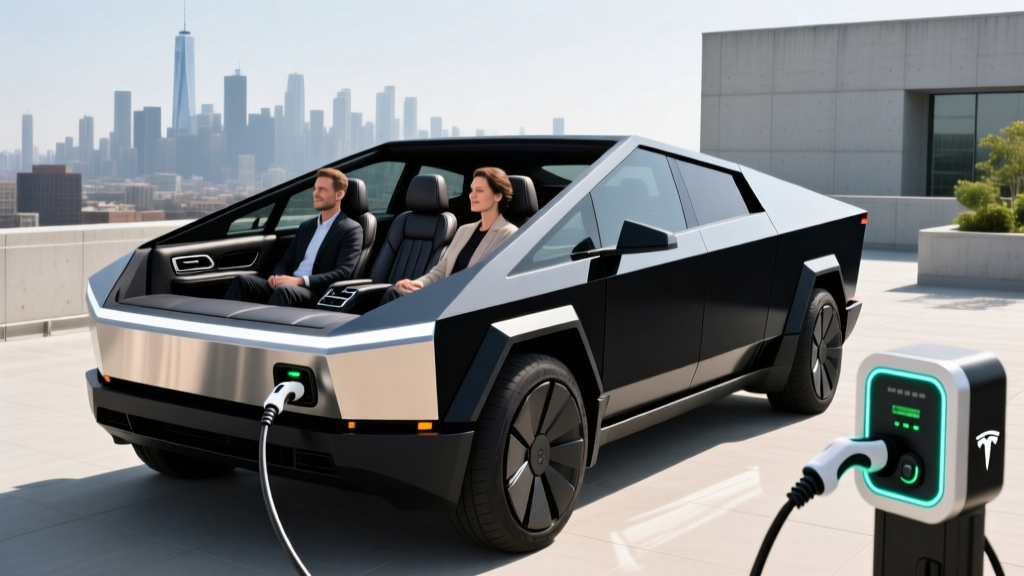
The Cybertruck seats five (six with the optional front bench). Interior dimensions are generous:
- Front legroom: 41.7 inches
- Rear legroom: 41.6 inches
- Bed length: 6 feet (with tailgate closed); extends to ~8 feet with tailgate down and ramp extended
- Bed width (between wheel wells): ~51 inches
- Frunk (front trunk): ~7.1 cu ft
- Enclosed bed volume (tonneau closed): ~67 cu ft
The powered retractable tonneau cover is a standout feature — it locks automatically, supports distributed loads up to 300 lbs, and can be operated from the touchscreen, phone app, or bed buttons. The stainless-steel bed floor is durable but can be slippery; Tesla offers a bed mat accessory. The frunk is useful for groceries or charging cables but smaller than the Rivian R1T's frunk.
Visibility is a known compromise. The thick A-pillars and angular roofline create significant blind spots, especially for shorter drivers. The camera-based mirror system (optional in some markets, not yet US-homologated as a full replacement) would help, but US models still use conventional side mirrors. The rearview camera and backup camera partially compensate.
Warranty, Battery Longevity, and Ownership Costs
| Component | Coverage |
|---|---|
| Basic Vehicle | 4 years / 50,000 miles |
| Battery & Drive Units | 8 years / 120,000 miles (minimum 70% retention) |
| Restraint System | 5 years / 60,000 miles |
| Roadside Assistance | 4 years / 50,000 miles |
Tesla's battery warranty guarantees at least 70% capacity retention over 8 years or 120,000 miles. With the NMC 4680 cells, real-world degradation data is still maturing given the Cybertruck's 2023 launch, but Tesla's Model Y and Model 3 packs on similar chemistry have shown roughly 10-12% degradation at 100,000 miles based on fleet data. To maximize longevity, avoid frequent 100% charges and DC fast-charging in extreme heat without preconditioning.
Insurance costs are a real consideration: the Cybertruck's stainless-steel body panels, steer-by-wire system, and high repair complexity push premiums well above average. Expect $2,500-$4,000 annually depending on your profile — get quotes before ordering. Tesla offers its own insurance product in many states, which sometimes undercuts traditional carriers but varies significantly by ZIP code and driving history.
Pros, Cons, and Who Should Buy the Cybertruck
Pros
- Best-in-class 0-60 acceleration (Cyberbeast: 2.6s)
- 800V architecture with 350 kW peak charging
- 11.5 kW Powershare (V2L) for job-site and home backup use
- Powered retractable locking tonneau cover
- Stainless-steel exoskeleton resists dents and minor impacts
- Rear-wheel steering makes parking manageable
- Full Supercharger network access with NACS port
Cons
- Cyberbeast exceeds $80K MSRP cap — no federal tax credit
- Steer-by-wire learning curve; polarizing yoke-only steering
- Poor outward visibility from thick pillars and angular glass
- High insurance premiums ($2,500-$4,000/yr typical)
- Real-world highway range ~270-290 mi, well below 340 mi EPA
- Stainless-steel panels show fingerprints and are difficult to repair
- Limited service center capacity for body and structural repairs
The Cybertruck is best for: Tech-forward truck buyers who want standout performance, need Powershare capability for tools or backup power, have home Level 2 charging, and drive primarily in urban/suburban environments where the range is sufficient. It works as a daily driver with job-site utility.
Look elsewhere if: You need maximum real-world highway range for frequent road trips (the Rivian R1T Dual-Motor Max offers ~352 miles EPA), you want a conventional steering wheel, you need affordable insurance, or you regularly tow heavy loads over long distances (towing cuts EV range by 40-50%).
Frequently Asked Questions
How do I activate Car Wash Mode on the Cybertruck?
Navigate to Controls > Service > Car Wash Mode on the 18.5-inch touchscreen. Toggle it on before entering an automated car wash. This closes the tonneau, locks the charge port, disables auto-wipers and walk-away locking, and sets climate to recirculate. Remember to turn it off after exiting the wash — your mirrors may remain folded until you do.
What is the real-world highway range of the Cybertruck?
While the EPA rates the AWD at 340 miles, independent highway testing at 70-75 mph consistently yields 270-290 miles. In cold weather (below 32°F), expect an additional 15-25% reduction, putting effective range around 210-250 miles. Towing drops range further — plan conservatively if you haul a trailer.
Does the Cybertruck qualify for the $7,500 federal tax credit?
The AWD trim at $79,990 MSRP falls under the $80,000 truck cap and may qualify if the buyer meets income limits ($300K joint / $150K single) and battery-sourcing requirements are satisfied. The Cyberbeast at $99,990 does NOT qualify due to the MSRP cap. Verify current rules at IRS.gov and with a tax professional.
How fast does the Cybertruck charge at home?
On a 48-amp Tesla Wall Connector (11.5 kW), the Cybertruck adds roughly 37 miles of range per hour and charges from empty to full in about 11 hours. Most owners who plug in nightly never need a full 0-100% charge, making Level 2 home charging convenient and battery-friendly.
Is the Cybertruck worth it vs. the Rivian R1T or Ford F-150 Lightning?
The Cybertruck wins on raw performance (2.6s Cyberbeast), Powershare V2L output (11.5 kW vs. Rivian's ~3.6 kW), and Supercharger network access. The Rivian R1T offers better real-world range (up to 420 mi with Max pack), a more conventional driving feel, and a gear tunnel for storage. The F-150 Lightning is the most affordable and practical for traditional truck buyers but is slower and heavier. Your choice depends on whether you prioritize performance/tech (Cybertruck), range/adventure (Rivian), or value/familiarity (Lightning).
Can I take the Cybertruck through a touchless car wash?
Yes, but still enable Car Wash Mode. Touchless washes use high-pressure jets that could trigger the tonneau sensors or activate wipers. Car Wash Mode prevents these issues. Avoid brush-style automatic washes — the stainless-steel panels can scratch, and brush bristles may catch on panel seams.