The Tesla Cybertruck remains one of the most polarizing vehicles on the road in 2026, but beneath the stainless-steel exoskeleton lies a genuinely capable electric pickup. For buyers researching a Cybertruck canopy — whether Tesla's powered tonneau cover, aftermarket camper shells, or rack-mounted solutions — understanding the truck's real-world range, charging behavior, and bed utility is essential before committing $80,000 or more. This review covers the full Cybertruck lineup (AWD, Cyberbeast, and the new Long Range AWD) with hard data on efficiency, charging curves, canopy compatibility, and whether the federal tax credit actually applies.
2026 Cybertruck Lineup: Trims, Pricing, and Tax Credit Reality
Tesla streamlined the Cybertruck lineup for 2026 after the controversial 2024-2025 "Foundation Series" pricing backlash. Here is where each trim stands on price and federal incentive eligibility.
| Trim | Base MSRP | As-Tested (w/ common options) | §30D Credit Eligible? | Effective Price* |
|---|---|---|---|---|
| AWD (Dual-Motor) | $79,990 | $83,490 (w/ FSD transfer, armor glass) | No — exceeds $80K truck cap | $79,990 |
| Cyberbeast (Tri-Motor) | $99,990 | $104,490 | No — exceeds $80K truck cap | $99,990 |
| Long Range AWD | $84,990 | $88,990 | No — exceeds $80K truck cap | $84,990 |
*Effective price shown before any state/local incentives. The IRS §30D clean vehicle credit caps pickup trucks at an $80,000 MSRP ceiling. Because every 2026 Cybertruck trim starts at or above $79,990 — and options push them well over — none currently qualify for the $7,500 federal credit. Buyers may still benefit from state-level rebates (e.g., California, Colorado, New York) and should consult a tax professional for point-of-sale transfer rules and income cap compliance ($150K single / $300K joint MAGI).
EPA Range, Battery Specs, and Real-World Expectations
Tesla equips the 2026 Cybertruck with a ~123 kWh usable battery pack using 4680-format cells with nickel-based (NMC-type) chemistry. The stainless-steel body and angular aerodynamics (despite active aero and air suspension lowering) impose a significant efficiency penalty compared to sleeker EVs.
| Spec | AWD | Long Range AWD | Cyberbeast |
|---|---|---|---|
| EPA Range | 320 miles | 340 miles | 320 miles |
| Battery (usable) | ~123 kWh (NMC 4680) | ~123 kWh (NMC 4680) | ~123 kWh (NMC 4680) |
| Efficiency | ~50 MPGe / 68 kWh/100mi | ~52 MPGe / 65 kWh/100mi | ~48 MPGe / 70 kWh/100mi |
| Drivetrain | Dual-Motor AWD | Dual-Motor AWD | Tri-Motor AWD |
| Horsepower | 600 hp | 600 hp | 845 hp |
| 0–60 mph | 4.1 sec | 4.3 sec | 2.6 sec |
| Towing Capacity | 11,000 lbs | 11,000 lbs | 11,000 lbs |
| Payload | 2,500 lbs | 2,500 lbs | 2,500 lbs |
EPA Sticker: 320–340 miles depending on trim.
Highway (75 mph, 70°F): Expect ~250–275 miles. The Cybertruck's brick-like drag coefficient (~0.34 Cd) and ~6,800 lb curb weight hammer efficiency at sustained speed.
Cold Weather (30°F or below): Plan for 190–220 miles. NMC chemistry loses 20–30% range in freezing temps, and cabin heating (even with the heat pump) draws significant power.
Towing (5,000+ lb trailer): Range roughly halves to ~150–170 miles.
With Canopy/Camper Shell: A hard canopy adds ~80–150 lbs and may slightly alter airflow over the bed, reducing range by 3–5% (~10–15 miles). Soft tonneau covers have negligible impact.
Data from fueleconomy.gov confirms the AWD model at approximately 68 kWh/100mi combined, making it one of the least efficient EVs on the market per mile — though that's somewhat expected for a 6,800-lb stainless-steel truck.
Charging Speed: DC Fast, Level 2, and the 4680 Curve
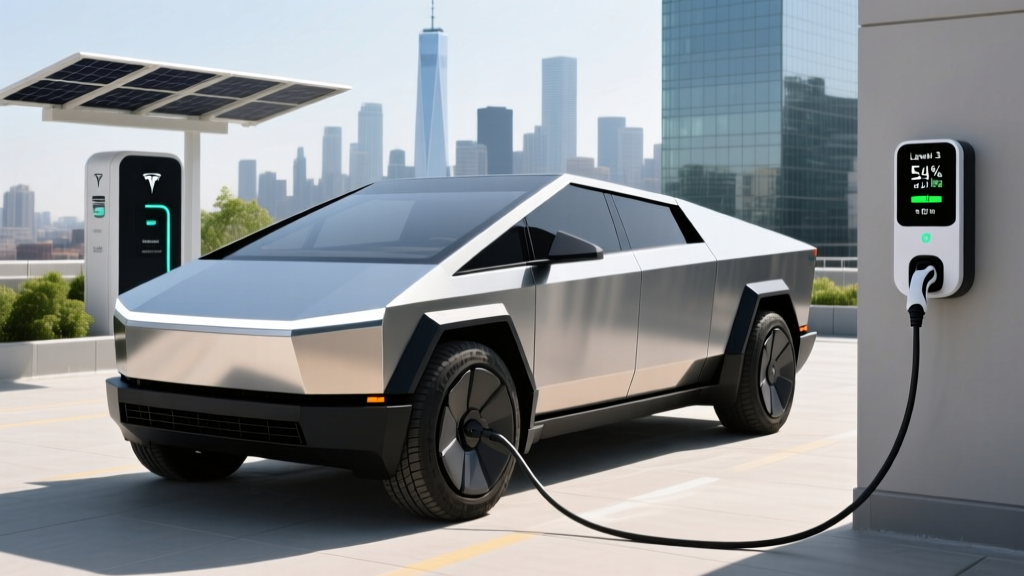
The Cybertruck uses the NACS connector natively (Tesla designed the standard) and supports V4 Supercharger stalls at up to 250 kW peak DC fast-charging. However, as with all EVs, peak rate is not sustained rate.
| Charging Level | Power / Rate | Speed | Notes |
|---|---|---|---|
| Level 1 (120V household) | ~1.4 kW | ~3–4 mi/hr | Emergency/trickle only; 35+ hours for full charge |
| Level 2 (240V home, 48A) | 11.5 kW | ~30–34 mi/hr | Full charge in ~11–12 hours; Tesla Wall Connector or J1772 w/ adapter |
| Level 2 (240V, 80A — rare) | 19.2 kW | ~50–56 mi/hr | Requires 100A circuit; most homes need panel upgrade |
| DC Fast (V4 Supercharger) | Peak 250 kW | 10–80% in ~28 min | Peak only at low SoC; tapers sharply above 60% |
| DC Fast (350 kW CCS stall w/ adapter) | ~200–250 kW peak | 10–80% in ~30–32 min | Adapter required for non-Tesla networks (EA, EVgo) |
Charging curve reality: The 4680 cells accept peak 250 kW only between roughly 5–40% state of charge. Above 60%, the rate drops to ~120 kW, and above 80% it falls below 50 kW. On a road trip, plan your stops around 10–80% increments for fastest sessions. Preconditioning (automatic when the truck navigates to a Supercharger) warms the battery for optimal charge acceptance — skipping this in cold weather can add 10+ minutes to your session.
Home charging cost: At the US average residential rate of ~$0.16/kWh, a full 123 kWh charge costs roughly $19.70, yielding about $0.06/mile. Compare that to a gas truck at 17 MPG and $3.50/gal = ~$0.21/mile.
Cybertruck Canopy and Bed Utility: What Fits, What Works
The 6-foot bed (officially the "vault") is a defining feature, and canopy selection directly impacts daily usability, range, and camping capability.
Tesla Powered Tonneneau Cover
Tesla's retractable aluminum tonneau is available as a factory option (~$2,500). It retracts electrically via the touchscreen or key fob, seals well against weather, and preserves the vault's angular aesthetic. It does not add meaningful weight (~45 lbs) and has negligible range impact. However, it limits vertical cargo clearance to roughly 28 inches when closed.
Aftermarket Hard Canopy / Camper Shell Options
Several manufacturers (ARE, SnugTop, and specialty EV-focused brands) now offer hard fiberglass or aluminum canopies designed for the Cybertruck's unique bed geometry. Key considerations:
- Weight: Hard shells typically add 120–200 lbs, reducing range by ~3–5% (10–15 miles on the EPA cycle).
- Fitment: The stainless-steel bed rails and composite bed floor require specific clamp systems — not all universal shells fit without modification.
- Wiring pass-through: The Cybertruck's 120V/240V bed outlets (PowerShare) are positioned on the bed walls. A canopy must accommodate or allow access to these outlets for powering tools, camp gear, or a fridge.
- Aerodynamics: A flush-fit hard shell slightly improves airflow over the open bed at highway speeds, partially offsetting its weight penalty. High-profile camper shells with roof racks increase drag and reduce range more noticeably (5–8%).
Rack-Mounted Canopy Systems
For overlanding and adventure use, rack systems (e.g., from Yakima or Cybertruck-specific brands) paired with rooftop tents are popular. These add significant weight (150–300 lbs for rack + tent) and raise the vehicle's center of gravity. Range impact: 8–12% reduction. Towing capacity remains unaffected, but the air suspension works harder to maintain level ride height.
Bed Dimensions and Cargo Volume
- Bed length: 72 inches (6 feet)
- Bed width (between wheel wells): ~49 inches
- Bed width (max): ~65 inches
- Cargo volume (bed, open): ~67 cu ft
- Front trunk (frunk): ~7.1 cu ft (lockable, weather-sealed)
- Sail pillar storage ("sail bins"): ~1.7 cu ft each side — accessible from bed, useful for charging cables or tools
Interior, Tech, and Driver Assistance
The Cybertruck cabin is unmistakably Tesla-minimal: an 18.5-inch center touchscreen dominates the dash, with a secondary 9.4-inch rear touchscreen for passengers. There are no physical stalks — turn signals are on the steering wheel, and gear selection is via the touchscreen (with a backup overhead panel).
Standout Tech Features
- Steer-by-Wire: No mechanical connection between the yoke and wheels. Enables a variable steering ratio (less than one full turn lock-to-lock) and 4-wheel steering for a tight 37-foot turning circle despite the truck's size.
- Armor Glass: Tesla's laminated "armor glass" (optional on AWD, standard on Cyberbeast) resists impacts from baseballs and hail. Tinted and acoustic-rated.
- Bioweapon Defense Mode: HEPA filtration system with positive cabin pressure.
- PowerShare: 120V (20A) and 240V (40A) outlets in the bed and cabin, plus a front charge port area outlet. Can power tools, appliances, or serve as backup home power (up to 11.5 kW continuous output with PowerWall integration).
- Air Suspension: Adjustable ride height from 9 to 16 inches of ground clearance. Automatically lowers at highway speed for aero efficiency.
Autopilot and FSD (Supervised)
Tesla's Autopilot and Full Self-Driving (Supervised) are Level 2 driver-assistance systems per SAE International standards. The driver must remain fully attentive, hands on the yoke (monitored via torque sensor and cabin camera), and ready to take over at any moment. This is not self-driving. Only Level 4 services like Waymo operate without a human driver — and those are geofenced robotaxis, not consumer vehicles.
FSD (Supervised) costs $8,000 as a one-time purchase or $99/month in 2026. It handles highway lane changes, city intersections, and parking maneuvers with varying competence. In our experience, it excels on well-marked highways but still requires active supervision in construction zones, complex urban environments, and adverse weather. Tesla's camera-only vision approach (no lidar or radar) remains a philosophical choice that limits performance in heavy rain, fog, and direct sun glare.
Notable Drawbacks
- Rear visibility: The sail pillars and small rear window create massive blind spots. The digital rearview mirror (fed by a tailgate camera) is mandatory for safe driving.
- Ride quality: Despite adaptive dampers, the Cybertruck's weight and stiff structure transmit more road harshness than a Rivian R1T or Ford F-150 Lightning.
- Panel gaps and build consistency: Improved since the 2024 launch, but stainless-steel body panels still show more variation than conventional stamped steel. Not a mechanical concern, but a quality-perception issue at this price.
- No Apple CarPlay / Android Auto: Tesla's proprietary infotainment is capable but closed. If you rely on phone-mirroring, this is a dealbreaker.
Ownership Costs, Warranty, and Long-Term Value
| Category | Estimated Cost | Notes |
|---|---|---|
| Purchase (after incentives) | $79,990 | No federal credit; state rebates vary |
| Depreciation (5yr) | ~$28,000–$35,000 | EV truck depreciation steeper than sedans; ~35–44% loss estimated |
| Electricity (home charging) | ~$7,400 | ~$0.16/kWh avg; 75,000 mi ÷ 3 mi/kWh |
| Insurance | ~$14,000–$18,000 | Cybertruck premiums 30–50% above F-150 Lightning avg |
| Maintenance | ~$1,500–$2,500 | Tires ($1,200+/set), cabin filter, wiper, brake fluid — no oil changes |
| Total 5-Year TCO | ~$59,000–$72,000 | Highly dependent on insurance and depreciation |
Warranty Coverage
- Basic Vehicle: 4 years / 50,000 miles
- Battery & Drive Units: 8 years / 120,000 miles (minimum 70% capacity retention)
- Corrosion: 12 years with no mileage limit (stainless body, but undercarriage still treated steel)
The 70% retention threshold at 8 years / 120K miles is standard for the industry. Tesla's 4680 cells have shown promising longevity in early data, but long-term degradation curves (200K+ miles) are still being established. A full battery replacement outside warranty, if ever needed, would likely cost $15,000–$22,000 based on current 4680 pack pricing estimates.
Cybertruck vs. Competitors: Rivian R1T, F-150 Lightning, and Silverado EV
- Best-in-class towing (11,000 lbs) among EV pickups
- Steer-by-wire gives an absurdly tight turning circle
- PowerShare 240V bed outlets (up to 11.5 kW) — best mobile power source in the segment
- Stainless-steel body is dent- and corrosion-resistant
- Supercharger network access (most reliable DC fast-charging network in the US)
- Tri-motor Cyberbeast offers supercar acceleration (2.6 sec 0–60) in a truck
- No federal tax credit — all trims exceed $80K MSRP cap
- Efficiency is poor (~50 MPGe) — highest cost-per-mile of any EV truck
- Real-world highway range is 250 mi or less, below the Rivian R1T Max Pack (352 mi EPA)
- Build quality still inconsistent vs. legacy automakers
- Polarizing design limits resale appeal to a narrow buyer pool
- No CarPlay, no physical controls, steep learning curve for new EV owners
| Spec | Cybertruck AWD | Rivian R1T (Dual Max) | Ford F-150 Lightning (Ext. Range) |
|---|---|---|---|
| EPA Range | 320 mi | 352 mi | 320 mi |
| Starting MSRP | $79,990 | $75,900 | $69,995 |
| §30D Tax Credit | No (over $80K cap) | Partial — varies by battery sourcing | Eligible (under $80K cap, subject to sourcing) |
| 0–60 mph | 4.1 sec | 4.5 sec | 5.0 sec |
| Towing | 11,000 lbs | 11,000 lbs | 10,000 lbs |
| Max DC Charge | 250 kW | 220 kW | 150 kW |
| Bed Length | 6 ft | 4.5 ft | 5.5 ft |
| Frunk | 7.1 cu ft | 11 cu ft | 14.1 cu ft |
Who Should Buy the Cybertruck (and Who Shouldn't)
- You need best-in-class mobile power output (240V / 11.5 kW from the bed) for job sites or off-grid camping
- You value the Supercharger network for frequent long-distance towing or road trips
- You want a 6-foot bed with a powered tonneau (canopy) that integrates seamlessly with Tesla's software
- You appreciate the steer-by-wire turning circle in tight urban environments
- Acceleration matters to you (Cyberbeast's 2.6-second 0–60 is unmatched in any truck)
- The $7,500 federal tax credit is important to your budget — the F-150 Lightning qualifies (subject to sourcing rules)
- You prioritize maximum real-world range — the Rivian R1T Max Pack delivers 352 EPA miles
- You want a conventional truck experience with physical controls, CarPlay, and a proven dealer service network
- Build quality consistency is a top priority — Ford and Rivian have more mature manufacturing processes
- You need a longer bed (5.5+ ft) with a larger frunk for daily hauling
Frequently Asked Questions
What is the real-world range of the 2026 Cybertruck?
The EPA rates the AWD and Cyberbeast at 320 miles, and the Long Range AWD at 340 miles. In real-world highway driving at 75 mph in moderate temperatures, expect 250–275 miles. In cold weather (below 30°F), plan for 190–220 miles. Towing cuts range roughly in half. Adding a hard canopy reduces range by approximately 3–5%.
How fast does the Cybertruck charge at home and on the road?
On a 240V Level 2 home charger at 48 amps (11.5 kW), the Cybertruck gains about 30–34 miles of range per hour, with a full charge taking roughly 11–12 hours. On a Tesla V4 Supercharger, it peaks at 250 kW and charges from 10–80% in approximately 28 minutes, though the rate tapers significantly above 60% state of charge.
Does the Cybertruck qualify for the $7,500 federal EV tax credit?
No. Under IRS §30D rules, pickup trucks must have an MSRP at or below $80,000 to qualify. The base AWD trim starts at $79,990, and any options push it above the cap. The Cyberbeast ($99,990) and Long Range AWD ($84,990) are also ineligible. Additionally, buyers must meet income caps ($150K single / $300K joint) and the vehicle must satisfy critical-mineral and battery-component sourcing requirements. State incentives may still apply.
What Cybertruck canopy options are available and how do they affect range?
Tesla offers a powered retractable aluminum tonneau cover (~$2,500) that adds negligible weight and has minimal range impact. Aftermarket hard canopy shells from brands like ARE and SnugTop add 120–200 lbs and reduce range by ~3–5% (10–15 miles). Rack-mounted rooftop tent systems have the largest impact, reducing range by 8–12%. All canopies must accommodate the Cybertruck's unique stainless-steel bed rails and PowerShare outlet placement.
Is the Cybertruck worth buying vs. the Rivian R1T or F-150 Lightning?
It depends on your priorities. The Cybertruck wins on towing (tied at 11,000 lbs with R1T), mobile power output (best-in-class 240V/11.5 kW), Supercharger access, and raw acceleration (Cyberbeast). The Rivian R1T wins on range (352 mi Max Pack), ride quality, and interior refinement. The F-150 Lightning wins on price ($69,995 start), tax credit eligibility, frunk space, and conventional truck familiarity. For job-site power and towing on the Supercharger network, the Cybertruck has no equal. For daily driving comfort and budget, the Lightning or R1T are stronger picks.
What is the Cybertruck's battery warranty and expected lifespan?
Tesla covers the battery and drive units for 8 years or 120,000 miles, guaranteeing at least 70% capacity retention over that period. The 4680 NMC cells are expected to last 200,000+ miles before reaching 70% state of health based on Tesla's published cell-cycle data, though independent long-term validation is still ongoing. A full battery replacement outside warranty would likely cost $15,000–$22,000.
Can the Cybertruck power my home during an outage?
Yes, with limitations. The Cybertruck's PowerShare system can output up to 11.5 kW continuously through its 240V bed outlet when paired with a Tesla PowerWall and appropriate transfer switch. This can run essential home circuits (refrigerator, lights, HVAC fan, well pump) for 1–3 days depending on the truck's state of charge and your home's load. This is vehicle-to-home (V2H) capability and is one of the Cybertruck's strongest differentiators for rural or storm-prone buyers.