Why Cybertruck Camera Locations Matter More Than You Think
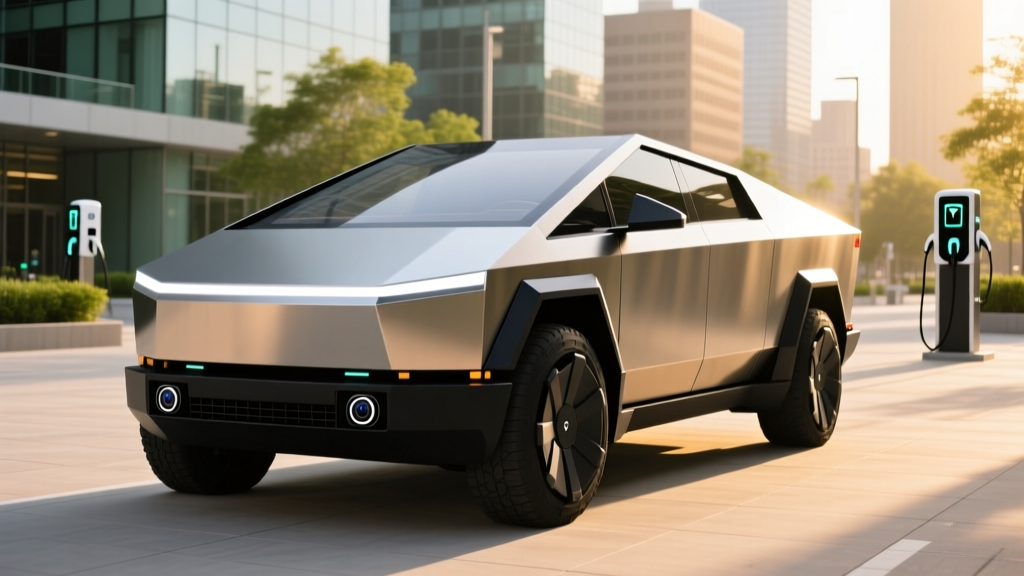
The Tesla Cybertruck's angular stainless-steel exoskeleton isn't just an aesthetic choice — it fundamentally shapes where Tesla engineers placed the vehicle's camera suite. Unlike the Model Y or Model 3, where cameras tuck neatly behind a rounded windshield header and flow into fender curves, the Cybertruck's flat planes, sharp creases, and massive bed demanded a rethought sensor layout. Understanding Cybertruck camera locations is critical for three reasons: maintaining Autopilot visibility (dirty or obstructed lenses degrade SAE Level 2 driver-assist performance), understanding repair cost exposure after minor collisions, and knowing what your blind spots actually look like through the camera feed on the 18.5-inch center display.
This review maps every exterior camera, then covers the full ownership picture — EPA range, real-world efficiency, DC fast-charging reality, 2026 pricing, and federal tax credit eligibility under IRS §30D.
Every Cybertruck Camera Location Mapped
The 2026 Cybertruck carries Tesla's latest Hardware 4 (HW4) vision suite. There are eight exterior cameras total, each serving overlapping functions for Autopilot, FSD (Supervised), Sentry Mode, and the digital rearview mirror. Here is every mounting point:
- Front main (narrow + wide): Mounted behind the windshield, just above the rearview mirror housing. This is the primary forward-vision pair — the wide lens covers ~120° for intersection and cross-traffic, the narrow lens handles long-range lane and object detection out to ~250 meters.
- Front fender repeaters (left and right): Embedded in the forward edge of each front fender, just behind the wheel well. These cover lateral blind-spot zones and are critical for Autopilot lane-change decisions.
- B-pillar cameras (left and right): Positioned on the B-pillar trim, roughly at occupant shoulder height. They monitor adjacent lanes and cross-traffic when pulling out of parking spaces.
- Rear quarter-panel cameras (left and right): Located near the rear corners of the bed, integrated into the tonneau/bed-rail trim. These replace the traditional side mirrors' blind-spot coverage and feed the camera-mirror display.
- Rear backup camera: Centered above the license plate recess on the tailgate. Provides the primary reversing view and feeds the trailer-hitch alignment overlay.
Range, Battery, and Efficiency: The Real Numbers
The Cybertruck's stainless-steel skin and boxy aerodynamics (Cd estimated around 0.34–0.38, significantly worse than the Model Y's ~0.23) impose a measurable efficiency penalty. Here's how the 2026 lineup breaks down:
| Spec | AWD | Cyberbeast |
|---|---|---|
| EPA Range | 340 mi | 320 mi |
| Battery (usable) | ~123 kWh | ~123 kWh |
| Chemistry | NMC (nickel-manganese-cobalt) | NMC |
| Efficiency | ~50 MPGe / ~67 kWh/100mi | ~48 MPGe / ~70 kWh/100mi |
| 0–60 mph | 3.9 sec | 2.6 sec |
| Horsepower | 600 hp | 845 hp |
| Drivetrain | Dual-motor AWD | Tri-motor AWD |
| Max Tow Capacity | 11,000 lb | 11,000 lb |
Charging: 800-Volt Architecture, Real Charge-Curve Behavior
The Cybertruck uses an 800-volt electrical architecture (shared with the refreshed Model S/X platform), which enables higher charge power with lower current and less heat generation. It charges via the NACS (North American Charging Standard) connector natively — no adapter needed at Tesla Superchargers.
| Level | Power | Speed | Notes |
|---|---|---|---|
| Level 1 (120V) | ~1.4 kW | ~3 mi/hr | Emergency only; 123 kWh battery takes days |
| Level 2 (240V, 48A) | 11.5 kW | ~26 mi/hr | Full charge in ~11 hours; ideal overnight |
| DC Fast (V4 Supercharger) | 250 kW peak | 10–80% in ~30 min | Sustained rate drops sharply above 60% SoC |
The charge curve is the nuance most spec sheets omit. The Cybertruck peaks near 250 kW only between roughly 10% and 35% State of Charge (SoC). From 35% to 60%, it tapers to ~175 kW. Above 60%, it drops further to ~100 kW, and above 80% it falls below 50 kW. This is typical NMC behavior — the chemistry requires careful current management at higher SoC to prevent lithium plating and accelerated degradation. Preconditioning (navigating to a Supercharger in the Tesla app so the battery warms up en route) is essential in cold weather; without it, peak charge power on a 30°F morning may be limited to ~120 kW for the first 10 minutes.
For home charging, a Tesla Wall Connector on a 60-amp circuit (48A continuous) delivers 11.5 kW — enough to add ~26 miles of range per hour, or a full 0–100% charge in roughly 11 hours. A panel upgrade to 200A service may be required in older homes; budget $1,500–$3,000 for the electrician work on top of the ~$450 Wall Connector unit.
Pricing, Trims, and Federal Tax Credit Eligibility (2026)
The Cybertruck's pricing has shifted multiple times since its 2023 launch. As of the 2026 model year, Tesla offers two primary trims (the originally promised sub-$40K RWD model was quietly discontinued):
| Trim | MSRP | §30D Credit Eligible? | Effective Price |
|---|---|---|---|
| AWD | $79,990 | Up to $7,500 (if income/sourcing met) | ~$72,490 |
| Cyberbeast | $99,990 | Up to $7,500 (if income/sourcing met) | ~$92,490 |
The IRS §30D federal tax credit offers up to $7,500, but eligibility is not automatic. You must satisfy all of the following:
- MSRP cap: The Cybertruck qualifies as a pickup truck (MSRP cap of $80,000 for trucks/vans/SUVs). The AWD trim at $79,990 clears the cap; the Cyberbeast at $99,990 exceeds it and is ineligible for the new-vehicle credit.
- Buyer income cap: Modified AGI must not exceed $150,000 (single), $225,000 (head of household), or $300,000 (married filing jointly).
- Battery sourcing: The credit splits into two $3,750 halves — one for critical-mineral sourcing, one for battery-component manufacturing. Tesla's North American battery production (4680 cells at Giga Texas) generally satisfies the component requirement; critical-mineral compliance depends on the specific supply-chain batch and shifts yearly. Verify at fueleconomy.gov before purchase.
- Point-of-sale transfer: As of 2024, you can transfer the credit to the dealer at purchase, reducing your out-of-pocket cost directly rather than waiting for tax filing. This requires IRS pre-registration.
Consult a tax professional — credit rules are subject to legislative change and individual circumstances vary.
Interior, Cargo, and Tech: Practical Ownership
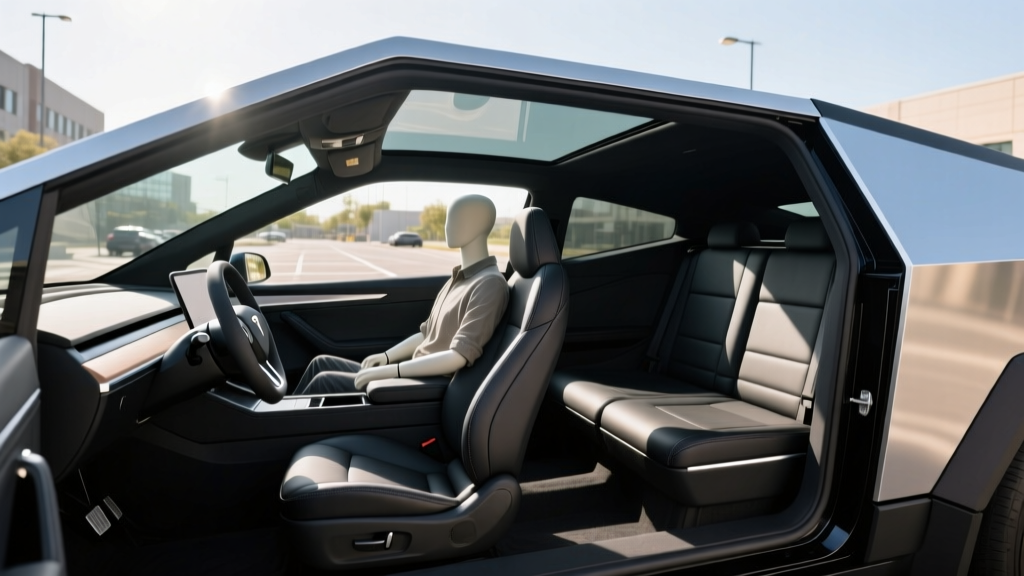
The Cybertruck seats five across two rows. Rear legroom is approximately 38 inches — adequate for adults but tighter than a Ford F-150 Lightning's rear seat due to the sloping roofline. The front 18.5-inch touchscreen dominates the dash and serves as the instrument cluster, climate control, camera feed display, and entertainment hub. There is no traditional gauge cluster and no Apple CarPlay or Android Auto — Tesla's proprietary OS handles everything.
Cargo capacity:
- Bed: 6 ft × 4 ft (74 cu ft with tonneau closed). The powered tonneau is standard and lockable — a genuine advantage over open-bed trucks for secure cargo.
- Front trunk (frunk): ~7 cu ft — enough for charging cables, a small bag, or groceries. Significantly smaller than the F-150 Lightning's ~14 cu ft Mega Power Frunk.
- Rear under-seat storage: Shallow bin behind the rear seats, ~3 cu ft.
Standout tech features:
- Steer-by-wire: No physical connection between the yoke/steering wheel and the front axle. Enables variable steering ratio (less than one full turn lock-to-lock at highway speed) and 4-wheel steering for a remarkably tight 35-foot turning circle.
- 48-volt electrical architecture: First in a production Tesla. Reduces wiring harness weight by ~50% and enables higher-power accessories.
- Powershare (V2L/V2H): Up to 11.5 kW of bidirectional power output — enough to run power tools at a job site, power a camper, or provide home backup during an outage (with a Tesla Powerwall gateway).
- Autopilot / FSD (Supervised): SAE Level 2 driver-assist. The driver must remain fully attentive, hands on the yoke, eyes on the road. This is not self-driving. FSD (Supervised) handles highway lane changes, city intersections, and parking maneuvers but requires constant oversight.
Notable drawbacks:
- Stainless-steel panels are fingerprint magnets and difficult to repair — minor dents often require full panel replacement rather than paintless dent repair.
- Visibility is compromised by thick A-pillars and the angular rear profile; the camera-based digital rearview mirror helps but takes adjustment.
- Ride quality on 20-inch wheels is firm, especially over expansion joints and broken pavement. The adaptive air suspension helps but cannot fully overcome the vehicle's ~6,800 lb curb weight.
- No rear windshield wiper. Rain and road grime accumulate on the rear glass, degrading the backup camera and rearward visibility.
- Class-leading tow rating (11,000 lb)
- 800V charging architecture with 250 kW peak
- 11.5 kW Powershare V2L/V2H capability
- Stainless exoskeleton resists dents and corrosion
- Steer-by-wire gives a car-like turning radius
- Real-world highway range ~270 mi, not 340 mi
- Cyberbeast trim exceeds §30D MSRP cap
- Poor rear visibility; no rear wiper
- Stainless panels are costly to repair after collision
- Firm ride; heavy curb weight (~6,800 lb)
Warranty and Long-Term Battery Outlook
Tesla covers the Cybertruck with:
- Basic vehicle warranty: 4 years / 50,000 miles
- Battery and drive unit warranty: 8 years / 120,000 miles (whichever comes first), with a minimum 70% capacity retention guarantee over that period.
The 4680 NMC cells in the Cybertruck are structurally integrated into the vehicle floor (a "structural battery pack"), which improves rigidity and reduces parts count but complicates out-of-warranty replacement. Industry estimates for a full pack replacement range from $15,000 to $25,000 — a significant long-term ownership cost if you plan to keep the truck past the 8-year mark. NMC chemistry typically degrades 10–15% over 150,000 miles under normal use (avoiding frequent 100% charges and DC fast-charging in extreme heat). Tesla recommends daily charging to 80% for NMC packs, reserving 100% for road trips.
Who the Cybertruck Is Actually For
Choose the Cybertruck if: You need a genuine work truck with 11,000 lb towing, job-site V2L power output, and a lockable 6-foot bed — and you want EV running costs with Supercharger access for long hauls. The Cyberbeast variant suits buyers who want supercar acceleration (2.6 sec 0–60) in a truck body and don't care about the tax credit.
Look elsewhere if: Your priority is maximum range efficiency (the Rivian R1T and Ford F-150 Lightning offer comparable utility with slightly better efficiency), you need a full-size rear seat for three adults regularly, or your budget is below $75,000. The Cybertruck's polarizing styling and stainless-steel maintenance also make it a poor fit for fleet or lease-return scenarios where resale predictability matters.
Frequently Asked Questions
What is the real-world range of the Cybertruck?
The EPA rates the AWD trim at 340 miles and the Cyberbeast at 320 miles. In real-world highway driving at 70–75 mph, expect 265–285 miles. Cold weather (below 25°F) reduces this further to roughly 220–240 miles. Towing a heavy trailer cuts range approximately in half.
How fast does the Cybertruck charge at home and on the road?
On a Level 2 home charger (11.5 kW / 48A), the Cybertruck gains about 26 miles of range per hour, with a full charge taking ~11 hours. At a V4 Supercharger, it peaks at 250 kW and charges from 10% to 80% in approximately 30 minutes, though the charge curve tapers significantly above 60% SoC.
Does the Cybertruck qualify for the $7,500 federal EV tax credit?
The AWD trim ($79,990 MSRP) falls under the $80,000 truck cap and can qualify for up to $7,500 if the buyer meets income limits ($150K single / $300K joint) and the vehicle's battery satisfies critical-mineral and component sourcing requirements. The Cyberbeast ($99,990) exceeds the MSRP cap and is ineligible for the new-vehicle credit. Always verify current eligibility at fueleconomy.gov and consult a tax professional.
Is the Cybertruck worth buying over the Rivian R1T or F-150 Lightning?
The Cybertruck wins on raw tow capacity (11,000 lb vs. the R1T's ~11,000 lb and Lightning's ~10,000 lb), V2L output (11.5 kW), and Supercharger network access. The R1T offers a more refined interior, better rear-seat space, and a more conventional steering system. The F-150 Lightning provides a larger frunk, more familiar truck ergonomics, and Ford dealer service infrastructure. Test-drive all three — the Cybertruck's steer-by-wire and yoke are polarizing and not for every driver.
Are Cybertruck cameras prone to damage or obstruction?
The front fender repeater cameras and rear quarter-panel cameras are the most exposed to road debris, mud, and spray. They are recessed slightly into the body trim, which offers minor protection, but they will accumulate grime on long highway drives. The front main camera pair behind the windshield is well-protected and benefits from Tesla's washer-nozzle cleaning system. Replacement cost for a single camera module ranges from $200 to $500 plus calibration.
Can I use the Cybertruck's cameras for off-road trail navigation?
Yes. The camera feed on the center display can be set to show a persistent low-speed surround view, which is useful for tight trail obstacles. However, mud and dust will quickly coat the lower cameras — carry a cleaning cloth and water bottle for trail use. The Cybertruck does not currently offer a dedicated ultrasonic sensor suite (Tesla removed parking sensors in favor of vision-based "Tesla Vision" distance estimation), so rely on the camera overlay gridlines rather than proximity beeps.