When Tesla famously smashed a steel ball through the Cybertruck's window during its 2019 debut, it inadvertently set the stage for years of scrutiny around the truck's "bulletproof" marketing. Now that the Cybertruck bulletproof test claims have been put through real-world ownership, independent ballistics testing, and thousands of miles of daily driving, it's time to separate armored-truck hype from the practical EV buyer's reality. This review covers the full 2026 Tesla Cybertruck lineup — its stainless-steel exoskeleton durability, EPA range, charging performance, pricing, and whether it actually earns a spot in your garage over a Rivian R1T or Ford F-150 Lightning.
What the Cybertruck Bulletproof Test Actually Proves (and Doesn't)
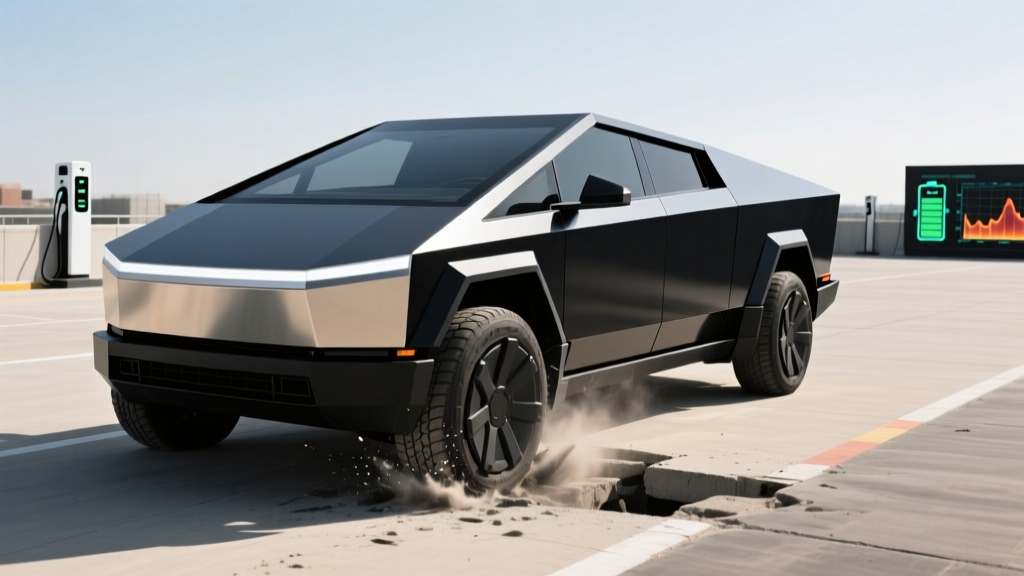
Tesla's marketing has leaned heavily on the Cybertruck's 30X cold-rolled ultra-hard stainless-steel exoskeleton, claiming it can withstand 9mm handgun rounds. Independent testing by outlets including ballistics experts on YouTube and third-party reviewers has confirmed that the body panels do resist certain small-arms fire at specific angles. However, there are critical caveats every buyer should understand:
- Panel-only protection: The stainless-steel skin resists penetration, but the glass (even the updated "armor glass") remains the weak point. Tesla revised the glass after the 2019 demo, but it is not rated to the same ballistic standard as the body panels.
- Angle and caliber matter: Testing confirms resistance to 9mm FMJ rounds at standard distances. Higher-caliber rounds, armor-piercing ammunition, or close-range rifle fire are not part of Tesla's claims or independent confirmations.
- No official NIJ certification: The Cybertruck does not carry a National Institute of Justice (NIJ) ballistic rating. It is not an armored vehicle in the certified sense — it's a consumer pickup with unusually tough body panels.
- Real-world durability win: Where the exoskeleton genuinely shines is in dent resistance, scratch tolerance, and corrosion protection. Owners report that parking-lot dings, brush scratches on trails, and hail damage are non-issues — a legitimate advantage over aluminum or stamped-steel trucks.
2026 Cybertruck Specs: Range, Battery, and Efficiency
| Specification | AWD (Dual-Motor) | Cyberbeast (Tri-Motor) |
|---|---|---|
| EPA Range | 340 miles | 320 miles |
| Battery Capacity | ~123 kWh usable (NMC) | ~123 kWh usable (NMC) |
| Efficiency | 76 MPGe / 44 kWh/100mi | 72 MPGe / 47 kWh/100mi |
| 0-60 mph | 4.1 seconds | 2.6 seconds |
| Horsepower | 600 hp | 845 hp |
| Drivetrain | Dual-motor AWD | Tri-motor AWD |
| Towing Capacity | 11,000 lbs | 11,000 lbs |
| Base MSRP | $79,990 | $99,990 |
Tesla uses an NMC (nickel manganese cobalt) battery pack in the Cybertruck, prioritizing energy density over the LFP chemistry found in the standard-range Model 3. The ~123 kWh usable pack is one of the largest in any consumer EV, which explains the truck's substantial range despite its heavy curb weight (roughly 6,600–6,800 lbs depending on trim) and angular, high-drag profile.
Charging Speed: DC Fast Charge and Home Level 2
Charging a 123 kWh battery is a physics challenge. Here's what the Cybertruck actually delivers at the plug:
| Charging Level | Max Power | Speed / Time | Notes |
|---|---|---|---|
| Level 1 (120V) | ~1.4 kW | ~3 mi/hr | Emergency/trickle only; full charge in 90+ hours |
| Level 2 (240V, 48A) | 11.5 kW | ~25 mi/hr, full charge ~13 hr | Tesla Wall Connector or equivalent; overnight charging |
| DC Fast Charge | Peak 250 kW (NACS) | 10–80% in ~30 min | Sustained rate ~150–170 kW avg; tapers above 80% |
The Cybertruck uses the NACS (North American Charging Standard) connector natively, giving it seamless access to Tesla's Supercharger network — widely regarded as the most reliable DC fast-charging infrastructure in the U.S. At a V3 or V4 Supercharger, the truck peaks at roughly 250 kW, but because of the massive 123 kWh pack, the 10–80% session takes about 30 minutes. The charge curve tapers significantly above 60% SoC, so highway road-trippers should plan to charge from 10–60% (about 18–20 minutes) and hop to the next station rather than waiting for a full top-off.
At home on a Level 2 Tesla Wall Connector (48 amps / 11.5 kW), overnight charging adds roughly 25 miles of range per hour. A full charge from 10% to 100% takes approximately 13 hours — plan accordingly if you're running the battery low on a road trip and need a full pack by morning.
Pricing, Trims, and Federal Tax Credit Eligibility
| Trim | Base MSRP | §30D Credit Eligible? | Effective Price (if eligible) |
|---|---|---|---|
| AWD (Dual-Motor) | $79,990 | No — exceeds $80,000 truck MSRP cap | $79,990 |
| Cyberbeast (Tri-Motor) | $99,990 | No — exceeds $80,000 truck MSRP cap | $99,990 |
Under current IRS §30D Clean Vehicle Credit rules, pickup trucks and SUVs face an $80,000 MSRP cap. The Cybertruck AWD at $79,990 sits just under the threshold in base form, but once any options, destination charges, or packages are added, the MSRP crosses $80,000 and disqualifies the vehicle. The Cyberbeast at $99,990 is well above the cap regardless of configuration.
Additionally, §30D has buyer income limits ($150,000 single / $300,000 joint MAGI) and strict battery-component and critical-minerals sourcing requirements that change annually. Even if the base AWD trim technically squeaks under the MSRP cap, buyers must verify current-year battery-sourcing compliance on the IRS qualified-vehicles list before counting on the credit. As of early 2026, the Cybertruck has not consistently appeared on the qualified list for the full $7,500 credit. Consult a tax professional before making a purchase decision based on incentive assumptions.
Cargo, Passenger Space, and Daily Practicality
The Cybertruck's angular geometry creates a genuinely useful 6-foot bed with a motorized tonneau cover that Tesla rates for 300 lbs of load on top. Key dimensions:
- Bed length: 72 inches (6 ft) with tailgate up; extends with tailgate down
- Bed volume: ~67 cu ft
- Front trunk (frunk): ~7 cu ft — useful for charging cables and small bags
- Rear-seat legroom: ~38 inches — adequate for adults on shorter trips, tight for long highway rides
- Front headroom: Generous, thanks to the tall roofline
- Ground clearance: Up to 17.4 inches (with adaptive air suspension in Extract mode)
- Approach/departure angles: 35°/30° — competitive with off-road-oriented trucks
The rear seat is the Cybertruck's most common complaint among family buyers. The upright seatback and elevated floor (to accommodate the battery pack underneath) create a knees-up seating position that's uncomfortable for adults on trips longer than 30 minutes. Families with older children or those who primarily use the rear seats for cargo overflow will manage, but the Rivian R1T and F-150 Lightning both offer more conventional, comfortable rear seating.
Technology, Driver Assists, and Standout Features
The Cybertruck's cabin is dominated by an 18.5-inch front touchscreen and a 9.4-inch rear screen, running Tesla's latest infotainment software. Notable tech features include:
- Steer-by-wire: The Cybertruck is the first high-volume Tesla with a fully steer-by-wire system, enabling the yoke-style steering wheel and a variable steering ratio that requires less than one full turn lock-to-lock. It's responsive but requires an adjustment period.
- 48-volt electrical architecture: A first for a mass-production vehicle, reducing wiring harness weight and enabling higher-power accessories.
- Autopilot / FSD (Supervised): Tesla's Level 2 driver-assistance suite is included (Autopilot) or available as a paid upgrade (FSD Supervised). This is not self-driving — the driver must remain fully engaged with hands on the yoke and eyes on the road at all times. SAE Level 2 means the system can steer, accelerate, and brake under specific conditions, but the human is always responsible.
- Adaptive air suspension: Automatically adjusts ride height with up to 12 inches of travel, from highway-low to off-road Extract mode.
- Powershare (V2L/V2H): Vehicle-to-load capability provides up to 11.5 kW of bidirectional power, enough to run tools at a job site or partially power a home during an outage.
Cybertruck vs. Rivian R1T vs. Ford F-150 Lightning
| Category | Tesla Cybertruck AWD | Rivian R1T Dual-Motor | Ford F-150 Lightning |
|---|---|---|---|
| EPA Range | 340 mi | ~352 mi (Max Pack) | 320 mi (Ext. Range) |
| Base Price | $79,990 | $79,900 | $62,995 |
| Towing | 11,000 lbs | 11,000 lbs | 10,000 lbs |
| Bed Length | 6 ft | 4.5 ft (+ Gear Tunnel) | 5.5 ft |
| DC Fast Charge | 250 kW (NACS) | ~220 kW (NACS) | ~150 kW (CCS/NACS adapter) |
| Rear Seat Comfort | Fair | Good | Excellent |
| §30D Credit | Unlikely (MSRP cap) | Trim-dependent | Eligible trims available |
- Choose the Cybertruck if: You want maximum dent/scratch resistance, steer-by-wire novelty, Supercharger network access, V2L powershare, and don't regularly carry rear-seat adults on long trips.
- Choose the Rivian R1T if: You want the best off-road capability, the Gear Tunnel for creative cargo, a more conventional driving feel, and a strong adventure-lifestyle community.
- Choose the F-150 Lightning if: You want the most affordable entry point, the most comfortable rear seat, Ford dealer service familiarity, and a proven work-truck platform with available §30D credit on lower trims.
Warranty, Battery Longevity, and Ownership Costs
Tesla provides the following warranty coverage for the 2026 Cybertruck:
- Basic vehicle warranty: 4 years / 50,000 miles
- Battery and drive unit warranty: 8 years / 120,000 miles, with a minimum 70% capacity retention threshold
- Restraint system: 5 years / 60,000 miles
The NMC battery chemistry in the Cybertruck offers high energy density but is more sensitive to repeated 100% charges and extreme heat than LFP chemistry. Best-practice ownership means charging to 80–90% for daily use and only charging to 100% before long road trips. Tesla's thermal management system is among the best in the industry, and degradation data from Model S/X vehicles with similar NMC packs shows typical capacity loss of 8–12% over 100,000 miles.
Insurance costs for the Cybertruck are notably higher than average for the pickup segment. Multiple insurers have reported premiums 40–70% above comparable F-150 Lightning policies, driven by the stainless-steel body's repair complexity, limited collision-repair training, and parts availability. Get an insurance quote before ordering.
Pros, Cons, and Final Verdict
Pros
- Exceptional stainless-steel dent and scratch resistance — genuine daily-driver durability advantage
- 340-mile EPA range (AWD) is best-in-class for electric pickups
- 250 kW NACS DC fast charging with seamless Supercharger access
- 11,000-lb towing and 11.5 kW V2L powershare capability
- Steer-by-wire and 48V architecture are genuinely innovative
- Cyberbeast's 2.6-second 0-60 is absurd performance for a 6,800-lb truck
Cons
- Not a certified ballistic-rated vehicle despite "bulletproof" marketing
- Rear seat comfort is poor for adult passengers on long trips
- Insurance premiums 40–70% above segment average
- Likely ineligible for §30D federal tax credit due to MSRP cap
- Highway real-world range drops significantly due to poor aerodynamics
- Steer-by-wire and yoke require a meaningful learning curve
- Stainless-steel body panels are extremely difficult (and expensive) to repair if dented by extreme force
Frequently Asked Questions
Is the Tesla Cybertruck actually bulletproof?
The stainless-steel exoskeleton panels can resist certain 9mm handgun rounds, as confirmed by independent testing. However, the Cybertruck has no NIJ ballistic certification, the glass is not rated to the same standard, and the undercarriage, battery, and seams are not armored. It is more accurate to call it "highly dent- and scratch-resistant" than bulletproof.
What is the real-world range of the Cybertruck?
The EPA rates the AWD at 340 miles and the Cyberbeast at 320 miles. Real-world highway driving at 70+ mph yields approximately 270–295 miles (AWD) and 255–280 miles (Cyberbeast). Cold weather below 30°F reduces range an additional 15–25%.
How fast does the Cybertruck charge?
On a Tesla Supercharger (DC fast charge), the Cybertruck peaks at 250 kW and charges from 10–80% in approximately 30 minutes. At home on a Level 2 Wall Connector (11.5 kW), it adds about 25 miles of range per hour, with a full charge taking roughly 13 hours.
Does the Cybertruck qualify for the federal EV tax credit?
Most likely not. The §30D credit has an $80,000 MSRP cap for trucks/SUVs/vans. The base AWD at $79,990 is borderline, but any options or destination charges push it over. The Cyberbeast at $99,990 is far above the cap. Additionally, battery-sourcing and buyer-income requirements apply. Check the current IRS qualified vehicles list before purchasing.
Is the Cybertruck worth buying over the Rivian R1T or F-150 Lightning?
It depends on your priorities. The Cybertruck wins on raw range, Supercharger access, and body durability. The R1T wins on off-road capability and cargo creativity. The F-150 Lightning wins on price, rear-seat comfort, and tax-credit eligibility. None of these trucks are bad choices — they serve different use cases.
How much does it cost to insure a Cybertruck?
Insurance premiums for the Cybertruck are significantly higher than the electric-truck average — typically 40–70% above comparable F-150 Lightning policies. The stainless-steel body's repair complexity, limited body-shop training, and high parts costs drive these rates. Always get a personalized insurance quote before committing to a purchase.