The Tesla Cybertruck's angular stainless-steel exoskeleton grabs headlines, but for truck buyers, the real test happens in the back. The Cybertruck's 6-foot bed — officially branded the "Vault" — is engineered around a lockable composite liner, a motorized roll-up tonneau, and integrated power delivery. This guide breaks down the Cybertruck bed interior dimensions, cargo management features, and the full vehicle profile you need to decide if it fits your workflow in 2026.
Cybertruck Bed Interior Dimensions & Cargo Volume
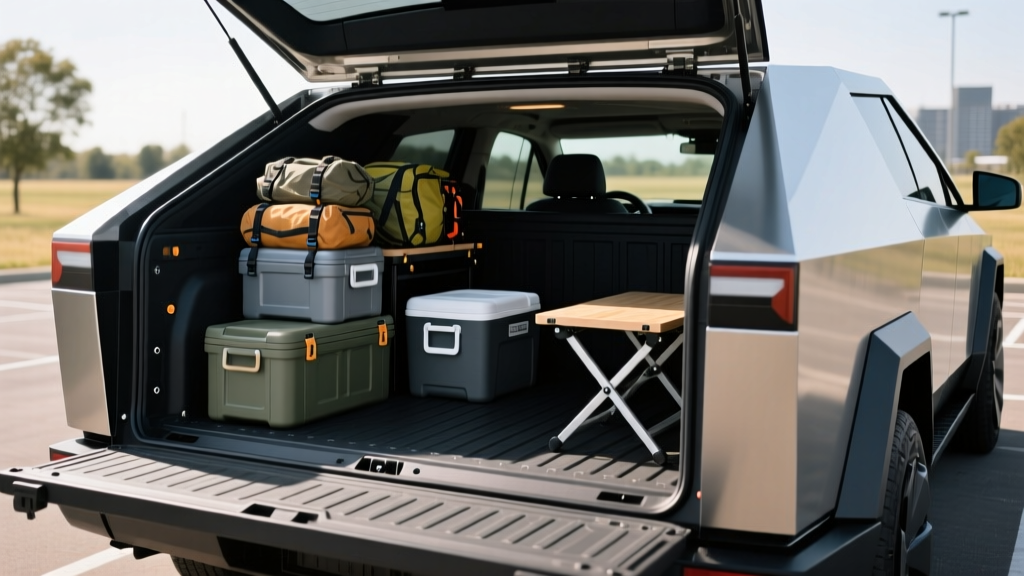
Tesla designed the Cybertruck bed to maximize enclosed, lockable utility while maintaining the aerodynamic efficiency needed for a heavy electric truck. The Vault measures approximately 72 inches long × 48 inches wide at the floor, with a total enclosed cargo volume of 67 cubic feet when the motorized tonneau cover is closed. That width accommodates standard 4×8 sheets of plywood flat — but only just, since the wheel wells intrude slightly.
| Dimension | Measurement |
|---|---|
| Bed Length (floor) | 72 in (6 ft) |
| Bed Width (floor) | 48 in |
| Bed Width (between wheel wells) | ~43 in |
| Bed Depth (walls) | ~26 in |
| Total Enclosed Volume (tonneau closed) | 67 cu ft |
| Tailgate Width (opening) | ~48 in |
| Sub-trunk (Under-bed Gear Locker) | ~7 cu ft |
| Frunk (Front Trunk) | 7.1 cu ft |
| Towing Capacity | 11,000 lbs |
| Payload Capacity | 2,500 lbs |
Under-Bed Gear Locker & Frunk
Beyond the main Vault, the Cybertruck includes an under-bed sub-trunk accessible from the rear — roughly 7 cubic feet of lockable space ideal for tools, recovery gear, or a portable air compressor. The front trunk (frunk) adds another 7.1 cubic feet, giving you three separate sealed compartments. Combined enclosed storage across all three zones approaches 81 cubic feet.
Built-In Bed Tech & Tie-Downs
- Motorized roll-up tonneau — rated to support up to 300 lbs distributed, walkable when closed.
- Integrated 120V/240V outlets — up to 9.6 kW of vehicle-to-load (V2L) power from bed-mounted and cabin outlets, enough to run a circular saw, welder, or campsite setup.
- Compressed air outlet — onboard compressor accessible via a bed-mounted quick-connect for tire inflation or pneumatic tools.
- Tie-down points — six reinforced L-track compatible anchors along the bed floor and walls.
- Integrated ramp — the tailgate deploys as a loading ramp rated for an ATV or motorcycle.
Full Cybertruck Powertrain & Performance Specs
The bed is only as useful as the truck pulling it. Here's the full 2026 Cybertruck spec breakdown across all three trims currently available.
| Spec | RWD (Base) | AWD | Cyberbeast |
|---|---|---|---|
| Drivetrain | Single Motor RWD | Dual Motor AWD | Tri-Motor AWD |
| Horsepower | ~600 hp | ~600 hp | 845 hp |
| 0-60 mph | ~6.5 sec | ~4.1 sec | 2.6 sec |
| EPA Range | ~250 mi (est.) | 340 mi | 320 mi |
| Battery (usable, approx.) | ~100 kWh | ~123 kWh | ~123 kWh |
| Chemistry | NMC (4680 cells) | NMC (4680 cells) | NMC (4680 cells) |
| Max DC Fast Charge | ~250 kW | ~350 kW | ~350 kW |
| 10-80% DCFC Time | ~28 min | ~18 min | ~18 min |
| Level 2 Home Charging | 11.5 kW (~37 mi/hr) | 11.5 kW (~37 mi/hr) | 11.5 kW (~37 mi/hr) |
| Base MSRP | $60,990 | $79,990 | $99,990 |
All trims use Tesla's in-house 4680-format NMC (nickel manganese cobalt) cells arranged in a structural battery pack. Unlike LFP chemistry found in some Tesla sedans, NMC delivers higher energy density — necessary in a truck this heavy — but requires care to avoid sustained storage at 100% state of charge.
Real-World Range vs. EPA Sticker
The AWD's EPA-estimated 340 miles is achievable in mild-weather city and suburban driving at moderate speeds. In our experience and consistent third-party testing:
- Highway (70 mph, 75°F): expect ~280–300 miles before needing a charger.
- Cold weather (30°F, mixed driving): range drops to ~230–260 miles due to battery resistance and cabin heating.
- Towing (5,000+ lb trailer): range can fall to 150–180 miles depending on terrain and speed.
The Cybertruck's angular shape works against it at highway speeds — aerodynamic drag is the single biggest range killer above 65 mph. Preconditioning the battery before DC fast charging is essential for reaching peak charge rates.
Charging Speed & Infrastructure
Fast-charging capability is where the Cybertruck AWD and Cyberbeast shine. The 4680 cell architecture supports a peak rate of ~350 kW on V3 and V4 Tesla Superchargers, though as with all EVs, the charge curve tapers significantly above 80% state of charge.
| Charging Level | Power / Rate | Miles Added per Hour | Notes |
|---|---|---|---|
| Level 1 (120V standard outlet) | ~1.4 kW | ~3–4 mi/hr | Emergency/trickle only |
| Level 2 (240V home Wall Connector) | 11.5 kW | ~37 mi/hr | Full charge in ~10–11 hrs |
| DC Fast Charge (V3 Supercharger) | Up to 250 kW | ~750+ mi/hr (peak) | AWD/Cyberbeast peak ~350 kW on V4 |
| DC Fast Charge (V4 Supercharger) | Up to 350 kW | ~1,000+ mi/hr (peak) | 10-80% in ~18 min (AWD/Beast) |
kW vs kWh reminder: kW (kilowatts) measures power — the rate at which energy flows into the battery. kWh (kilowatt-hours) measures energy capacity — the total amount stored. Think of kW as the width of the hose and kWh as the size of the tank.
Home Charging Setup
A Tesla Wall Connector on a 60-amp circuit delivers the full 11.5 kW Level 2 rate. Expect a professional installation (electrician + permit + 240V run) to cost $800–$2,500 if your panel has spare capacity. A 200-amp panel upgrade — sometimes needed for larger battery packs — adds $1,500–$3,000. Always consult a licensed electrician for final specs.
Pricing, Tax Credit Eligibility & Ownership Cost
The Cybertruck launched with aggressive pricing that has since adjusted. Here is where the 2026 lineup stands, including the critical federal tax credit picture.
| Trim | Base MSRP | Federal Tax Credit (§30D) | Effective Price (if eligible) |
|---|---|---|---|
| RWD (Base) | $60,990 | Potentially $0–$7,500 | $53,490–$60,990 |
| AWD | $79,990 | $0 (MSRP cap exceeded) | $79,990 |
| Cyberbeast | $99,990 | $0 (MSRP cap exceeded) | $99,990 |
Key §30D tax credit rules for 2026 (per IRS.gov):
- MSRP cap: Trucks and SUVs must have an MSRP at or below $80,000 to qualify. This eliminates the AWD and Cyberbeast. The RWD base model at $60,990 clears this threshold.
- Buyer income cap: Modified AGI must not exceed $150,000 (single), $225,000 (head of household), or $300,000 (joint).
- Battery sourcing: A percentage of critical minerals and battery components must be sourced from the U.S. or free-trade-agreement partners. Tesla's U.S. cell manufacturing helps, but sourcing rules tighten annually — confirm current-year compliance at purchase.
- Point-of-sale transfer: Eligible buyers can apply the credit as an instant discount at the dealership rather than waiting for tax filing.
Because the AWD and Cyberbeast exceed the $80,000 MSRP cap, only the RWD base model has a realistic path to the full $7,500 credit — and only if the buyer meets income and sourcing requirements. Consult a tax professional before relying on credit eligibility.
Efficiency & Running Cost
The AWD Cybertruck achieves approximately 2.0 kWh/mile (roughly 50 MPGe combined) per fueleconomy.gov data. At a national average electricity rate of $0.16/kWh, that's roughly $0.32 per mile on home charging — compared to $0.55–$0.65/mile for a comparable gas truck at 16 MPG and $3.50/gallon. DC fast charging on the road raises the per-mile cost to $0.40–$0.55 depending on network pricing.
Interior, Tech & Driver Assistance
The Cybertruck cabin seats five across two rows with a minimalist, yoke-steering-forward design. Rear legroom is approximately 38 inches, and the rear bench folds flat to extend enclosed cargo length when the pass-through to the Vault is opened.
Infotainment & Connectivity
- 18.5-inch front touchscreen — runs Tesla's latest UI with navigation, media, and vehicle controls.
- 9.4-inch rear touchscreen — climate and media control for rear passengers.
- 15-speaker premium audio with active noise cancellation.
- Over-the-air updates — continuous feature additions and performance tuning.
- Sentry Mode & Dashcam — all-around cameras record incidents; useful on job sites and trailheads.
Autopilot & FSD (Supervised)
SAE Automation Level: 2
Tesla Autopilot and Full Self-Driving (Supervised) are Level 2 driver-assistance systems. They provide lane centering, adaptive cruise, and automated lane changes — but the driver must remain fully engaged, hands on the yoke, and eyes on the road at all times. These are not self-driving systems. Only Level 4 services like Waymo operate without a human driver in defined zones.
Autopilot comes standard. FSD (Supervised) remains a $8,000 add-on or $99/month subscription and continues to require active supervision. On highway routes, it reduces fatigue significantly; in complex urban environments, it demands constant vigilance.
Warranty & Long-Term Ownership
Tesla provides the following coverage for the 2026 Cybertruck:
- Basic Vehicle Limited Warranty: 4 years / 50,000 miles
- Battery & Drive Unit Warranty: 8 years / 120,000 miles (whichever comes first), with a minimum 70% capacity retention guarantee during that period
- Restraint System: 5 years / 60,000 miles
- Corrosion Perforation: 12 years / unlimited miles
The 8-year/120,000-mile battery warranty is competitive with the broader truck segment. However, out-of-warranty battery replacement for a ~123 kWh structural pack is estimated at $18,000–$28,000 based on current Tesla service pricing — a factor for high-mileage buyers planning ownership beyond the warranty window.
Known Drawbacks & Owner Considerations
- Stainless steel body — resists dents but shows fingerprints, smudges, and fine scratches; Tesla recommends specific cleaning products.
- Tonneau reliability — early production units experienced motorized tonneau issues; Tesla has issued service bulletins and OTA fixes, but it remains a component to monitor.
- Insurance premiums — Cybertruck insurance averages 20–40% higher than comparable trucks due to repair complexity and parts cost.
- No traditional bed rails — aftermarket rack compatibility is limited to Tesla's proprietary T-track system; the third-party accessory ecosystem is still maturing.
- Visibility — the rear camera replaces a traditional rearview mirror (no rear window), which some drivers find disorienting initially.
Pros
- Fully enclosed, lockable 67 cu ft Vault with motorized tonneau
- 9.6 kW V2L power from bed outlets — runs tools and appliances
- 11,000 lb towing + 2,500 lb payload capacity
- Tri-motor Cyberbeast: 2.6 sec 0-60 in a truck
- Low per-mile energy cost vs gas trucks
- Over-the-air feature updates
Cons
- AWD & Cyberbeast exceed $80K MSRP cap — no federal tax credit
- Real-world highway range ~280–300 mi (AWD), less when towing
- Higher insurance premiums than F-150 Lightning or Silverado EV
- Proprietary bed rail system limits aftermarket racks
- No rear window — camera-only rear visibility
- Stainless exterior requires specific maintenance
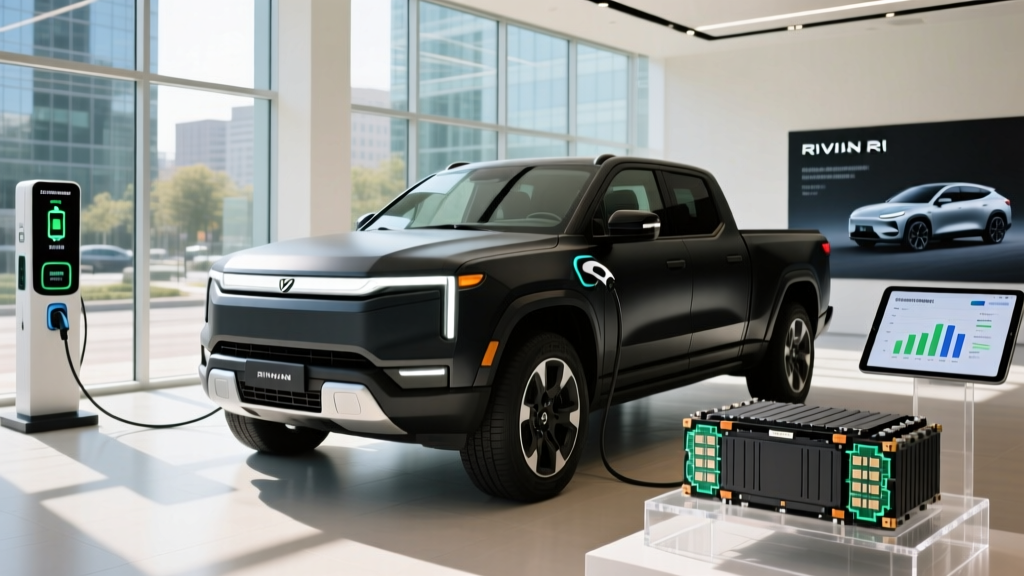
Cybertruck vs. Ford F-150 Lightning & Rivian R1T: Bed Comparison
| Feature | Tesla Cybertruck AWD | Ford F-150 Lightning (Std Range) | Rivian R1T (Dual Motor) |
|---|---|---|---|
| Bed Length | 72 in (6 ft) | 67 in (5.5 ft) | 54 in (4.5 ft) |
| Enclosed Volume | 67 cu ft (w/ tonneau) | 52.8 cu ft (open) | ~34 cu ft (open bed) |
| Lockable Cover | Standard (motorized) | Optional | Optional tonneau |
| Frunk | 7.1 cu ft | 14.1 cu ft (Mega Power Frunk) | 11.1 cu ft (Gear Tunnel) |
| V2L / Power Outlets | 9.6 kW | 9.6 kW (Pro Power Onboard) | ~3.6 kW |
| Towing Capacity | 11,000 lbs | 7,700 lbs | 11,000 lbs |
| EPA Range | 340 mi | 240 mi | 270 mi (Std) / 352 mi (Max) |
| Base MSRP | $79,990 | ~$54,995 | ~$69,900 |
| Tax Credit Eligible | No (over MSRP cap) | Yes (select trims) | Yes (select trims) |
The F-150 Lightning wins on price and tax credit access. The R1T offers the unique Gear Tunnel (a full-width pass-through behind the cab). The Cybertruck offers the longest enclosed, lockable bed and the most V2L power flexibility — but at a premium price that disqualifies it from the federal credit.
Who Is the Cybertruck Best For?
- Choose the Cybertruck if: you need a fully enclosed, lockable 6-foot bed with integrated power for tools and equipment, you tow up to 11,000 lbs regularly, you have reliable home charging, and you value performance and tech over traditional truck aesthetics.
- Choose the F-150 Lightning if: budget and federal tax credit eligibility are priorities, you prefer a conventional truck layout with a massive frunk, and you need broad dealer service access.
- Choose the Rivian R1T if: you prioritize off-road capability, the Gear Tunnel is appealing for adventure gear, and you want a more refined interior at a lower starting price than the Cybertruck AWD.
Frequently Asked Questions
What is the real-world range of the Cybertruck?
The AWD is EPA-rated at 340 miles. Real-world highway driving at 70 mph typically yields 280–300 miles. In cold weather (below freezing), expect 230–260 miles. Towing a heavy trailer can cut range to 150–180 miles. The Cyberbeast, with tri-motor performance tuning, is EPA-rated at 320 miles with similar real-world reductions.
How fast does the Cybertruck charge at home and on the road?
At home on a Level 2 Tesla Wall Connector (11.5 kW), the Cybertruck gains roughly 37 miles per hour — a full charge takes 10–11 hours. On a V4 Supercharger, the AWD and Cyberbeast peak at ~350 kW, achieving a 10–80% charge in approximately 18 minutes. Charge speed tapers significantly above 80% to protect battery health.
Does the Cybertruck qualify for the $7,500 federal EV tax credit?
Only the RWD base model ($60,990 MSRP) is potentially eligible, since the §30D credit requires trucks to have an MSRP at or below $80,000. The AWD ($79,990) and Cyberbeast ($99,990) exceed this cap and do not qualify. Even for the RWD, eligibility depends on buyer income limits and battery-sourcing compliance. Check current rules at IRS.gov and consult a tax professional.
Can you fit a full 4×8 sheet of plywood in the Cybertruck bed?
The bed floor is 48 inches wide, which matches a standard plywood sheet. However, the wheel wells narrow the clearance between them to approximately 43 inches, so sheets must sit above the wheel wells or on the bed rails. With the tonneau open and the 6-foot bed length, full sheets fit — but loading requires care around the well intrusion.
Is the Cybertruck worth buying over the F-150 Lightning?
It depends on your priorities. The Cybertruck offers a longer enclosed bed, higher towing capacity (11,000 vs 7,700 lbs), more EPA range (340 vs 240 mi on base battery), and integrated compressed air. The F-150 Lightning is significantly cheaper, qualifies for the tax credit on eligible trims, has a larger frunk (14.1 cu ft), and benefits from Ford's nationwide dealer network. If price and credit matter most, the Lightning wins. If enclosed bed utility and range are paramount, the Cybertruck has the edge.
What is the Cybertruck's bed weight capacity?
Tesla rates the Cybertruck's payload at 2,500 lbs (including passengers and cargo combined). The motorized tonneau cover supports up to 300 lbs distributed when closed — enough to stand on while working at a job site.