The 'Cybertruck Ban' Explained: What's Real and What's Noise
If you've searched for information on a Cybertruck ban, you've likely encountered a tangle of headlines, social media rumors, and legitimate regulatory concerns. Let's cut through it: as of 2026, no federal or state-wide ban prohibits the sale, registration, or operation of the Tesla Cybertruck in the United States. The truck is fully street-legal in all 50 states, registered with the NHTSA, and carries full EPA certification.
What does exist are specific, narrower issues that fuel the "ban" narrative:
- Pedestrian safety scrutiny in Europe: The Cybertruck has not received EU type approval, and its angular stainless-steel exoskeleton raises concerns under EU pedestrian-impact regulations (UN Regulation 127). This effectively prevents new sales in European Union member states — not a "ban" so much as a failure to meet different regulatory standards.
- UK classification challenges: The Cybertruck exceeds the UK's maximum weight limit for vehicles drivable on a standard Category B license (3,500 kg / 7,716 lbs for the AWD and Cyberbeast trims), requiring a Category C1 license. This isn't a ban — it's a licensing hurdle.
- Aftermarket throttle-pedal recall (2024): Tesla recalled approximately 3,878 Cybertrucks due to an accelerator pedal pad that could dislodge and become trapped in the interior trim, potentially causing unintended acceleration. This was a recall and fix, not a ban. The NHTSA monitored the remediation.
- Local fleet and rental restrictions: Some rental agencies and corporate fleet policies have declined to add the Cybertruck to their inventories due to its size, repair complexity, and parts availability — private business decisions, not government action.
The Cybertruck remains fully legal to purchase, register, insure, and drive across the United States. Below is a complete, data-driven review of what you're actually buying in 2026.
2026 Tesla Cybertruck: Core Specifications at a Glance
| Specification | AWD (Dual Motor) | Cyberbeast (Tri Motor) |
|---|---|---|
| Base MSRP | $79,990 | $99,990 |
| EPA Estimated Range | 340 miles | 320 miles |
| Battery Capacity (Usable) | ~123 kWh | ~123 kWh |
| Battery Chemistry | NMC (Nickel Manganese Cobalt) | NMC |
| Max DC Fast Charge | 250 kW | 250 kW |
| 10–80% DC Charge Time | ~28 minutes | ~28 minutes |
| Level 2 Home Charge Rate | 11.5 kW (~30 mi/hr) | 11.5 kW (~30 mi/hr) |
| 0–60 mph | 4.1 seconds | 2.6 seconds |
| Horsepower | 600 hp | 845 hp |
| Drivetrain | Dual Motor AWD | Tri Motor AWD |
| MPGe (Combined) | 74 MPGe | 69 MPGe |
| Efficiency (kWh/100 mi) | 46 kWh/100 mi | 49 kWh/100 mi |
| Towing Capacity | 11,000 lbs | 11,000 lbs |
| Payload Capacity | 2,500 lbs | 2,500 lbs |
| Battery & Drive Unit Warranty | 8 years / 120,000 miles | 8 years / 120,000 miles |
| Basic Vehicle Warranty | 4 years / 50,000 miles | 4 years / 50,000 miles |
Source: EPA / fueleconomy.gov and Tesla official specifications. Range and efficiency figures are for the most efficient wheel/tire configuration; larger wheel options reduce range.
Real-World Range: What the EPA Sticker Doesn't Tell You
EPA Estimated: 340 miles (AWD) / 320 miles (Cyberbeast)
Real-World Highway (70–75 mph): Expect 270–295 miles (AWD), 250–275 miles (Cyberbeast)
Cold Weather (below 32°F): Expect 220–260 miles (AWD) — a 20–35% reduction
Mixed Commute (city + suburban): Closer to EPA at 310–330 miles (AWD)
The Cybertruck's boxy, angular design creates significant aerodynamic drag — its estimated drag coefficient is roughly 0.39 to 0.42 Cd, far higher than a Model Y (~0.23 Cd). This means highway efficiency degrades steeply as speed increases. At 80 mph on a flat interstate in moderate temperatures, expect to consume roughly 50–55 kWh/100 mi in the Cyberbeast, which erodes range quickly.
Cold weather compounds the problem. The NMC battery pack requires energy for thermal management, and cabin heating in a large, poorly insulated stainless-steel cabin draws substantial power. Tesla's heat pump helps, but real-world winter testing by multiple outlets consistently shows 20–35% range loss in sub-freezing conditions compared to the EPA sticker.
For context: a 300-mile road trip in an AWD Cybertruck at 75 mph in 40°F weather will likely require at least one fast-charge stop. Plan accordingly.
Charging Speed: DC Fast Charging and Home Setup
| Level | Power | Charge Time / Rate | Notes |
|---|---|---|---|
| Level 1 (120V outlet) | ~1.4 kW | ~4 mi/hr | Emergency/trickle only; full charge takes 4+ days |
| Level 2 (240V / 48A) | 11.5 kW | ~30 mi/hr (~11 hrs 10–100%) | Requires NACS connector; standard home install |
| DC Fast Charge (V4 Supercharger) | Peak 250 kW | ~28 min (10–80%) | Sustained rate drops significantly above 60% SoC |
| DC Fast Charge (3rd-party CCS via adapter) | Up to 250 kW | Varies by station | Tesla includes CCS adapter; NACS is native port |
The Cybertruck uses Tesla's NACS (North American Charging Standard) connector natively. At Tesla V4 Supercharger stalls, the truck can accept up to 250 kW — but this is a peak rate, not a sustained one. The charge curve tapers noticeably after 50–60% state of charge, and by 80%, charging speed drops to roughly 60–80 kW. This is normal lithium-ion behavior designed to protect cell longevity, but it means the last 20% takes nearly as long as the first 40%.
For home charging, a Level 2 wall connector on a 60-amp circuit (48A continuous) delivers 11.5 kW, adding roughly 30 miles of range per hour. A full overnight charge from 10% to 100% takes approximately 11 hours — feasible for daily use if you charge to 80–90% each night.
Home install reality: Budget $800–$2,500 for a professional Level 2 installation (Tesla Wall Connector costs ~$450). If your home electrical panel needs an upgrade from 100A to 200A service, add $1,500–$4,000. Always consult a licensed electrician for final specs.
Performance, Efficiency, and Towing
The Cybertruck's performance figures are genuinely impressive for a vehicle with a 6,800+ lb curb weight (AWD) to 7,000+ lb (Cyberbeast). The tri-motor Cyberbeast hits 0–60 mph in 2.6 seconds — faster than a Porsche 911 Turbo S — and the dual-motor AWD manages 4.1 seconds. Both use permanent-magnet synchronous motors with torque vectoring.
Efficiency is where the Cybertruck's physics catch up. At 74 MPGe combined (AWD), it consumes 46 kWh per 100 miles — roughly 50% more energy per mile than a Model Y Long Range (122 MPGe, 28 kWh/100 mi). For owners paying $0.15/kWh at home, that's roughly $0.069/mile in electricity vs. $0.042/mile for a Model Y. At 12,000 miles/year, the Cybertruck costs approximately $828 in home electricity vs. $504 for a Model Y.
Towing is rated at 11,000 lbs — competitive with a Ford F-150 Lightning (10,000 lbs extended range) and Rivian R1T (11,000 lbs). However, towing at or near max capacity reduces range by 40–60%. Expect 140–180 miles of range when towing 10,000+ lbs on the highway.
Pricing, Trims, and Federal Tax Credit Eligibility
| Item | AWD | Cyberbeast |
|---|---|---|
| Base MSRP (incl. destination) | $79,990 | $99,990 |
| As-Tested (typical options) | $82,000–$85,000 | $102,000–$108,000 |
| IRS §30D Federal Tax Credit | $0 (exceeds MSRP cap) | $0 (exceeds MSRP cap) |
| Effective Price After Federal Credit | $79,990+ | $99,990+ |
The Cybertruck does not qualify for the $7,500 federal EV tax credit under IRS §30D. Here's why:
- ✅ Vehicle type: Battery electric vehicle — qualifies
- ✅ Battery capacity: ≥7 kWh — qualifies (123 kWh)
- ❌ MSRP cap for trucks/SUVs: Must be ≤$80,000 — AWD at $79,990 is at the absolute limit, but destination and any options push it over. Cyberbeast at $99,990 far exceeds the cap.
- ⚠️ Buyer income cap: AGI ≤$150,000 (single) / ≤$300,000 (joint) — buyer-dependent
- ⚠️ Battery component sourcing: Must meet critical-mineral and battery-component requirements per the Inflation Reduction Act — Tesla's supply chain compliance varies by production batch
- ✅ Final assembly: Must be in North America — qualifies (Austin, TX)
Source: IRS §30D Clean Vehicle Credit guidelines. Consult a tax professional for your specific eligibility.
Even the base AWD model at $79,990 sits exactly at the truck MSRP cap, and adding any factory options, accessories, or destination-fee adjustments pushes it over the $80,000 threshold. In practice, virtually no Cybertruck configuration qualifies for the federal credit as of 2026.
Cargo, Passenger Space, and Daily Practicality
The Cybertruck is a full-size crew-cab pickup with a 6-foot bed (the "vault"). Key dimensions:
- Bed volume: ~67 cu ft (bed floor)
- Front trunk (frunk): ~7.1 cu ft — lockable, weather-sealed
- Front headroom: ~40.2 inches
- Front legroom: ~41.0 inches
- Rear headroom: ~38.4 inches
- Rear legroom: ~36.5 inches — adequate for adults on short trips, tight for long hauls
- Seating: 5-passenger (bench front seat in some configs, bucket seats standard)
- Bed payload: 2,500 lbs
- Ground clearance: Up to 17.4 inches (with adaptive air suspension in Extract Mode)
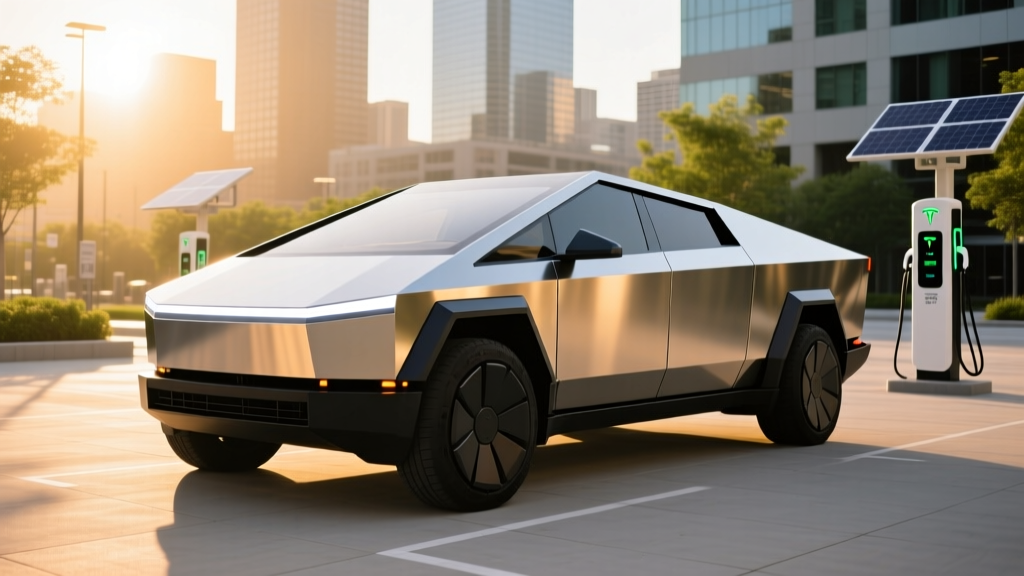
The stainless-steel exoskeleton is dent-resistant but shows fingerprints aggressively. The motorized tonneau cover is standard and integrates with the vehicle's locking system. However, the angular bed design means standard 4x8 sheets of plywood do not lay flat between the wheel wells — a notable practicality miss for a truck marketed to contractors.
Technology, Driver Assistance, and Drawbacks
The Cybertruck features Tesla's latest hardware suite (HW4/AI4) with:
- 18.5-inch central touchscreen with Tesla's vehicle OS — controls nearly all vehicle functions (no physical buttons for HVAC, mirrors, or wipers)
- 9.4-inch rear touchscreen for rear-seat climate and entertainment
- Steer-by-wire: No mechanical connection between the yoke/steering wheel and the wheels — fully electronic, with variable ratio that requires less than one full turn lock-to-lock
- 48-volt electrical architecture: A first for a production Tesla, reducing wiring harness weight and enabling higher-power accessories
- Autopilot (standard): SAE Level 2 adaptive cruise control + lane centering — driver must remain engaged at all times
- Full Self-Driving (Supervised): Optional ($8,000 or $99/month) — still SAE Level 2, requires active driver supervision despite the name
- Armor glass: Laminated composite glass, more impact-resistant than traditional auto glass but expensive to replace if cracked
Tesla Autopilot and FSD (Supervised) are SAE Level 2 driver-assistance systems. The driver must remain fully attentive, hands engaged (or eyes monitored), and ready to take over at any moment. These systems are not self-driving. Only Level 4 services like Waymo operate without a human driver in defined geographic zones.
Notable drawbacks:
- Steer-by-wire feels disorienting for the first several hundred miles and has no mechanical fallback if the electrical system fails (redundant systems mitigate this)
- All-screen control of mirrors, wiper speed, and glove box is frustrating while driving
- Stainless-steel panels are difficult and expensive to repair — collision repair wait times are long
- Rear visibility is poor; the bed-mounted camera helps but doesn't replace a rear window
- Parts availability remains inconsistent; minor collision repairs can take weeks
- No Apple CarPlay or Android Auto — Tesla's native infotainment only
Cybertruck vs. Competitors: Is It Worth Buying?
- Class-leading 11,000-lb towing capacity among EV trucks
- Extreme performance (2.6s 0–60 Cyberbeast)
- Stainless exoskeleton is virtually dent-proof
- Best-in-class off-road ground clearance (17.4 in)
- Access to Tesla Supercharger network (18,000+ stalls)
- 48V architecture and steer-by-wire are genuinely innovative
- No federal tax credit eligibility (§30D MSRP cap)
- Poor highway efficiency (46–49 kWh/100 mi)
- Real-world range significantly below EPA sticker at speed
- Expensive, slow collision repair; parts scarcity
- Rear legroom is tight for a full-size truck
- No physical controls — everything is touchscreen-based
- Polarizing design limits resale appeal
- Choose the Cybertruck AWD if: You need serious towing capacity (11,000 lbs), want Supercharger network access, and prioritize performance and off-road capability over efficiency and daily comfort. Budget $80,000+ with no tax credit.
- Choose the Ford F-150 Lightning instead if: You want a more conventional truck experience, qualify for the §30D tax credit (XLT/Lariat trims under $80,000), and value dealer service networks over Supercharger access. EPA range: 230–320 mi depending on battery.
- Choose the Rivian R1T instead if: You want a premium adventure truck with better build quality, a proper rear window, physical controls, and competitive 11,000-lb towing. EPA range up to 410 mi (Dual Motor Max Pack). Priced $75,000–$100,000+.
- Choose the Chevrolet Silverado EV instead if: You want maximum range (up to 450 mi EPA with 4WT trim) and GM's Ultium platform with CCS/NACS compatibility. Fleet-oriented trims start lower.
Who Should Buy the Cybertruck?
The Cybertruck is best suited for:
- Tech-forward truck buyers who value innovation (steer-by-wire, 48V architecture) over traditional truck ergonomics
- Heavy tower/haulers who need 11,000-lb capacity and don't mind the range penalty
- Off-road enthusiasts who benefit from 17.4 inches of ground clearance and stainless-steel body panels that shrug off trail damage
- Tesla ecosystem loyalists who already use Powerwall, Solar Roof, and want seamless Supercharger integration
It is not ideal for:
- Efficiency-focused commuters (a Model Y or Ioniq 5 uses half the energy per mile)
- Families needing spacious rear seating (Rivian R1T and F-150 Lightning offer more rear comfort)
- Buyers counting on the $7,500 federal tax credit to make the math work
- Those who want quick, affordable collision repair from a local body shop
Frequently Asked Questions
Is the Tesla Cybertruck banned in the United States?
No. The Cybertruck is fully legal to purchase, register, and drive in all 50 U.S. states. It has NHTSA certification and EPA compliance. The "Cybertruck ban" narrative stems primarily from its inability to meet EU pedestrian-safety regulations for European sales, UK weight-based licensing restrictions, and isolated rental/fleet company decisions — none of which constitute a U.S. ban.
What is the real-world range of the Cybertruck?
The EPA rates the AWD at 340 miles and the Cyberbeast at 320 miles. Real-world highway driving at 70–75 mph yields approximately 270–295 miles (AWD) and 250–275 miles (Cyberbeast). In cold weather below 32°F, expect 20–35% less, or roughly 220–260 miles for the AWD.
How fast does the Cybertruck charge?
At a Tesla V4 Supercharger, the Cybertruck peaks at 250 kW DC fast charging and reaches 10–80% in approximately 28 minutes. The charge curve tapers significantly above 60% state of charge. At home on a Level 2 (240V / 48A) connection, it charges at 11.5 kW, adding roughly 30 miles of range per hour.
Does the Cybertruck qualify for the federal EV tax credit?
Practically, no. The IRS §30D credit has an $80,000 MSRP cap for trucks, vans, and SUVs. The Cybertruck AWD starts at $79,990 before destination, and any options push it over. The Cyberbeast at $99,990 far exceeds the cap. Even if the base AWD somehow qualifies at the exact sticker, battery-sourcing and buyer-income requirements further limit eligibility. Always verify with a tax professional and the IRS §30D guidelines.
Is the Cybertruck worth buying over the F-150 Lightning or Rivian R1T?
It depends on your priorities. The Cybertruck wins on towing (11,000 lbs), off-road clearance (17.4 in), raw acceleration, and Supercharger access. The F-150 Lightning wins on conventional truck ergonomics, tax-credit eligibility, and dealer service. The Rivian R1T wins on range (up to 410 mi), build quality, rear-seat comfort, and physical controls. If the Cybertruck's unique strengths align with your needs and you can absorb the $80,000+ price without a tax credit, it's a capable — if polarizing — choice.
Is Tesla Autopilot or FSD self-driving?
No. Both Autopilot and Full Self-Driving (Supervised) are SAE Level 2 driver-assistance systems. You must remain fully attentive and ready to take over steering, braking, and acceleration at any time. Tesla's FSD name is aspirational marketing — the system does not drive autonomously.