Quick Verdict: The Cybertruck's Rear Cabin in Context
The Tesla Cybertruck is polarizing by design — angular stainless steel, steer-by-wire, and a 123-cubic-foot vault of a bed. But for buyers considering it as a daily family hauler, the question that actually matters is deceptively simple: Is the Cybertruck back seat livable?
After spending extended time in both the front and rear cabins across AWD and Cyberbeast trims, the answer is nuanced. The rear seat is adequate for adults on shorter trips and genuinely comfortable for children, but it falls short of the spaciousness you'd find in a Rivian R1T or even a midsize SUV like the Tesla Model X. Combined with the truck's range limitations under load and its polarizing ride quality over rough pavement, the Cybertruck works best as a two-plus-occasional-passenger vehicle rather than a five-person family hauler.
Here's everything you need to know about the Cybertruck's rear cabin, its real-world range and charging behavior, pricing after tax credits, and whether it makes sense for your household.
Cybertruck Back Seat Dimensions and Passenger Comfort
The Cybertruck seats five across two rows, with a 60/40 split-folding rear bench. Tesla publishes the following interior measurements:
| Dimension | Cybertruck (AWD/Cyberbeast) | Rivian R1T (for comparison) |
|---|---|---|
| Rear Legroom | ~38.0 inches | ~37.3 inches |
| Rear Headroom | ~38.2 inches | ~38.5 inches |
| Rear Shoulder Room | ~57.0 inches | ~56.8 inches |
| Rear Hip Room | ~54.5 inches | ~54.0 inches |
On paper, the Cybertruck's rear legroom slightly edges out the Rivian R1T. In practice, several design factors compress the real-world experience:
- Seat cushion height: The floor-mounted battery pack raises the floor, so rear passengers sit with knees higher than in a traditional body-on-frame truck. This creates a somewhat "knees-up" posture that adults over 6 feet find tiring beyond 45 minutes.
- Roofline slope: The aggressive angular roofline cuts into headroom near the outboard seats. Adults over 6'1" will notice their hair brushing the headliner.
- Seat cushion firmness: The rear bench is firmer than the front seats, with limited recline adjustment. It's fine for kids and shorter trips but not competitive with the reclining, ventilated rear seats available in luxury SUVs.
- Center position: The middle seat is narrow and straddles a pronounced floor hump. It works for a child in a booster but is uncomfortable for an adult on anything longer than a grocery run.
Child seat installation: The Cybertruck includes LATCH anchors on both outboard rear seats. The angular door openings are narrower than a traditional truck's, so maneuvering a rear-facing infant carrier requires some angling. Forward-facing seats and boosters install without issue.
Rear Cabin Tech and Amenities
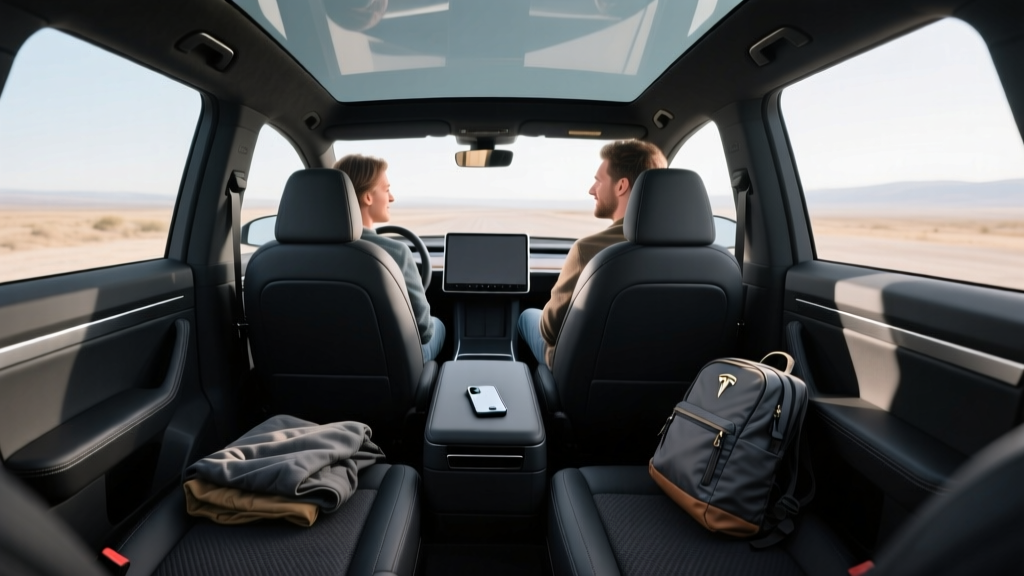
Rear passengers get a dedicated 9.4-inch touchscreen mounted on the back of the center console. It controls rear climate zones, seat heaters (standard on all trims), and media playback. There are two USB-C ports (up to 65W each — enough to fast-charge a laptop) and a small storage shelf. No rear AC vents protrude from the B-pillars; instead, climate air routes through the floor and headliner, which is effective but less direct than traditional vent placement.
Range, Efficiency, and Real-World Expectations
EPA estimate (AWD): 340 miles
EPA estimate (Cyberbeast): 320 miles
Real-world highway (70 mph, mild weather): ~270–295 miles (AWD), ~255–280 miles (Cyberbeast)
Real-world cold weather (below 32°F): expect 20–30% reduction, or ~220–260 miles (AWD)
With bed loaded (500+ lbs payload): subtract an additional 10–15%
The Cybertruck AWD uses an estimated ~123 kWh battery pack (usable capacity; Tesla does not publish official kWh figures, but independent teardowns and EPA test data confirm this range). The chemistry is Tesla's 4680-cell NMC (nickel manganese cobalt) architecture, which prioritizes energy density over the cycle-life advantages of LFP.
Efficiency is rated at approximately 53 MPGe combined (AWD), translating to roughly 63–65 kWh per 100 miles — making the Cybertruck one of the least efficient EVs on the road per mile. The stainless-steel exoskeleton is heavy (curb weight exceeds 6,800 lbs for the Cyberbeast), and the truck's aerodynamic profile, while angular, creates substantial drag at highway speeds.
For context: a Tesla Model Y Long Range AWD achieves 122 MPGe combined and uses about 28 kWh/100 mi. You'll spend roughly twice as much per mile charging a Cybertruck compared to a crossover.
Charging Speed: DC Fast and Home Level 2
| Charging Level | Power / Rate | Speed / Time |
|---|---|---|
| DC Fast Charge (peak) | ~350 kW (NACS connector) | 10–80% in approximately 25–30 minutes |
| DC Fast Charge (sustained avg) | ~180–220 kW (typical session average) | Charge curve tapers significantly above 60% SoC |
| Level 2 (home, 48A / 11.5 kW) | 11.5 kW | ~22–25 miles of range per hour; full charge in ~11–13 hours |
| Level 2 (Tesla Wall Connector, 80A circuit) | Up to 11.5 kW (truck-limited) | Same as above — Cybertruck onboard charger caps at ~11.5 kW |
| Level 1 (120V household) | ~1.4 kW | ~3 miles per hour — emergency/trickle only |
Charging curve reality check: While the Cybertruck can peak near 350 kW at a Tesla V4 Supercharger under ideal conditions (low SoC, preconditioned battery, warm ambient temperature), that peak is not sustained. Expect the session average to land between 180–220 kW for a 10–80% charge. Above 60% SoC, the curve tapers aggressively to protect the 4680 cells. A 10–80% session typically takes 25–30 minutes; 10–90% can stretch past 40 minutes.
Home charging setup: The Cybertruck's ~123 kWh battery is enormous. On a standard 48-amp Level 2 circuit (the most common home installation), a full 0–100% charge takes 11–13 hours. Most owners will charge from 20–80% overnight (roughly 7–8 hours), which is practical. However, if you arrive home near-empty, a single overnight session won't fully replenish the pack. Consider a 60-amp circuit with a Tesla Wall Connector for maximum Level 2 throughput.
Preconditioning matters: Always use the Tesla app or navigation to precondition the battery before arriving at a Supercharger. Without preconditioning, cold-soaked batteries may peak below 150 kW, adding 10–15 minutes to your session.
Performance and Drivetrain
| Spec | AWD | Cyberbeast |
|---|---|---|
| Drivetrain | Dual-Motor AWD | Tri-Motor AWD |
| Horsepower | ~600 hp | ~845 hp |
| 0–60 mph | ~4.1 seconds | ~2.6 seconds |
| Top Speed | 112 mph | 130 mph |
| Towing Capacity | 11,000 lbs | 11,000 lbs |
| Payload Capacity | ~2,500 lbs | ~2,500 lbs |
The Cyberbeast's 2.6-second 0–60 time is extraordinary for a vehicle weighing nearly 7,000 pounds. However, that performance comes at the cost of efficiency and range. For most buyers, the AWD trim's 4.1-second sprint is more than adequate and nets 20 additional EPA miles of range.
Steer-by-wire: All Cybertrucks use a steer-by-wire system with no mechanical connection between the yoke and the wheels. The steering ratio is variable and extremely quick (less than one full turn lock-to-lock). Some drivers adapt within a day; others find it twitchy at highway speeds. This is a test-drive essential — do not buy without experiencing it.
Ride quality: The air suspension provides up to 12 inches of ground clearance and can lower for highway efficiency. On smooth pavement, the ride is composed. On broken surfaces and expansion joints, the truck's weight and stiff structure transmit more impact into the cabin than a Ford F-150 Lightning or Rivian R1T. Rear-seat passengers feel this more than front-seat occupants.
Cargo Space: Bed, Frunk, and Interior Storage
The Cybertruck's cargo story is where it redeems some of its rear-seat compromises:
- Bed volume: 67 cubic feet (with tonneau cover closed); approximately 123 cu ft with the bed and "vault" storage combined
- Bed length: ~72 inches (6 feet) with tailgate up; extends with tailgate down
- Frunk (front trunk): ~7.1 cubic feet — enough for a charging cable bag and a small duffel
- Rear under-seat storage: The rear bench flips up to reveal a shallow but wide storage area for groceries or tools
- Interior cabin storage: Modest. The angular dash eliminates a traditional glovebox (replaced by a lockable center console compartment). Door pockets are slim.
The motorized tonneau cover is a standout feature — it's strong enough to support 300 lbs of distributed weight (you can stand on it) and seals well against rain. However, it limits bed height for tall items like motorcycles unless partially retracted.
Pricing, Trims, and Federal Tax Credit Eligibility
| Trim | Base MSRP (2025/2026) | Est. After §30D Credit* |
|---|---|---|
| Rear-Wheel Drive (announced, 2026+) | ~$60,990 | ~$53,490 (if eligible) |
| AWD | ~$79,990 | ~$72,490 (if eligible) |
| Cyberbeast | ~$99,990 | ~$92,490 (if eligible) |
*Federal tax credit eligibility is NOT guaranteed and depends on multiple factors that change frequently.
- MSRP cap: Trucks and SUVs must have an MSRP at or below $80,000. This means the AWD trim qualifies but the Cyberbeast ($99,990) does not.
- Buyer income cap: Modified adjusted gross income must not exceed $150,000 (single), $225,000 (head of household), or $300,000 (joint filers).
- Battery sourcing: Critical minerals and battery components must meet phased-in domestic-sourcing thresholds that tighten each year. Check current-year rules at IRS.gov.
- Point-of-sale transfer: Eligible buyers can transfer the credit to the dealer at purchase, reducing the out-of-pocket price immediately rather than waiting for tax filing.
- Assembly: Vehicle must undergo final assembly in North America (Cybertruck is assembled in Austin, TX — qualifies).
Always consult a tax professional and verify current-year rules before relying on credit eligibility. See IRS Publication on Clean Vehicle Credits for details.
As-tested pricing: Our AWD test vehicle with no additional options came in at $81,230 (including destination). Tesla's options list for the Cybertruck is minimal — most features are standard, with the primary upgrade being the Cyberbeast trim itself and potential future range-extender battery pack.
Standout Tech and Notable Drawbacks
What Works Well
- 18.5-inch front touchscreen: Massive, responsive, and controls nearly every vehicle function. The UI is fast and includes streaming media, gaming, and a detailed energy app.
- Autopilot / FSD (Supervised): Tesla's SAE Level 2 driver-assistance suite is standard (Autopilot) with FSD available as an $8,000 add-on or $99/month subscription. FSD handles highway merges, traffic lights, and some city streets but requires constant driver supervision.
- Bioweapon Defense Mode: HEPA filtration system with positive cabin pressure — genuinely useful in wildfire smoke or urban pollution.
- Powered frunk and tonneau: Both open via the app, key fob, or touchscreen. The tonneau auto-closes when the truck shifts out of park.
- Vehicle-to-load (V2L): 120V and 240V outlets in the bed can power tools, camping gear, or a small home circuit during an outage (with appropriate transfer equipment).
- Over-the-air updates: Tesla continues to push feature additions, efficiency improvements, and UI refinements post-purchase.
Drawbacks to Consider
- No Apple CarPlay or Android Auto: Tesla's proprietary infotainment is the only option. If you rely on phone-mirroring, this is a dealbreaker.
- Visibility: The angular A-pillars and high beltline create significant blind spots. The rear camera and digital mirror help but don't eliminate the issue.
- Ride harshness: As noted, rear-seat passengers experience more road impact than in competitor trucks.
- Insurance costs: Cybertruck insurance premiums are among the highest in the EV segment. Get quotes before purchasing — expect $2,500–$4,000+ annually depending on your profile and state.
- Panel-gap and build variability: Early-production Cybertrucks had widely reported panel-gap inconsistencies and trim issues. Tesla has improved this on later builds, but inspect any delivery carefully.
- Yoke steering: The standard yoke (no round wheel option) is divisive. Low-speed parking maneuvers require adaptation, and hand-over-hand techniques don't apply.
Warranty Coverage
| Coverage | Terms |
|---|---|
| Basic Vehicle Limited Warranty | 4 years / 50,000 miles |
| Battery & Drive Unit Warranty | 8 years / 120,000 miles (minimum 70% capacity retention) |
| Roadside Assistance | 4 years / 50,000 miles |
Tesla's 8-year/120,000-mile battery warranty is competitive and covers capacity degradation below 70%. Given the Cybertruck's large ~123 kWh pack, 70% retention still leaves approximately 86 kWh usable — enough for roughly 240 miles of real-world range. Battery replacement costs out of warranty are estimated at $15,000–$22,000 based on current 4680-cell pricing, though this is expected to decline over the warranty period.
Who Should Buy the Cybertruck — And Who Shouldn't
- Prioritize bed utility, towing, and V2L capability over rear-seat comfort
- Mostly drive solo or with one front-seat passenger
- Want standout design and Tesla's Supercharger network access
- Need 11,000-lb towing with zero tailpipe emissions
- Have home Level 2 charging and don't frequently road-trip beyond 250 miles between stops
- Regularly carry three adults in the rear seat
- Prioritize ride comfort and quiet over performance
- Want Apple CarPlay/Android Auto
- Need maximum efficiency (consider Model Y or a PHEV truck)
- Live in a region with sparse Supercharger coverage and no home charging
Competitor Comparison
| Attribute | Cybertruck AWD | Rivian R1T Dual-Motor | Ford F-150 Lightning Lariat |
|---|---|---|---|
| EPA Range | 340 mi | ~352 mi (Max Pack) | ~320 mi (Extended Range) |
| Rear Legroom | ~38.0 in | ~37.3 in | ~43.6 in |
| 0–60 mph | 4.1 sec | ~4.5 sec | ~3.8 sec |
| Towing | 11,000 lbs | 11,000 lbs | 10,000 lbs |
| Starting MSRP | ~$79,990 | ~$79,900 | ~$65,495 |
| Apple CarPlay | No | No | Yes |
The Ford F-150 Lightning is the clear winner for rear-seat space and traditional truck usability, with a full-size crew cab that dwarfs the Cybertruck's rear bench. The Rivian R1T offers a more refined ride, a unique gear tunnel for cross-vehicle storage, and better off-road capability, though at a similar price. The Cybertruck wins on raw acceleration, Supercharger network access, and polarizing-but-distinctive design.
Frequently Asked Questions
What is the real-world range of the Cybertruck?
The EPA rates the AWD at 340 miles and the Cyberbeast at 320 miles. In real-world highway driving at 70 mph, expect 270–295 miles (AWD) and 255–280 miles (Cyberbeast). Cold weather and heavy payloads reduce range further — plan for 220–260 miles in freezing conditions.
How fast does the Cybertruck charge at home and on the road?
At a V4 Supercharger, it peaks near 350 kW and charges 10–80% in roughly 25–30 minutes. At home on a 48-amp Level 2 charger, expect about 22–25 miles of range per hour, with a full charge taking 11–13 hours due to the large ~123 kWh battery.
Does the Cybertruck qualify for the $7,500 federal EV tax credit?
The AWD trim ($79,990 MSRP) is under the $80,000 truck/SUV cap and may qualify, provided you meet income limits and battery-sourcing requirements. The Cyberbeast ($99,990) exceeds the MSRP cap and does not qualify. Always verify current-year rules at IRS.gov and consult a tax professional.
Is the Cybertruck back seat comfortable for adults?
It's adequate for adults under 6 feet on trips under an hour. Taller passengers will find the raised floor and sloping roofline restrictive. For regular five-passenger use, the Ford F-150 Lightning or a full-size SUV is significantly more comfortable.
Is the Cybertruck worth buying over the Rivian R1T or F-150 Lightning?
Choose the Cybertruck if you value Tesla's Supercharger network, extreme acceleration, and distinctive design. Choose the F-150 Lightning for rear-seat space and traditional truck ergonomics. Choose the Rivian R1T for ride refinement, off-road capability, and creative storage. Test-drive all three before deciding.
What are the biggest pros and cons of the Cybertruck?
Pros: Supercharger access, 11,000-lb towing, V2L capability, rapid acceleration, stainless-steel durability, OTA updates, strong frunk/bed utility.
Cons: Rear-seat comfort, high insurance premiums, poor efficiency (53 MPGe), no CarPlay, yoke-only steering, visibility blind spots, build-quality variability on early units.