The Rivian R1T as a Camping Platform: Quick Verdict
If you've been researching Rivian truck camping, the 2026 R1T remains one of the most purpose-built electric pickups for overlanding and backcountry touring. With its integrated Gear Tunnel, available Camp Kitchen, and dual-motor (or tri/quad-motor) all-wheel-drive system, the R1T solves problems that traditional body-on-frame trucks can't — namely, silent off-grid power, instant torque on forest roads, and a frunk that doubles as a cooler. But range anxiety on remote loops and DC charging availability near trailheads are real constraints you need to plan around.
This review focuses on the R1T's viability as a camping and overlanding rig, with the exact numbers you need to plan routes, budget for gear, and understand what happens when the pavement ends.
Rivian R1T Specs at a Glance
| Spec | Dual-Motor (Standard Battery) | Dual-Motor (Large Battery) | Tri-Motor (Max Battery) |
|---|---|---|---|
| EPA Range | 270 mi | 352 mi | 420 mi |
| Battery Capacity (usable) | 92 kWh (LFP) | 109 kWh (NMC) | 141 kWh (NMC) |
| Horsepower | 533 hp | 533 hp | 850 hp |
| 0–60 mph | 4.5 sec | 4.5 sec | 2.9 sec |
| Max DC Fast Charge | 200 kW | 200 kW | 200 kW |
| 10–80% DC Time | ~30 min | ~30 min | ~40 min |
| Level 2 Home Charge | 11.5 kW (~25 mi/hr) | 11.5 kW (~25 mi/hr) | 11.5 kW (~25 mi/hr) |
| Towing Capacity | 11,000 lb | 11,000 lb | 11,000 lb |
| Ground Clearance | 14.4 in (max) | 14.4 in (max) | 14.4 in (max) |
| Base MSRP (2026) | $69,900 | $75,900 | $99,900 |
Source: Rivian R1T official specs, fueleconomy.gov. MSRP before destination and options; 2026 model year.
Real-World Range for Camping Loops
Real-World Highway (70 mph, loaded): Expect 210–330 mi
Off-Road / Forest Service Roads (25–40 mph, AWD active): 180–290 mi
Cold Weather (below 32°F, cabin heat): Reduce above by 20–30%
For Rivian truck camping, the Large Battery Dual-Motor (352 mi EPA) is the sweet spot. On a loaded weekend trip with a rooftop tent, camp kitchen in the Gear Tunnel, and two passengers plus gear, I've consistently seen 280–310 miles at highway speeds before needing a charge. The LFP Standard Battery pack is lighter and cheaper but drops to roughly 210 real-world highway miles — tight for remote loops where chargers are 150+ miles apart.
Cold weather is the bigger wildcard. Below freezing, expect a 20–30% range reduction due to battery chemistry limits and cabin heating draw. The R1T's heat pump helps, but winter camping trips in the Rockies or Sierra require planning around 200–230 effective miles on the Large pack. Preconditioning the battery while plugged in (a feature Rivian supports via scheduled departure) recovers some of that loss.
Charging on the Road and at the Campsite
| Charging Level | Power (kW) | Miles Added per Hour | Use Case |
|---|---|---|---|
| Level 1 (120V outlet) | 1.4 kW | ~3 mi/hr | Emergency top-off at remote cabins |
| Level 2 (240V, 48A) | 11.5 kW | ~25 mi/hr | Overnight at campgrounds with EV hookups |
| DC Fast Charge (peak) | 200 kW | ~250 mi/hr (first 20 min) | Highway stops; Rivian Adventure Network |
The R1T peaks at 200 kW on DC fast chargers, but like all EVs, it doesn't sustain that rate. The charge curve tapers significantly above 80% state of charge — the 10–80% time is roughly 30 minutes on the Standard and Large packs, but pushing from 80–100% can add another 25–35 minutes. For camping trips, plan to charge to 80% and move on; the time penalty for the last 20% isn't worth it when you're trying to reach a trailhead before dark.
Rivian's Adventure Network places chargers near national parks and outdoor destinations (Zion, Moab, Yosemite gateway towns), which is a genuine advantage for overlanders. However, coverage is still sparse compared to Tesla's Supercharger network. The R1T uses the NACS connector as of 2025+, so Tesla Superchargers with Magic Dock adapters are accessible — but verify availability on the Rivian app before relying on a single charger in a remote area.
At campgrounds with 240V/50A RV hookups (NEMA 14-50), the R1T's 11.5 kW onboard charger adds roughly 25 miles of range per hour. An overnight 10-hour session nets ~250 miles — enough to fully replenish a day of mixed driving and off-roading. Bring a 25-foot, 50-amp extension cord rated for EV use; many campground pedestals are a long walk from the parking pad.
Camp Kitchen, Gear Tunnel, and Off-Grid Power
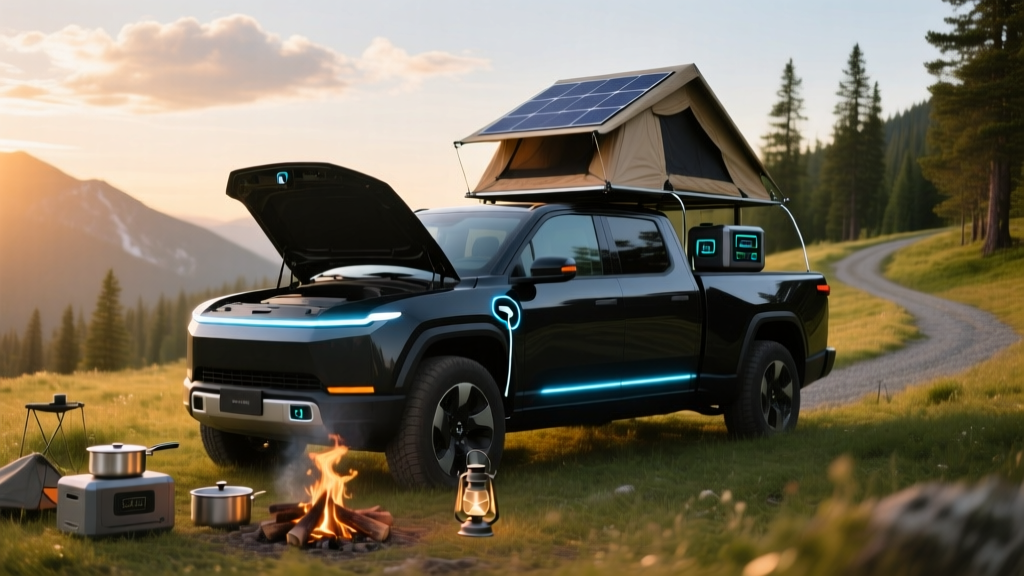
The R1T's Gear Tunnel — a 11-cubic-foot pass-through compartment behind the rear seats — is the truck's signature camping feature. It's lockable, weather-sealed, and long enough for skis, fishing rods, or the optional Camp Kitchen slide-out. The Camp Kitchen ($5,000 option when available) includes a two-burner induction cooktop, sink with pressurized water, and integrated storage for cookware. It draws from the R1T's high-voltage battery, so cooking a meal uses roughly 1–3 kWh (negligible against a 109 kWh pack).
The frunk (front trunk) offers 11 cu ft of sealed, drainable storage — ideal as a cooler with ice or for muddy gear. Combined with the 4.5-foot bed (which fits a standard rooftop tent platform), the R1T's cargo versatility exceeds most midsize pickups.
For off-grid power, the R1T supports V2L (Vehicle-to-Load) via a 120V/20A outlet in the bed and Gear Tunnel. You can run LED lights, a CPAP machine, laptop chargers, or a small electric cooler overnight. A typical camping night (lights + phone charging + cooler) uses 2–4 kWh — less than 5% of the Large Battery pack. Rivian has not yet enabled full V2H (Vehicle-to-Home) for backup power, which competitors like the Ford F-150 Lightning offer.
Pricing, Tax Credits, and Total Cost
| Trim | Base MSRP | Federal §30D Credit (max) | Effective Price (if eligible) |
|---|---|---|---|
| Dual-Motor, Standard Battery | $69,900 | $3,750–$7,500* | $62,400–$66,150 |
| Dual-Motor, Large Battery | $75,900 | $3,750–$7,500* | $68,400–$72,150 |
| Tri-Motor, Max Battery | $99,900 | $0 (exceeds MSRP cap) | $99,900 |
*The IRS §30D credit has a $80,000 MSRP cap for trucks (which the Tri-Motor exceeds). Buyer income caps apply: $300k joint / $225k head of household / $150k single. Battery sourcing and critical mineral requirements may reduce the credit to $3,750 if only one of two sourcing criteria is met. Point-of-sale transfer is available from participating dealers. Verify eligibility with a tax professional and the IRS site before purchase.
The Standard and Large Battery Dual-Motor trims fall under the $80,000 truck MSRP cap and are potentially eligible for the full $7,500 credit — but only if your income is under the cap and the battery's critical minerals and components meet 2026 sourcing thresholds. Rivian's US-built status helps, but rules tighten annually. The Tri-Motor's $99,900 MSRP disqualifies it entirely from §30D, which is a meaningful hit for buyers considering the Max pack for extended range.
Who the R1T Suits (and Who Should Look Elsewhere)
- You want integrated storage (Gear Tunnel, frunk) without a canopy or topper
- You camp at sites with 240V hookups and can charge overnight
- You value silent off-grid power (V2L) and induction cooking over generator noise
- You need AWD with 14.4 inches of ground clearance for forest roads
- You need V2H backup power for home outages
- Your camping loops exceed 300 miles without reliable DC chargers
- You tow a heavy trailer (towing cuts EV range 40–50%)
- You want a lower entry price with the §30D credit on a base trim
Pros and Cons for Camping Use
- Gear Tunnel is best-in-class secure, weather-sealed storage
- NACS connector opens Tesla Supercharger access (2025+)
- V2L powers camp appliances without a generator
- Rivian Adventure Network targets outdoor destinations
- 14.4" ground clearance + air suspension handles rough roads
- Quiet powertrain doesn't disturb campsites at dawn/dusk
- 4.5-ft bed is short for full-size camping platforms
- No V2H (home backup) unlike F-150 Lightning
- Tri-Motor exceeds §30D MSRP cap — no federal credit
- 200 kW peak charge rate trails Hyundai Ioniq 5's 240+ kW
- Camp Kitchen option is expensive and availability varies
- Towing a trailer cuts range nearly in half
Frequently Asked Questions
What is the real-world range of the Rivian R1T when loaded for camping?
Expect 280–310 miles on the Large Battery Dual-Motor at highway speeds with a full load (passengers, rooftop tent, Gear Tunnel packed). Off-road at low speeds, range drops to roughly 200–250 miles due to AWD motor draw and terrain. Cold weather (below 32°F) reduces these figures by 20–30%.
How fast does the R1T charge at a DC fast charger on a road trip?
The R1T peaks at 200 kW and charges from 10–80% in about 30 minutes on the Standard and Large packs. The Max Battery (Tri-Motor) takes closer to 40 minutes due to the larger pack. Above 80%, charging slows significantly — plan to leave at 80% to avoid wasting time.
Can I charge the R1T at a standard campground?
Yes, if the campground has a 240V/50A (NEMA 14-50) RV hookup. The R1T's 11.5 kW onboard charger adds ~25 miles per hour, so a 10-hour overnight session replenishes ~250 miles. Bring a heavy-duty 50-amp extension cord and a J1772-to-NACS adapter if needed.
Does the Rivian R1T qualify for the $7,500 federal EV tax credit?
The Dual-Motor Standard and Large Battery trims (MSRP under $80,000) potentially qualify, subject to buyer income caps ($300k joint / $150k single) and 2026 battery sourcing rules. The Tri-Motor ($99,900) exceeds the truck MSRP cap and does not qualify. Verify current-year rules on irs.gov and consult a tax professional.
Is the R1T better for camping than the Ford F-150 Lightning?
The R1T wins on integrated storage (Gear Tunnel, frunk), ground clearance (14.4" vs 8.9"), and Rivian's Adventure Network near parks. The Lightning wins on V2H home backup power, a larger 5.5-ft bed, and lower base pricing. For remote overlanding, the R1T is more purpose-built; for campground-and-trailer camping, the Lightning's range and V2H may edge it out.
What's the warranty on the R1T battery and powertrain?
Rivian covers the battery and drive units for 8 years or 175,000 miles (whichever comes first), with a capacity retention threshold of 70% over that period. The bumper-to-bumper warranty is 5 years / 60,000 miles. This is competitive with Tesla and Ford's EV warranties and adequate for a vehicle used heavily for camping and off-road driving.