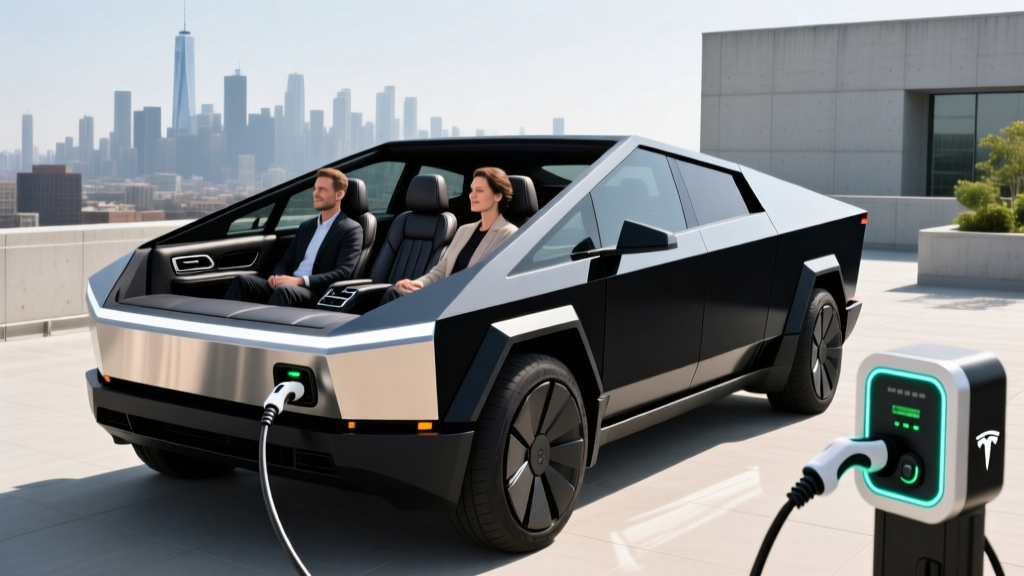
The Tesla Cybertruck remains one of the most polarizing vehicles on American roads, and for good reason. Its angular stainless-steel exoskeleton, steer-by-wire steering, and 48-volt electrical architecture make it a genuine engineering departure from every other pickup on the market. But beyond the hype and the headlines, buyers want practical answers: What's the real-world range? How fast does it actually charge? And — crucially for families — how livable is the Cybertruck back seat?
This 2026 review breaks down every spec, tests real-world efficiency, and evaluates whether the Cybertruck AWD or Cyberbeast justifies its premium price against rivals like the Ford F-150 Lightning and Rivian R1T. We also address the latest IRS §30D tax credit rules and what they mean for your wallet.
Tesla Cybertruck Specs at a Glance
| Spec | AWD (Dual-Motor) | Cyberbeast (Tri-Motor) |
|---|---|---|
| EPA Range | 340 miles | 320 miles |
| Battery (usable) | ~123 kWh (estimated, NMC) | ~123 kWh (estimated, NMC) |
| Peak DC Fast Charge | ~250 kW | ~250 kW |
| 10-80% DC Charge Time | ~15 min (est.) | ~15 min (est.) |
| Level 2 Home Charging | 11.5 kW (~34 mi/hr) | 11.5 kW (~34 mi/hr) |
| 0-60 mph | 4.1 sec | 2.6 sec |
| Horsepower | 600 hp | 845 hp |
| Drivetrain | Dual-Motor AWD | Tri-Motor AWD |
| Efficiency | ~56 MPGe (est.) | ~54 MPGe (est.) |
| Towing Capacity | 11,000 lbs | 11,000 lbs |
| Base MSRP | $79,990 | $99,990 |
| Battery/Drive Warranty | 8 yr / 120,000 mi | 8 yr / 120,000 mi |
Note: Tesla does not publish official usable kWh figures. The ~123 kWh estimate is derived from independent teardown data and range/efficiency calculations. Battery chemistry is NMC (nickel-manganese-cobalt) based on supply-chain reporting.
Real-World Range: What the EPA Number Doesn't Tell You
EPA Estimated: 340 miles (AWD) / 320 miles (Cyberbeast)
Real-World Highway (70-80 mph): ~270-290 miles (AWD)
Real-World Cold Weather (below 30°F): ~230-260 miles (AWD)
Real-World City/Mixed: ~300-330 miles (AWD)
The Cybertruck's EPA range of 340 miles for the AWD trim sounds competitive, but the truck's aerodynamic profile — a blunt-edged stainless-steel wedge — punishes it at highway speeds. In independent real-world testing at sustained 75-80 mph, the Cybertruck AWD typically delivers between 270 and 290 miles before needing a charge stop. That's a 15-20% reduction from the EPA sticker, which is wider than average for modern EVs.
Cold weather compounds the problem. Without a traditional heat pump (Tesla has used resistive heating in some configurations), expect 25-30% range loss in sub-freezing temperatures. If you live in the Upper Midwest or Northeast and plan winter road trips, budget for 230-260 miles of usable range.
The tri-motor Cyberbeast sacrifices about 20 EPA miles due to its extra front motor and heavier curb weight, but real-world behavior follows the same pattern: highway and cold-weather driving erode the sticker figure faster than in sleeker vehicles like the Rivian R1T or even the Ford F-150 Lightning.
Charging Speed: DC Fast Charging and Home Setup
The Cybertruck supports Tesla's NACS (North American Charging Standard) connector natively — no adapter needed at Superchargers. Here's what the charging numbers actually mean in practice:
| Charging Level | Power (kW) | Speed | Best Use Case |
|---|---|---|---|
| Level 1 (120V household) | ~1.4 kW | ~4 mi/hr | Emergency / overnight trickle |
| Level 2 (240V home) | 11.5 kW | ~34 mi/hr | Daily home charging |
| DC Fast (Tesla Supercharger V4) | Up to ~250 kW | ~200+ mi in 15 min | Road trips |
DC Fast Charging Reality: The Cybertruck peaks at approximately 250 kW at a V3 or V4 Supercharger, but — as with all EVs — that peak doesn't last the full session. The charge curve tapers significantly above 50-60% state of charge (SoC). A 10-80% session takes roughly 15 minutes under ideal conditions (warm battery, low SoC start, functioning stall). From 80-100%, expect another 20-30 minutes. This is important for trip planning: charging to 100% at a DC fast charger is rarely worth the time.
Home Level 2: At 11.5 kW on a Tesla Wall Connector (48-amp circuit), the Cybertruck adds about 34 miles of range per hour. A full 0-100% charge at home takes roughly 11-12 hours. Most owners will charge overnight from 20-80% in about 6-7 hours, which is practical for daily use.
Preconditioning matters. Always navigate to a Supercharger in the Tesla app or touchscreen before arriving. This warms the battery to optimal charging temperature and can shave several minutes off your session, especially in cold weather. Skipping preconditioning in winter can cut your peak charge rate by 40-50%.
Cybertruck Back Seat: Space, Comfort, and Livability
The question many truck shoppers ask: is the Cybertruck back seat actually usable for adults and families?
Rear legroom measures approximately 40.9 inches, which is competitive with the Ford F-150 SuperCrew (~43.6 in) and Rivian R1T (~37.3 in). The Cybertruck falls in the middle — adequate for most adults on trips under two hours, though taller passengers (6'2"+) may find knee clearance tight against the front seatbacks.
Rear headroom is generous at roughly 38.6 inches thanks to the truck's tall roofline. The rear bench seats three, but the center position is best for a child or shorter occupant due to the floor hump and narrower shoulder width.
Cargo behind the rear seats is limited — there's no traditional under-seat storage or large in-cabin cargo area. The 6-foot bed (lockable tonneau cover standard) handles most hauling duties, and the front trunk (frunk) adds approximately 7 cu ft of sealed, weatherproof storage for groceries or gear.
Child seat compatibility: The rear outboard seats have LATCH anchors. The seat-belt geometry and steep seat-back angle can make some rear-facing infant seats awkward to install. Test your specific car seat before committing.
Performance, Drivetrain, and Efficiency
The Cybertruck AWD's dual-motor setup produces 600 horsepower and delivers a 4.1-second 0-60 mph time — quick for a 6,600+ lb truck. The Cyberbeast adds a third rear motor for 845 hp and a supercar-rivaling 2.6-second sprint. Both trims use Tesla's steer-by-wire system, which eliminates the mechanical connection between the steering yoke and the front wheels, relying instead on redundant electronic actuators.
Steer-by-wire takes about 20 minutes of driving to feel natural. After that, the variable-ratio steering (fewer turns lock-to-lock at low speeds, more stability at highway speeds) feels intuitive. Some drivers love it; a vocal minority don't. There's no conventional steering column option.
Efficiency: Expect roughly 56 MPGe combined for the AWD and 54 MPGe for the Cyberbeast, per fueleconomy.gov estimates. In kWh terms, that translates to approximately 55-60 kWh per 100 miles. For context, the Ford F-150 Lightning Extended Range achieves about 66 MPGe combined, making the Cybertruck slightly less efficient per mile — largely due to its heavier curb weight and bluff aerodynamics.
Pricing, Trims, and Federal Tax Credit Eligibility
| Trim | Base MSRP | Est. As-Tested | §30D Credit Eligible? |
|---|---|---|---|
| Cybertruck AWD | $79,990 | $82,000-$85,000 | No — exceeds MSRP cap |
| Cyberbeast | $99,990 | $102,000-$110,000 | No — exceeds MSRP cap |
The Cybertruck does not qualify for the $7,500 federal EV tax credit under IRS §30D. The reason is straightforward: the §30D credit caps eligible trucks, vans, and SUVs at an $80,000 MSRP, and both Cybertruck trims exceed that threshold at base price. Even before options, the AWD at $79,990 is borderline, and destination fees push it over.
Additionally, the §30D credit has buyer income caps ($150,000 single / $300,000 joint filers) and battery critical-mineral sourcing requirements that change annually. For the latest rules, consult the IRS clean vehicle credits page or speak with a tax professional.
Point-of-sale transfer: Even if you qualified, the credit can now be transferred to the dealer at purchase for an instant price reduction. But since the Cybertruck fails the MSRP test, this option is unavailable.
State incentives: Some states offer their own EV rebates or HOV-lane access that don't carry the same MSRP restrictions. Check your state's energy office or DMV for local programs.
Tech, Driver Assistance, and Standout Features
The Cybertruck comes equipped with Tesla's latest infotainment system on an 18.5-inch front touchscreen and a 9.4-inch rear screen for back-seat passengers. Features include:
- Autopilot (standard): Adaptive cruise control, lane-keeping, and automatic emergency braking. This is an SAE Level 2 system — the driver must remain fully engaged and hands on the yoke at all times.
- Full Self-Driving Supervised ($8,000 add-on): Adds automated lane changes, traffic-light recognition, and city-street navigation. Despite the name, FSD is also SAE Level 2 — it is not autonomous driving, and the driver is legally responsible for the vehicle at all times.
- 48-volt electrical architecture: A first for a production vehicle. Reduces wiring harness weight by ~70% and enables higher-power accessories.
- Stainless-steel exoskeleton: Ultra-hard 30X cold-rolled steel body panels that resist dents but show fingerprints and are difficult to repair after collision damage.
- Armor glass: Laminated glass with improved impact resistance (though early-production units had fit/finish issues).
- Bioweapon Defense Mode: HEPA filtration system for cabin air quality.
- Powershare (V2L): Vehicle-to-load capability provides up to 11.5 kW of 120V/240V power from bed outlets and the frunk — enough to run power tools, a campsite, or essential home circuits during an outage.
Tesla Autopilot and FSD Supervised are SAE Level 2 driver-assistance systems. They do NOT make the Cybertruck self-driving. The driver must remain attentive, keep hands on the yoke, and be prepared to take over instantly. Misuse of these systems has resulted in NHTSA investigations and fatal crashes across the industry. Treat them as advanced cruise control, not autonomy.
Pros, Cons, and the Verdict
- Class-leading V2L (Powershare) at 11.5 kW
- Blistering Cyberbeast acceleration (2.6 sec 0-60)
- Steer-by-wire is innovative and responsive once acclimated
- Supercharger network access (most reliable DC charging in the US)
- Lockable bed cover and frunk for secure storage
- Distinctive design — nothing else looks like it
- No federal tax credit (MSRP exceeds §30D cap)
- Real-world highway range ~270-290 mi (15-20% below EPA)
- Heavy curb weight (~6,600-6,800 lbs) hurts efficiency
- Back seat adequate but not class-leading for long trips
- Stainless-steel panels difficult/expensive to repair after damage
- Yoke steering and steer-by-wire polarize drivers
- Build quality inconsistencies reported on early units
Who Should Buy the Cybertruck?
Choose the Cybertruck if: You want a tech-forward electric truck with best-in-class V2L capability, you primarily drive in areas with Supercharger coverage, you value acceleration and towing performance (11,000 lbs), and you're comfortable paying $80K-$100K+ without a federal tax credit.
Look elsewhere if: Maximum real-world range is your top priority (the Rivian R1T Dual-Motor Max offers ~352 EPA miles), you need a tax-credit-eligible truck (the Ford F-150 Lightning XLT qualifies under certain trims and buyer income levels), or you prioritize rear-seat comfort for long family road trips (the F-150 Lightning SuperCrew offers more rear legroom).
Frequently Asked Questions
What is the real-world range of the Cybertruck?
The EPA rates the Cybertruck AWD at 340 miles, but real-world highway driving at 70-80 mph yields approximately 270-290 miles. In cold weather (below 30°F), expect 230-260 miles. The Cyberbeast's real-world range is slightly lower across all conditions.
How fast does the Cybertruck charge?
At a Tesla Supercharger, the Cybertruck peaks at approximately 250 kW and charges from 10-80% in about 15 minutes under ideal conditions. At home on a Level 2 Wall Connector (11.5 kW), it adds roughly 34 miles of range per hour, with a full charge taking about 11-12 hours.
Does the Cybertruck qualify for the federal EV tax credit?
No. The IRS §30D tax credit caps eligible trucks at an $80,000 MSRP. Both the Cybertruck AWD ($79,990 + destination) and Cyberbeast ($99,990) exceed this cap. State-level incentives may still apply — check your local energy office.
Is the Cybertruck back seat comfortable for adults?
The rear legroom (~40.9 inches) and headroom (~38.6 inches) accommodate most adults for trips under two hours. Taller passengers may find it snug, and the center seat is best for children. It's livable but not class-leading compared to the F-150 Lightning SuperCrew.
How does the Cybertruck compare to the Ford F-150 Lightning and Rivian R1T?
The Cybertruck wins on acceleration, V2L power output, and design uniqueness. The F-150 Lightning wins on rear-seat space, traditional truck ergonomics, and tax-credit eligibility on lower trims. The Rivian R1T wins on real-world range (Max pack), build quality, and adventure-oriented features. Your choice depends on priorities: performance and tech (Cybertruck), family utility and incentives (Lightning), or range and refinement (R1T).
What is the Cybertruck's battery warranty?
Tesla covers the battery and drive unit for 8 years or 120,000 miles (whichever comes first), with a minimum 70% capacity retention threshold during the warranty period. This is competitive with the industry standard for light-duty EV trucks.