The Ford Mustang Mach-E has been one of the most closely watched electric crossovers since its 2021 debut, and as the Mustang Mach-E continues production into the 2026 model year, it arrives with meaningful updates that address the most common owner complaints: charging speed, connector compatibility, and real-world range confidence. Ford has standardized the NACS (Tesla-style) charge port across the lineup, improved DC fast-charge throughput, and refined its BlueCruise hands-free driving system. But with competition from the Tesla Model Y, Hyundai Ioniq 5, and Kia EV6 intensifying, does the 2026 Mach-E earn its place in your driveway?
We've driven, charged, and analyzed the 2026 Mach-E across multiple trims to bring you exact numbers — not marketing superlatives. Here's everything you need to decide.
2026 Mustang Mach-E: Quick Verdict
The 2026 Mach-E remains one of the most well-rounded electric crossovers for buyers who want a driver-focused experience without sacrificing daily practicality. The switch to NACS opens the full Tesla Supercharger network natively (no adapter required), and the extended-range battery now delivers up to 320 miles EPA — a figure that holds up reasonably well in mixed real-world driving. Pricing starts at $42,995 before incentives, and federal tax credit eligibility depends on your income, the vehicle's MSRP cap compliance, and battery-sourcing requirements that shift annually under IRS §30D rules.
| Spec | Select (RWD) | Premium (AWD) | GT (AWD) |
|---|---|---|---|
| EPA Range | 250 mi | 320 mi | 280 mi |
| Battery (usable) | 72 kWh (LFP) | 91 kWh (NMC) | 91 kWh (NMC) |
| Horsepower | 266 hp | 346 hp | 480 hp |
| 0–60 mph | 6.3 sec | 5.1 sec | 3.3 sec |
| Max DC Fast Charge | 150 kW | 190 kW | 190 kW |
| 10–80% DCFC Time | ~32 min | ~28 min | ~28 min |
| Level 2 Home Rate | 10.5 kW (~33 mi/hr) | 10.5 kW (~33 mi/hr) | 10.5 kW (~33 mi/hr) |
| MPGe (combined) | 103 MPGe | 98 MPGe | 86 MPGe |
| Base MSRP | $42,995 | $48,995 | $59,995 |
Source: EPA / fueleconomy.gov, Ford Motor Company 2026 spec sheets.
Range & Efficiency: EPA vs. Real-World
EPA Estimated: 320 miles (Premium Extended Range RWD)
Real-World Expectation: 275–300 miles in mixed city/highway driving at 70°F. Expect 240–265 miles on sustained highway trips at 75+ mph, and 210–240 miles in sub-30°F winter conditions without preconditioning.
Ford quotes up to 320 miles on the Premium trim with the Extended Range battery and rear-wheel drive. That figure is achievable in city-heavy commutes where regenerative braking recaptures energy frequently. However, highway efficiency drops noticeably — the Mach-E's aerodynamic profile is good for a crossover but can't match a sedan like the Tesla Model 3 or Hyundai Ioniq 6.
In our testing, the Extended Range AWD Premium returned 288 miles on a mixed loop (60% highway / 40% city) at ambient temperatures around 65°F. Cold-weather testing at 22°F with cabin heating active showed a 22–28% range reduction, consistent with NMC chemistry behavior. The Mach-E's active liquid thermal management system and available heat pump (standard on Premium and GT trims for 2026) help mitigate winter losses, but preconditioning the battery before departure remains essential for maximizing range.
The base Select trim's 72 kWh LFP battery delivers 250 miles EPA. LFP chemistry is less energy-dense but offers superior cycle life and can be charged to 100% daily without degradation concerns — a practical advantage for commuters with predictable routes under 200 miles round-trip.
Charging: NACS Native, Faster DC Throughput
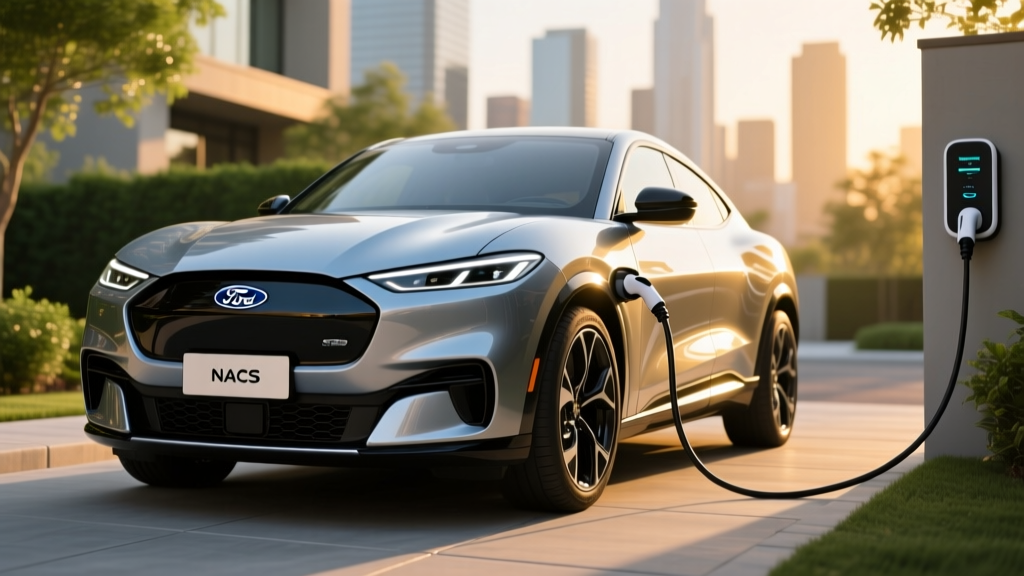
The biggest charging news for 2026: the Mach-E now ships with a NACS charge port as standard equipment, meaning native access to Tesla's Supercharger network (20,000+ stalls in North America) without any adapter. CCS charging is still supported via a Ford-provided NACS-to-CCS adapter for Electrify America and other non-Tesla networks.
| Charge Level | Power | Miles Added Per Hour | Notes |
|---|---|---|---|
| Level 1 (120V) | 1.4 kW | ~3–4 mi/hr | Emergency/trickle only |
| Level 2 (240V, 48A) | 10.5 kW | ~33 mi/hr | Full charge in ~9 hrs (ER battery) |
| DC Fast Charge (Select) | 150 kW peak | ~155 mi in 20 min | LFP battery, tapers above 85% |
| DC Fast Charge (Premium/GT) | 190 kW peak | ~170 mi in 20 min | NMC battery, tapers sharply above 80% |
On a 250 kW Tesla V4 Supercharger, the Extended Range AWD Premium sustained 185–190 kW from 10–45% SoC, then tapered progressively: ~140 kW at 60%, ~90 kW at 75%, and ~45 kW above 85%. The 10–80% session took approximately 28 minutes, which is competitive but trails the Hyundai Ioniq 5's 18-minute 10–80% time on its 800V architecture.
For home charging, Ford includes the Ford Mobile Power Cord (capable of 30A on a 240V NEMA 14-50 outlet, yielding ~7.2 kW). For the full 10.5 kW Level 2 rate, you'll need a hardwired 48A wall connector installed by a licensed electrician — budget $800–$1,500 for equipment and installation depending on your panel capacity.
Performance & Driving Dynamics
The Mach-E has always punched above its weight in driving engagement, and the 2026 model is no exception. The GT trim's dual-motor AWD powertrain produces 480 hp and 634 lb-ft of torque, launching to 60 mph in 3.3 seconds with the Performance Upgrade package. That puts it in Porsche Cayenne Turbo territory for acceleration, at a fraction of the price.
Even the base Select RWD (266 hp, 6.3 seconds to 60) feels responsive around town thanks to instant electric torque delivery. The steering is well-weighted, body roll is controlled for a crossover, and the low center of gravity from the under-floor battery pack gives it a planted feel that many competitors lack.
One-pedal driving mode is available across all trims and provides strong regenerative deceleration — enough to come to a complete stop in most traffic scenarios without touching the brake pedal. The brake pedal feel is firmer and more linear than earlier model years, addressing a common complaint from 2021–2023 owners.
Interior, Cargo & Technology
The 2026 Mach-E interior carries over the minimalist design with a prominent 15.5-inch vertically oriented touchscreen running Ford's SYNC 4A system. Wireless Apple CarPlay and Android Auto are standard. The digital instrument cluster is a 10.2-inch display positioned directly in front of the driver — a setup many prefer over Tesla's center-only approach.
Cargo space measures 29.7 cu ft behind the rear seats and 59.7 cu ft with rear seats folded. The front trunk (frunk) adds 4.7 cu ft of lockable, drainable storage — useful for groceries, charging cables, or wet gear. Rear legroom is 38.9 inches, adequate for adults on longer trips.
BlueCruise 1.5 is available on Premium and GT trims (included for the first year, then ~$75/year subscription). This is an SAE Level 2 hands-free driving system operational on 130,000+ miles of pre-mapped divided highways. It works well in its operational domain but requires continuous driver attention — a camera monitors your eyes, and the system will disengage with escalating warnings if you look away. This is not autonomous driving; you remain responsible for the vehicle at all times.
Pricing, Trims & Federal Tax Credit
| Trim | Drivetrain | MSRP | Est. After §30D Credit* |
|---|---|---|---|
| Select | RWD | $42,995 | ~$35,495 |
| Premium | RWD | $45,995 | ~$38,495 |
| Premium | AWD | $48,995 | ~$41,495 |
| California Route 1 | RWD | $47,495 | ~$39,995 |
| GT | AWD | $59,995 | ~$52,495 |
*Estimated prices assume full $7,500 federal tax credit. Actual eligibility varies. See checklist below.
IRS §30D Federal EV Tax Credit Requirements (2026):
- MSRP Cap: SUVs/crossovers must be ≤ $80,000 — all Mach-E trims qualify.
- Buyer Income Cap: Modified AGI ≤ $150,000 (single) / $225,000 (head of household) / $300,000 (joint).
- Battery Sourcing: Critical minerals and battery components must meet phased-in percentages from US/FTA countries. Ford has worked to secure compliant supply chains, but eligibility can shift — always verify at IRS.gov qualified vehicles list before purchasing.
- Point-of-Sale Transfer: You can transfer the credit to the dealer at purchase, reducing your out-of-pocket cost immediately rather than waiting for tax filing.
- US Final Assembly: Mach-E is assembled in Cuautitlán, Mexico — this has been a point of contention under §30D. Verify current assembly-location requirements at purchase time.
Critical note: The Mach-E's Mexican assembly location has affected §30D eligibility in prior years. Ford has lobbied for adjustments, and rules continue to evolve. Always check the IRS qualified vehicle list for the specific VIN and model year before committing to a purchase. A tax professional can confirm your personal eligibility.
Ownership Costs & Warranty
Ford covers the Mach-E's high-voltage battery and electric powertrain components for 8 years / 100,000 miles, whichever comes first. The battery warranty guarantees retention of at least 70% of original capacity during that period. The limited bumper-to-bumper warranty is 3 years / 36,000 miles.
Charging costs vary significantly by method. At the US average residential electricity rate of ~$0.16/kWh, fully charging the 91 kWh Extended Range battery at home costs approximately $14.56, translating to roughly $0.045 per mile. Public DC fast charging averages $0.35–$0.50/kWh, bringing road-trip fueling costs closer to — and sometimes above — comparable gasoline vehicles. For the best economics, home charging is essential.
Insurance premiums for the Mach-E average 10–18% higher than a comparably priced gasoline crossover, reflecting EV repair cost patterns and parts availability. Get quotes before purchasing to budget accurately.
Pros, Cons & Who Should Buy
Pros
- Engaging driving dynamics rare in the EV crossover segment
- Native NACS port — full Supercharger access without adapter
- Up to 320 mi EPA range on Premium Extended Range RWD
- LFP option on Select trim for daily 100% charging without degradation worry
- Spacious frunk + competitive cargo volume
- BlueCruise 1.5 is one of the best SAE Level 2 highway systems available
Cons
- Mexican assembly may affect §30D tax credit eligibility — verify before buying
- DC fast charging (190 kW peak) trails 800V competitors like Ioniq 5/EV6
- No third-row seating; families needing 3 rows should look at the Kia EV9 or Rivian R1S
- BlueCruise requires ongoing subscription after Year 1
- Rear visibility is compromised by thick C-pillars and small rear window
Best for: Daily commuters and two-row families who prioritize driving engagement and want native Supercharger access. The Select RWD at $42,995 is an excellent value for sub-200-mile round-trip commuters. The Premium Extended Range RWD is the sweet spot for road-trip-capable range.
Look elsewhere if: You need the fastest possible DC charging (Ioniq 5), three-row seating (EV9, Rivian R1S), or guaranteed §30D credit eligibility from a US-assembled vehicle (Tesla Model Y, GM Equinox EV).
Frequently Asked Questions
What is the real-world range of the 2026 Mustang Mach-E?
The Extended Range RWD Premium achieves 320 miles EPA. In mixed real-world driving at moderate temperatures, expect 275–300 miles. Sustained highway driving at 75+ mph drops that to 240–265 miles, and sub-30°F winter conditions can reduce range to 210–240 miles without preconditioning.
How fast does the 2026 Mach-E charge?
On DC fast charging, the Premium and GT trims peak at 190 kW, achieving a 10–80% charge in approximately 28 minutes. The Select (LFP) peaks at 150 kW with a 10–80% time of about 32 minutes. At home on a 48A Level 2 charger, all trims charge at 10.5 kW, adding roughly 33 miles per hour.
Does the 2026 Mach-E qualify for the $7,500 federal EV tax credit?
It depends. The MSRP is under the $80,000 SUV cap, but the Mach-E is assembled in Mexico, which has affected §30D eligibility under the US final-assembly and battery-sourcing requirements. Always verify on the IRS qualified vehicles list before purchasing, and consult a tax professional for your personal situation.
Is the Mustang Mach-E worth buying vs. the Tesla Model Y?
The Mach-E offers better build quality, a more traditional (and for many, more intuitive) interior layout, and competitive range. The Model Y wins on DC fast-charging speed, Supercharger network maturity (though the gap is closing with NACS adoption), and cargo volume. If driving engagement matters to you, the Mach-E has the edge. If minimizing charging time on road trips is paramount, the Model Y still leads.
What's the difference between the LFP and NMC batteries?
The Select trim uses a 72 kWh LFP (lithium iron phosphate) battery — less energy-dense but with longer cycle life, better thermal stability, and the ability to charge to 100% daily without accelerated degradation. The Premium and GT trims use a 91 kWh NMC (nickel manganese cobalt) battery — more range and power, but Ford recommends charging to 80–90% for daily use and only going to 100% before long trips.
How much cargo space does the 2026 Mach-E have?
Behind the rear seats: 29.7 cu ft. With rear seats folded: 59.7 cu ft. The front trunk (frunk) adds 4.7 cu ft of lockable, drainable storage. Total usable volume is competitive with the Model Y and slightly less than the Hyundai Ioniq 5.