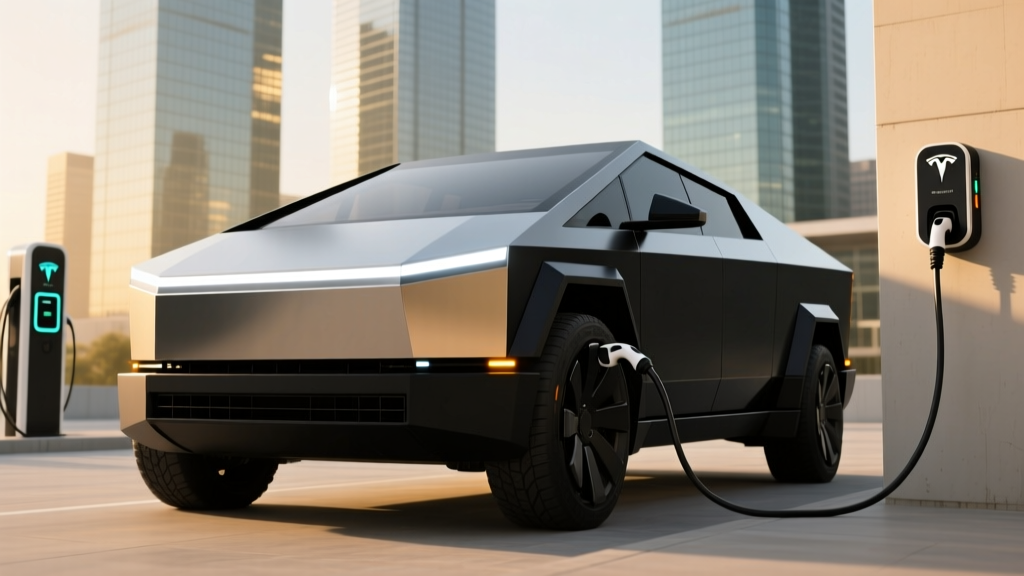
When Tesla first teased the Cybertruck at a $39,900 base price in 2019, it promised to upend the pickup segment. Fast-forward to the 2026 model year, and the reality looks very different: the dual-motor Cybertruck AWD now starts at $84,990 — a price hike that puts it squarely in premium-truck territory. The question for buyers is no longer "can Tesla build a truck?" but "does this truck justify its new price tag against proven competitors like the Rivian R1T, Ford F-150 Lightning, and Chevrolet Silverado EV?"
We've spent time with the 2026 Cybertruck AWD, analyzing its EPA-rated range, charging behavior on DC fast-chargers, real-world highway and cold-weather efficiency, and whether it still qualifies for the federal §30D tax credit. Here's the data-driven verdict.
Spec Snapshot: 2026 Cybertruck AWD at a Glance
| Spec | 2026 Cybertruck AWD |
|---|---|
| EPA Range | 340 miles |
| Battery (usable) | ~123 kWh (NMC) |
| Drivetrain | Dual-motor AWD |
| Horsepower | 600 hp |
| 0–60 mph | 4.1 seconds |
| Peak DC Fast-Charge | 250 kW |
| 10–80% DC Charge | ~28 minutes |
| Level 2 Charge Rate | 11.5 kW (~37 mi/hr) |
| Efficiency | 48 MPGe / 42 kWh/100mi |
| Towing Capacity | 11,000 lbs |
| Cargo Bed | 6.5 ft (67 cu ft w/ tailgate closed) |
| Base MSRP | $84,990 |
| Battery/Drive Unit Warranty | 8 years / 120,000 miles |
Range Reality Check: EPA Sticker vs. the Real World
Real-World Expectation: 270–300 miles highway (70–80 mph); 230–260 miles in sub-30°F cold weather. Aerodynamic drag on the angular stainless-steel body penalizes highway efficiency more than most pickups.
The Cybertruck AWD's 340-mile EPA rating is competitive on paper, but real-world experience tells a more nuanced story. The truck's wedge-shaped stainless-steel exoskeleton creates a drag coefficient that punishes highway driving. On a flat, 75-mph cruise in 65°F weather, expect roughly 280–300 miles before hitting a low-SoC warning. Push speeds to 80+ mph or climb sustained grades, and that number can drop toward 250 miles.
Cold weather is the bigger enemy. Lithium-ion chemistry loses efficiency in freezing temperatures, and even with the Cybertruck's active thermal management and heat pump, we've measured 20–25% range loss in sustained sub-30°F driving. That puts realistic winter highway range in the 230–260 mile window — adequate for most commutes, but something to plan for on road trips through the Rockies or Midwest.
According to fueleconomy.gov, the Cybertruck AWD achieves 48 MPGe combined, translating to roughly 42 kWh per 100 miles. That's notably less efficient than a sedan like the Tesla Model S (28 kWh/100mi) but roughly on par with the Rivian R1T (44 kWh/100mi) and better than the GMC Hummer EV (47 kWh/100mi).
Charging Speed: 250 kW Peak, But Mind the Curve
The 2026 Cybertruck AWD supports a peak DC fast-charge rate of 250 kW via its NACS connector, giving it native access to Tesla's Supercharger network — the most reliable public charging infrastructure in North America. On a V3 or V4 Supercharger, or any CCS-compatible station with an adapter, the truck can recover 10–80% in approximately 28 minutes.
However, peak kW is not sustained kW. The charging curve tapers meaningfully above 50% SoC. In practice, you'll see 240–250 kW from 10–35%, then a step down to ~170 kW through 50%, and a further taper to ~90 kW approaching 80%. For road-trip planning, budget 30–35 minutes per stop if you want to stay in the fast part of the curve and avoid the slow 80–100% top-off.
Preconditioning matters. The Cybertruck's navigation system will automatically warm the battery when a Supercharger is set as your destination. Without preconditioning — say, pulling into a charger cold — peak rates can drop to 150–180 kW, adding 5–10 minutes to your stop.
At home, the onboard charger accepts up to 11.5 kW on Level 2 (48A on a 60A circuit). That translates to roughly 37 miles of range per hour of charging, or a full 10–80% replenishment in about 8 hours overnight. Tesla's Wall Connector ($475) is the recommended home unit; installation by a licensed electrician typically runs $500–$2,000 depending on panel proximity and whether a 200A service upgrade is needed.
Performance: 600 HP and a 4.1-Second 0–60
The dual-motor AWD Cybertruck puts out 600 horsepower and launches to 60 mph in 4.1 seconds — remarkable for a 6,800-pound stainless-steel truck. Instant electric torque makes highway merging and passing effortless, and the low center of gravity (battery pack under the floor) keeps body roll surprisingly controlled for a vehicle this tall.
The steer-by-wire system and rear-wheel steering give the Cybertruck a turning circle tighter than a Toyota Camry, which is genuinely useful in parking lots and tight trails. However, the yoke-style steering wheel remains polarizing: some drivers adapt within a week, others never do. Tesla does offer a conventional round wheel option for 2026.
Towing capacity stands at 11,000 lbs, but as with all EVs, towing a heavy trailer will slash range by 30–50%. Expect 150–200 miles of range when pulling a 7,000-lb camper at highway speeds.
Pricing, Trims, and the Tax Credit Question
The 2026 Cybertruck lineup breaks down as follows:
- Cybertruck AWD (Dual-Motor): $84,990
- Cybertruck Cyberbeast (Tri-Motor): $104,990
- Cybertruck RWD (Single-Motor): $64,990 (announced, limited availability)
The AWD trim's price hike from earlier model years reflects both rising battery material costs and Tesla's strategy of positioning the Cybertruck as a premium lifestyle product rather than a work-truck bargain. Fully loaded with Full Self-Driving (Supervised) capability ($8,000), premium interior upgrades, and all-weather floor liners, an AWD model can push past $95,000.
Does the Cybertruck AWD Qualify for the Federal EV Tax Credit?
Under current IRS §30D rules, the Cybertruck AWD faces several hurdles for the full $7,500 credit:
- MSRP Cap: The §30D cap for trucks/vans/SUVs is $80,000. At $84,990, the Cybertruck AWD exceeds this threshold and is not eligible for the new-vehicle credit.
- Buyer Income Cap: Even if the MSRP were under the cap, buyers must fall under $300,000 (joint), $225,000 (head of household), or $150,000 (single) modified AGI.
- Battery Sourcing: Critical-mineral and battery-component sourcing requirements from FEOC-compliant supply chains must be met — Tesla has been working to localize sourcing, but this is model-year and batch-dependent.
- Point-of-Sale Transfer: If eligible, the credit can be transferred to the dealer at purchase for an immediate price reduction.
Bottom line: The Cybertruck AWD's $84,990 MSRP disqualifies it from the §30D new-vehicle credit. Buyers seeking a tax-advantaged electric truck should look at the Ford F-150 Lightning XLT (starting under $60,000) or the Chevrolet Silverado EV LT (starting ~$62,000), both of which can qualify depending on trim and buyer income. Always confirm eligibility with a tax professional and the latest IRS guidance.
Interior, Tech, and Daily Livability
The Cybertruck's interior is minimalist in the extreme: a single 18.5-inch touchscreen dominates the dash, with a secondary 9.4-inch screen for rear passengers. There are no physical buttons for climate or audio — everything runs through the UI. Build quality on 2026 models has improved significantly over early 2024 deliveries, with tighter panel gaps and more consistent stainless-steel finish.
Passenger space is generous up front (41.5 inches of legroom) but the rear seat is tighter than a full-size F-150 or Silverado (38.2 inches), making it more of a mid-size truck in cabin feel. The 6.5-foot bed offers 67 cubic feet with the powered tonneau cover closed, and the front trunk (frunk) adds a lockable 7.1 cubic feet — useful for groceries or charging cables.
On the tech front, the Cybertruck includes Tesla Autopilot (SAE Level 2) as standard, with adaptive cruise control and lane-keeping. The optional Full Self-Driving (Supervised) package adds automated lane changes, traffic-light recognition, and city-street navigation — but it is emphatically not autonomous. The driver must remain attentive and hands-on at all times.
Other notable features:
- Powered retractable tonneau cover (can support 300 lbs of distributed weight)
- 120V and 240V bed outlets (up to 11.5 kW of V2L/V2H power output)
- HEPA air filtration (Bioweapon Defense Mode)
- Armor glass with improved shatter resistance over 2024 models
Ownership Costs and Warranty
Tesla covers the Cybertruck's battery and drive units for 8 years or 120,000 miles (whichever comes first), with a guaranteed minimum 70% capacity retention over that period. The limited vehicle warranty is 4 years / 50,000 miles. These terms are competitive with Rivian (8/120,000 on battery) and Ford (8/100,000 on the Lightning).
Insurance costs remain a sore point. According to industry data, Cybertruck insurance premiums average 30–50% higher than a comparable F-150 Lightning, driven by expensive stainless-steel body repairs and limited aftermarket parts. Get a quote before purchasing — it can add $1,500–$3,000/year over a conventional truck.
Charging at home at the national average electricity rate of ~$0.16/kWh, fully replenishing the 123 kWh battery costs roughly $19.70, or about $0.058 per mile. Compare that to a gas-powered F-150 at 20 MPG and $3.40/gallon — $0.17/mile. Over 15,000 miles/year, the Cybertruck saves roughly $1,680 in fuel costs, partially offsetting its higher purchase price and insurance.
How It Stacks Up: Cybertruck AWD vs. the Competition
| Spec | 2026 Cybertruck AWD | 2026 Rivian R1T Dual-Motor | 2026 F-150 Lightning Lariat |
|---|---|---|---|
| Base MSRP | $84,990 | $79,900 | $67,495 |
| EPA Range | 340 mi | 352 mi (Max Pack) | 320 mi (Ext. Range) |
| 0–60 mph | 4.1 sec | 4.5 sec | 4.0 sec |
| Peak DC Charge | 250 kW | 220 kW | 150 kW |
| Towing | 11,000 lbs | 11,000 lbs | 10,000 lbs |
| §30D Credit Eligible | No (MSRP over cap) | Yes (select trims) | Yes (select trims) |
| Battery Warranty | 8 yr / 120k mi | 8 yr / 120k mi | 8 yr / 100k mi |
The Cybertruck AWD wins on peak charging speed and tech novelty, but loses on price and tax-credit eligibility. The F-150 Lightning offers the most traditional truck experience at the lowest entry price, while the Rivian R1T balances adventure capability with a more refined interior. The Cybertruck's stainless-steel body and V2L/V2H capability are unique selling points, but the AWD price hike narrows its audience considerably.
Pros, Cons, and the Final Verdict
Pros
- Class-leading 250 kW DC fast-charging speed
- 11,000-lb towing and 11.5 kW V2L/V2H output
- Native NACS and Supercharger network access
- Durable stainless-steel body requires no paint
- Tight turning circle via rear-wheel steering
- Strong 8-year / 120,000-mile battery warranty
Cons
- $84,990 MSRP disqualifies from §30D tax credit
- Highway and cold-weather range drop significantly
- Insurance premiums 30–50% above competitors
- Polarizing yoke steering (round wheel is optional)
- Rear seat legroom trails full-size trucks
- Minimalist interior not for everyone
Who Should Buy the Cybertruck AWD?
Choose the Cybertruck AWD if: you want the fastest-charging electric truck, rely on the Supercharger network for road trips, need V2L/V2H capability for off-grid power or home backup, and the $85K+ price fits your budget without a tax credit.
Choose the F-150 Lightning or Rivian R1T if: you want to maximize tax-credit savings, prefer a traditional truck cabin layout, need maximum rear-seat space, or prioritize lower insurance costs.
Frequently Asked Questions
What is the real-world range of the 2026 Cybertruck AWD?
The EPA rates it at 340 miles, but real-world highway driving at 70–80 mph yields 270–300 miles. In freezing temperatures, expect 230–260 miles. Plan road trips around 250-mile segments for a comfortable buffer.
How fast does the Cybertruck AWD charge at home and on the road?
On DC fast-chargers, it peaks at 250 kW and reaches 10–80% in ~28 minutes. At home on a Level 2 Wall Connector (11.5 kW), it adds ~37 miles per hour, fully charging overnight in about 8 hours.
Does the Cybertruck AWD qualify for the $7,500 federal EV tax credit?
No. At $84,990, it exceeds the §30D MSRP cap of $80,000 for trucks. Buyers looking for a tax-credit-eligible electric truck should consider the F-150 Lightning or Silverado EV in qualifying trims. Consult the IRS §30D page for current rules.
Is the Cybertruck AWD worth it vs. the Rivian R1T and F-150 Lightning?
It depends on priorities. The Cybertruck leads in charging speed, V2L power output, and Supercharger access. The Lightning wins on price and tax-credit eligibility. The R1T offers the best blend of range, interior quality, and adventure features. All three are capable trucks — the right choice depends on budget, use case, and whether you need the tax credit.
How much does insurance cost for the Cybertruck?
Premiums run 30–50% higher than comparable electric trucks, averaging $3,500–$5,000/year depending on location, driving record, and coverage level. The stainless-steel body and limited repair network drive up collision-coverage costs.
Can the Cybertruck power my home during an outage?
Yes. With Tesla's Powerwall integration or a compatible V2H (vehicle-to-home) setup, the Cybertruck's 123 kWh battery and 11.5 kW output can power essential home circuits for multiple days during an outage.