Why the Cybertruck Ambulance Concept Keeps Surfacing
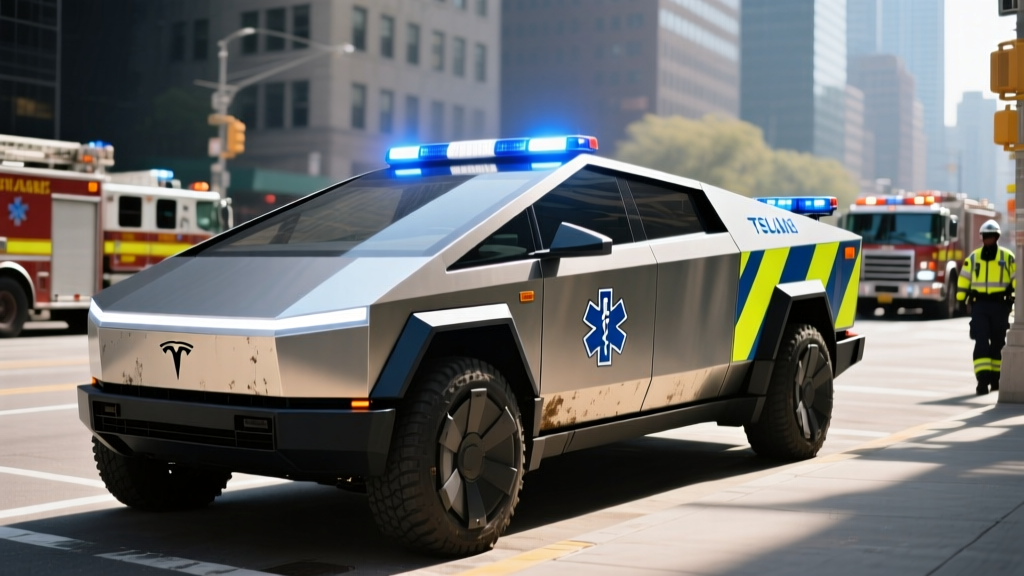
Search interest in a Cybertruck ambulance isn't driven by an official Tesla product — no such factory-built emergency vehicle exists as of the 2026 model year. Instead, the concept has gained traction among EV-minded fleet managers, emergency medical services (EMS) planners, and aftermarket coachbuilders evaluating whether Tesla's stainless-steel pickup could serve as a light-duty first-responder platform. The appeal is straightforward: instant torque for rapid response, a low center of gravity from the under-floor battery pack, zero tailpipe emissions in urban corridors, and a payload rating that theoretically supports modular ambulance upfits.
But converting any production pickup into an ambulance requires meeting stringent NHTSA and KKK-A-1822 (General Services Administration) ambulance specifications, which govern everything from interior headroom to crashworthiness. This article evaluates the Tesla Cybertruck — specifically the 2026 AWD and Cyberbeast trims that remain in production — against the real demands of ambulance service, using hard data on range, charging, payload, and total cost of ownership.
Cybertruck Specs at a Glance: The Numbers That Matter for Fleet Buyers
| Spec | AWD | Cyberbeast |
|---|---|---|
| EPA Range | 340 miles | 320 miles |
| Battery (usable) | ~123 kWh (NMC) | ~123 kWh (NMC) |
| Horsepower | 600 hp | 845 hp |
| 0–60 mph | 4.1 sec | 2.6 sec |
| Drivetrain | Dual-motor AWD | Tri-motor AWD |
| Max DC Fast Charge | 250 kW (NACS) | 250 kW (NACS) |
| 10–80% DC Charge | ~28 min | ~28 min |
| Level 2 Charge Rate | 11.5 kW (~44 mi/hr) | 11.5 kW (~44 mi/hr) |
| MPGe (combined) | 79 MPGe | 74 MPGe |
| kWh/100 mi | 43 | 45 |
| Payload Capacity | 2,500 lbs | 2,500 lbs |
| Towing Capacity | 11,000 lbs | 11,000 lbs |
| Bed Length | 6 ft (72 in) | 6 ft (72 in) |
| Bed Width (between wells) | 43 in | 43 in |
| Cargo Volume (bed) | ~34 cu ft (closed) | ~34 cu ft (closed) |
| Front Trunk (Frunk) | ~7 cu ft | ~7 cu ft |
| Curb Weight | ~6,603 lbs | ~6,843 lbs |
| GVWR | ~9,100 lbs | ~9,100 lbs |
| Base MSRP | $79,990 | $99,990 |
| Battery/Drive Unit Warranty | 8 yr / 120,000 mi | 8 yr / 120,000 mi |
| Basic Vehicle Warranty | 4 yr / 50,000 mi | 4 yr / 50,000 mi |
Range Reality: What an Ambulance Conversion Does to Those EPA Numbers
The 2026 Cybertruck AWD carries an EPA-estimated 340 miles of range. In real-world ambulance operations — stop-and-go urban response, climate control running continuously, emergency lighting draws, and upfit weight — expect 200–250 miles of usable range before needing to recharge. Highway efficiency drops to roughly 280–300 miles unloaded; cold-weather operation (below 32°F) can reduce range by an additional 15–25%.
The Cybertruck's ~123 kWh usable battery pack uses nickel-manganese-cobalt (NMC) chemistry, chosen for its higher energy density versus LFP. That density matters here: ambulance conversions add significant weight from medical equipment, oxygen systems, stretcher mounts, and modular cabinetry. A typical Type I ambulance upfit adds 2,000–3,500 lbs of equipment to a chassis. The Cybertruck's 2,500-lb payload rating and ~9,100-lb GVWR create a narrow margin — a fully equipped ambulance module could push the truck to or beyond its rated capacity, which directly compresses range.
For comparison, a conventional Ford F-450 ambulance chassis has a GVWR of 14,000+ lbs, giving it far more headroom for medical equipment. This is the fundamental engineering tension: the Cybertruck's payload is competitive for a half-ton pickup but falls well short of the medium-duty platforms that dominate ambulance service.
Efficiency Under Load
At its EPA-rated 79 MPGe (43 kWh/100 mi), the Cybertruck is reasonably efficient for its size. However, fueleconomy.gov data reflects a stock, unloaded truck. Adding 1,500–2,000 lbs of ambulance equipment and running auxiliary power for medical devices could push consumption to 55–65 kWh/100 mi in real operations, effectively reducing range to the 190–220 mile band even without cold-weather penalties.
Charging Infrastructure: Can an Ambulance Fleet Keep the Cybertruck on the Road?
| Charging Level | Power | Speed (Approx.) | Ambulance Fleet Relevance |
|---|---|---|---|
| Level 1 (120V) | ~1.4 kW | ~5 mi/hr | Unusable for fleet ops |
| Level 2 (240V, 48A) | 11.5 kW | ~44 mi/hr | Overnight depot charging; full charge in ~11 hrs |
| DC Fast (Supercharger) | Peak 250 kW | 10–80% in ~28 min | Shift-change top-ups; adds ~170 mi in 20 min |
| DC Fast (above 80%) | Tapers to ~50 kW | 80–100% in ~30+ min | Avoid in fleet ops — too slow for turnaround |
The Cybertruck charges at a peak of 250 kW on Tesla's V3/V4 Superchargers using the NACS connector. The 10–80% charge takes approximately 28 minutes, which is adequate for shift-change top-ups but problematic for high-utilization ambulance fleets that need vehicles back in service within 10–15 minutes.
The Charging-Curve Reality for Fleet Operations
Peak 250 kW is not sustained — the charge curve tapers significantly above 50% state of charge (SoC) and drops sharply past 80%. Fleet charging strategy must target the 20–80% window where the truck accepts the most power. A 20-minute Supercharger session in that sweet spot adds roughly 170 miles of range, which is sufficient for most urban ambulance shifts covering 80–120 miles.
Depot Charging Requirements
For overnight depot charging, each Cybertruck ambulance needs a dedicated 240V/48A Level 2 circuit delivering 11.5 kW. A full 0–100% charge takes approximately 11 hours. Fleet operators planning 10+ vehicles need to budget for commercial-grade electrical service — likely a 400A–800A panel upgrade, which can cost $15,000–$40,000 depending on existing infrastructure. Tesla's Wall Connector ($475 per unit) or commercial-grade ChargePoint/Enel X stations are typical choices.
Performance and Drivetrain: Where the Cybertruck Ambulance Concept Excels
This is where the EV argument for emergency response gets compelling. The dual-motor AWD Cybertruck delivers 600 horsepower and hits 0–60 mph in 4.1 seconds. The tri-motor Cyberbeast pushes that to 845 hp and 2.6 seconds — faster than virtually any production ambulance on the road.
For ambulance response, the relevant metric isn't 0–60 but 0–30 mph acceleration, which determines how quickly a unit can pull away from a station or navigate through an intersection. Electric motors deliver peak torque at 0 RPM, meaning the Cybertruck launches immediately without the turbo lag or transmission shift delays of a diesel-powered ambulance. In congested urban environments, this torque advantage translates to measurably faster response times for the first critical blocks.
All-Wheel-Drive and Low Center of Gravity
The Cybertruck's battery pack sits beneath the floor, giving it a significantly lower center of gravity than a body-on-frame F-450 ambulance. This matters for emergency driving: rollover risk is a leading cause of ambulance crashes, and the Cybertruck's weight distribution inherently reduces that risk. The dual-motor AWD system provides torque-vectoring traction in rain, snow, and ice without the mechanical complexity of a traditional transfer case.
Towing and Payload: The Honest Limitation
Rated at 2,500 lbs payload and 11,000 lbs towing, the Cybertruck is competitive among half-ton pickups but falls short of the 5,000–7,000 lb payloads that medium-duty ambulance chassis offer. A fully equipped Type I ambulance patient module typically weighs 2,500–4,000 lbs, which means the Cybertruck could theoretically handle a lightweight Type II or Type III modular unit — but only at the very edge of its rated capacity. Running at max payload continuously accelerates suspension wear, reduces braking margins, and compresses range.
Pricing, Tax Credits, and Total Cost of Ownership
| Item | AWD | Cyberbeast |
|---|---|---|
| Base MSRP | $79,990 | $99,990 |
| Destination Fee | $1,995 | $1,995 |
| Estimated Ambulance Upfit | $40,000–$80,000 | $40,000–$80,000 |
| Total Estimated Cost | $122,000–$162,000 | $142,000–$182,000 |
| Federal §30D Tax Credit | See eligibility analysis below | |
Federal Tax Credit: The §30D Problem for Fleet Buyers
The IRS §30D Clean Vehicle Credit offers up to $7,500 for qualifying new EVs, but the Cybertruck faces multiple eligibility barriers for ambulance fleet buyers:
- MSRP Cap: Pickup trucks must have an MSRP at or below $80,000 to qualify. The AWD trim at $79,990 squeaks under; the Cyberbeast at $99,990 does not.
- Income Cap: Buyer AGI must not exceed $150,000 (single), $225,000 (head of household), or $300,000 (joint). Fleet purchases by municipalities or private EMS companies generally don't meet individual income requirements — the credit applies to individual taxpayers, not entities.
- Battery Sourcing: Critical mineral and battery component sourcing requirements tighten annually. Tesla's supply chain has evolved, but specific 2026 compliance status should be verified on the IRS eligible vehicle list before purchase.
- Point-of-Sale Transfer: Since 2024, the credit can be transferred to the dealer at point of sale as a price reduction, but only for eligible individual buyers — not fleet or commercial purchases.
Bottom line: Most ambulance fleets — whether municipal, hospital-based, or private — will not qualify for the §30D credit on a Cybertruck purchase. Commercial EV fleet buyers should instead investigate the §45W Commercial Clean Vehicle Credit, which applies to qualified commercial vehicles and may cover up to $7,500 for vehicles under 14,000 lbs GVWR. Consult a tax professional for your specific situation.
Five-Year Operating Cost Estimate
Where the Cybertruck ambulance concept gains ground is operating cost. Electricity at $0.15/kWh yields a fuel cost of roughly $0.065/mile (at 43 kWh/100 mi). A diesel F-450 ambulance at 8 MPG and $4.00/gallon diesel costs approximately $0.50/mile in fuel alone. Over 100,000 miles of ambulance service, that's a fuel savings of roughly $43,500 per vehicle. Add reduced maintenance (no oil changes, fewer brake replacements due to regenerative braking, no transmission fluid) and the five-year total cost of ownership can be competitive despite the higher upfront price.
Standout Tech and Notable Drawbacks for Emergency Service
Technology Advantages
- 18.5-inch touchscreen: The massive central display could theoretically integrate with CAD (Computer-Aided Dispatch) systems and electronic patient care reporting (ePCR) software, though aftermarket integration would be required.
- Tesla Vision / Autopilot: The Cybertruck ships with Tesla's camera-based driver-assist suite. Important: this is SAE Level 2 — the driver must remain fully engaged at all times. It is not autonomous driving and cannot replace an attentive emergency vehicle operator.
- Over-the-air updates: Tesla's OTA capability means software improvements, bug fixes, and feature additions without depot visits — a significant advantage for fleet management.
- Vehicle-to-Load (V2L) potential: The Cybertruck's Powershare feature can output up to 11.5 kW of AC power, enough to run medical equipment, scene lighting, or even provide backup power to a residence during a medical emergency.
- Stainless steel exoskeleton: The 30X cold-rolled stainless steel body is dent-resistant and doesn't require paint — potentially reducing cosmetic repair costs after the minor scrapes that plague urban ambulance service.
Critical Drawbacks
- Bed dimensions: The 6-foot bed (72 in long, 43 in between wheel wells) is too narrow for a standard ambulance patient module. Most Type I modules require at least a 96-inch-wide platform. This would necessitate a custom, narrow-profile modular design or a chassis-cab conversion that Tesla does not currently offer.
- No chassis-cab variant: The ambulance industry relies on chassis-cab configurations (cab + bare frame rails) for custom upfits. Tesla only sells the Cybertruck as a complete pickup — there is no stripped chassis option.
- Service network: Tesla's service infrastructure is not designed for fleet turnaround. Ambulance fleets need 24/7 service availability with guaranteed response times; Tesla's mobile ranger and service center model doesn't currently match that standard.
- Emergency vehicle lighting integration: Federal and state regulations require specific light-bar mounting, siren integration, and reflective striping. The Cybertruck's angular stainless steel body and lack of a traditional roof rack or light-bar mounting points would require custom fabrication.
- GVWR limitations: At ~9,100 lbs, the Cybertruck falls below the 10,001+ lb threshold that defines many commercial ambulance classifications, potentially limiting its use in certain jurisdictions.
- Instant torque for rapid urban response (0–30 in ~2 sec)
- Low center of gravity reduces rollover risk
- ~$43,500 fuel savings over 100K miles vs. diesel
- 11.5 kW V2L / Powershare for scene power
- OTA updates reduce fleet software maintenance
- Stainless body resists dents and corrosion
- 340-mi EPA range covers most urban shifts
- 2,500-lb payload too low for standard ambulance modules
- No chassis-cab configuration available from Tesla
- 43-inch bed width can't fit standard patient modules
- §30D tax credit unlikely for fleet/commercial buyers
- 28-min DC fast charge slows high-utilization rotations
- Tesla service network not built for fleet SLAs
- Custom emergency lighting/siren integration required
Who Should Consider a Cybertruck-Based Emergency Vehicle?
The Cybertruck ambulance concept makes the most sense for a narrow set of use cases rather than broad frontline ambulance service:
- Quick-response vehicles (QRVs): Paramedic fly-cars that carry a medic and jump bag to the scene ahead of a full ambulance don't need a patient module. A Cybertruck QRV with equipment stored in the bed and frunk could work well, leveraging its speed and range.
- Community paramedicine / mobile integrated healthcare: Programs that dispatch providers to homes for chronic-care check-ins, post-discharge follow-ups, or treat-in-place protocols need a mobile office more than a rolling ER. The Cybertruck's tech-forward cabin and V2L power suit this role.
- Supervisor and command vehicles: Battalion chief or EMS supervisor vehicles that need AWD capability, long range, and on-scene power without patient transport.
- Rural first-responder units: Volunteer fire/EMS departments in areas with long response distances and access to home/depot charging could benefit from the range and low operating costs, particularly if equipped with a lightweight canopy-based medical module.
For traditional Type I, II, or III ambulance service — transporting patients with a full crew, stretcher, cardiac monitor, oxygen, and medication — the Cybertruck's payload, bed dimensions, and lack of a chassis-cab option make it impractical without a purpose-built aftermarket conversion that doesn't yet exist at scale.
Cybertruck Ambulance vs. Key Competitors in the EV Emergency Space
| Platform | EPA Range | Payload | GVWR | Base Price | Ambulance Readiness |
|---|---|---|---|---|---|
| Tesla Cybertruck AWD | 340 mi | 2,500 lbs | ~9,100 lbs | $79,990 | QRV/command only |
| Ford F-150 Lightning (ext. range) | 320 mi | 2,235 lbs | ~7,050 lbs | ~$69,995 | QRV only; lower payload |
| BrightDrop Zevo 600 | ~250 mi | ~3,500 lbs | ~9,900 lbs | Fleet pricing | Step-van ambulance possible |
| Ford E-Transit (cutaway) | ~126 mi | ~3,800 lbs | ~9,500 lbs | ~$52,000 | Type II ambulance (limited range) |
| Lightship AE.1 (announced) | ~500 mi (est.) | ~5,000 lbs (est.) | TBD | TBD | Preliminary — not available |
Among currently available EV pickups, neither the Cybertruck nor the F-150 Lightning offers the payload and chassis configuration needed for a full ambulance conversion. The Ford E-Transit cutaway is the closest thing to a production EV ambulance platform today, with several coachbuilders (e.g., Demers, Braun) developing electric ambulance bodies on that chassis — but its 126-mile range limits it to dense urban routes with depot charging.
Is a Cybertruck Ambulance Worth Pursuing?
As a quick-response vehicle, community paramedicine platform, or EMS command unit, the 2026 Cybertruck AWD is a compelling EV option — its 340-mile range, rapid acceleration, V2L power, and low operating costs are genuine advantages for these roles. As a full patient-transport ambulance, the Cybertruck's 2,500-lb payload, 43-inch bed width, lack of chassis-cab variant, and 28-minute DC charge time make it impractical with current technology and aftermarket support. Fleet buyers should watch for Tesla's next-generation platforms and third-party coachbuilder developments, but should not plan a Cybertruck ambulance conversion for frontline transport service today.
Frequently Asked Questions
Does Tesla make an official Cybertruck ambulance?
No. Tesla does not manufacture or sell an ambulance variant of the Cybertruck. The "Cybertruck ambulance" concept refers to aftermarket conversions or speculative fleet evaluations. No major ambulance coachbuilder (Braun, Horton, Demers, Wheeled Coach) currently offers a Cybertruck-based ambulance module as of 2026.
What is the real-world range of a Cybertruck used for emergency response?
With a stock Cybertruck AWD, expect 280–300 miles on the highway and 250–270 in mixed city driving. With ambulance equipment adding 1,500–2,000 lbs and auxiliary power draws for medical devices and lighting, realistic range drops to approximately 200–250 miles in typical urban response operations. Cold weather (below 32°F) further reduces this by 15–25%.
How fast does the Cybertruck charge for fleet operations?
On a Tesla V3/V4 Supercharger, the Cybertruck peaks at 250 kW and charges from 10–80% in approximately 28 minutes. On a Level 2 depot charger (240V, 48A), it charges at 11.5 kW, adding about 44 miles of range per hour — a full 0–100% charge takes roughly 11 hours.
Does the Cybertruck qualify for the federal EV tax credit?
The AWD trim at $79,990 MSRP falls just under the $80,000 §30D cap for trucks, but the credit is further limited by buyer income caps and battery-sourcing requirements. Most ambulance fleet purchases by municipalities or commercial EMS entities will not qualify for §30D, which is designed for individual taxpayers. Fleet buyers should investigate the §45W Commercial Clean Vehicle Credit instead. Always verify current eligibility on irs.gov and consult a tax professional.
What ambulance type could the Cybertruck realistically support?
The Cybertruck is best suited as a Quick Response Vehicle (QRV) — a fly-car that delivers a paramedic and emergency equipment to the scene before a full ambulance arrives. It could also serve as an EMS supervisor vehicle, community paramedicine unit, or disaster-response command post leveraging its V2L capability. It cannot currently support a Type I, II, or III patient-transport ambulance conversion due to payload and dimensional constraints.
How does the Cybertruck's operating cost compare to a diesel ambulance?
At $0.15/kWh, the Cybertruck costs roughly $0.065/mile in electricity versus approximately $0.50/mile in diesel for an F-450 ambulance at 8 MPG. Over 100,000 miles, that's a fuel savings of approximately $43,500. Maintenance savings (no oil changes, reduced brake wear from regenerative braking, no emissions system repairs) add an estimated $5,000–$10,000 over five years.
Can the Cybertruck power medical equipment on scene?
Yes. Tesla's Powershare (V2L) feature can output up to 11.5 kW of AC power through the bed and cabin outlets. This is sufficient to run cardiac monitors, suction units, scene lighting, laptop workstations, and even small oxygen concentrators simultaneously — a significant advantage for extended on-scene medical operations.