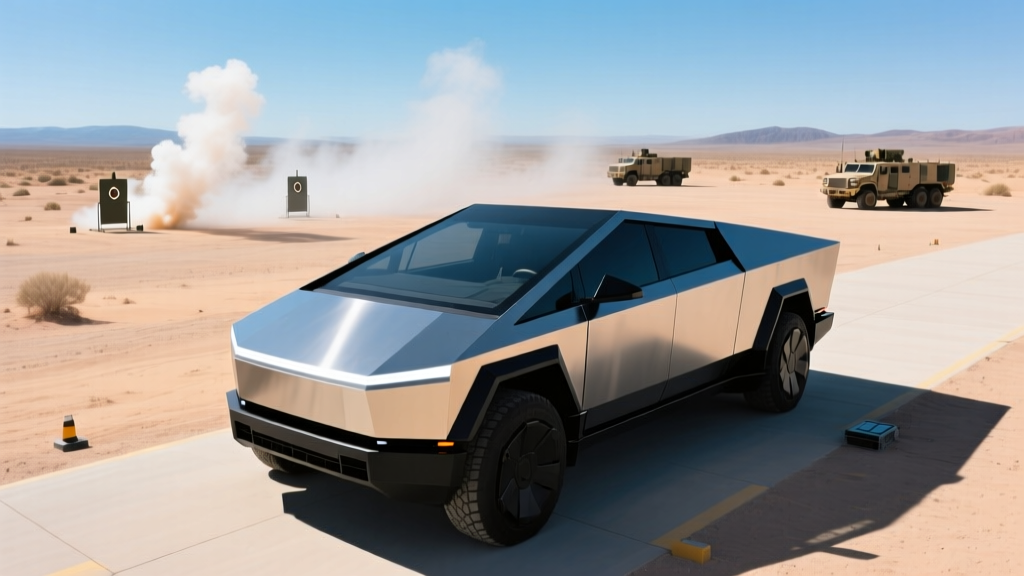
The Tesla Cybertruck has never been a conventional pickup, and its collision with military testing only underscores how polarizing this stainless-steel EV really is. When footage surfaced of the US Air Force using a Cybertruck for ballistic and blast-resistance assessments — colloquially dubbed "Cybertruck target practice" — it reignited debate about the truck's exoskeleton claims, its real-world utility, and whether its engineering holds up outside of Tesla's carefully controlled demos. This review examines the Cybertruck as a daily-driver EV first, then contextualizes what those military durability tests actually tell potential buyers.
What the US Air Force Target Practice Tests Revealed
In 2024 and 2025, footage and reports emerged showing US military branches, including Air Force security forces, evaluating the Cybertruck's cold-rolled stainless-steel body against ballistic and explosive threats. The intent was not to adopt the truck as a tactical vehicle but to benchmark its 30X-grade stainless exoskeleton against up-armored Humvees and JLTVs in controlled blast and small-arms scenarios.
The results were mixed but instructive: the Cybertruck's ultra-hard steel panels defeated certain handgun and intermediate rifle rounds at oblique angles, consistent with Tesla's own "bulletproof" marketing claims for 9mm and some .45 ACP threats. However, against armor-piercing rifle ammunition and shaped-charge blast tests, the truck's non-armored undercarriage, glass, and panel gaps proved vulnerable — a reminder that automotive stainless steel is not military-grade ballistic armor.
For civilian buyers, the takeaway is practical rather than tactical: the Cybertruck's exoskeleton does offer exceptional dent and scratch resistance compared to aluminum-body competitors like the Ford F-150 Lightning or Rivian R1T. Parking-lot dings, trail pinstriping, and minor hail are genuinely less consequential. But "bulletproof" is a marketing simplification, not an engineering guarantee.
EPA Range, Battery Chemistry, and Real-World Efficiency
The 2026 Cybertruck lineup continues with a structural battery pack using Tesla's 4680-format cells. The AWD Dual Motor and Cyberbeast trims use an NMC (nickel manganese cobalt) chemistry for maximum energy density, while Tesla has signaled future LFP (lithium iron phosphate) variants for a base RWD model — though that trim remains limited in availability.
| Specification | AWD Dual Motor | Cyberbeast (Tri-Motor) |
|---|---|---|
| EPA Range | 340 miles | 320 miles |
| Battery Capacity (usable) | ~123 kWh | ~123 kWh |
| Battery Chemistry | NMC (4680 cells) | NMC (4680 cells) |
| Horsepower | 600 hp | 845 hp |
| 0-60 mph | 4.1 seconds | 2.6 seconds |
| Drivetrain | Dual-Motor AWD | Tri-Motor AWD |
| MPGe (combined) | 72 MPGe | 68 MPGe |
| kWh per 100 miles | 47 kWh | 50 kWh |
| Towing Capacity | 11,000 lbs | 11,000 lbs |
| Payload Capacity | 2,500 lbs | 2,500 lbs |
| Bed Length | 6 ft (72 in) | 6 ft (72 in) |
| Cargo Volume (bed + frunk) | ~67 cu ft bed / ~7 cu ft frunk | ~67 cu ft bed / ~7 cu ft frunk |
| Battery Warranty | 8 yr / 120,000 mi | 8 yr / 120,000 mi |
| Base MSRP | $79,990 | $99,990 |
Charging Speed: DC Fast Charging and Home Level 2
The Cybertruck's 800-volt-class architecture enables strong DC fast-charging performance, though Tesla's characteristic charge-curve taper means peak rates are sustained only briefly. The truck uses the NACS (North American Charging Standard) connector natively, giving it seamless access to Tesla's Supercharger network — the most reliable DC fast-charging ecosystem in the US.
| Charging Level | Power (kW) | Speed (miles of range per hour) | Notes |
|---|---|---|---|
| Level 1 (120V household) | ~1.4 kW | ~4 mi/hr | Emergency/trickle only |
| Level 2 (240V home wall connector) | 11.5 kW (48A) | ~34 mi/hr | Full overnight charge in ~11 hrs |
| DC Fast Charge (Supercharger V4) | Peak 350 kW | ~200+ mi in 15 min | 10-80% in ~18–20 min; taper above 80% |
The 10–80% DC fast-charge time of approximately 18–20 minutes is competitive with the best in the segment. However, sustained charging above 80% slows dramatically — a full 80–100% top-off can add another 25–30 minutes. For road-trip planning, Tesla's navigation system preconditions the battery automatically when a Supercharger is set as the destination, which is critical for achieving peak charge rates in cold weather.
Pricing, Trim Levels, and Federal Tax Credit Eligibility
The Cybertruck's pricing has stabilized after the early-production Foundation Series premiums. As of the 2026 model year, the lineup sits firmly in the luxury-truck segment. Federal tax credit eligibility under IRS §30D requires careful attention to the MSRP cap, buyer income limits, and battery-component/critical-mineral sourcing rules.
| Trim | Base MSRP | Federal §30D Credit Eligibility | Effective Price (if eligible) |
|---|---|---|---|
| AWD Dual Motor | $79,990 | Not eligible — exceeds $80,000 truck MSRP cap | $79,990 |
| Cyberbeast (Tri-Motor) | $99,990 | Not eligible — exceeds $80,000 truck MSRP cap | $99,990 |
Critical caveat: Under current IRS §30D rules, new clean vehicle credits are capped at $80,000 MSRP for trucks, vans, and SUVs. Both current Cybertruck trims exceed this threshold, meaning buyers cannot claim the $7,500 federal credit on a new purchase. Additionally, buyer adjusted gross income caps ($150,000 single / $300,000 joint) and battery-sourcing requirements further limit eligibility for any EV. If Tesla introduces a lower-priced RWD trim under the $80,000 cap in the future, eligibility would need to be re-evaluated against then-current sourcing rules. Consult a tax professional before assuming credit availability.
Performance, Tech, and Daily-Driving Practicality
The Cyberbeast's 2.6-second 0–60 mph time makes it the quickest production pickup ever sold, and even the Dual Motor's 4.1-second run outpaces most sports sedans. The steer-by-wire system — which eliminates the mechanical connection between the steering wheel and the front wheels — is the most distinctive driving characteristic. It offers variable ratio steering that requires less than a full turn lock-to-lock, making parking maneuvers surprisingly easy for a truck this size. However, the system demands an adjustment period, and some drivers report a synthetic, disconnected feel at highway speeds.
The interior centers on an 18.5-inch front touchscreen and a 9.4-inch rear screen, with no traditional instrument cluster. Tesla's Autopilot comes standard, with Full Self-Driving (Supervised) available as a $8,000 add-on or $99/month subscription.
Practical drawbacks are real: the Cybertruck's 8.5-foot width (including mirrors) makes it challenging in standard parking spaces and narrow urban streets. Rear visibility is limited despite the camera-based digital rearview mirror. The angular bed design, while distinctive, offers less usable volume than a conventional F-150 or Silverado bed of similar length. And the stainless-steel body, while dent-resistant, shows fingerprints relentlessly and requires specific cleaning products to maintain its appearance.
Cybertruck vs. F-150 Lightning vs. Rivian R1T
The electric pickup segment offers three distinct philosophies. The Ford F-150 Lightning (EPA range up to 320 miles, starting ~$55,000) is the conventional-choice EV truck — it looks, drives, and works like a traditional F-150 with an electric powertrain, and its Pro Power Onboard system turns it into a mobile generator. It also qualifies for the $7,500 federal credit on eligible trims, dramatically reducing effective cost.
The Rivian R1T (EPA range up to 420 miles with Max Pack, starting ~$75,000) is the adventure-oriented option, with a quad-motor variant producing over 1,000 hp and genuine off-road credibility. Its tank turn feature and gear tunnel storage are unique differentiators.
The Cybertruck wins on raw acceleration, Supercharger network access, and exoskeleton durability — but loses on price-per-mile-of-range, tax-credit eligibility, and mainstream practicality. It is the most polarizing choice and the one most likely to attract attention, for better or worse.
- Class-leading acceleration (2.6s Cyberbeast)
- Seamless Tesla Supercharger network access
- Stainless-steel exoskeleton resists dents and scratches
- Steer-by-wire enables tight low-speed maneuverability
- 11,000-lb towing capacity competitive with full-size trucks
- Over-the-air updates continually add features
- No federal §30D tax credit — MSRP exceeds $80K cap
- Real-world highway range well below EPA sticker
- 8.5-ft width problematic in urban/parking environments
- Steer-by-wire feel divisive and requires adaptation
- Limited rear visibility; heavy reliance on cameras
- Bed volume less practical than conventional pickups
Who Should Buy the Cybertruck (and Who Shouldn't)
The Cybertruck is best suited for buyers who want a high-performance electric truck as a daily driver and lifestyle statement, have reliable home Level 2 charging, and prioritize Tesla's Supercharger ecosystem for road trips. It works for tech-forward professionals who value acceleration, software integration, and the durability of the stainless exoskeleton over conventional truck practicality.
It is not the right choice for fleet buyers, budget-conscious shoppers (the F-150 Lightning with tax credit is tens of thousands cheaper), those who regularly park in tight urban spaces, or anyone who needs maximum bed volume for work use. If tax credit eligibility is a deciding factor, the Cybertruck currently locks you out entirely.
Frequently Asked Questions
What is the real-world range of the Cybertruck?
The EPA rates the AWD Dual Motor at 340 miles and the Cyberbeast at 320 miles. In real-world highway driving at 70–75 mph, expect 260–290 miles. In freezing temperatures, highway range drops to roughly 210–250 miles. Towing at max capacity can reduce range to 150–170 miles.
How fast does the Cybertruck charge at home and on the road?
On a Level 2 home charger (11.5 kW / 48A), the Cybertruck adds approximately 34 miles of range per hour, achieving a full charge overnight in about 11 hours. On a V4 Supercharger, it peaks at 350 kW and charges from 10–80% in approximately 18–20 minutes, adding roughly 200 miles of range in 15 minutes.
Does the Cybertruck qualify for the $7,500 federal EV tax credit?
No. Under current IRS §30D rules, the new-vehicle credit is capped at $80,000 MSRP for trucks. Both Cybertruck trims (AWD at $79,990 and Cyberbeast at $99,990) meet or exceed this cap. Even the AWD trim at $79,990 sits at the boundary, and destination fees typically push it over. Always verify with a tax professional and check the latest IRS guidance.
Is the Cybertruck worth buying over the F-150 Lightning or Rivian R1T?
It depends on your priorities. If you value Supercharger access, extreme acceleration, and the stainless-steel exoskeleton's durability, the Cybertruck is unique. If you need federal tax credit eligibility, maximum practicality, or a lower entry price, the F-150 Lightning is the more rational choice. If you want off-road capability and maximum range, the Rivian R1T with Max Pack leads the segment.
What did the US Air Force target practice tests prove about the Cybertruck?
Military ballistic and blast testing confirmed that the Cybertruck's 30X stainless-steel panels can defeat certain small-arms rounds at oblique angles, supporting Tesla's dent-resistance claims. However, the truck is not military-grade armored — it remains vulnerable to armor-piercing ammunition, shaped charges, and undercarriage blasts. The tests validated the exoskeleton's consumer durability benefits rather than tactical viability.
What is the Cybertruck's warranty coverage?
Tesla provides a 4-year / 50,000-mile limited vehicle warranty and an 8-year / 120,000-mile battery and drive unit warranty, which guarantees a minimum 70% battery capacity retention over that period. This is competitive with Rivian's 8-year / 175,000-mile battery warranty but shorter on mileage than Ford's 8-year / 100,000-mile battery coverage for the Lightning.