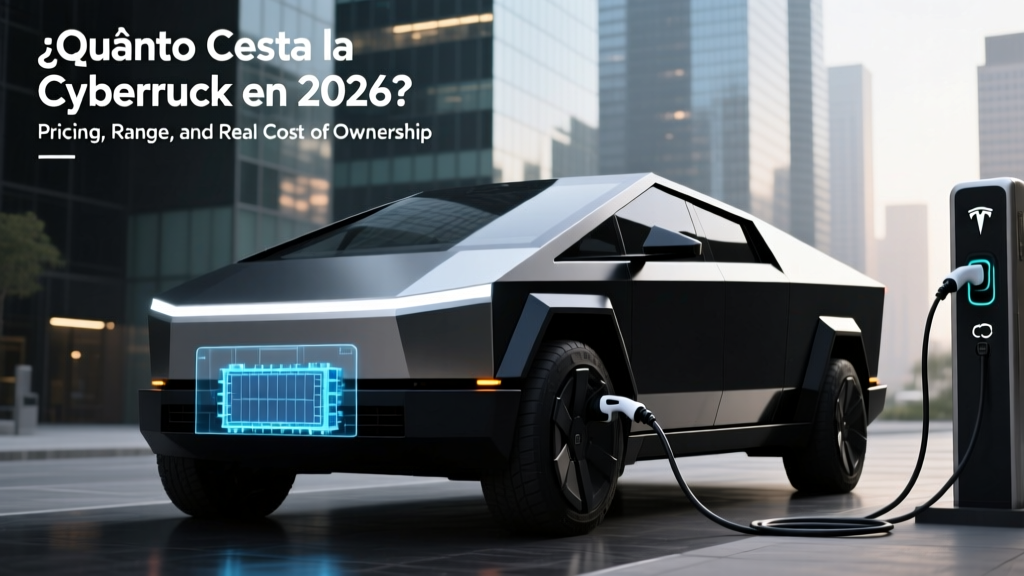
If you've been searching "cuánto cuesta la Cybertruck" and getting a maze of conflicting numbers, you're not alone. Tesla's stainless-steel pickup has seen multiple price adjustments since its late-2023 launch, and the 2026 model year brings a revised lineup that finally includes a more accessible rear-wheel-drive variant alongside the dual- and tri-motor AWD trims. This review breaks down every cost layer — sticker price, federal tax credit eligibility under IRS §30D, charging economics, and five-year ownership — so you know exactly what you'd pay to put a Cybertruck in your driveway.
2026 Tesla Cybertruck: Trim Pricing and What You Actually Pay
The 2026 Cybertruck is offered in three primary trims. Tesla restructured pricing for the 2026 model year after the controversial 2024 "Foundation Series" bundling was pared back. Here is the current MSRP breakdown before any incentives or destination fees:
| Trim | Drivetrain | MSRP | Est. Destination | Total Before Credits |
|---|---|---|---|---|
| RWD (Long Range) | Single Motor / RWD | $60,990 | $1,995 | $62,985 |
| AWD (Dual Motor) | Dual Motor / AWD | $79,990 | $1,995 | $81,985 |
| Cyberbeast (Tri-Motor) | Tri-Motor / AWD | $99,990 | $1,995 | $101,985 |
Key pricing note: The RWD trim was reintroduced for 2026 at a lower entry point than the original 2023 pricing structure, making it the most attainable Cybertruck to date. However, Tesla's pricing has historically shifted mid-year without notice, so these figures reflect the MSRP at the time of writing. Always confirm on Tesla's configurator before committing.
Federal Tax Credit: Does the Cybertruck Qualify for §30D?
This is where many Cybertruck shoppers hit a wall. Under current IRS §30D rules, the federal EV tax credit provides up to $7,500 — but eligibility hinges on three interlocking requirements that disqualify most Cybertruck trims for many buyers:
- MSRP Cap: Pickup trucks must have an MSRP at or below $80,000 to qualify. The RWD ($60,990) and AWD ($79,990) trims clear this threshold. The Cyberbeast at $99,990 does not.
- Buyer Income Cap: Modified adjusted gross income (MAGI) must not exceed $150,000 (single), $225,000 (head of household), or $300,000 (married filing jointly).
- Battery Component & Critical Mineral Sourcing: A percentage of battery components must be manufactured or assembled in North America, and critical minerals must be sourced from the U.S. or FTA partners. Tesla's U.S.-built battery packs generally satisfy the component requirement, but critical-mineral sourcing thresholds tighten annually. For 2026, 80% of critical minerals (by value) must meet the sourcing test to claim the full $3,750 mineral half of the credit.
The point-of-sale transfer option allows eligible buyers to apply the credit as an immediate discount at purchase rather than waiting for tax filing. According to IRS.gov §30D guidelines, the dealer must register the sale through the IRS Energy Credits Online portal at the time of purchase.
| Trim | MSRP + Dest. | Max §30D Credit | Effective Price (if eligible) |
|---|---|---|---|
| RWD | $62,985 | $7,500 | ~$55,485 |
| AWD | $81,985 | $7,500 | ~$74,485 |
| Cyberbeast | $101,985 | $0 (over MSRP cap) | $101,985 |
Bottom line: The RWD and AWD trims can qualify for the full $7,500 if your income and the battery-sourcing requirements align. Consult a tax professional — we cannot guarantee eligibility as sourcing rules are subject to change and individual tax situations vary.
Range, Efficiency, and the Real-World Reality Check
The Cybertruck's angular, stainless-steel exoskeleton is visually striking, but its brick-like aerodynamics take a toll on highway efficiency. Here's what the EPA says versus what you'll actually experience:
EPA Range vs. Real-World Expectations
| Trim | EPA Est. Range | Real-World Highway (~75 mph) | Cold Weather (20°F, mixed) |
|---|---|---|---|
| RWD | ~325 mi | ~250–270 mi | ~210–230 mi |
| AWD | ~340 mi | ~260–280 mi | ~220–240 mi |
| Cyberbeast | ~320 mi | ~240–260 mi | ~200–220 mi |
Note: The Cybertruck's 0.335+ drag coefficient means range drops more sharply at highway speeds than sleeker EVs like the Model Y or Lucid Air. Towing a trailer (up to 11,000 lbs rated) can cut range by 40–50%.
Efficiency varies by trim. The AWD model returns approximately 64 MPGe combined (roughly 52 kWh/100 mi), per fueleconomy.gov. That's less efficient than the Ford F-150 Lightning Extended Range (~70 MPGe) and substantially thirstier than the Rivian R1T Dual-Motor (~73 MPGe). If you commute mostly in the city with regenerative braking doing the heavy lifting, you'll do better than the combined figure. Sustained highway driving, especially above 70 mph, is where the Cybertruck's aero penalty shows up on the energy graph.
Battery Capacity, Chemistry, and Long-Term Degradation
Tesla has not published exact usable kWh figures for the Cybertruck, but teardown data and EPA energy-consumption calculations point to a ~123 kWh usable battery pack in the AWD and Cyberbeast trims, with the RWD likely using a slightly smaller pack (~100–110 kWh usable). The chemistry is Tesla's 4680-format cells, which use an NMC (nickel manganese cobalt) cathode — prioritizing energy density over the extreme cycle life of LFP.
What this means for ownership:
- NMC trade-offs: Higher energy density gives the Cybertruck its 300+ mile range in a physically constrained pack. However, NMC cells degrade slightly faster than LFP over thousands of cycles. Expect roughly 8–12% capacity loss over 150,000 miles based on Tesla fleet data for similar packs.
- Daily charging advice: Tesla recommends charging NMC packs to 80% for daily use and 100% only for long trips. This differs from LFP packs (Model 3 RWD), which Tesla says can be charged to 100% regularly.
- Warranty: The battery and drive unit are covered for 8 years / 120,000 miles (whichever comes first) with a minimum 70% capacity retention threshold. This is in line with industry norms and slightly better than the F-150 Lightning's 8-yr/100,000-mi battery warranty.
Charging Speed: DC Fast Charge and Home Level 2
Charging speed is one of the Cybertruck's stronger suits, thanks to its 800-volt-class architecture. Here's what you can expect at the plug:
| Charging Level | Power / Rate | Speed (mi/hr added) | Notes |
|---|---|---|---|
| Level 1 (120V household) | ~1.4 kW | ~3–4 mi/hr | Emergency/trickle only — full charge takes 3+ days |
| Level 2 (240V / 48A home) | ~11.5 kW | ~28–32 mi/hr | Full charge overnight (~10–11 hrs from 10%); requires NEMA 14-50 or hardwired wall connector |
| DC Fast Charge (V4 Supercharger) | Peak ~350 kW | ~150+ mi in 15 min | 10–80% in approximately 22–25 minutes; sustained rate tapers significantly above 60% SoC |
| DC Fast Charge (non-Tesla 350 kW CCS/NACS) | Peak ~250 kW (adapter-dependent) | ~120 mi in 15 min | Third-party networks via NACS port; speeds vary by station |
Charging curve reality: The Cybertruck peaks near 350 kW only at low state-of-charge (10–25% SoC) on a V4 Supercharger. By 50% SoC, the rate tapers to roughly 200 kW, and above 80% it drops below 80 kW. This is normal for large NMC packs — the charge curve protects cell longevity — but it means that last 20% (80–100%) adds about 20–25 extra minutes. Plan road-trip stops around 10–80% sprints for the best time efficiency.
The Cybertruck uses the NACS (North American Charging Standard) connector natively — the same port now adopted by Ford, GM, Rivian, and most major automakers. At home, a Tesla Wall Connector or any NACS-compatible Level 2 EVSE on a 60A circuit (48A continuous) will deliver the fastest home charging. Budget $800–$2,500 for professional Level 2 installation depending on your panel capacity and run length.
Performance, Dimensions, and Practical Utility
The Cybertruck's performance numbers are extraordinary for a vehicle weighing over 6,600 pounds (AWD curb weight). Here are the headline specs:
| Spec | RWD | AWD | Cyberbeast |
|---|---|---|---|
| Horsepower | ~315 hp | ~600 hp | ~845 hp |
| 0–60 mph | ~6.2 sec | ~3.9 sec | ~2.6 sec |
| Top Speed | 112 mph | 130 mph | 130 mph |
| Towing Capacity | 7,500 lbs | 11,000 lbs | 11,000 lbs |
| Payload Capacity | ~2,500 lbs | ~2,500 lbs | ~2,500 lbs |
| Bed Length | 6 ft (72 in) | ||
| Cargo Volume (bed) | ~67 cu ft (with tonneau closed) | ||
| Front Trunk (Frunk) | ~7.1 cu ft | ||
| Ground Clearance | Up to 17.4 in (with adaptive air suspension, Extraction Mode) | ||
| Approach / Departure Angle | 35° / 28° (max ride height) | ||
Interior space is adequate for a crew-cab pickup but not class-leading. Rear legroom measures approximately 38.4 inches, which trails the F-150 Lightning (~43.5 in) by a noticeable margin. The rear seatback is relatively upright, making long-distance rear-seat comfort a compromise. Front legroom is generous at ~41.5 inches, and the driving position is commanding thanks to the high cowl and flat floor.
Standout Tech and Notable Drawbacks
Tech highlights:
- 18.5-inch center touchscreen running Tesla's latest infotainment (fast, responsive, but no Apple CarPlay/Android Auto)
- 9.4-inch rear-seat touchscreen for climate and entertainment
- Steer-by-wire system with variable ratio (no mechanical linkage to the wheels) — unique in the pickup segment, with ~340° lock-to-lock
- Adaptive air suspension with 12 inches of travel and automatic load-leveling
- Powered tonneau cover with integrated bed lighting and 120V/240V bed outlets (up to 11.5 kW vehicle-to-load power output)
- Tesla Autopilot standard; Full Self-Driving (Supervised) available as a $8,000 option or $99/month subscription
Drawbacks you should know about:
- Stainless-steel body panels show fingerprints aggressively and are difficult/expensive to repair if dented — traditional paintless dent repair often doesn't work
- No rear windshield wiper — visibility in rain relies on the aero-shape shedding water, which is inconsistent
- Tonneau cover reliability — early-production units had motor and seal issues; 2026 models are improved but worth inspecting
- Steer-by-wire learning curve — the variable ratio takes adaptation, especially at low speeds and in parking lots
- Size and weight — at ~223 inches long and 6,600+ lbs, it's cumbersome in tight urban settings and some parking garages
Pros
- Tri-motor Cyberbeast offers supercar-level acceleration in a pickup
- 350 kW peak DC fast-charging on V4 Superchargers
- 11,000-lb towing and robust V2L power output
- Stainless-steel body is dent- and corrosion-resistant (if you accept the patina)
- Access to the Tesla Supercharger network (20,000+ stalls in North America)
- Air suspension with Extraction Mode for serious ground clearance
Cons
- Aerodynamic drag crushes highway range — real-world 250 mi at 75 mph
- Cyberbeast ($99,990) is ineligible for the federal tax credit
- Rear-seat space and comfort lag behind F-150 Lightning and Rivian R1T
- Steer-by-wire and no rear wiper are polarizing design choices
- Insurance premiums run 20–35% higher than comparable pickups
- No Apple CarPlay or Android Auto integration
Cybertruck vs. Competitors: Is It Worth Buying?
The Cybertruck competes in a segment that now has credible alternatives. Here's a quick decision framework:
Choose the Cybertruck if:
- You prioritize acceleration and performance above all else in a truck (Cyberbeast's 2.6-sec 0–60 is unmatched)
- You want access to the Tesla Supercharger network for road-trip convenience
- Steer-by-wire and tech-forward design appeal to you
- You need robust V2L capability for job-site or camping power
Choose the Ford F-150 Lightning if:
- Rear-seat comfort and interior space are priorities (significantly roomier cabin)
- You prefer a more conventional truck layout with proven fleet/commercial support
- You want a lower starting price (~$55,000 for the standard-range Lariat) and broader dealer service network
Choose the Rivian R1T if:
- Off-road capability and build quality are top concerns (quad-motor R1T is exceptionally capable)
- You value a more refined interior and traditional steering feel
- You're willing to accept a smaller charging network (though Rivian now has NACS access to Superchargers)
According to IIHS, the F-150 Lightning has earned Top Safety Pick+ recognition, while the Cybertruck has not yet been fully crash-tested by IIHS or NHTSA as of early 2026 — a consideration for family buyers.
Who Should Buy the 2026 Cybertruck?
Best suited for: Tech-savvy truck buyers who value performance and design statement over traditional utility. The Cybertruck excels as a daily-driver commuter (if you have home charging), a light-duty job-site vehicle with V2L power, and a weekend adventure rig with its air suspension and ground clearance. The RWD trim at ~$55,485 after the tax credit is a compelling value for a 325-mile electric pickup.
Think twice if: You need maximum rear-seat space for family hauling, you regularly tow heavy loads over long distances (range drops to ~150–180 miles while towing 8,000+ lbs), or you live in an area without reliable DC fast-charging infrastructure. The Cybertruck's real-world range limitations and polarizing ergonomics make it a less practical choice than the F-150 Lightning for traditional truck duties.
Frequently Asked Questions
What is the real-world range of the Tesla Cybertruck?
The EPA rates the AWD Cybertruck at approximately 340 miles. In real-world highway driving at 70–75 mph, expect 260–280 miles. In cold weather (below 30°F), range can drop to 220–240 miles due to battery chemistry limitations and increased cabin heating demand. Towing reduces range by 40–50%.
How fast does the Cybertruck charge at home and on the road?
On a Tesla V4 Supercharger, the Cybertruck peaks at ~350 kW and charges from 10–80% in about 22–25 minutes. At home on a 240V/48A Level 2 charger, it adds roughly 30 miles of range per hour, meaning a full charge takes about 10–11 hours. The charge curve tapers significantly above 60% state-of-charge, so the last 20% is noticeably slower.
How much does the Cybertruck cost after federal tax credits?
The RWD trim starts at $60,990 MSRP and can drop to approximately $55,485 after the full $7,500 §30D federal credit (if you meet income and battery-sourcing requirements). The AWD at $79,990 qualifies similarly. The Cyberbeast at $99,990 exceeds the $80,000 MSRP cap for pickups and does not qualify for the federal credit.
Does the Cybertruck qualify for the federal EV tax credit?
The RWD and AWD trims qualify for up to $7,500 under IRS §30D, provided the buyer's MAGI is within limits ($150K single / $300K married) and the battery meets 2026 critical-mineral sourcing thresholds (80% from U.S. or FTA partners). The Cyberbeast is ineligible due to its $99,990 MSRP exceeding the $80,000 pickup cap. Always verify current rules at IRS.gov and consult a tax professional.
Is the Cybertruck worth buying over the F-150 Lightning or Rivian R1T?
It depends on your priorities. The Cybertruck wins on acceleration, DC fast-charging speed, and Supercharger network access. The F-150 Lightning wins on rear-seat comfort, dealer service access, and conventional truck ergonomics. The Rivian R1T wins on off-road capability, interior refinement, and build quality. If you value performance and tech above traditional truck practicality, the Cybertruck is worth a serious look — especially the RWD trim at its new lower price point.
What is the Cybertruck's battery warranty?
Tesla covers the Cybertruck's battery and drive unit for 8 years or 120,000 miles (whichever comes first), with a guaranteed minimum 70% capacity retention over that period. The limited vehicle warranty is 4 years / 50,000 miles.