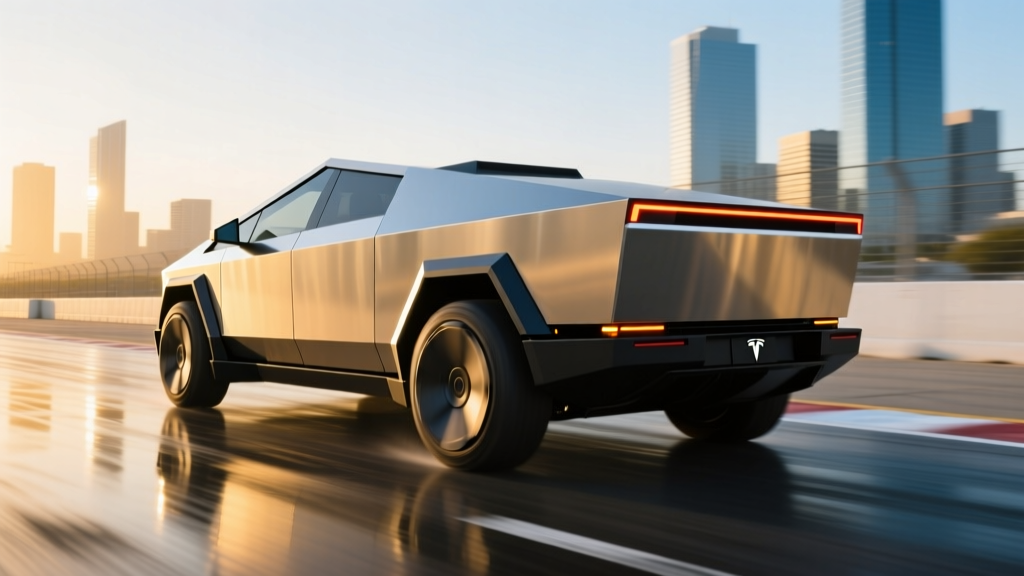
The Tesla Cybertruck remains one of the most polarizing vehicles on the road, but beneath its angular stainless-steel exoskeleton lies a serious performance machine. Buyers researching the Cybertruck often start with one question: how quick is it really? The answer depends heavily on which trim you choose, but even the base model delivers acceleration that embarrasses most sports cars from a decade ago. This review covers every critical spec — from the headline Cybertruck 0-60 time to real-world range, charging curves, and ownership costs — so you can decide whether this electric truck earns a spot in your driveway.
Quick Verdict: Who the Cybertruck Is For
The Cybertruck is best suited for tech-forward truck buyers who prioritize acceleration, towing technology, and over-the-air updates over traditional pickup conventions. If you need a daily driver that can tow a trailer on weekends, carry dirty gear in a stainless-steel bed, and hit 60 mph in under 3 seconds (in the right trim), nothing else in the EV truck segment matches the package. However, if you value proven long-term reliability data, conventional service networks, or a traditional truck ride, competitors like the Ford F-150 Lightning and Rivian R1T deserve equal consideration.
Cybertruck 0-60 Time and Performance Specs by Trim
Tesla offers the Cybertruck in three configurations, each with dramatically different performance profiles. The dual-motor AWD and the tri-motor Cyberbeast share the spotlight, while the long-promised single-motor RWD variant has been pushed to a future model year and remains unreleased as of early 2026.
| Spec | AWD (Dual Motor) | Cyberbeast (Tri Motor) |
|---|---|---|
| 0-60 mph | 3.9 seconds | 2.6 seconds |
| Horsepower | 600 hp | 845 hp |
| Torque | 743 lb-ft | 743 lb-ft |
| Drivetrain | Dual-motor AWD | Tri-motor AWD |
| Top Speed | 112 mph | 130 mph |
| Max Towing | 11,000 lbs | 11,000 lbs |
| Payload Capacity | 2,500 lbs | 2,500 lbs |
The Cybertruck 0-60 time of 2.6 seconds for the Cyberbeast trim places it in hypercar territory — a remarkable figure for a vehicle weighing over 6,800 pounds. Tesla achieves this through a tri-motor setup with torque vectoring across the rear axle. In real-world testing, the Cyberbeast consistently hits 60 mph in 2.6 to 2.8 seconds on prepped surfaces, though warm tires and a full battery state of charge (above 85%) are necessary to achieve the factory claim. The AWD trim's 3.9-second run is more accessible day-to-day and still outpaces the Ford F-150 Lightning Extended Range (4.0 seconds) and the Rivian R1T Dual-Motor (4.5 seconds).
Range, Efficiency, and the Real-World Reality Check
EPA range estimates tell only part of the story for a vehicle this heavy and this un-aerodynamic. Here's what the sticker says versus what you should actually plan for.
- AWD: EPA 340 miles — Expect 280–310 miles in mixed highway/city driving; 240–270 miles in sustained 75+ mph highway use or cold weather (below 32°F).
- Cyberbeast: EPA 320 miles — Expect 260–290 miles mixed; 220–250 miles highway or cold conditions.
For extended range, Tesla offers an optional Range Extender battery pack (bed-mounted) that adds approximately 130+ miles of EPA range to the AWD trim, pushing total capacity beyond 500 miles on paper. Availability has been limited and is currently on a waitlist basis.
Efficiency ratings from fueleconomy.gov place the AWD Cybertruck at approximately 2.0 kWh/mile (roughly 50 MPGe combined), which is notably less efficient than the F-150 Lightning (around 2.0–2.2 kWh/mile depending on trim) but expected given the Cybertruck's mass and stainless-steel body panels. The Cyberbeast, with its more aggressive powertrain calibration, dips slightly lower in MPGe.
Battery Capacity, Chemistry, and Long-Term Health
Tesla has not published official usable battery capacity figures for the Cybertruck, but independent teardowns and telemetry data from early owners point to a pack size of approximately 123 kWh usable in both AWD and Cyberbeast trims. The battery chemistry is NMC (nickel manganese cobalt), which offers higher energy density than LFP but trades some cycle-life longevity. Tesla's proprietary 4680-format cells are manufactured at Giga Texas and represent the first high-volume deployment of this cell format in a production vehicle.
NMC chemistry means Tesla recommends daily charging to 80–90% for routine use, reserving 100% charges for road trips. This contrasts with LFP packs (found in the base Model 3/Y RWD), which tolerate daily 100% charges. Battery degradation data is still early for the Cybertruck, but Tesla's 4680 cells are expected to retain approximately 85–90% capacity after 150,000 miles based on modeling and early fleet data.
Charging Speed: DC Fast, Level 2, and the Charge Curve
The Cybertruck uses the NACS (North American Charging Standard) connector natively, giving it seamless access to Tesla's Supercharger network — currently the most reliable DC fast-charging infrastructure in the US.
| Charging Level | Power (kW) | Speed / Time |
|---|---|---|
| Level 1 (120V household) | ~1.4 kW | ~3–4 miles per hour |
| Level 2 (240V home, 48A) | 11.5 kW | ~34 miles per hour; full charge in ~11 hours |
| Level 2 (240V home, 80A Wall Connector) | 19.2 kW | ~52 miles per hour; full charge in ~7 hours |
| DC Fast Charge (Supercharger V4) | Peak ~250 kW | 10–80% in approximately 28 minutes |
The 10–80% DC fast-charge time of roughly 28 minutes is competitive but not class-leading. The Hyundai Ioniq 5, with its 800V architecture, manages the same swing in about 18 minutes. The Cybertruck's massive 123 kWh battery means that even at 250 kW peak, filling the pack takes longer than smaller-battery EVs. The charge curve peaks around 250 kW up to approximately 40% state of charge, then tapers progressively — dropping to around 100 kW by 65% and below 50 kW past 85%. This taper is typical of NMC chemistry and is managed by the vehicle's thermal preconditioning system.
For home charging, Tesla's Wall Connector at 80 amps (requiring a 100-amp circuit) is the practical sweet spot. Expect to pay $1,200–$2,500 for a professional Level 2 installation including the circuit, depending on your panel capacity and run distance. If your home has a 200-amp main panel with limited spare capacity, a panel upgrade or load-management device may add $1,500–$4,000.
Pricing, Tax Credits, and True Cost of Ownership
The Cybertruck's pricing has been a moving target since its reveal, but current MSRP figures for the 2025–2026 model year are as follows:
| Trim | Base MSRP | Federal §30D Credit Eligible? | Effective Price (est.) |
|---|---|---|---|
| AWD (Dual Motor) | $79,990 | Yes — up to $7,500 (subject to income, sourcing rules) | ~$72,490 |
| Cyberbeast (Tri Motor) | $99,990 | Yes — up to $7,500 (subject to income, sourcing rules) | ~$92,490 |
Critical tax credit caveats: Under current IRS §30D rules, the Cybertruck qualifies as a light truck, so it falls under the $80,000 MSRP cap for trucks/vans/SUVs. The AWD trim at $79,990 clears this threshold; the Cyberbeast at $99,990 exceeds it and is not eligible for the federal credit unless Tesla adjusts pricing or options. Buyer income caps also apply: $300,000 MAGI for joint filers, $225,000 for heads of household, $150,000 for single filers. Additionally, critical-mineral and battery-component sourcing requirements must be met — Tesla's 4680 cells are US-manufactured, which helps, but final eligibility depends on the specific build date and supply-chain compliance. Always verify with a tax professional before relying on the credit. The point-of-sale transfer option allows eligible buyers to apply the credit as a down-payment reduction at delivery.
Interior, Cargo, and Daily-Use Practicality
The Cybertruck's interior is minimalist in the extreme — a single 18.5-inch front touchscreen handles nearly all vehicle functions, with a 9.4-inch rear screen for passengers. There are no traditional stalks for turn signals or wipers; these are integrated into the steering wheel and touchscreen, which remains a polarizing choice.
| Dimension | Measurement |
|---|---|
| Front Legroom | 41.4 inches |
| Rear Legroom | 38.2 inches |
| Bed Length | 72 inches (6 feet) |
| Bed Width (between wheel wells) | 48.5 inches |
| Cargo Volume (bed, tonneau closed) | 67 cu ft |
| Frunk Volume | ~7 cu ft (lockable) |
| Seating Capacity | 5 (bench front seat with fold-down center armrest) |
| Vehicle Length | 223.6 inches |
The powered tonneau cover is a standout feature — it retracts into the bed wall and supports up to 300 pounds of distributed weight on top. The bed itself is stainless steel, requiring no liner, and includes built-in tie-downs, a 240V outlet (for power tools or camping), and integrated LED lighting. The frunk is small compared to the F-150 Lightning's massive front trunk but provides secure, weather-sealed storage for a laptop bag or groceries.
Driver Assistance, Tech, and What It Cannot Do
The Cybertruck ships with Tesla's Autopilot suite, which includes adaptive cruise control, lane-centering, and automatic emergency braking. The optional Full Self-Driving (Supervised) package adds automated lane changes, traffic-light recognition, and city-street navigation — but this remains a SAE Level 2 system. The driver must remain attentive, keep hands available, and be prepared to intervene at any moment. This is not autonomous driving; it is an advanced driver-assistance system, comparable in automation level to Ford BlueCruise or GM Super Cruise, though with a different operational design domain.
Tesla Autopilot and FSD (Supervised) are SAE Level 2 systems. The driver is legally and operationally responsible for the vehicle at all times. FSD does not make the Cybertruck self-driving. Expect occasional phantom braking, lane-centering imperfections in construction zones, and the need for active supervision. Review NHTSA guidance on automated vehicle safety before relying on any driver-assist feature.
Other standout tech includes steer-by-wire (no mechanical connection between the steering wheel and the wheels), rear-wheel steering for a tight 34.9-foot turning circle, and an adaptive air suspension with 16 inches of ground clearance in Extract mode for off-road use. The vehicle also supports a digital key via the Tesla app and Sentry Mode for parking-lot surveillance.
Warranty Coverage and Long-Term Reliability
Tesla provides the following warranty coverage for the Cybertruck:
- Vehicle Limited Warranty: 4 years / 50,000 miles
- Battery & Drive Unit Warranty: 8 years / 120,000 miles (with minimum 70% capacity retention)
- Rust-Through Warranty: Not separately published; stainless-steel body panels are inherently corrosion-resistant
The 8-year/120,000-mile battery warranty is competitive with the industry standard (most EVs offer 8 years / 100,000 miles). The 70% retention threshold means Tesla will repair or replace the pack if it drops below that capacity within the warranty period. Given the early stage of 4680-cell fleet data, long-term reliability remains an open question — early adopters should budget for potential service delays, as Tesla's service center network is still expanding to handle Cybertruck-specific body and drivetrain work.
Cybertruck vs. the Competition: Is It Worth It?
- You want the fastest-accelerating production pickup (2.6s 0-60 Cyberbeast)
- Supercharger network access is a priority for road trips
- Steer-by-wire and rear-wheel steering appeal to you
- You value OTA updates and software-centric vehicle evolution
- You need a proven service network and conventional dealer support (F-150 Lightning)
- You prefer a more refined interior and adventure-focused design (Rivian R1T)
- You need a larger frunk for gear storage (Lightning offers 14.1 cu ft)
- You want a more traditional driving feel without steer-by-wire
- Class-leading 0-60 time (2.6s Cyberbeast)
- Seamless Supercharger network access (NACS native)
- Stainless-steel bed requires no liner; powered tonneau standard
- 11,000-lb towing with integrated trailer tech
- Steer-by-wire enables tight turning radius (34.9 ft)
- 240V bed outlet for job-site or camping power
- Cyberbeast exceeds $80K MSRP cap — no federal tax credit
- Real-world highway range drops 15–25% below EPA
- Steer-by-wire and stalkless controls require adaptation
- Limited service center capacity for body repairs
- Heavy (6,800+ lbs) — tire wear and efficiency penalties
- No Apple CarPlay or Android Auto support
Frequently Asked Questions
What is the real-world range of the Tesla Cybertruck?
The AWD trim carries an EPA rating of 340 miles, but in real-world highway driving at 70–80 mph, expect 280–310 miles. In cold weather (below freezing), plan for 240–270 miles. The Cyberbeast rates at 320 miles EPA with a real-world expectation of 260–290 miles mixed driving.
How fast does the Cybertruck charge at home and on the road?
On a 240V Level 2 home charger at 80 amps, the Cybertruck adds approximately 52 miles of range per hour and charges fully in about 7 hours. On a Tesla V4 Supercharger, it peaks at approximately 250 kW and charges from 10–80% in roughly 28 minutes, with significant taper above 65% SoC.
Does the Cybertruck qualify for the $7,500 federal EV tax credit?
The AWD trim at $79,990 MSRP falls under the $80,000 truck MSRP cap and is potentially eligible for up to $7,500 under IRS §30D, subject to buyer income limits, battery-sourcing requirements, and point-of-sale transfer rules. The Cyberbeast at $99,990 exceeds the MSRP cap and is not eligible for the federal credit. Always confirm eligibility with a tax professional and consult the latest IRS guidance.
Is the Cybertruck worth buying over the F-150 Lightning or Rivian R1T?
If raw acceleration, Supercharger access, and the stainless-steel utility bed are priorities, the Cybertruck is unmatched. For buyers who need a larger frunk, conventional dealer service, or a more refined ride, the F-150 Lightning and Rivian R1T are strong alternatives. Test-drive all three before deciding — the Cybertruck's steer-by-wire feel and minimalist interior are love-it-or-leave-it propositions.
What is the Cybertruck's towing range impact?
Towing at or near the 11,000-pound maximum will cut range roughly in half — expect 150–170 miles from the AWD trim when towing a heavy trailer at highway speeds. Tesla's integrated trailer brake controller and hitch-assist camera system help, but plan charging stops accordingly.
Does the Cybertruck have Apple CarPlay or Android Auto?
No. Tesla does not support Apple CarPlay or Android Auto in any vehicle. All infotainment, navigation, and media functions run through Tesla's proprietary interface on the 18.5-inch center screen.