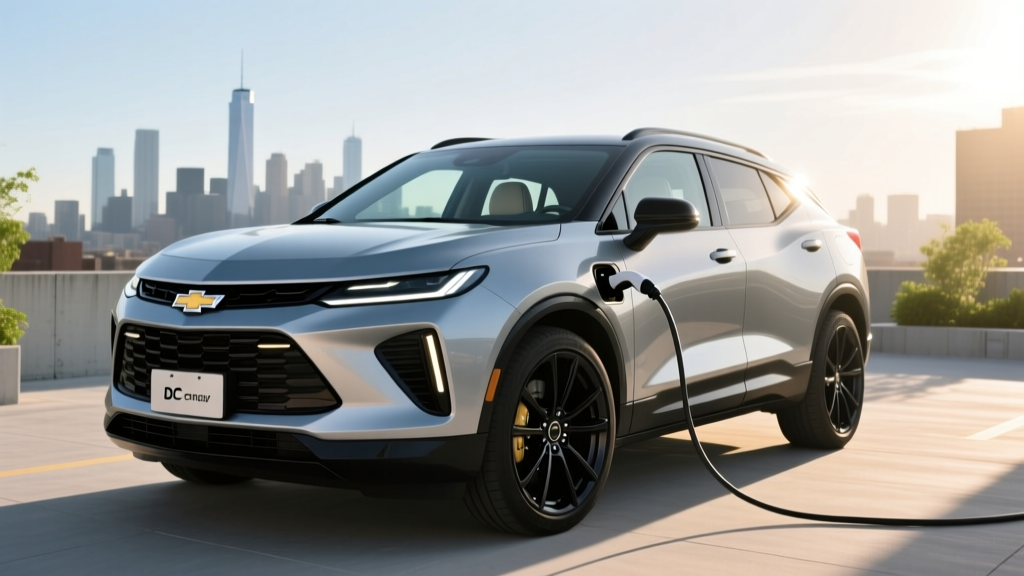
The 2026 Chevrolet Blazer EV returns after a turbulent launch cycle with a clearer value proposition: a midsize electric crossover built on GM's Ultium platform that prioritizes cabin space, ride comfort, and accessible fast-charging infrastructure over outright performance. With EPA-estimated ranges stretching to 324 miles and a starting MSRP that lands within the federal tax credit window, it is one of the more practical family-sized EVs on the market. But how does it stack up once you leave the spec sheet behind?
We've spent time with the Blazer EV across city commuting, highway road trips, and DC fast-charging sessions to separate the marketing from reality. Here's everything you need to decide whether this SUV earns a spot in your driveway.
Range, Efficiency, and the Real-World Reality Check
The 2026 Blazer EV lineup offers three distinct range tiers depending on trim and drivetrain. The volume seller — the 2LT with the larger battery pack and rear-wheel drive — carries an EPA-estimated 324 miles. All-wheel-drive variants drop to roughly 279–283 miles, while the performance-oriented SS trim sits at approximately 293 miles.
EPA estimate: 324 mi (2LT RWD) / 279 mi (AWD) / 293 mi (SS)
Expect on the highway (70+ mph): ~255–270 mi for the 2LT RWD; ~230–245 mi for AWD trims
Cold-weather penalty (below 30°F): Plan for a 20–30% reduction — a 324-mi sticker can shrink to ~225–260 mi in freezing conditions without aggressive preconditioning.
Bottom line: The 324-mi figure is achievable in mild weather around town. Highway road trippers should plan stops at 220–250 miles to maintain a comfort buffer.
Efficiency lands in the middle of the midsize EV pack. The 2LT RWD achieves an EPA-rated 89 MPGe combined (roughly 38 kWh/100 mi). AWD trims dip to approximately 84 MPGe. These numbers trail the Hyundai Ioniq 5's 114 MPGe but are competitive with the Ford Mustang Mach-E AWD and Volkswagen ID.4 Pro S. The Blazer EV's size and weight work against it — at over 5,600 pounds for AWD models, physics demands more energy per mile.
Battery, Platform, and Chemistry
The Blazer EV rides on GM's BEV3 architecture with an Ultium-format battery pack. The larger pack — standard on 2LT and SS trims — provides approximately 102 kWh of usable capacity (gross capacity is slightly higher, with a software buffer protecting the cells at the top and bottom of the state-of-charge window). GM uses NMC (nickel manganese cobalt) chemistry in these packs, which delivers higher energy density than LFP at the cost of slightly faster long-term degradation and a lower thermal runaway threshold.
For daily ownership, this means you'll want to follow the 80% daily charge guideline for NMC packs — only charging to 100% when you need the full range for a road trip. GM's MyChevy app allows you to set a target charge level to automate this. The Blazer EV does not currently offer an LFP battery option, which some competitors (notably Tesla's Model Y Standard Range) use for buyers who prefer the 100% daily-charge tolerance and longer cycle life of iron-phosphate chemistry.
| Spec | 2LT RWD | 2LT / RS AWD | SS AWD |
|---|---|---|---|
| EPA Range | 324 mi | 279–283 mi | 293 mi |
| Battery (usable) | ~102 kWh (NMC) | ~102 kWh (NMC) | ~102 kWh (NMC) |
| Horsepower | 288 hp | 288 hp | 557 hp (Wide Open Watts mode) |
| 0–60 mph | ~7.5 sec | ~7.0 sec | ~3.9 sec |
| Drivetrain | RWD (single motor) | AWD (dual motor) | AWD (dual motor, performance) |
| MPGe (combined) | 89 MPGe | ~84 MPGe | ~82 MPGe |
| Max DC Fast Charge | 190 kW | 190 kW | 190 kW |
| 10–80% DC Time | ~33 min | ~33 min | ~33 min |
| Base MSRP | $44,600 | $47,600 | $55,400 |
Charging Speed: DC Fast Charging and Home Setup
Charging capability is where the Blazer EV makes a practical — if not class-leading — statement. All trims support a peak DC fast-charge rate of 190 kW via the standard CCS connector (GM has confirmed NACS adapter availability for Tesla Supercharger access). At a 350 kW Electrify America or EVgo station, the Blazer EV can add approximately 78 miles of range in 10 minutes when starting from a low state of charge.
The 10–80% charge takes approximately 33 minutes under ideal conditions (warm battery, low state of charge at plug-in). As with all NMC packs, the charge curve tapers significantly above 80% — a full 80–100% session can add another 25–30 minutes. Preconditioning the battery before arrival at a DC station (via the navigation system's charge-stop routing) is essential to hitting these peak rates, especially in cooler weather.
| Level | Power | Speed | Typical Use |
|---|---|---|---|
| Level 1 (120V) | ~1.4 kW | ~3–4 mi/hr | Emergency / overnight trickle |
| Level 2 (240V, 48A) | 11.5 kW | ~31 mi/hr | Home / workplace daily charging |
| DC Fast Charge | Up to 190 kW | 10–80% in ~33 min | Road trips, public stations |
For home charging, the Blazer EV's onboard charger accepts up to 11.5 kW on a Level 2, 48-amp circuit. This means a full 0–100% charge takes roughly 9.5 hours — easily accomplished overnight. A proper home Level 2 installation (240V, 60-amp circuit with a hardwired charger like the ChargePoint Home Flex or Emporia Level 2) typically costs $800–$2,200 depending on panel capacity and run length. If your home has a 100-amp electrical panel that's already near capacity, budget an additional $1,500–$3,000 for a panel upgrade to 200 amps. Always consult a licensed electrician for a site-specific quote.
Performance and Drivetrain Behavior
The 2LT and RS trims deliver 288 horsepower — adequate for confident highway merging and passing but not thrilling. The RWD 2LT hits 60 mph in approximately 7.5 seconds, while AWD versions shave about half a second. For a 5,600-pound crossover, these are respectable numbers that put the Blazer EV in the same ballpark as the base Mustang Mach-E and ID.4.
The SS trim is the outlier. With dual performance motors and GM's Wide Open Watts (WOW) mode, it produces 557 horsepower and 648 lb-ft of torque, launching to 60 mph in approximately 3.9 seconds. That's legitimately quick — faster than a base Corvette from a decade ago. However, the SS's 293-mile range and $55,400+ price tag make it a niche choice. Most buyers will be better served by the 2LT AWD, which balances range, traction, and value.
Ride quality is where the Blazer EV quietly excels. The independent rear suspension and well-tuned damping absorb highway expansion joints and rough city pavement with composure. The steering is light and numb by enthusiast standards, but for a family SUV, it's tuned for low-effort maneuverability in parking lots. Regenerative braking offers two modes — one-pedal driving for around-town efficiency and a coasting mode for highway cruising. The brake pedal feel is among the better EV blends, with a natural transition from regen to friction braking.
Interior Space, Cargo, and Technology
The Blazer EV is a midsize two-row crossover, and its cabin dimensions reflect that positioning. Front-seat legroom measures 43.1 inches, with rear legroom at 38.4 inches — competitive with the Mach-E and slightly tighter than the Ioniq 5's generous 39.4-inch rear. Headroom is ample front and rear, and the flat floor (no transmission tunnel) makes the rear middle seat genuinely usable for an adult on shorter trips.
Cargo space behind the second row comes in at 25.5 cubic feet, expanding to approximately 58.5 cubic feet with the rear seats folded. There is no front trunk (frunk) — the space under the hood houses HVAC and power electronics. This is a notable omission versus the Mach-E (which offers 4.7 cu ft of frunk space) and the Ioniq 5 (0.85 cu ft). For a vehicle this size, the 25.5 cu ft rear cargo area is on the modest side; the Hyundai Ioniq 5 offers 27.2 cu ft behind its rear seats.
The infotainment system centers on a 17.7-inch diagonal touchscreen running GM's latest Ultifi software platform — a significant improvement over the early Blazer EV software that drew criticism at launch. Wireless Apple CarPlay and Android Auto are standard, as is Google Built-In for Maps, Assistant, and Play Store apps. The driver faces an 11-inch digital instrument cluster. Wireless phone charging, a Wi-Fi hotspot, and a Bose premium audio system (on RS and SS) round out the tech suite.
On the driver-assistance front, the Blazer EV comes standard with Chevy Safety Assist (automatic emergency braking, lane-keep assist, adaptive cruise control, following distance indicator). Available Super Cruise — GM's hands-off, eyes-on Level 2 highway driving system — is offered on RS and SS trims and operates on over 750,000 miles of mapped roads in North America. It remains one of the most polished Level 2 systems available, but it is emphatically not self-driving: the driver must remain attentive, and the infrared camera monitoring your eyes will issue escalating warnings if you look away.
Pricing, Trims, and Federal Tax Credit Eligibility
The 2026 Blazer EV is offered in three main trims. Pricing starts at $44,600 for the 2LT (including destination), with AWD adding approximately $3,000. The RS trim starts around $50,200, and the performance SS begins at $55,400. A fully loaded SS with all packages can push past $62,000.
| Trim | Base MSRP | Est. As-Tested | §30D Credit Eligibility | Effective Price (with max credit) |
|---|---|---|---|---|
| 2LT RWD | $44,600 | $47,500 | Eligible (under $80K cap) | ~$37,100–$40,000 |
| 2LT AWD | $47,600 | $50,800 | Eligible (under $80K cap) | ~$40,100–$43,300 |
| RS AWD | $50,200 | $54,500 | Eligible (under $80K cap) | ~$42,700–$47,000 |
| SS AWD | $55,400 | $62,000+ | Eligible (under $80K cap) | ~$47,900–$54,500 |
All Blazer EV trims fall well under the IRS §30D MSRP cap of $80,000 for SUVs. However, qualifying for the full $7,500 credit depends on several factors that change annually and vary by buyer:
- Buyer income caps: Modified adjusted gross income must not exceed $150,000 (single), $225,000 (head of household), or $300,000 (joint filers).
- Battery sourcing requirements: The credit is split into two $3,750 halves — one for critical minerals sourcing and one for battery component manufacturing. GM has been working to onshore Ultium battery production (cells are manufactured at Ultium Cells plants in Ohio and Tennessee), but the critical-minerals half depends on supply-chain agreements that can shift year to year.
- Point-of-sale transfer: As of 2024, eligible buyers can transfer the credit to the dealer at purchase, reducing the out-of-pocket price immediately rather than waiting for a tax refund.
We strongly recommend verifying current-year eligibility on IRS.gov and consulting a tax professional before relying on the credit in your purchase math. The partial credit ($3,750) is a realistic scenario if only one of the two sourcing requirements is met.
Warranty and Long-Term Ownership
GM backs the Blazer EV's battery pack and electric drive components with an 8-year/100,000-mile limited warranty, which covers defects and capacity loss below a specified threshold (typically 60–70% of original capacity, though the exact retention floor should be confirmed in your purchase documentation). The vehicle limited warranty is 3 years/36,000 miles, which is average for the segment.
For long-term ownership, the NMC chemistry in the Ultium pack will experience gradual degradation — industry data suggests most NMC packs lose 8–12% of capacity over the first 100,000 miles, with degradation slowing significantly after the initial break-in period. GM's active thermal management system (liquid cooling and heating) helps mitigate temperature-driven degradation, which is critical in both hot desert climates and cold northern winters. Replacement cost for an Ultium pack is not yet widely published for the Blazer EV specifically, but GM has indicated modular repairability — individual battery modules can be replaced rather than the entire pack, which should reduce out-of-warranty repair costs versus competitors with monolithic packs.
Pros, Cons, and the Competitive Verdict
- Up to 324 mi EPA range (2LT RWD)
- Comfortable, quiet ride quality
- 17.7-inch infotainment with Google Built-In
- Super Cruise availability (mature Level 2 system)
- Competitive pricing under §30D MSRP cap
- Spacious rear seat for adults
- CCS + NACS adapter for Supercharger access
- No front trunk (frunk)
- Cargo space modest for the class (25.5 cu ft)
- 190 kW peak DC charge — trails Hyundai/Kia's 800V architecture
- Efficiency (89 MPGe) lags Ioniq 5 and Model Y
- SS trim expensive for its range tradeoff
- Early-production software issues may linger in buyer perception
- No LFP battery option for daily 100% charging
Against the Hyundai Ioniq 5, the Blazer EV offers more traditional crossover styling and a slightly lower entry price, but the Ioniq 5's 800V architecture enables 10–80% charging in ~18 minutes at 350 kW stations — a significant road-trip advantage. The Ioniq 5 also delivers better MPGe and a frunk, though its rear cargo area is comparable.
Against the Ford Mustang Mach-E, the Blazer EV wins on rear-seat space and ride comfort but trails in driving engagement and available performance (the Mach-E GT hits 60 in ~3.5 seconds at a lower price than the Blazer SS). The Mach-E also offers BlueCruise, a competitive hands-off Level 2 system.
Against the Tesla Model Y, the Blazer EV offers a more conventional dealership experience, physical buttons for climate controls, and available Super Cruise. But the Model Y still leads in efficiency, Supercharger network seamlessness, and cargo versatility (including a frunk). The Model Y's price advantage after tax credits can also be substantial.
Who Should Buy the 2026 Blazer EV?
- You want a midsize electric SUV with a comfortable, car-like ride and generous rear-seat room for car seats or adult passengers.
- You value a traditional dealership purchase experience and GM's service network.
- Super Cruise hands-off highway driving is a priority for your commute or road trips.
- You want 300+ miles of EPA range without paying a luxury-badge premium.
Look elsewhere if:
- Fastest possible DC charging is critical (consider the Ioniq 5 or Ioniq 6).
- You need maximum cargo space or a frunk (consider the Model Y or Rivian R1S).
- You want an LFP battery for worry-free daily 100% charging (consider the Tesla Model Y RWD).
- Driving dynamics and engagement matter more than comfort (consider the Mach-E or Ioniq 5 N).
Frequently Asked Questions
What is the real-world range of the 2026 Chevrolet Blazer EV?
The EPA rates the 2LT RWD at 324 miles, but expect approximately 255–270 miles on highway road trips at 70+ mph in mild weather. In cold conditions (below 30°F), plan for 225–260 miles before needing to charge. AWD trims deliver proportionally less — figure 230–245 miles highway for the 2LT AWD.
How fast does the Blazer EV charge at home and on the road?
On a home Level 2 charger (240V, 48A), the Blazer EV charges at up to 11.5 kW, adding roughly 31 miles per hour — a full overnight charge takes about 9.5 hours. On DC fast chargers, it peaks at 190 kW and achieves 10–80% in approximately 33 minutes under ideal conditions.
Does the 2026 Blazer EV qualify for the $7,500 federal tax credit?
All trims fall under the $80,000 MSRP cap for SUVs. However, the full $7,500 credit depends on your income (must be under $150K single / $300K joint), the battery's critical-minerals sourcing, and component manufacturing requirements. A partial $3,750 credit is a realistic scenario. Verify current rules at IRS.gov and consult a tax professional.
Is the Blazer EV worth buying over the Ioniq 5 or Model Y?
It depends on your priorities. The Blazer EV wins on ride comfort, rear-seat room, and Super Cruise availability. The Ioniq 5 charges faster and is more efficient. The Model Y offers the best cargo versatility and Supercharger network integration. Test-drive all three and compare the effective price after incentives for your specific situation.
Does the Blazer EV have Super Cruise, and is it self-driving?
Super Cruise is available on RS and SS trims. It is a Level 2 hands-off, eyes-on system — meaning you can take your hands off the wheel on mapped highways, but you must remain attentive and ready to resume control. It is not autonomous driving.
What is the battery warranty?
GM provides an 8-year/100,000-mile battery and powertrain warranty covering defects and significant capacity loss. The bumper-to-bumper warranty is 3 years/36,000 miles.