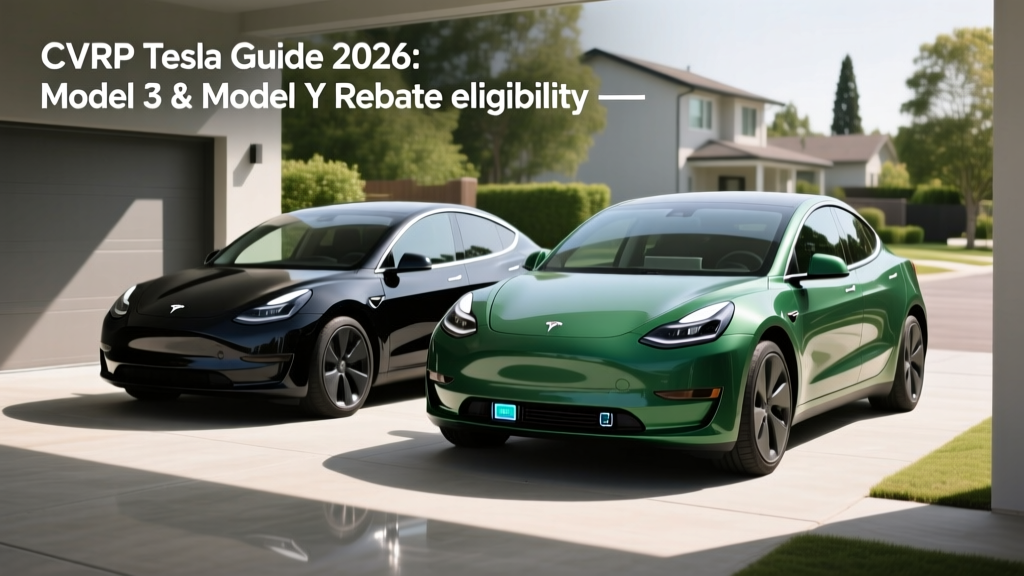
Understanding the CVRP Tesla Incentive Landscape
For California residents eyeing a Tesla, the Clean Vehicle Rebate Project (CVRP) has historically been the go-to state incentive. However, as of 2026, the landscape has shifted. The original CVRP funding was exhausted and transitioned into broader equity-focused programs under the California Air Resources Board (CARB). While the specific "CVRP" brand is largely retired for new applicants, California buyers can still access significant point-of-sale incentives through the Clean Cars 4 All program and federal §30D tax credits, which can often be stacked for maximum savings on a new Tesla Model 3 or Model Y.
This guide breaks down the 2026 Tesla lineup, focusing on how current state and federal incentives apply, alongside the hard data on range, charging, and ownership costs you need to make a decision.
2026 Tesla Model 3: Range, Battery, and Efficiency
The 2026 Tesla Model 3 "Highland" refresh continues to offer one of the most efficient powertrains on the market. For buyers prioritizing range and value, the Long Range RWD is the sweet spot.
Real-World Range Reality
EPA Estimate: 363 miles (Long Range RWD)
Real-World Expectation: Expect ~310 miles at sustained highway speeds (75 mph). In freezing weather (below 32°F), range can drop by 20-30% due to cabin heating and battery chemistry limitations, bringing usable range closer to 250 miles.
| Trim | Battery (Usable) | Chemistry | EPA Range | MPGe | 0-60 mph |
|---|---|---|---|---|---|
| RWD | ~57 kWh | LFP | 272 mi | 132 MPGe | 5.8s |
| Long Range RWD | ~75 kWh | NMC | 363 mi | 132 MPGe | 4.9s |
| Long Range AWD | ~75 kWh | NMC | 346 mi | 124 MPGe | 4.2s |
| Performance | ~75 kWh | NMC | 315 mi | 113 MPGe | 2.9s |
Battery Chemistry: LFP vs. NMC
The base RWD model uses a Lithium Iron Phosphate (LFP) battery. LFP is heavier and less energy-dense but offers a longer cycle life and can be charged to 100% daily without degradation concerns. The Long Range and Performance trims use Nickel Manganese Cobalt (NMC) chemistry, which provides higher energy density for longer range but should typically be charged to 80% for daily use to preserve long-term health.
Charging Speed and Infrastructure
Tesla's Supercharger network remains the gold standard for reliability, but home charging is where most owners spend their time.
- DC Fast Charging: Long Range models peak at ~250 kW on V3 Superchargers. A 10-80% charge takes approximately 25-30 minutes. Note that charging curves taper significantly above 80% to protect the battery.
- Level 2 Home Charging: The onboard charger accepts up to 11.5 kW (48 amps). Using a Tesla Wall Connector on a 60-amp circuit, you can add up to 44 miles of range per hour.
Pricing and Incentive Eligibility (CVRP & Federal)
Navigating incentives is complex. While the traditional CVRP is no longer accepting new general applications, the federal §30D credit remains a primary factor for 2026 Tesla buyers.
2026 Pricing & Credit Stack
| Model | Base MSRP | Federal §30D (Est.) | CA Clean Cars 4 All (Max) | Effective Price |
|---|---|---|---|---|
| Model 3 RWD | $38,990 | $7,500 | Up to $9,500* | ~$21,990 |
| Model 3 LR | $42,990 | $7,500 | Up to $9,500* | ~$25,990 |
| Model Y LR | $44,990 | $7,500 | Up to $9,500* | ~$27,990 |
*CA Clean Cars 4 All incentives are income-based and require retirement of an older gas vehicle. Federal §30D credit has income caps ($150k single / $300k joint) and MSRP limits ($55k sedans / $80k SUVs).
For the latest official rules on California's transition from CVRP to current equity programs, refer to the California Air Resources Board (CARB).
Interior Tech and Cargo Utility
The 2026 Model 3 interior is minimalist, dominated by a 15.4-inch central touchscreen that controls everything from mirrors to glovebox release. The "Highland" update added ambient lighting, ventilated seats, and a rear touchscreen for passengers.
- Cargo Volume: 23 cu ft (rear trunk) + 3.1 cu ft (frunk).
- Legroom: 42.7 inches (front) / 35.2 inches (rear).
- Tech: Standard Autopilot (SAE Level 2) includes traffic-aware cruise and lane centering. FSD (Supervised) remains an expensive add-on that requires full driver attention.
Ownership and Warranty
Tesla's warranty is competitive but not class-leading. The Model 3 and Model Y include a 4-year/50,000-mile limited warranty and an 8-year/100,000-mile (or 120,000-mile for LR/AWD) battery and drive unit warranty. Tesla guarantees the battery will retain at least 70% of its capacity during this period.
Pros and Cons
Pros
- Class-leading efficiency and real-world range
- Access to the Supercharger network
- High performance even on base trims
- Strong resale value relative to other EVs
Cons
- No physical stalks (turn signals on steering wheel)
- Panel gap inconsistencies still reported
- Repair costs can be high out-of-warranty
- Rear visibility is limited
FAQ: CVRP and Tesla Ownership
Is the CVRP still available for Tesla in 2026?
The original CVRP rebate program has been largely superseded by the Clean Cars 4 All program and federal point-of-sale incentives. You should check current CARB guidelines for your specific income and zip code eligibility.
Does the Tesla Model 3 qualify for the $7,500 federal credit?
Yes, provided your income is below the IRS caps and the vehicle's MSRP is under $55,000. The credit can now be transferred to the dealer at the point of sale to reduce the purchase price immediately.
Which Tesla model is best for a California commuter?
The Model 3 Long Range RWD offers the best balance of range (363 mi EPA), efficiency, and price after incentives for daily commuting and occasional road trips.