The Cream Interior Tesla: A 2026 Buyer's Deep Dive
If you've been browsing Tesla's configurator or scrolling through owner forums, you've likely searched for the perfect cream interior Tesla. The light, airy cabin option has become one of the most requested upgrades across the Model 3 and Model Y lineup, offering a premium feel that contrasts sharply with the standard all-black cabin. But beyond aesthetics, what are you actually getting when you spec a Tesla with the cream interior in 2026? This review breaks down the exact specifications, real-world range expectations, charging performance, and ownership economics of the models that offer this sought-after interior option.
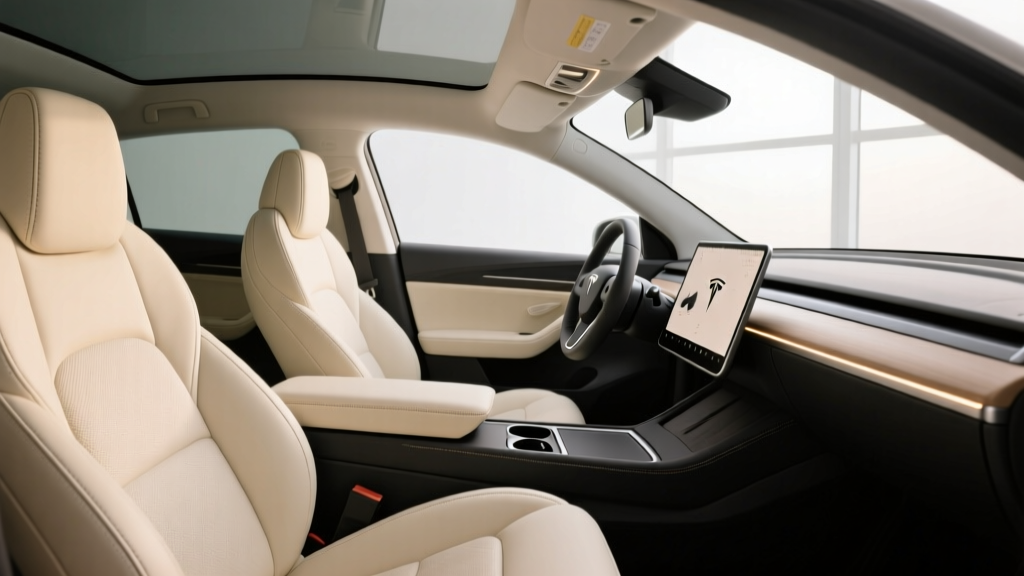
For 2026, Tesla offers the cream interior as a $1,000 premium upgrade on select trims of the Model 3 Long Range and Model Y Long Range. It's not merely a color swap — the cream option includes vegan leather upholstery with a unique perforated pattern on the seats, light-colored door panels, and a cream-toned lower dashboard trim that fundamentally changes the cabin's character. Let's examine whether the numbers behind these vehicles justify the investment.
Range, Battery, and Real-World Efficiency
Real-World Expectation: Expect 270–290 miles on highway-heavy trips at 70–75 mph. In freezing winter conditions (below 30°F), plan for 220–250 miles depending on cabin heat usage and whether you precondition. City driving with regen braking can push closer to or slightly above the EPA sticker.
Both the 2026 Model 3 Long Range and Model Y Long Range use Tesla's latest 4680-format cells in a structural battery pack configuration. The usable capacity sits at approximately 79 kWh for the Model 3 Long Range and 81 kWh for the Model Y Long Range. Tesla uses an NMC (nickel manganese cobalt) chemistry in these Long Range variants, which offers higher energy density compared to the LFP (lithium iron phosphate) cells found in the base RWD trims. The trade-off: NMC batteries benefit from charging to 80% daily rather than 100%, whereas LFP packs can be charged to full without accelerated degradation concerns.
Efficiency figures from fueleconomy.gov show the Model 3 Long Range achieving 132 MPGe combined (25 kWh/100mi) while the Model Y Long Range comes in at 122 MPGe combined (28 kWh/100mi). These are among the best efficiency numbers in their respective segments, a result of Tesla's industry-leading heat pump thermal management and aerodynamic optimization.
| Specification | Model 3 Long Range AWD | Model Y Long Range AWD |
|---|---|---|
| EPA Range | 320 miles | 310 miles |
| Battery (Usable) | ~79 kWh, NMC | ~81 kWh, NMC |
| Efficiency | 132 MPGe / 25 kWh/100mi | 122 MPGe / 28 kWh/100mi |
| 0–60 mph | 4.2 seconds | 4.8 seconds |
| Horsepower | 346 hp (dual motor) | 384 hp (dual motor) |
| Drivetrain | AWD (dual motor) | AWD (dual motor) |
| Max DC Fast Charge | 250 kW (peak) | 250 kW (peak) |
| 10–80% DC Time | ~27 minutes | ~28 minutes |
| Level 2 Home Rate | 11.5 kW (~44 mi/hr) | 11.5 kW (~42 mi/hr) |
| Cargo Volume | 23 cu ft (trunk) + 3 cu ft (frunk) | 34 cu ft (rear seats up) + 4 cu ft (frunk) |
| Rear Legroom | 35.3 inches | 37.0 inches |
| Cream Interior Price Add | $1,000 | $1,000 |
| Base MSRP (w/ cream) | $48,990 | $49,990 |
Charging Speed: DC Fast and Home Level 2
Charging performance remains a Tesla stronghold in 2026. Both the Model 3 and Model Y Long Range peak at 250 kW on V3 Superchargers and compatible third-party DC fast chargers (via the integrated NACS port). However, peak rate is not sustained rate — a critical distinction many spec sheets gloss over. The 4680 cells sustain approximately 200–230 kW between 10% and 50% SoC, then taper progressively. Between 50% and 80%, expect rates between 100–150 kW. This taper curve is why the 10–80% time lands around 27 minutes rather than the theoretical minimum.
Above 80%, charging slows dramatically to protect battery health — a session from 80% to 100% can take nearly as long as 10% to 80%. For road trips, the practical strategy is to charge to 80% and move on, which Tesla's navigation system already accounts for in its Supercharger routing.
| Charging Level | Power / Rate | Miles Added per Hour | Best Use Case |
|---|---|---|---|
| Level 1 (120V household) | ~1.4 kW | ~4–5 mi/hr | Emergency / overnight trickle |
| Level 2 (240V, 48A Wall Connector) | 11.5 kW | ~42–44 mi/hr | Daily home charging |
| DC Fast (V3 Supercharger) | Up to 250 kW | ~180 mi in 15 min | Road trips, quick top-ups |
| DC Fast (V4 Supercharger) | Up to 250 kW* | Similar to V3 | Newer stations with cable management |
*The vehicle's onboard charge architecture limits intake to 250 kW regardless of charger capability. Future hardware revisions may increase this.
For home charging, Tesla's Gen 3 Wall Connector at 48 amps delivers 11.5 kW on a 60-amp circuit. An overnight session of 8 hours adds approximately 330+ miles — more than enough for any daily driving pattern. Installation costs vary widely: budget $800–$2,000 for a straightforward install near your electrical panel, or $2,500–$5,000+ if a panel upgrade (to 200A service) or long conduit runs are required. Always get a quote from a licensed electrician before committing.
Pricing, Trims, and Federal Tax Credit Eligibility
The cream interior is available as a $1,000 add on the Long Range AWD trims of both models. Here's how the pricing breaks down for 2026:
| Model / Trim | Base MSRP | + Cream Interior | Destination | As-Configured | Est. After §30D Credit |
|---|---|---|---|---|---|
| Model 3 Long Range AWD | $47,490 | +$1,000 | $1,090 | $49,580 | ~$42,080* |
| Model Y Long Range AWD | $48,490 | +$1,000 | $1,090 | $50,580 | ~$43,080* |
*Federal tax credit estimates assume full §30D eligibility. Actual credit varies based on battery sourcing, buyer income, and MSRP cap compliance. See details below.
The IRS §30D federal tax credit remains complex in 2026. Here's what you need to know before assuming you'll receive $7,500:
- MSRP Cap: SUVs (Model Y) must be under $80,000; sedans (Model 3) must be under $55,000. Both cream-interior configurations clear this cap.
- Buyer Income Limits: AGI must not exceed $300,000 (married filing jointly), $225,000 (head of household), or $150,000 (single).
- Battery Sourcing: The credit splits into two halves — $3,750 for critical minerals and $3,750 for battery component manufacturing. Tesla's supply chain has progressively shifted to comply, but eligibility can shift by production batch. Verify the specific VIN's eligibility at the point of sale.
- Point-of-Sale Transfer: As of 2024, buyers can transfer the credit to the dealer at purchase, reducing the out-of-pocket cost immediately rather than waiting for a tax refund.
- FEOC Restriction: Vehicles with battery components from a "foreign entity of concern" (primarily Chinese-sourced materials) may see reduced credit. Tesla's sourcing has adapted, but confirm at purchase.
Because these rules shift with regulatory updates, we strongly recommend consulting a tax professional and checking the latest IRS guidance on clean vehicle credits before finalizing your order.
Performance, Tech, and the Cream Cabin Experience
The dual-motor AWD powertrain in both Long Range models delivers confident, linear acceleration. The Model 3 Long Range hits 0–60 mph in 4.2 seconds with 346 combined horsepower, while the Model Y Long Range manages 4.8 seconds with 384 hp (the extra weight of the crossover body requires more output). Both vehicles use Tesla's latest HW4 Autopilot computer.
The cream interior itself deserves specific commentary. The vegan leather used in 2026 has improved markedly in hand-feel and durability compared to earlier Tesla offerings. The perforated seat surfaces (standard with cream) add ventilation breathability. The light door panels and lower dash create a genuinely premium atmosphere — owners consistently report the cabin feels more spacious and less "tech-dorm" than the black-on-black default. The trade-off: cream seats show denim dye transfer from dark jeans within the first few weeks. Many owners apply a ceramic coating to the seats at delivery to mitigate this, a $200–$400 aftermarket step worth budgeting for.
On the tech front, the 15.4-inch center touchscreen runs Tesla's latest software with an improved navigation interface, native streaming apps, and the increasingly capable FSD (Supervised) visualization. The Model 3 "Highland" refresh brought ventilated front seats, ambient lighting, rear-seat ventilation controls, and a significantly quieter cabin — all of which carry into the 2026 model year. The Model Y "Juniper" update mirrors many of these improvements.
Pros and Cons of the Cream Interior Tesla
Pros
- Class-leading efficiency (25–28 kWh/100mi)
- Extensive Supercharger network (20,000+ stalls in North America)
- 250 kW DC fast charging with proven reliability
- OTA updates that add features post-purchase
- Strong resale value relative to EV segment average
- Heat pump standard — minimal cold-weather range loss vs. resistive heaters
- Cream interior elevates cabin premium feel significantly
- Spacious cargo area (especially Model Y at 34 cu ft behind rear seats)
Cons
- Cream seats prone to denim dye transfer — requires proactive protection
- No Apple CarPlay or Android Auto — Tesla-only infotainment ecosystem
- FSD (Supervised) remains Level 2 despite the "self-driving" branding
- NMC chemistry requires 80% daily charge limit for longevity
- Ride quality firm on rough pavement (improved but still notable in Model 3)
- Insurance premiums 20–35% higher than comparable ICE vehicles
- Panel gaps and build consistency improved but still occasionally criticized
- No spare tire — tire repair kit only
Who Should Buy a Cream Interior Tesla?
The cream interior Tesla Model 3 Long Range is ideal for commuters and tech-forward professionals who prioritize efficiency, charging speed, and a premium cabin aesthetic. If your daily drive is under 100 miles round-trip and you have home Level 2 access, the 320-mile EPA range means you'll charge once or twice a week at most.
The cream interior Model Y Long Range fits families and active-lifestyle buyers who need the crossover cargo space (34 cu ft with seats up, 72 cu ft folded) and slightly roomier rear legroom. It's a strong road-trip vehicle given Supercharger network density, though you should plan for 20–25 minute charge stops every 200 miles on longer drives.
If you tow, note that the Model Y Long Range is rated for up to 3,500 lbs — adequate for a small trailer or pair of jet skis but not for large campers. Towing will cut range by 30–50% depending on weight and aerodynamics.
Choose the Cream Interior Model 3 LR if:
- You prioritize maximum efficiency and range (320 mi EPA)
- You prefer a sedan driving position and lower center of gravity
- You mostly commute solo or with one passenger
Choose the Cream Interior Model Y LR if:
- You need family-friendly cargo space and rear-seat room
- You want a higher seating position and easier ingress/egress
- You occasionally tow light loads (up to 3,500 lbs)
Warranty and Long-Term Ownership
Tesla covers the battery and drive units with an 8-year / 120,000-mile warranty (Long Range models) with a minimum 70% capacity retention threshold. The basic vehicle limited warranty is 4 years / 50,000 miles. Real-world data from high-mileage Tesla owners suggests NMC packs in the Long Range models typically lose 8–12% capacity over the first 100,000 miles, with degradation slowing significantly after the initial break-in period.
Battery replacement outside of warranty remains expensive — current estimates for a Long Range pack replacement run $12,000–$16,000 including labor. However, the vast majority of packs outlast the warranty period without needing replacement. Tesla's battery management system (BMS) and thermal management are widely considered industry-leading in preserving cell health.
According to NHTSA data, both the Model 3 and Model Y have earned 5-star overall safety ratings, with strong performance across frontal, side, and rollover crash tests. The IIHS has similarly recognized the Model 3 with Top Safety Pick+ status when equipped with specific headlight configurations.
Frequently Asked Questions
What is the real-world range of a cream interior Tesla?
For the Model 3 Long Range with cream interior, expect approximately 270–290 miles on highway trips at 70–75 mph, and 220–250 miles in freezing winter conditions. City driving with regenerative braking can match or slightly exceed the 320-mile EPA estimate. The Model Y Long Range runs about 5–8% lower across all scenarios due to its larger frontal area and weight.
How fast does it charge on DC fast chargers and at home?
Both models peak at 250 kW on DC fast chargers, achieving a 10–80% charge in approximately 27 minutes. On a home Level 2 charger (Tesla Wall Connector at 48A / 11.5 kW), you'll add roughly 42–44 miles of range per hour, fully replenishing the battery overnight in 7–8 hours.
How much does a cream interior Tesla cost after tax credits?
The Model 3 Long Range with cream interior comes to approximately $49,580 before incentives. If you qualify for the full $7,500 §30D credit, your effective cost drops to roughly $42,080. The Model Y Long Range with cream interior sits around $50,580 before incentives, or approximately $43,080 after the maximum credit. Eligibility depends on income, battery sourcing, and MSRP caps — verify before ordering.
Does a cream interior Tesla qualify for the federal EV tax credit?
Both the Model 3 Long Range and Model Y Long Range are eligible for the §30D credit, but the actual amount ($3,750 or $7,500) depends on battery component and critical mineral sourcing at the time of manufacture, your adjusted gross income, and MSRP compliance. The point-of-sale transfer option allows you to apply the credit directly at purchase. Always confirm eligibility for your specific VIN with the dealer and your tax advisor.
Is a cream interior Tesla worth buying vs. competitors?
Against the Hyundai Ioniq 6 (360-mile range, 800V charging) and BMW i4 eDrive40 (307-mile range, more traditional luxury), the Tesla's advantages are the Supercharger network, software ecosystem, and efficiency. The Ioniq 6 charges faster in sustained sessions (10–80% in ~18 min on 350 kW chargers), and the BMW i4 offers CarPlay and a more traditional luxury interior. If charging infrastructure confidence and software are priorities, Tesla wins. If you prefer faster peak charging or CarPlay, look at Hyundai or BMW.
How do I maintain the cream Tesla seats?
Apply a ceramic or nano-coating designed for vegan leather within the first week of delivery — this creates a hydrophobic barrier that resists denim dye transfer and liquid stains. Wipe seats weekly with a damp microfiber cloth. Avoid wearing new dark denim for extended periods during the first month. Many owners report that once the coating is applied, the cream seats remain remarkably clean with minimal effort.