Why Tesla Model Y Owners Are Choosing Vinyl Wraps in 2026
The Tesla Model Y remains the best-selling electric vehicle in the United States, and its ubiquity is precisely why thousands of owners are exploring a visual upgrade: a full vinyl wrap. If you've searched for the cost to wrap a Tesla Model Y, you've likely found conflicting numbers ranging from $1,500 to $8,000. The truth depends on film quality, shop expertise, your location, and whether you're wrapping the entire exterior or doing a partial color change.
This guide gives you exact pricing tiers for a 2026 Model Y wrap, the factors that move the needle on cost, and — because a wrap is a multi-thousand-dollar investment on a specific vehicle — a complete ownership profile of the car underneath the film: its range, charging speed, battery chemistry, tax credit eligibility, and how it stacks up against the Hyundai Ioniq 5 and Ford Mustang Mach-E.
The Real Cost to Wrap a Tesla Model Y: 2026 Pricing Tiers
A full exterior vinyl wrap on a Tesla Model Y typically requires 55–65 linear feet of film. The Model Y's crossover body has more surface area and complex curves than a sedan, which pushes labor hours higher. Here's what you should budget based on film grade and shop type:
| Tier | Film Brand Examples | Material Cost | Labor (20–35 hrs) | Total Range | Warranty |
|---|---|---|---|---|---|
| Economy (Cast vinyl, 3–5 yr) | Oracal 970, Avery Dennison Supreme | $600–$900 | $1,800–$2,500 | $2,500–$3,500 | 3 years |
| Premium (Color-shift, satin, chrome) | 3M 2080, KPMF K75400 | $1,000–$1,800 | $2,500–$3,500 | $3,800–$5,500 | 5–7 years |
| Luxury (PPF-wrapped color, forged carbon) | STEK DYNO, XPEL Fusion Plus | $2,000–$3,500 | $3,500–$5,000 | $5,500–$8,500 | 7–10 years |
Partial wraps (roof, hood, mirrors, or a two-tone effect) typically run $800–$2,200 depending on coverage. Chrome-delete wraps — extremely popular on Teslas — cost $400–$900 as a standalone service.
What Drives the Price Up or Down
- Color complexity: Matte black and gloss white are the cheapest. Chameleon, brushed metal, and color-shift films cost 40–80% more in materials alone.
- Surface prep: Paint correction before wrapping ($300–$700) is strongly recommended. Wrapping over swirl marks or rock chips telegraphs imperfections through the film.
- Disassembly: Budget shops wrap around trim and handles. Premium shops remove door handles, mirrors, tail lights, and trim for edge-tucked seams — adding 8–15 labor hours but dramatically improving longevity and appearance.
- Geography: Expect to pay 20–40% more in Los Angeles, Miami, or New York versus the Midwest or Southeast.
- Tesla-specific quirks: The Model Y's flush door handles, glass roof trim, and tight panel gaps require experienced installers. Shops unfamiliar with Teslas may damage wiring clips behind handle assemblies.
2026 Tesla Model Y: Range, Battery & Real-World Efficiency
Before investing in a wrap, confirm the vehicle underneath meets your daily needs. The 2026 Model Y continues on the refreshed "Juniper" platform introduced in early 2025, with three trims available in the US market:
| Spec | Long Range RWD | Long Range AWD | Performance AWD |
|---|---|---|---|
| EPA Range | 320 miles | 295 miles | 277 miles |
| Battery (usable) | ~75 kWh (NMC) | ~75 kWh (NMC) | ~75 kWh (NMC) |
| MPGe (combined) | 123 MPGe | 116 MPGe | 111 MPGe |
| Efficiency | 27 kWh/100 mi | 29 kWh/100 mi | 30 kWh/100 mi |
| 0–60 mph | 5.8 sec | 4.8 sec | 3.5 sec |
| Horsepower | 346 hp | 384 hp | 456 hp |
| Drivetrain | Rear-Wheel Drive | Dual-Motor AWD | Dual-Motor AWD |
| Top Speed | 125 mph | 125 mph | 155 mph |
The 2026 Model Y uses NMC (nickel manganese cobalt) battery chemistry across all US trims. NMC offers higher energy density than LFP, which is why Tesla reserves LFP for the standard-range variants sold in other markets. The trade-off: NMC degrades slightly faster over time and Tesla recommends charging to 80% for daily use, reserving 100% charges for road trips.
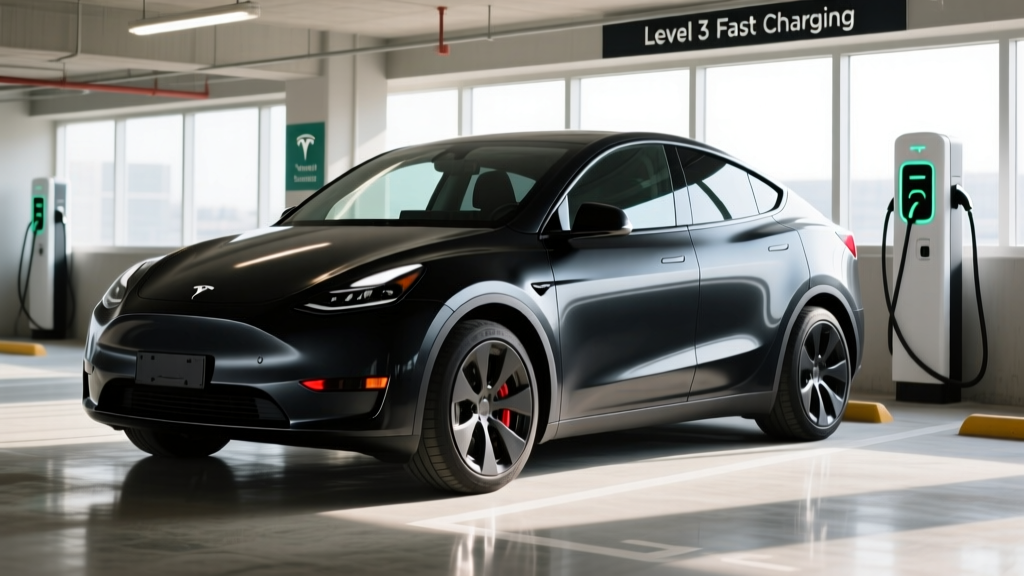
Charging Speed: DC Fast Charge and Home Level 2
A wrap doesn't change how the Model Y charges, but knowing the charge curve is essential for trip planning and daily ownership.
| Charging Type | Max Rate | Speed / Time | Connector |
|---|---|---|---|
| DC Fast Charge (Supercharger V3/V4) | 250 kW peak | 10–80% in ~25 min | NACS (native) |
| DC Fast Charge (CCS adapter) | ~170 kW (adapter-limited) | 10–80% in ~35 min | CCS1 via adapter |
| Level 2 Home (Tesla Wall Connector) | 11.5 kW (48A) | ~44 miles/hr of charge | NACS |
| Level 2 Public (J1772 adapter) | 11.5 kW max | ~44 miles/hr of charge | J1772 via adapter |
| Level 1 (120V household) | ~1.4 kW | ~4 miles/hr of charge | NACS (mobile connector) |
Charging curve reality: The 250 kW peak rate only holds between approximately 5–25% state of charge. From 25–50%, the rate tapers to ~170 kW. From 50–80%, it drops further to ~90 kW. Above 80%, charging slows dramatically to protect the battery — often below 40 kW. This is why Tesla (and all EV best practices) recommend DC fast charging only to 80% on road trips.
For home charging, a Tesla Wall Connector on a 60-amp circuit delivers the full 48 amps (11.5 kW), replenishing the 75 kWh battery from 10–80% in roughly 5 hours. Most owners charge overnight and wake up to a full battery. Installation typically costs $500–$1,800 depending on panel capacity and conduit run length.
Pricing, Tax Credits & Total Cost After Incentives
| Trim | Base MSRP | As-Tested (common config) | §30D Federal Credit | Effective Price |
|---|---|---|---|---|
| Long Range RWD | $44,990 | $46,490 (w/ FSD transfer) | Up to $7,500 (if eligible) | ~$37,490–$44,990 |
| Long Range AWD | $47,990 | $49,990 (w/ tow + FSD) | Up to $7,500 (if eligible) | ~$40,490–$47,990 |
| Performance AWD | $52,490 | $53,990 (w/ performance wheels) | Up to $7,500 (if eligible) | ~$44,990–$52,490 |
Federal tax credit eligibility (§30D) is not automatic. As of 2026, the IRS clean vehicle credit requires all of the following:
- MSRP cap: SUVs/crossovers must be under $80,000 — all Model Y trims qualify.
- Buyer income cap: Modified AGI must not exceed $150,000 (single), $225,000 (head of household), or $300,000 (joint filers).
- Battery sourcing: A percentage of critical minerals and battery components must be sourced from the US or free-trade-agreement countries. Tesla's US-built Model Y has generally met this threshold, but component sourcing shifts yearly — verify on the IRS eligible vehicle list at point of purchase.
- Point-of-sale transfer: Since 2024, you can transfer the credit to the dealer at purchase, reducing your out-of-pocket cost immediately rather than waiting for a tax refund.
Consult a tax professional before relying on the credit — eligibility is taxpayer-specific and rules are subject to legislative change.
Interior Space, Cargo & Practicality
The Model Y's crossover form factor is a major reason buyers choose it over the Model 3 sedan. With a wrap, the exterior turns heads; the interior is where you'll spend every mile.
- Cargo volume (behind 2nd row): 30.2 cu ft (34.3 cu ft with lower sub-trunk included)
- Cargo volume (2nd row folded): 72.1 cu ft
- Front trunk (frunk): 4.1 cu ft — fits a charging cable bag and small backpack
- Rear legroom: 41.6 inches
- Front headroom: 41.0 inches
- Seating: 5-passenger standard; 7-seat option (small 3rd row) available on Long Range AWD — best suited for children under 5'4"
The 2025+ Juniper refresh added ventilated front seats, ambient lighting, a rear-seat touchscreen, and improved sound insulation — all of which carry into the 2026 model year. Build quality has noticeably improved over 2020–2023 units, with tighter panel gaps and fewer interior rattle reports.
Tech, Driver Assistance & Safety
The Model Y's 15.4-inch center touchscreen runs Tesla's latest software, which includes navigation with real-time Supercharger routing, streaming media, and over-the-air updates that have added features like adaptive high beams and improved regenerative braking profiles throughout 2025.
Driver assistance: Every Model Y ships with Tesla's Basic Autopilot (lane centering + adaptive cruise). The optional Full Self-Driving (Supervised) package ($8,000 one-time or $99/month as of 2026) adds automatic lane changes, traffic-light recognition, and city-street navigation.
Safety: The refreshed Model Y earned a 5-star overall rating from NHTSA and was named an IIHS Top Safety Pick+ (when equipped with acceptable headlights). Standard active safety includes automatic emergency braking, blind-spot monitoring, and rear cross-traffic alert.
Warranty & Battery Longevity
| Component | Coverage |
|---|---|
| Basic Vehicle | 4 years / 50,000 miles |
| Battery & Drive Unit | 8 years / 120,000 miles (Long Range) |
| Battery capacity retention | Minimum 70% over warranty period |
Tesla's NMC batteries have demonstrated strong longevity in fleet data. Most Model Y packs lose 8–12% capacity over the first 100,000 miles, with degradation slowing significantly after the initial break-in period. Out-of-warranty battery replacement runs approximately $12,000–$16,000 at current pricing — a figure to weigh if buying a high-mileage used unit.
Is It Worth Wrapping a Model Y vs. Buying a Competitor?
If you already own a Model Y and love its charging network, efficiency, and software, a $3,500–$5,500 wrap is a cost-effective way to personalize the vehicle and protect the factory paint for resale. But if you're cross-shopping, consider how the total wrapped cost compares to buying a distinctive competitor outright:
| Vehicle | Base MSRP | EPA Range | 10–80% DC Charge | Unique Advantage |
|---|---|---|---|---|
| 2026 Tesla Model Y LR AWD + wrap | ~$52,500 ($48k + wrap) | 295 mi | ~25 min (250 kW) | Supercharger network, efficiency |
| 2026 Hyundai Ioniq 5 Limited AWD | $53,500 | 290 mi | ~18 min (350 kW) | Faster charging, 800V architecture |
| 2026 Ford Mustang Mach-E Premium AWD | $51,995 | 290 mi | ~32 min (150 kW) | Driving dynamics, dealer service |
The Ioniq 5's 800V architecture delivers meaningfully faster DC charging — a tangible advantage on road trips. The Mach-E offers a more traditional dealership service experience. But the Model Y's efficiency (27–30 kWh/100 mi vs. 30–34 for competitors) and the breadth of the Supercharger network remain compelling, especially for buyers without reliable home charging.
Choose the Ioniq 5 instead if: You road-trip frequently and value 7-minute-faster DC charging sessions, or you prefer a more distinctive factory design without needing a wrap.
Choose the Mach-E if: You want traditional dealership service in your area and sportier driving dynamics, and don't mind slightly slower charging.
Pros, Cons & Final Verdict
- Best-in-class Supercharger network (17,000+ stalls in North America)
- Excellent efficiency — lowest kWh/100mi in its segment
- Spacious cargo area with 72 cu ft max and usable frunk
- Strong OTA update track record adding features post-purchase
- High resale value relative to EV segment average
- Wrap cost ($3,500–$5,500) is far less than comparable paint
- No Apple CarPlay or Android Auto — Tesla's ecosystem only
- Service center availability varies widely by region
- Touchscreen-dependent controls (no physical buttons for HVAC, mirrors)
- NMC battery requires 80% daily charge limit for longevity
- FSD ($8,000) remains a Level 2 system despite the price and name
- Insurance premiums run 15–30% higher than comparable ICE crossovers
Verdict: The 2026 Tesla Model Y remains the default EV crossover recommendation for buyers who value charging infrastructure and efficiency above all else. At $44,990–$52,490 before incentives, it's competitively priced — and a $3,500–$5,500 vinyl wrap is a smart, reversible investment to differentiate your vehicle and protect the paint. Just go to a shop with proven Tesla experience; the flush handles and tight gaps demand precision.
Frequently Asked Questions
How long does a Tesla Model Y wrap last?
A premium cast vinyl wrap (3M 2080, Avery Supreme) lasts 5–7 years with proper care. Garage-kept vehicles often exceed 7 years. Economy films last 3–5 years. Hand-wash only — automatic car washes with brushes will damage edges and reduce lifespan significantly.
Does wrapping a Tesla Model Y void the warranty?
No. A professionally installed vinyl wrap does not void Tesla's vehicle or battery warranty. However, if wrap removal damages paint or trim, those specific repairs won't be covered. Keep documentation of the installation shop and film brand.
Can I wrap over Tesla's factory paint without paint correction?
You can, but you shouldn't. Any swirl marks, rock chips, or contaminants on the surface will be visible through the film. Budget $300–$700 for paint correction before wrapping — it's the single biggest factor in a wrap that looks factory-fresh versus amateur.
Does a vinyl wrap affect Tesla's cameras or sensors?
A proper wrap shop will not cover camera lenses, ultrasonic sensor areas, or radar zones (if equipped). Some owners wrap the areas around cameras in matching film and carefully cut out the lens openings. Confirm your shop's protocol for sensor areas before signing a work order.
What's the cheapest way to change a Model Y's color?
A partial wrap (roof + hood + mirrors) in gloss or satin black costs $800–$1,500 and dramatically changes the vehicle's appearance. A full chrome-delete ($400–$900) is even cheaper and removes the bright trim that makes many Model Ys look identical. These two modifications together cost less than a full wrap and deliver outsized visual impact.
Does the 2026 Model Y qualify for the full $7,500 federal tax credit?
The Model Y meets the MSRP cap (under $80,000 for SUVs) and has historically met the battery-sourcing requirements. However, eligibility depends on your personal income (AGI caps apply) and the specific battery-component sourcing for your build month. Verify on the IRS clean vehicle credit page and with your tax advisor before finalizing a purchase.