The Real Cost to Fully Charge a Tesla Model Y
If you're shopping for a Tesla Model Y or already own one, the question isn't just "how far can it go" — it's "how much will it cost me to keep it charged." Unlike a gas car where fuel pricing is visible on every street corner, EV charging costs depend on your electricity rate, where you charge, and which Model Y battery you have. This guide walks through the exact math for every charging scenario in 2026, using real utility rates and Tesla's current battery specifications.
Tesla Model Y Battery Capacity and Chemistry
Understanding charging cost starts with understanding how much energy the battery actually holds. The 2026 Model Y lineup uses two distinct battery chemistries depending on trim:
| Specification | Standard Range RWD | Long Range AWD | Performance AWD |
|---|---|---|---|
| Battery Chemistry | LFP (Lithium Iron Phosphate) | NMC (Nickel Manganese Cobalt) | NMC (Nickel Manganese Cobalt) |
| Usable Battery Capacity | ~60 kWh | ~75 kWh | ~75 kWh |
| EPA Range | 295 miles | 320 miles | 303 miles |
| Efficiency | 127 MPGe / 26 kWh/100mi | 122 MPGe / 27 kWh/100mi | 117 MPGe / 29 kWh/100mi |
| Drivetrain | Rear-Wheel Drive | Dual-Motor AWD | Dual-Motor AWD |
| Horsepower | 346 hp | 384 hp | 510 hp |
| 0–60 mph | 5.8 seconds | 4.8 seconds | 3.5 seconds |
LFP vs. NMC — what it means for charging: LFP batteries (Standard Range) tolerate regular charging to 100% without significant degradation concerns, so Tesla recommends daily 100% charges. NMC batteries (Long Range, Performance) are best kept between 20–80% for daily use, reserving 100% for road trips. This means your effective daily energy budget differs: LFP owners use the full 60 kWh, while NMC owners cycle roughly 45 kWh in daily driving (80% of 75 kWh minus a 20% buffer).
Cost to Fully Charge Tesla Model Y at Home
Home charging is where most Tesla owners do 80% or more of their charging — and it's consistently the cheapest option. Here's the straightforward math:
Formula: Battery kWh × Electricity Rate ($/kWh) = Cost to Fully Charge
| Scenario | National Avg Rate | California (PG&E) | Texas (off-peak) | New York (ConEd) |
|---|---|---|---|---|
| Rate per kWh | $0.16 | $0.32 | $0.09 | $0.24 |
| Standard Range (60 kWh) | $9.60 | $19.20 | $5.40 | $14.40 |
| Long Range (75 kWh) | $12.00 | $24.00 | $6.75 | $18.00 |
| Cost per mile (Long Range, 320 mi) | $0.038 | $0.075 | $0.021 | $0.056 |
For comparison, a gas crossover averaging 28 MPG at $3.40/gallon costs roughly $0.12 per mile — meaning home-charged Model Y owners save 50–80% on fuel depending on their utility rate.
Level 2 Home Charging Speed
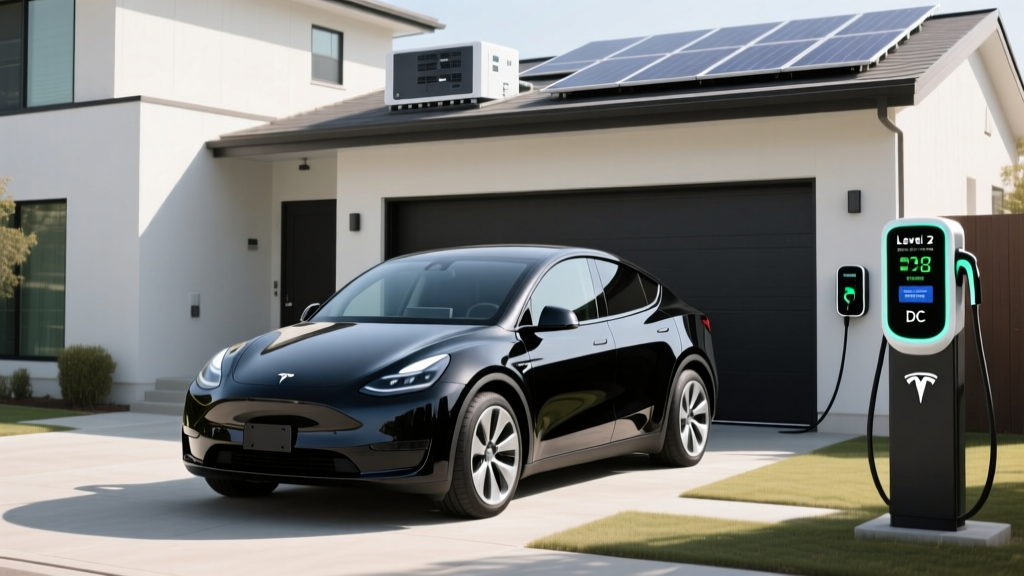
A Tesla Wall Connector on a 48-amp circuit delivers up to 11.5 kW, adding approximately 44 miles of range per hour. A full 0–100% charge on a Long Range takes roughly 7–8 hours — ideal for overnight charging. On a standard 240V/40A dryer-style outlet (NEMA 14-50), expect about 9.6 kW or roughly 37 miles per hour of charging.
Supercharger and Public DC Fast Charging Costs
Tesla's Supercharger network remains the gold standard for road-trip charging, but it costs significantly more than home charging. As of early 2026, Supercharger pricing averages $0.28–$0.36 per kWh depending on location, time of day, and regional electricity demand. Some urban Superchargers peak at $0.43/kWh during high-demand hours.
| Charging Method | Avg $/kWh | Cost for 60 kWh (Std Range) | Cost for 75 kWh (Long Range) | Cost per Mile (LR, 320 mi) |
|---|---|---|---|---|
| Home (national avg) | $0.16 | $9.60 | $12.00 | $0.038 |
| Tesla Supercharger (avg) | $0.32 | $19.20 | $24.00 | $0.075 |
| Tesla Supercharger (peak urban) | $0.43 | $25.80 | $32.25 | $0.101 |
| Electrify America / 3rd-party | $0.48 | $28.80 | $36.00 | $0.113 |
DC Fast Charging Speeds — What to Expect
The 2026 Model Y Long Range and Performance support a peak DC fast-charge rate of 250 kW on V3 Superchargers. The Standard Range RWD with its LFP battery peaks at approximately 170 kW. Here's what that means in practice:
- Long Range/Performance: 10–80% in approximately 22–25 minutes at a V3 Supercharger (250 kW peak, tapering above 50% SoC)
- Standard Range RWD: 10–80% in approximately 28–32 minutes due to the lower peak charge rate
Charging curve reality check: The 250 kW peak is only sustained briefly at low states of charge (typically 10–25% SoC). By 50% SoC, charge rate tapers to roughly 120 kW, and above 80% it drops below 50 kW. This is why Tesla and most EV analysts quote 10–80% times rather than 0–100% — the last 20% can take as long as the first 70%.
2026 Tesla Model Y Pricing and Federal Tax Credit
The Model Y's purchase price and post-incentive cost remain critical factors for buyers weighing it against the Hyundai Ioniq 5, Ford Mustang Mach-E, and Chevrolet Equinox EV.
| Trim | Base MSRP | Federal §30D Credit | Effective Price |
|---|---|---|---|
| Standard Range RWD | $44,990 | $7,500 (if eligible) | ~$37,490 |
| Long Range AWD | $48,990 | $7,500 (if eligible) | ~$41,490 |
| Performance AWD | $53,990 | $7,500 (if eligible) | ~$46,490 |
- MSRP cap: Vehicle must be under $80,000 (SUVs/crossovers) — all Model Y trims qualify
- Income cap: Modified AGI must not exceed $150,000 (single), $225,000 (head of household), or $300,000 (joint)
- Battery sourcing: Must meet critical mineral and battery component requirements that tighten annually — Tesla's US-built battery cells have largely met these thresholds, but verify at IRS.gov before purchase
- Point-of-sale transfer: Eligible buyers can transfer the credit to the dealer for an immediate price reduction rather than claiming it on their tax return
Always confirm eligibility with a tax professional. Sourcing rules are subject to change, and not every buyer will qualify.
Range, Efficiency, and What You'll Actually Drive
The EPA's range and efficiency figures for the Model Y are well-documented via fueleconomy.gov, but real-world results depend heavily on driving style, climate, and terrain.
Highway driving (75 mph, moderate climate): Expect 270–290 miles on the Long Range AWD. Efficiency drops to roughly 30–32 kWh/100mi at sustained highway speeds versus the EPA-rated 27 kWh/100mi combined.
Cold weather (below 32°F): Range loss of 15–30% is typical. The Model Y's heat pump helps mitigate cabin-heating energy draw compared to resistive heaters, but battery chemistry itself becomes less efficient in cold. Preconditioning the battery while plugged in recovers some of this loss.
City/commuter driving with regen: This is where the Model Y shines — stop-and-go traffic allows regenerative braking to recapture energy, often exceeding the EPA combined figure. Many owners report 310+ miles equivalent in warm-weather city driving.
Interior, Cargo, Tech, and Daily Ownership
The 2026 Model Y continues with Tesla's minimalist interior architecture centered on a 15.4-inch touchscreen. Key dimensions and features:
- Cargo volume: 30.2 cu ft behind second row; 72.1 cu ft with seats folded (Long Range/Performance)
- Front headroom: 41.0 in | Rear headroom: 39.0 in
- Rear legroom: 40.5 in — competitive with midsize crossovers
- Frunk (front trunk): 4.1 cu ft — useful for charging cables and small bags
- Towing capacity: 3,500 lbs (Long Range/Performance with tow package)
Standout tech: Tesla's infotainment remains class-leading in responsiveness and over-the-air update frequency. The available FSD (Supervised) package offers automated lane changes, traffic light recognition, and city-street navigation — but it remains an SAE Level 2 driver-assist system requiring continuous driver attention. It is not autonomous driving.
Notable drawbacks: The absence of physical buttons for climate and mirror adjustment frustrates some drivers. Rear visibility is compromised by the sloping roofline. Panel-gap quality has improved but still draws criticism relative to similarly priced luxury crossovers. Insurance premiums for the Model Y run 20–35% higher than comparable gas crossovers — get quotes before committing.
Warranty Coverage
Tesla's warranty structure is competitive within the EV segment:
- Basic vehicle: 4 years / 50,000 miles
- Battery & drive unit (Standard Range, LFP): 8 years / 100,000 miles, minimum 70% capacity retention
- Battery & drive unit (Long Range/Performance, NMC): 8 years / 120,000 miles, minimum 70% capacity retention
The 70% retention threshold means Tesla considers up to 30% degradation within warranty spec — though real-world data from high-mileage Model Y owners shows most batteries retain 88–93% capacity at 100,000 miles when following recommended charging practices (avoiding prolonged 100% storage on NMC, minimizing DC fast-charge exclusivity).
Tesla Model Y vs. Key Competitors
| Spec | 2026 Tesla Model Y LR AWD | 2026 Hyundai Ioniq 5 Limited AWD | 2026 Ford Mustang Mach-E Premium AWD |
|---|---|---|---|
| EPA Range | 320 mi | 305 mi | 312 mi |
| Battery | 75 kWh NMC | 84 kWh NMC | 75.7 kWh NMC |
| Peak DC Charge | 250 kW | 240 kW | 150 kW |
| 10–80% DC Time | ~22 min | ~18 min | ~38 min |
| Base MSRP (comparable trim) | $48,990 | $53,500 | $48,500 |
| Home Charge Cost (75 kWh × $0.16) | $12.00 | $13.44 | $12.11 |
| Supercharger / Network Access | Tesla network (native) | NACS adapter (2025+) | NACS adapter (2025+) |
The Model Y's charging-cost advantage comes partly from its slightly smaller battery and high efficiency. The Ioniq 5 charges faster (18 vs 22 minutes) thanks to its 800V architecture, but carries a larger battery that costs marginally more per fill-up. The Mach-E's slower 150 kW peak charge rate means longer road-trip stops.
Choose the Ioniq 5 if: You want the fastest DC charging in the segment, prefer a more conventional interior with physical controls, and don't mind carrying a NACS adapter for Supercharger access.
Choose the Mach-E if: You prefer Ford's dealer network for service, want a slightly sportier driving feel, and mostly charge at home where DC speed is irrelevant.
Pros and Cons
- Lowest cost-per-mile in its class when charging at home
- Tesla Supercharger network reliability exceeds 95% uptime
- Strong efficiency (27 kWh/100mi combined) reduces every charging cost
- Over-the-air updates add features post-purchase
- Class-leading infotainment responsiveness
- LFP Standard Range option allows daily 100% charging without degradation worry
- Insurance premiums 20–35% above segment average
- Minimalist interior lacks physical controls for climate/mirrors
- Peak Supercharger pricing ($0.36–$0.43/kWh) narrows the cost gap with gas
- FSD (Supervised) is expensive ($8,000 or $99/mo) and remains Level 2 only
- Panel gap inconsistency still reported on some deliveries
- Rear visibility limited by coupe-like roofline
Who the Tesla Model Y Suits Best
Ideal for: Home-charging commuters who drive 30–80 miles daily and can charge overnight on Level 2. The cost-per-mile advantage over gas is maximized when 80%+ of charging happens at home. Families who road-trip 2–4 times per year benefit from the Supercharger network's reliability and speed. Tech-forward buyers who value OTA updates and a responsive infotainment system will find the Tesla ecosystem hard to match.
Less ideal for: Apartment dwellers without reliable home or workplace charging — exclusive reliance on public DC fast charging raises the per-mile cost to near-parity with a fuel-efficient hybrid. Buyers in extreme cold climates (consistent sub-10°F winters) should budget for 25–30% range loss and may prefer a longer-range model or a PHEV as a winter backup.
Frequently Asked Questions
How much does it cost to fully charge a Tesla Model Y at home?
At the US national average electricity rate of $0.16/kWh, a full charge costs approximately $9.60 for the Standard Range (60 kWh) and $12.00 for the Long Range (75 kWh). In states with lower off-peak rates like Texas, costs can drop to $5–$7 per full charge.
Is it cheaper to charge a Tesla at home or at a Supercharger?
Home charging is consistently cheaper — roughly 50–60% less per kWh than Supercharger pricing. At $0.32/kWh average Supercharger rates, a full Long Range charge costs $24.00 versus $12.00 at home. Road-trip Supercharging is a convenience premium, not a cost-saving strategy.
Does the Tesla Model Y qualify for the $7,500 federal tax credit?
All 2026 Model Y trims fall under the $80,000 SUV MSRP cap. However, buyer eligibility depends on income limits ($150K single / $300K joint) and battery-sourcing requirements that tighten annually. The point-of-sale transfer option allows eligible buyers to apply the credit as an immediate discount. Verify current eligibility at IRS.gov or with a tax professional.
How long does it take to charge a Tesla Model Y at home?
On a Tesla Wall Connector (48A, 11.5 kW), a full 0–100% charge takes approximately 7–8 hours for the Long Range. On a NEMA 14-50 outlet (40A, 9.6 kW), expect 8–9 hours. Most owners charge from 20–80% overnight, which takes roughly 4–5 hours.
What is the real-world range of the Tesla Model Y Long Range?
The EPA rates it at 320 miles. Real-world highway driving at 75 mph yields approximately 270–290 miles. Cold weather (below 32°F) reduces this to 230–260 miles. City driving with regenerative braking in warm weather can exceed the EPA estimate.
How does the Model Y's charging cost compare to gas?
A comparable gas crossover at 28 MPG and $3.40/gallon costs about $0.12 per mile. The Model Y Long Range charged at home ($0.16/kWh) costs about $0.038 per mile — roughly 68% less. Even at peak Supercharger rates ($0.43/kWh), the per-mile cost is $0.101, still below gasoline.
Is FSD (Supervised) worth the cost?
FSD (Supervised) remains an SAE Level 2 system requiring active driver supervision at all times. It handles highway lane changes, on-ramps, and some city streets, but disengagements are frequent in construction zones and complex intersections. At $8,000 or $99/month, it's a personal-preference purchase — not a necessity, and not autonomous driving. Most buyers are better served by the included Autopilot and Basic driver-assist features.