The Short Answer on Converting a Classic Car to Electric
A professional EV conversion of a classic car typically costs between $20,000 and $60,000+ on top of the donor vehicle price, delivering 80 to 200 miles of real-world range, 100 to 400 horsepower, and Level 2 home charging in 4–10 hours. DIY kits start around $8,000–$15,000 but require serious electrical and fabrication skills. Most conversions use salvaged Tesla or Nissan Leaf battery packs (24–85 kWh) paired with AC induction or permanent magnet motors. Expect to spend 12–18 months on a professional build and zero dollars on gas, oil changes, or emissions testing afterward. However, conversions rarely recoup their cost at resale, and federal tax credits do not apply to converted vehicles.
What an EV Conversion Actually Involves
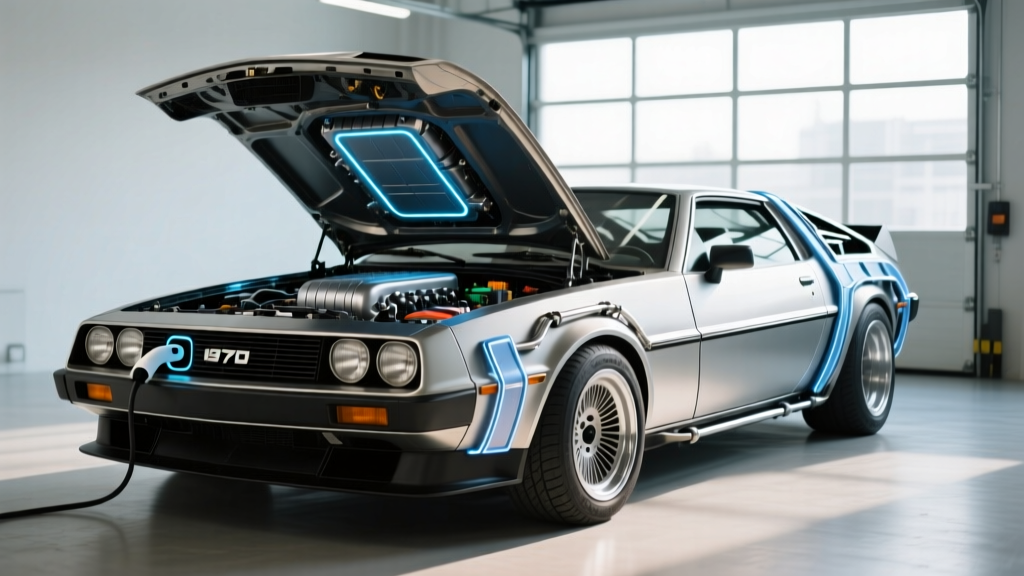
At its core, converting a classic car to electric means removing the internal combustion engine, fuel tank, exhaust system, and transmission (in most cases), then installing an electric motor, battery pack, power electronics, and charging hardware. The process is part mechanical surgery, part electrical engineering, and part custom fabrication.
The major components in a typical conversion include:
- Electric motor: Usually an AC motor from companies like NetGain (HyPer 9), HPEVS, or a salvaged Tesla drive unit. Output ranges from 50 kW (67 hp) for a lightweight roadster to 200+ kW (270+ hp) for a muscle car build.
- Battery pack: The single most expensive component. Options range from 24 kWh salvaged Nissan Leaf modules (~$3,000–$5,000) to 60–85 kWh Tesla packs (~$8,000–$15,000) to custom-built packs using new Samsung or CATL cells ($15,000–$30,000+).
- Motor controller / inverter: Manages power delivery from the battery to the motor. Controllers from Cascadia Motion, Sevcon, or Tesla-compatible units run $1,500–$5,000.
- Onboard charger: Enables Level 1 (120V) and Level 2 (240V) AC charging. A 3.3 kW to 7.2 kW charger is standard; DC fast charging (CCS or NACS) adds $3,000–$8,000 and significant complexity.
- Battery management system (BMS): Monitors individual cell voltages, temperatures, and state of charge. Non-negotiable for safety. Orion BMS or Thunder Sky units cost $500–$1,500.
- DC-DC converter: Steps down high-voltage battery to 12V for lights, gauges, and accessories. Typically $200–$500.
- Thermal management: Battery cooling/heating is critical for longevity and fast-charge capability. Active liquid cooling adds $1,000–$3,000 but is strongly recommended for packs over 40 kWh.
A well-executed conversion also addresses weight distribution (batteries are heavy—expect 500–1,200 lbs of battery mass), brake upgrades (regenerative braking helps but classic drum brakes are inadequate for modern traffic), and power steering/brake assist (the engine no longer drives the vacuum booster or hydraulic pump).
EV Conversion Cost Breakdown: Parts, Labor, and Hidden Expenses
The total investment depends heavily on whether you DIY, hire a specialist shop, or buy a turn-key conversion. Here is what the numbers look like in 2026:
| Cost Category | Budget DIY Build | Mid-Range Shop Build | High-End Turn-Key |
|---|---|---|---|
| Battery pack (kWh / source) | $3,000–$5,000 (24 kWh, salvaged Leaf) | $8,000–$15,000 (60–85 kWh, Tesla) | $15,000–$30,000 (custom, new cells) |
| Motor + controller | $2,500–$4,000 | $4,000–$8,000 | $8,000–$15,000 |
| Charger + BMS + DC-DC | $1,500–$2,500 | $3,000–$5,000 | $5,000–$10,000 |
| Fabrication & machining | $500–$2,000 (own tools) | $3,000–$8,000 | $8,000–$20,000 |
| Labor (shop hours) | $0 (your time) | $5,000–$15,000 | $20,000–$50,000+ |
| Brake/suspension/steering upgrades | $1,000–$3,000 | $2,000–$5,000 | $5,000–$10,000 |
| Registration, inspection, insurance | $500–$1,500 | $1,000–$2,500 | $1,500–$3,000 |
| Total estimated cost | $9,000–$18,000 | $26,000–$58,000 | $62,000–$138,000+ |
Shops like EV West, Icon, and Zelectric Motors have built reputations on turn-key Porsche, VW, and muscle car conversions that routinely exceed $100,000 total. A budget DIY build on a light car (think 1970s VW Beetle or MG MGB) can come in under $15,000 if you source salvaged components and do your own welding and wiring.
Hidden costs to plan for: Electrical panel upgrades at home for Level 2 charging ($500–$2,000), spare parts sourcing for aging donor chassis, and potential title/registration hurdles in states that require special inspection for modified vehicles.
Range, Charging, and Performance: What to Expect
Range in a converted classic is dictated by two things: battery capacity (kWh) and vehicle efficiency (how many watt-hours the car uses per mile). Classic cars are generally less aerodynamic and heavier than modern EVs, so expect efficiency in the range of 300–500 Wh/mile (compared to 250–300 Wh/mile for a Tesla Model 3).
| Spec | Typical Classic EV Conversion | Modern Production EV (e.g., 2026 Tesla Model 3) | Original Gas-Powered Classic |
|---|---|---|---|
| Usable battery / fuel | 24–85 kWh | 60–75 kWh | 12–18 gallon tank |
| EPA-equivalent range | 60–200 miles | 320–363 miles | 240–400 miles |
| Real-world range (highway/70 mph) | 45–150 miles | 260–310 miles | 200–350 miles |
| Cold-weather range loss (~30°F) | 15–30% (less with active thermal mgmt) | 10–20% (heat pump equipped) | Negligible |
| Level 2 charge time (full) | 4–12 hours (3.3–7.2 kW) | 8–10 hours (11.5 kW) | 5 minutes at gas station |
| DC fast charge (10–80%) | N/A (most lack DCFC) or 30–60 min | 15–25 minutes (170–250 kW) | N/A |
| 0–60 mph | 5–12 seconds | 3.1–5.8 seconds | 8–15 seconds (original) |
| Horsepower | 67–400 hp | 271–510 hp | 80–300 hp (original) |
Real-world range caveat: A conversion with a 40 kWh pack in a 1965 Mustang weighing 3,200 lbs will likely deliver around 80–100 miles of mixed driving range. At highway speeds (70+ mph), aerodynamic drag eats into that number significantly—expect 60–80 miles on the interstate. In cold weather (below 40°F), battery chemistry slows and cabin heating draws additional power, cutting range by 15–30% unless you install a dedicated heat pump system.
Charging reality: Most classic EV conversions charge at Level 2 only (240V, 3.3–7.2 kW). That means a full charge from empty takes 6–12 hours at home. DC fast charging is possible but requires a CCS or NACS charge port, a high-voltage contactor system, and a battery pack that can accept high C-rates—adding significant cost and complexity. Plan on home charging as your primary fueling strategy.
EV Conversion vs. Buying a Production EV vs. Keeping Gas
The decision to convert isn't purely financial—it's emotional. But the numbers matter. Here is how the three paths compare over five years of ownership, assuming 8,000 miles driven per year:
| Cost Factor (5 Years) | Classic EV Conversion ($40K build) | New 2026 Production EV (~$40K) | Classic Gas Car (Restored) |
|---|---|---|---|
| Acquisition / build cost | $40,000 + $10K donor | $40,000 (MSRP) | $25,000–$50,000 |
| Fuel / energy cost | ~$2,400 (electricity @ $0.15/kWh) | ~$2,200 (electricity) | ~$7,200 (gas @ $3.50/gal, 18 MPG) |
| Maintenance | ~$1,500 (brakes, tires, coolant) | ~$2,000 (tires, cabin filter, fluid) | ~$6,000 (tune-ups, carb, exhaust, trans) |
| Insurance (specialty/agreed value) | ~$4,500 ($900/yr) | ~$6,000 ($1,200/yr) | ~$4,000 ($800/yr classic policy) |
| Federal tax credit (§30D) | $0 (not eligible—conversion) | Up to $7,500 (if eligible) | $0 |
| Resale value recovery | Low (niche market, 30–60% of build cost) | Moderate (~40–55% after 5 yrs) | Variable (can appreciate if rare) |
Key takeaway: You will not save money converting a classic compared to buying a new production EV, especially when the §30D federal tax credit (up to $7,500, subject to MSRP caps, buyer income limits, and battery sourcing requirements per IRS guidelines) is factored in. The conversion path is for enthusiasts who want a specific classic vehicle with modern drivability—not for cost optimization.
Common Misconceptions About Classic EV Conversions
| Myth | Fact |
|---|---|
| "It's a simple weekend swap. Even bolt-in kits take 200–500 hours for a first-time builder. Professional shops log 300–800+ hours per build." | Even bolt-in kits take 200–500 hours for a first-time builder. Professional shops log 300–800+ hours per build. |
| "You'll get 300 miles of range." | Only with a very large (100+ kWh) pack in a light, aerodynamic car—rare in classics. Most builds deliver 80–150 miles realistically. |
| "It qualifies for the $7,500 federal EV tax credit." | The §30D credit applies only to new, qualifying production vehicles from OEMs. Converted vehicles are not eligible. Some states offer separate incentives for EV conversions—check your local DMV or energy office. |
| "Electric means zero maintenance." | Tires, brakes, suspension bushings, cooling systems, and 12V electrical still need attention. Brake fluid, coolant, and cabin air (if equipped) are still service items. |
| "Any classic can be converted." | Heavier vehicles (full-size trucks, large sedans) need much larger, more expensive battery packs to achieve usable range. Lighter cars (VW Beetle, Porsche 911, MG, Fiat 500) are far better conversion candidates. |
| "It'll be faster than a Tesla." | It can be quick (instant torque helps), but traction, weight, and motor sizing limit most builds to 5–10 second 0–60 times. A Tesla Model 3 Performance does it in 3.1 seconds. |
Real-World Ownership Considerations Before You Convert
Home Charging Access
A Level 2 home charger (240V, 32–48 amps) is essentially mandatory for a converted classic. Relying on public Level 2 chargers (which may not accommodate a non-standard vehicle's charging profile) is impractical for daily use. Budget $500–$2,000 for a quality Level 2 EVSE (ChargePoint Home Flex, Emporia Vue, or similar) and $500–$2,500 for professional electrical installation. If your home has a 100-amp electrical panel, a panel upgrade to 200 amps may be required—adding $1,500–$3,500. Always consult a licensed electrician for final specifications.
Climate and Driving Patterns
If you live in a region with harsh winters, battery thermal management is not optional. Lithium-ion cells degrade faster when charged below freezing, and range drops significantly in cold weather. A liquid-cooled and heated battery pack adds cost but preserves both range and long-term battery health. For warm-climate owners who drive 30–50 miles per day on local roads, a simpler air-cooled pack with 24–40 kWh is often sufficient.
Registration and Insurance
Most states require a special inspection or modified-vehicle certification for an engine-swapped car. Some states (California, Oregon, Washington) have specific EV conversion registration pathways. Insurance for a converted classic typically requires an agreed-value specialty policy from companies like Hagerty or Grundy. Expect annual premiums of $800–$1,500 depending on the vehicle's agreed value and your driving profile.
Parts and Service Support
Unlike a production EV with a dealer network, a converted classic is essentially a one-off prototype. If the motor controller fails or the BMS throws a fault code, you are your own service department—or you need a relationship with the shop that built it. Factor in long-distance shipping of components or travel to a specialist if something goes wrong.
Decision Framework: Should You Convert Your Classic?
Convert to Electric If:
- You own a lightweight classic (under 3,000 lbs) and want reliable daily-driver usability without carburetor fuss, choke starts, and vapor lock.
- Your typical driving is under 80 miles per day with home charging available.
- You value the driving experience of a classic chassis but want modern reliability, instant torque, and zero tailpipe emissions.
- You have a build budget of $25,000–$60,000+ beyond the donor car cost and accept that resale recovery will be limited.
- You enjoy the technical challenge (DIY) or have a trusted conversion shop in mind.
Keep It Gas (or Buy a Production EV Instead) If:
- Your primary goal is saving money on fuel and maintenance—a new EV with the §30D credit will almost always win on total cost of ownership.
- You need 250+ miles of range, DC fast charging for road trips, or live in an area with limited charging infrastructure.
- The classic car is a rare, numbers-matching collector vehicle where removing the original drivetrain would destroy its value and provenance.
- You don't have access to home charging (apartment, street parking) and would rely on public infrastructure.
- You want a warranty, dealer service support, and modern safety features (airbags, crumple zones, ABS, stability control).
Frequently Asked Questions
How long does a classic car EV conversion take?
A professional shop build typically takes 6–18 months from start to delivery, depending on parts availability, fabrication complexity, and the shop's backlog. A motivated DIY builder working weekends might complete a simpler conversion in 12–24 months.
Can I use a Tesla motor and battery in my conversion?
Yes, salvaged Tesla drive units (from Model S, Model 3, or Model Y) are among the most popular choices for high-performance conversions. However, Tesla's battery packs and motor controllers use proprietary communication protocols that require aftermarket interface boards (such as those from EV West or Damien Maguire's open-source projects) to function in a non-Tesla vehicle. Expect to spend $10,000–$25,000 for a complete Tesla-sourced powertrain.
Will converting my classic car hurt its resale value?
For rare, original, numbers-matching collector cars, yes—removing the original engine and drivetrain typically reduces value significantly among traditional collectors. For common classics (VW Beetles, Ford Mustangs with non-original engines, Porsche 914s), an EV conversion can actually increase appeal and value among a growing segment of buyers who want classic style with modern drivability. The conversion market is niche but expanding.
Do converted EVs need to pass emissions testing?
In most states, once a vehicle is converted to electric and re-registered, it is exempt from emissions testing entirely. However, the process for re-registration varies by state. Check with your local DMV for specific requirements regarding modified-vehicle inspections.
What is the best donor car for an EV conversion?
Ideal donor cars are lightweight (under 3,000 lbs), have ample space for battery mounting (front engine bay + rear trunk or fuel tank area), and use a simple chassis. Top conversion candidates include the VW Beetle, VW Bus (Type 2), Porsche 914, Porsche 911 (air-cooled), MG MGB, Fiat 500, BMW 2002, and Ford Ranger (light truck). Heavier vehicles like full-size American sedans or trucks require much larger battery packs to achieve usable range.
Can I add DC fast charging to my conversion?
Technically yes, but it requires a CCS or NACS charge port, a compatible high-voltage contactor and precharge circuit, a battery pack capable of accepting high charge rates (at least 1C, ideally 2C+), and often a liquid-cooled battery thermal system. The total added cost is typically $5,000–$10,000. Most conversion owners find that Level 2 home charging (which fully replenishes the pack overnight) is sufficient for their driving patterns.
Is it safe to convert a classic car to electric?
A properly engineered conversion with a quality BMS, appropriate fusing, high-voltage safety interlocks, and crash-rated battery enclosures can be very safe. However, classic cars lack modern crash structures, airbags, and stability control. The conversion itself does not improve crash safety. Work with a reputable shop that follows SAE and NHTSA best practices for high-voltage systems, and always include an inertia cutoff switch and clearly marked high-voltage cabling.