The Short Answer on Convertible EV Cars
As of 2026, the production convertible EV market is extremely limited. The only widely available new electric convertible is the MINI Cooper SE Convertible (EPA-estimated ~145 miles range, ~32 kWh usable battery, starting around $39,000). The Fisker Ocean Force-E concept was announced but never reached meaningful production before Fisker's 2024 restructuring. The MG Cyberster launched in China and select international markets but remains unavailable in the U.S. Several OEMs — including Volkswagen (ID.3 convertible study) and Mercedes-Benz — have shown concepts, but none have committed to U.S. production.
If you want a true open-top EV today, you're choosing between a niche city car (MINI), the used/gray market, or waiting 1-2 years for announced models to materialize. For most buyers, a gasoline convertible like the Mazda MX-5 Miata ($30,170 base, 30 MPG combined) or a plug-in hybrid alternative (none currently in convertible form) remains the pragmatic open-air choice. Below, we break down exactly what exists, what it costs to own, and who should consider making the switch.
What Convertible EV Cars Are Actually Available in 2026?
The intersection of "electric vehicle" and "convertible body style" is a remarkably small set. Structural rigidity, battery packaging, weight, and low sales volume make convertibles a tough engineering and business proposition for EVs. Here's what's real and what's vapor:
| Model | Status (2026) | EPA Range | Battery (kWh Usable) | Peak DC Charge (kW) | 0-60 mph | Base MSRP |
|---|---|---|---|---|---|---|
| MINI Cooper SE Convertible | Available (limited markets) | ~145 mi | ~32.6 kWh (NMC) | 95 kW | 8.2 sec | ~$39,000 |
| MG Cyberster | Not available in U.S. | ~310 mi (WLTP/CLTC) | ~77 kWh (NMC) | ~120 kW | ~3.2 sec (AWD) | N/A (U.S.) |
| Fi500e Cabrio (Fiat) | Announced (EU only) | ~165 mi (WLTP) | ~42 kWh (NMC) | 85 kW | ~9.0 sec | N/A (U.S.) |
| Fisker Ocean Force-E | Discontinued (company restructured) | N/A | N/A | N/A | N/A | N/A |
| VW ID.3 Convertible | Concept only | N/A | N/A | N/A | N/A | N/A |
The MINI Cooper SE Convertible is essentially the only buyable option for U.S.-adjacent buyers (it's sold in Europe and limited import channels). Its 145-mile EPA-equivalent range and 95 kW peak DC charging rate make it a city runabout, not a road-trip car. A 10-80% DC fast charge takes roughly 30-35 minutes — acceptable for urban use but painful for touring.
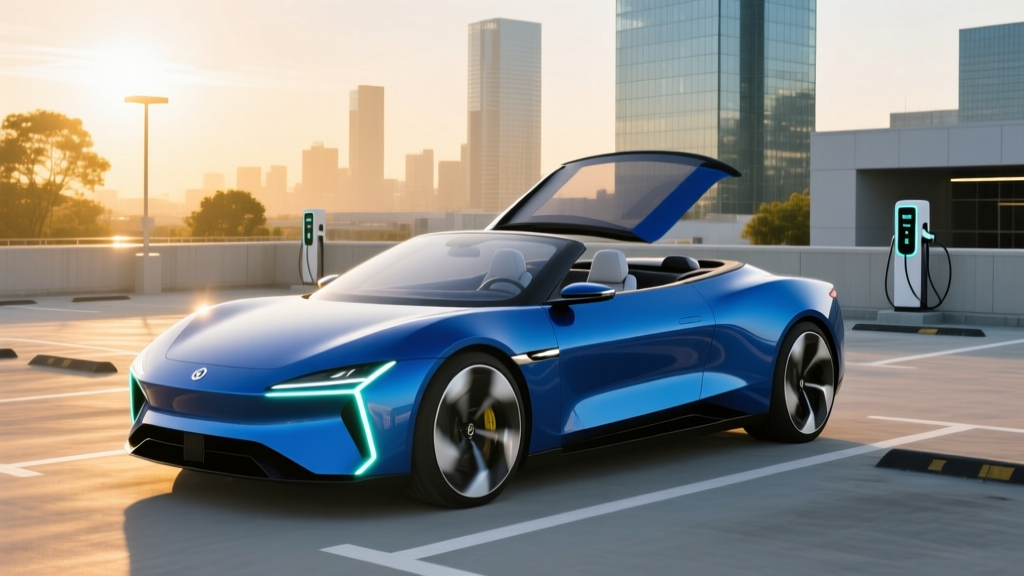
The MG Cyberster is the most impressive electric convertible on paper — a proper sports car with a long hood, scissor-like doors, and a claimed WLTP range exceeding 310 miles. But MG (owned by SAIC Motor) does not sell vehicles in the U.S., and NHTSA has no crash-test data for it. It remains a fascinating "what if" for American buyers.
Real-World Range Reality Check
MINI Cooper SE Convertible: The ~145-mile EPA figure already reflects the convertible's aerodynamic penalty (open-top driving increases drag). In real-world highway driving at 70+ mph with the top down, expect 100-115 miles of usable range. In cold weather (below 40°F), that drops to 85-100 miles. This is a strict commuter and weekend toy — not a primary vehicle for anyone without a second car.
EV Convertible vs. Gas Convertible: The Ownership Cost Comparison
Most buyers cross-shopping convertible EV cars are comparing against established gas drop-tops. Let's run the numbers against the segment benchmark — the Mazda MX-5 Miata — over a 5-year/60,000-mile ownership period.
| Cost Factor | MINI Cooper SE Convertible (EV) | Mazda MX-5 Miata (Gas) |
|---|---|---|
| Base MSRP | $39,000 | $30,170 |
| Federal §30D Tax Credit | $0 (does not meet battery sourcing requirements) | N/A |
| Effective Purchase Price | $39,000 | $30,170 |
| Fuel/Energy (60,000 mi) | $2,100 (home charging at $0.15/kWh, ~3.5 mi/kWh) | $6,600 (30 MPG combined, $3.30/gal) |
| Maintenance (5 yr) | $1,200 (cabin filter, brake fluid, tire rotation) | $3,800 (oil changes, spark plugs, belts, brake pads) |
| Insurance (5 yr avg) | $7,500 ($1,500/yr) | $6,000 ($1,200/yr) |
| Estimated Depreciation | $18,000 (~46%) | $10,500 (~35%) |
| 5-Year Total Cost | $70,800 | $57,070 |
The EV saves roughly $4,500 in energy costs and $2,600 in maintenance over five years, but gives back most of those savings — and then some — through higher purchase price, steeper depreciation on a niche model, and elevated insurance premiums. The Miata wins on total cost of ownership by a wide margin unless you're driving very high annual mileage (20,000+ miles/year) or have access to free workplace/solar charging.
Tax Credit Reality
The MINI Cooper SE Convertible does not qualify for the IRS §30D federal tax credit of up to $7,500. The credit requires battery components and critical minerals to meet North American sourcing thresholds that MINI/BMW's supply chain does not satisfy for this model. Additionally, the vehicle's MSRP must be under $55,000 (sedans) or $80,000 (SUVs/trucks), and buyer income must fall below caps ($150,000 single / $300,000 joint). Always verify current-year eligibility on the IRS site — rules shift annually.
Charging an EV Convertible: What You Actually Need
Convertible EVs are typically smaller-battery vehicles, which changes the charging calculus in your favor — smaller batteries charge faster on Level 2 and don't require the massive home electrical upgrades that a 100+ kWh truck battery might demand.
| Charging Level | Power (kW) | Miles Added Per Hour | Full Charge Time (MINI SE Conv.) | Typical Cost |
|---|---|---|---|---|
| Level 1 (120V outlet) | 1.4 kW | ~4-5 mi/hr | ~24 hours | $0.10-0.20/kWh (home) |
| Level 2 (240V home) | 7.4-11 kW | ~22-33 mi/hr | ~3.5-4.5 hours | $0.12-0.20/kWh (home) |
| DC Fast Charge | Up to 95 kW | ~180+ mi/hr (peak) | 10-80% in ~30 min | $0.30-0.50/kWh (public) |
For a convertible EV with a ~32 kWh battery like the MINI, a standard Level 2 home charger (7.4 kW, 32A) is more than sufficient. You don't need a 48A hardwired unit — that's overkill for a small battery. A quality 32A Level 2 unit (ChargePoint Home Flex, Emporia Level 2) runs $350-$650 for equipment plus $500-$1,500 for electrician installation if your panel has capacity. Most homes with a 200A service panel can add this circuit without a panel upgrade.
Common Convertible EV Myths vs. Facts
| Myth | Fact |
|---|---|
| "The battery makes it too heavy to handle well with the top down" | The MINI SE Convertible weighs ~3,600 lbs — comparable to many gas convertibles. The low battery placement actually lowers the center of gravity, improving body rigidity feel. |
| "You can't charge an EV convertible in the rain" | All production EVs have sealed charging ports rated IP67 or better. Charging in rain is perfectly safe and standard practice. |
| "EV convertibles have no range because of aerodynamics" | Open-top driving does increase drag by roughly 5-10%, but the bigger range killer is cold weather (20-30% loss below freezing) and highway speeds — the same factors affecting all EVs. |
| "There will be dozens of EV convertibles by 2026" | Structural engineering challenges (convertibles need reinforced sills and A-pillars, adding weight on top of an already heavy battery) and low sales volume have kept OEMs cautious. Only 1-2 models are buyable in the U.S. |
Who Should Buy an Electric Convertible — and Who Shouldn't
Convertible EV cars serve a very specific use case. Here's a practical decision framework based on real ownership patterns we've observed:
Choose an EV Convertible If:
- You have reliable Level 2 home charging and a daily commute under 80 miles round-trip
- You already own a primary vehicle and want a weekend/fun car with zero tailpipe emissions and minimal maintenance
- You live in a mild climate (Southern California, Florida, Arizona) where the top is down 6+ months per year
- You value instant torque and quiet cruising — electric motors eliminate the exhaust drone and vibration of small gas engines at highway speed
- You have solar panels and can effectively "fuel" the car for near-zero marginal cost
Stick With a Gas Convertible (or Wait) If:
- This will be your only car — the MINI's 145-mile range is not viable as a sole vehicle for most households
- You take regular road trips over 200 miles — DC charging infrastructure is improving, but a 30-minute stop every 100 miles in a small-battery EV is exhausting
- You live in a cold-winter climate — cold weather + highway + top-down driving can cut real range to under 90 miles
- You care about total cost of ownership — gas convertibles like the Miata or Ford Mustang EcoCost convert significantly less over 5 years
- You need back seats or meaningful cargo space — current EV convertibles are strictly two-seaters with tiny trunks
What's Coming: The Convertible EV Pipeline (2026-2028)
Several manufacturers have signaled interest in electric convertibles, though commitments remain tentative:
- Porsche 911/Boxster EV: Porsche has confirmed an electric 718 Boxster (expected 2027-2028 model year). This would be the first credible performance electric convertible for the U.S. market. Preliminary specs suggest an 800V architecture with 100+ kWh battery and 270+ kW DC charging capability. Expect pricing above $80,000.
- Mercedes-Benz: The company showed a CLE convertible EV concept but has not committed to production. Mercedes is currently scaling back its all-electric timeline, making this uncertain.
- Chinese OEMs (BYD, NIO, MG): Several Chinese brands produce electric convertibles for domestic and European markets, but U.S. tariffs (currently 100% on Chinese-built EVs) make import economically impossible.
The honest assessment: if you want an electric convertible that's actually practical for American roads and infrastructure, you're likely waiting until 2028 or later for the Porsche electric Boxster to arrive.
First-Time EV Buyer Checklist for Convertibles
If you're seriously considering a convertible EV — whether the MINI now or a future model — run through this practical checklist before committing:
- Confirm home charging access. Do you own your home or have landlord permission for a Level 2 install? Can your electrical panel support a new 40A circuit? Get a quote from a licensed electrician before buying the car.
- Calculate your real daily mileage. Take the EPA range, subtract 25% for highway driving, subtract another 15% for cold weather if applicable. Is the result still above your daily round-trip + a 20% buffer?
- Check public charging near your routes. Use PlugShare or your vehicle's native app to map DC fast chargers along any route over 120 miles. In rural areas, gaps of 80+ miles between chargers are still common.
- Verify §30D tax credit eligibility. Check the IRS qualified vehicles list — it updates monthly. Confirm your income is under the cap ($150K single / $300K joint) and the vehicle's MSRP is within limits.
- Get insurance quotes before purchase. EV insurance premiums run 15-25% higher than equivalent gas cars due to battery replacement costs and specialized repair requirements. Convertibles add another 10-15% on top.
- Understand battery warranty terms. The EPA and manufacturer data show most EV batteries retain 85-92% capacity after 8 years. Federal law mandates a minimum 8-year/100,000-mile battery warranty, but check the capacity-retention threshold (typically 70%).
Frequently Asked Questions
Why are there so few electric convertibles?
Convertibles require significant structural reinforcement (thicker sills, reinforced A-pillars, cross-bracing) to compensate for the missing roof. This adds weight. EVs are already heavy due to battery packs. Combining both penalties creates engineering and efficiency challenges. Additionally, convertibles are a low-volume niche — most OEMs prioritize SUVs and sedans where volume justifies R&D costs.
Can I install a Level 2 charger in a garage that's also used for a convertible?
Yes — there's no conflict. The only consideration is ensuring the charger cable reaches your vehicle's charge port location (which varies by model — the MINI's port is on the rear passenger side). Plan your parking orientation accordingly and mount the charger on the correct wall.
Is a used Tesla Model 3 convertible conversion a viable option?
Third-party convertible conversions (like those offered by Coachbuilder and Avento for older Model 3s) exist but are extremely niche. They void the factory warranty, have no NHTSA crash testing for the modified structure, and typically cost $25,000-$40,000 on top of the donor car price. We do not recommend them for most buyers due to safety, warranty, and resale-value concerns.
Do electric convertibles handle worse than gas convertibles?
Not necessarily. The low-mounted battery pack in an EV lowers the center of gravity, which can offset the structural flex that plagues gas convertibles. The MINI Cooper SE Convertible's handling is generally praised as tight and responsive, though the added weight (~400 lbs more than the gas MINI convertible) is noticeable under hard cornering.
What's the cheapest way to own a convertible EV?
Given the tiny new-car market, the cheapest path is likely a used/lease-return MINI Cooper SE hardtop with an aftermarket soft-top conversion — though again, this carries warranty and safety trade-offs. For a factory-built option, leasing the MINI SE Convertible (if available in your market) at $400-$550/month avoids the steep depreciation hit that niche EVs take in the used market.