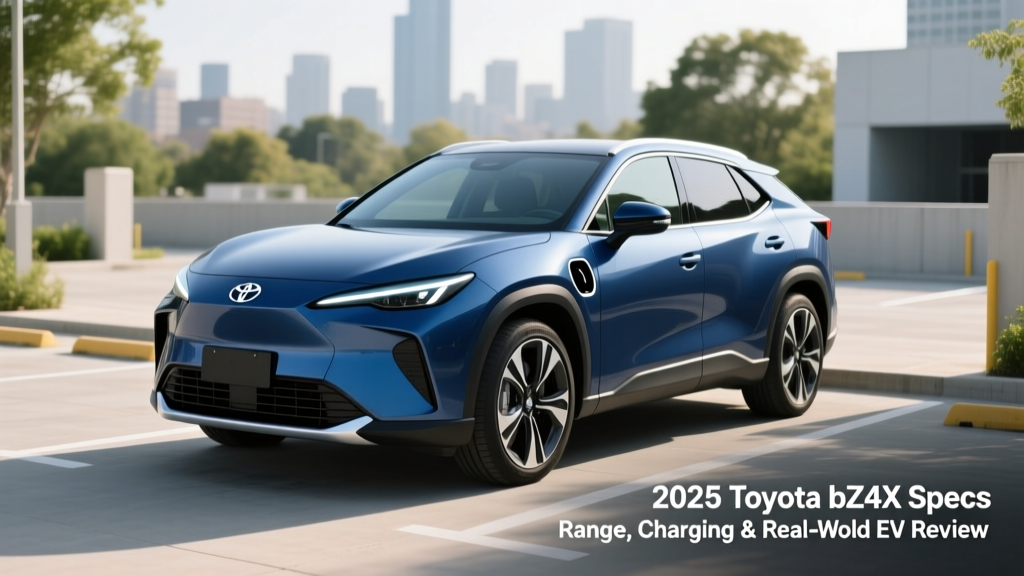
Toyota's first dedicated battery-electric vehicle has evolved from a rocky 2023 launch into a genuinely competitive compact electric SUV for the 2025 model year. The 2025 Toyota bZ4X specs tell the story of a mainstream automaker refining its EV formula: improved range figures, faster DC charging capability, and aggressive pricing that undercuts key rivals. But spec sheets only go so far. After analyzing EPA data, owner reports, and competitive benchmarks, here's what these numbers actually mean for your daily driving and your wallet.
2025 Toyota bZ4X Spec Sheet at a Glance
| Specification | XLE FWD | XLE AWD | Limited FWD |
|---|---|---|---|
| EPA Range | 252 miles | 228 miles | 236 miles |
| Battery (usable) | 71.4 kWh (NMC lithium-ion) | ||
| Efficiency | 119 MPGe / 28 kWh/100mi | 106 MPGe / 32 kWh/100mi | 112 MPGe / 30 kWh/100mi |
| Motor Output | 201 hp / 196 lb-ft | 214 hp / 248 lb-ft | 201 hp / 196 lb-ft |
| 0–60 mph | ~7.1 seconds | ~5.8 seconds | ~7.1 seconds |
| Max DC Charge Rate | 150 kW peak | ||
| 10–80% DC Time | ~30 minutes (optimal conditions) | ||
| Level 2 Charge Rate | 7.2 kW / ~25 mi/hr | ||
| Cargo Volume (rear seats up) | 27.7 cu ft | ||
| Cargo Volume (rear seats folded) | 56.9 cu ft | ||
| Base MSRP (incl. destination) | $38,465 | $40,465 | $43,580 |
Source: fueleconomy.gov and Toyota Motor North America official specifications.
Range and Efficiency: EPA Sticker vs. Reality
EPA Estimated: 252 miles (XLE FWD) / 228 miles (XLE AWD)
Real-World Highway (70–75 mph, moderate temps): ~200–220 miles
Real-World Cold Weather (below 32°F, mixed driving): ~160–185 miles
Real-World City/Commuter (stop-and-go, mild temps): ~240–255 miles
The FWD XLE trim delivers the best range in the lineup at 252 miles EPA, thanks to its single front-mounted motor and slightly lower curb weight. That number holds up reasonably well in city and suburban driving, where regenerative braking recaptures energy in stop-and-go traffic. However, highway driving at sustained speeds of 70–75 mph pushes consumption higher — expect roughly 200 to 220 miles of practical range on a full charge under normal conditions.
Cold weather remains the great equalizer for all EVs, and the bZ4X is no exception. Without a standard heat pump (available only on certain trims and markets), cabin heating draws directly from the 71.4 kWh battery pack. In sustained sub-freezing temperatures, plan for a 25–30% range reduction. If your typical winter commute is 60 miles round-trip, you'll still have comfortable margin, but a 200-mile winter road trip will require at least one DC fast-charge stop.
The AWD models sacrifice roughly 24 miles of EPA range due to the additional rear motor and increased weight. For buyers in snow-belt states, the traction advantage of the dual-motor system may justify that trade-off, but range-conscious shoppers should stick with FWD.
Charging Speed: DC Fast Charging and Home Level 2
| Charging Level | Power (kW) | Speed (miles of range per hour) | Typical Use Case |
|---|---|---|---|
| Level 1 (120V household) | ~1.2 kW | ~4 mi/hr | Emergency/overnight top-off |
| Level 2 (240V home/public) | 7.2 kW | ~25 mi/hr | Daily home charging, full charge in ~10 hrs |
| DC Fast Charge (CCS) | 150 kW peak | ~350 mi/hr (peak) | Road trips, 10–80% in ~30 min |
The bZ4X's 150 kW peak DC fast-charging capability places it in the middle of the compact EV SUV segment. For context, the Hyundai Ioniq 5 peaks at 240 kW on 800V architecture, while the Volkswagen ID.4 tops out at 170 kW. Toyota's figure is adequate but not class-leading.
The critical detail that spec sheets gloss over is the charging curve. The bZ4X hits its 150 kW peak only at a low state of charge (roughly 10–25% SoC) and under optimal battery temperature conditions. As the battery fills, charge rate tapers progressively: expect roughly 100–120 kW through the 40–60% range, dropping to 50 kW or below past 80%. A 10–80% session takes approximately 30 minutes at a properly rated 150 kW+ station, but an 80–100% top-off can add another 30–40 minutes. For road trips, the practical strategy is to charge to 80% and go.
One notable advantage: the 2025 bZ4X comes with a complimentary charging partnership. Toyota has offered varying programs with Electrify America and other networks — check with your dealer for current included charging credits, as these change by model year and region.
For home charging, the onboard 7.2 kW charger means a full 0–100% charge from a Level 2 wall connector takes approximately 10 hours. Most owners who plug in nightly will wake up to a full battery every morning. A 240V/32A home circuit is sufficient; a 48A circuit provides no additional benefit given the vehicle's 7.2 kW onboard limit.
Battery Chemistry, Degradation, and Warranty Coverage
The 2025 bZ4X uses a 71.4 kWh (usable capacity) lithium-ion battery pack with NMC (nickel-manganese-cobalt) chemistry. This is the same chemistry family used in most mainstream EVs, chosen for its balance of energy density and thermal stability. Unlike some competitors that have shifted to LFP (lithium iron phosphate) for lower trims — which offers longer cycle life but lower energy density — Toyota has stuck with NMC across the bZ4X lineup.
Toyota's battery warranty is one of the strongest in the industry:
- EV Battery Warranty: 8 years / 100,000 miles (whichever comes first), covering defects and capacity loss below 70% of original capacity
- Hybrid/EV Component Warranty: 8 years / 100,000 miles
- Basic Vehicle Warranty: 3 years / 36,000 miles
- Powertrain Warranty: 5 years / 60,000 miles
The 70% retention threshold is standard across the industry (Tesla, Hyundai, and Ford use similar benchmarks). Real-world degradation data from 2023–2024 bZ4X owners suggests typical capacity loss of 3–5% over the first 30,000 miles, which aligns with NMC pack behavior across the segment. Long-term 100,000+ mile data specific to the bZ4X platform is still accumulating.
Performance and Drivetrain: Competent, Not Thrilling
The FWD bZ4X sends 201 horsepower and 196 lb-ft of torque to the front wheels via a single permanent-magnet synchronous motor. The 0–60 mph time of approximately 7.1 seconds is perfectly adequate for merging and passing but won't win any stoplight sprints. This is a comfort-tuned SUV, not a performance EV.
The AWD model adds a rear motor for a combined 214 hp and 248 lb-ft, dropping the 0–60 time to roughly 5.8 seconds. The dual-motor AWD system also enables Toyota's X-MODE traction management, which adjusts torque distribution for slippery surfaces. It's not an off-roader, but it handles snow and gravel roads with more confidence than the FWD variant.
Ride quality is where the bZ4X earns points. The suspension tuning prioritizes comfort, absorbing road imperfections effectively at the expense of sporty handling. Steering is light and low-effort — ideal for parking lots and city streets, less engaging on winding back roads. The cabin remains well-isolated from wind and road noise at highway speeds, a hallmark of Toyota's engineering priorities.
Pricing, Trims, and Federal Tax Credit Eligibility
| Trim | Base MSRP (incl. destination) | §30D Federal Credit (max) | Effective Price (if eligible) |
|---|---|---|---|
| XLE FWD | $38,465 | Up to $7,500 | ~$30,965 |
| XLE AWD | $40,465 | Up to $7,500 | ~$32,965 |
| Limited FWD | $43,580 | Up to $7,500 | ~$36,080 |
| Limited AWD | $46,580 | Up to $7,500 | ~$39,080 |
The 2025 bZ4X qualifies for the full $7,500 federal EV tax credit under IRS §30D rules, provided the buyer meets all eligibility requirements. This credit can now be transferred to the dealer at point of sale, effectively reducing your purchase price by $7,500 on the spot rather than waiting for a tax refund.
- Vehicle MSRP cap: SUVs must have MSRP ≤ $80,000 (all bZ4X trims qualify)
- Buyer income cap: Modified AGI ≤ $150,000 (single) / $300,000 (joint filing)
- Battery sourcing: Must meet critical minerals and battery component requirements per IRS guidance — verify with dealer at purchase, as sourcing rules tighten annually
- Point-of-sale transfer: Available — dealer reduces purchase price by credit amount and claims the credit
- Leasing: Leased vehicles may qualify under commercial credit rules (§45W), often with fewer restrictions — check with leasing company
Always verify current eligibility at irs.gov and consult a tax professional. Rules change and individual circumstances vary.
With the tax credit applied, the XLE FWD bZ4X becomes one of the most affordable mainstream electric SUVs on the market at roughly $31,000 effective. That price competes directly with used EVs and significantly undercuts the Tesla Model Y, Hyundai Ioniq 5, and Ford Mustang Mach-E on an out-of-pocket basis.
Interior, Cargo, and Technology
The bZ4X interior reflects Toyota's practical-over-flashy philosophy. A 12.3-inch touchscreen (8-inch on base XLE) runs Toyota's latest multimedia system with wireless Apple CarPlay and Android Auto, native navigation, and over-the-air updates. The digital instrument cluster sits high on the dash, positioned to reduce eye movement — an ergonomic choice that some drivers love and others find awkward depending on seating position and steering wheel height.
Passenger space is competitive for the compact SUV segment:
- Front legroom: 42.1 inches
- Rear legroom: 35.7 inches
- Cargo behind rear seats: 27.7 cu ft
- Cargo with rear seats folded: 56.9 cu ft
Those cargo numbers trail the Hyundai Ioniq 5 (27.2 / 59.3 cu ft) and Tesla Model Y (30.2 / 76.2 cu ft) in total volume, though the bZ4X's cargo area is well-shaped and accessible. There is no front trunk (frunk), which is a missed opportunity given the packaging freedom EVs typically offer.
On the driver-assistance front, Toyota Safety Sense 3.0 comes standard on all trims, including:
- Pre-Collision System with Pedestrian Detection
- Lane Departure Alert with Steering Assist
- Full-Speed Range Dynamic Radar Cruise Control
- Lane Tracing Assist (centering in marked lanes)
- Road Sign Assist
- Proactive Driving Assist (gentle braking/steering in certain scenarios)
These are SAE Level 2 driver-assistance features — not self-driving. The driver must maintain hands on the wheel and full attention on the road at all times. Toyota's system is competent and less aggressive than some competitors' lane-keeping, which many drivers find more comfortable for long highway stretches.
How the bZ4X Stacks Up Against Key Competitors
Pros
- Aggressive pricing, especially after $7,500 federal credit
- Strong 8-yr/100,000-mi battery warranty
- Comfortable, quiet ride quality
- Standard Toyota Safety Sense 3.0 on all trims
- AWD with X-MODE available for snow/rain traction
- Established Toyota dealer network for service
Cons
- 150 kW peak DC charging trails Hyundai/Kia 800V rivals
- Range drops significantly with AWD (228 mi EPA)
- No front trunk (frunk) — lost cargo utility
- Cargo volume trails Model Y and Ioniq 5
- Heat pump not standard on all trims (cold-weather efficiency hit)
- Infotainment UI less polished than Tesla/Hyundai
Choose the bZ4X if: You want a comfortable, no-surprises electric SUV from a brand you trust, your daily driving is under 150 miles, you primarily charge at home, and you want to maximize the federal tax credit on a lower-priced vehicle. It's an excellent commuter and family hauler for suburban households with reliable Level 2 home charging.
Look elsewhere if: You take frequent road trips over 250 miles (the Ioniq 5's 240 kW charging saves real time), you need maximum cargo space (Model Y wins decisively), or you want the longest possible EPA range in this segment (the Ioniq 5 Long Range offers 303 miles EPA).
Frequently Asked Questions
What is the real-world range of the 2025 Toyota bZ4X?
The EPA rates the FWD XLE at 252 miles, but expect approximately 200–220 miles on highway-heavy trips and 160–185 miles in cold weather below freezing. City commuters with regenerative braking opportunities may see 240+ miles in mild conditions. The AWD models start at a lower baseline of 228 miles EPA.
How fast does the bZ4X charge at home and on the road?
At home on a 240V Level 2 charger, the bZ4X accepts up to 7.2 kW, adding roughly 25 miles of range per hour — a full charge takes about 10 hours. On DC fast chargers, it peaks at 150 kW and can go from 10% to 80% in approximately 30 minutes under optimal conditions. Above 80%, charging slows significantly to protect battery health.
Does the 2025 bZ4X qualify for the $7,500 federal EV tax credit?
Yes, all bZ4X trims fall under the $80,000 SUV MSRP cap and are eligible for up to $7,500 under IRS §30D, provided the buyer meets income requirements ($150K single / $300K joint MAGI) and the vehicle meets battery sourcing requirements, which tighten annually. The credit can be transferred to the dealer at point of sale. Always confirm current eligibility at irs.gov before purchasing.
Is the bZ4X worth buying over the Hyundai Ioniq 5 or Tesla Model Y?
It depends on your priorities. The bZ4X wins on upfront price after the tax credit and offers a quieter, more comfort-oriented ride. The Ioniq 5 wins on charging speed (240 kW peak, 10–80% in ~18 minutes) and offers more range in its Long Range variant. The Model Y wins on cargo space, Supercharger network access, and tech integration but costs significantly more. For budget-conscious buyers who charge primarily at home, the bZ4X is a compelling value.
Does the bZ4X have a heat pump for cold weather?
Heat pump availability varies by trim and market. On the 2025 model, the heat pump is not standard across all trims — it's either optional or standard on higher trims depending on the region. Confirm with your dealer. Without a heat pump, cabin heating draws more energy from the battery, increasing winter range loss to 25–30% or more.
Can the bZ4X tow?
Toyota does not rate the US-spec bZ4X for towing. If you need an electric SUV with towing capability, the Ford Mustang Mach-E (up to 1,500 lbs with the GT) or the Tesla Model Y (up to 3,500 lbs) are more suitable choices.