The Short Answer on EV Conversions
A converter electric car — a gasoline vehicle retrofitted with an electric motor, battery pack, and power electronics — typically costs $15,000 to $50,000+ in parts and labor on top of the donor vehicle price. Most DIY conversions yield 60–150 miles of EPA-equivalent range, use CCS1 or J1772 charging at modest speeds (often Level 2 only), and produce 100–300 horsepower depending on the motor selected. Professional, high-end conversions from shops like EV West or Lunaz can exceed $80,000 total.
Bottom line: For 95% of buyers, a used production EV (a 2023–2025 Chevrolet Bolt EUV at ~$18,000–$25,000, or a Tesla Model 3 at ~$22,000–$30,000) delivers better range, faster charging, full safety certification, and warranty coverage for less money. Conversions make sense primarily for classic car enthusiasts, specialty fleet operators, or those with a specific donor vehicle they want to preserve.
What Is a Converter Electric Car?
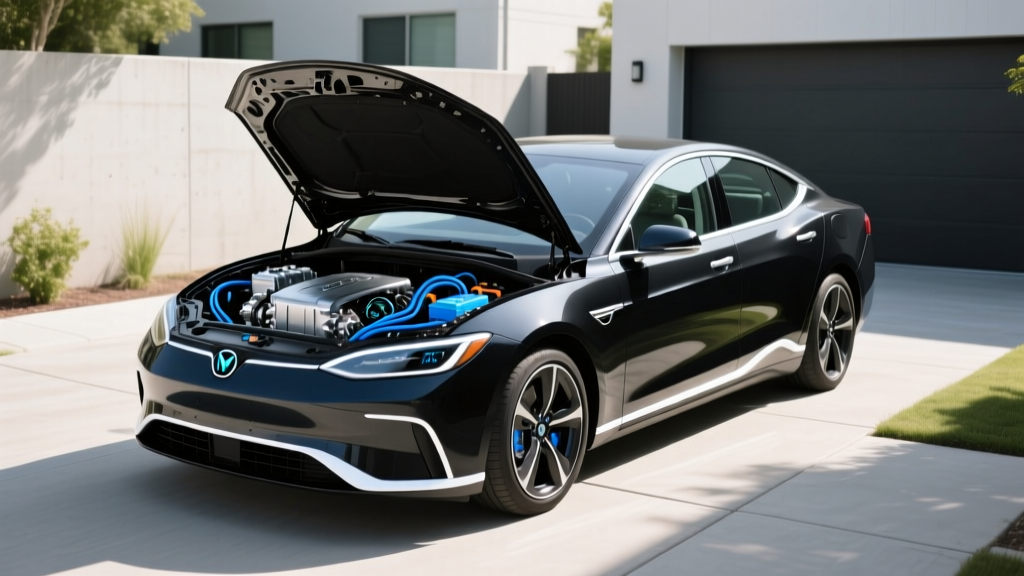
An EV conversion replaces a vehicle's internal combustion engine, fuel tank, and exhaust system with an electric powertrain: a motor (commonly an AC induction or permanent magnet unit sourced from a salvaged Nissan Leaf, Tesla drive unit, or NetGain HyPer motor), a battery pack (typically salvaged lithium-ion modules or new LFP cells), a motor controller, and a charger. The donor vehicle's transmission may be retained or replaced with a single-speed reduction gear.
The term "converter electric car" spans a wide spectrum:
- DIY garage builds — Hobbyists converting a VW Beetle, Porsche 914, or pickup truck using kits from companies like EV West or OpenSource EV.
- Professional restomod conversions — Shops like Lunaz, Electrogenic, and Everrati performing full resto-mod EV swaps on classics (Jaguar E-Type, Porsche 911, Land Rover Defender) at $100,000–$400,000+.
- Fleet/commercial conversions — Companies converting delivery vans or medium-duty trucks to electric to avoid new-vehicle lead times and capitalize on existing chassis.
Each path has radically different cost, performance, and practicality outcomes.
EV Conversion Cost Breakdown vs. Buying a Production EV
Understanding the real economics is the single most important step before committing to a converter electric car. Here's a side-by-side comparison:
| Cost Category | DIY Conversion (e.g., '74 VW Beetle) | Professional Conversion (Classic 911) | Used Production EV (2023 Bolt EUV) | New Production EV (2026 Hyundai Ioniq 5) |
|---|---|---|---|---|
| Donor / Vehicle Purchase | $5,000–$12,000 | $30,000–$80,000 | $18,000–$25,000 | $42,900 (SE Standard Range) |
| EV Parts (Motor, Battery, Controller, Charger) | $8,000–$18,000 | $25,000–$60,000 | N/A | N/A |
| Labor (if not DIY) | $0–$10,000 | $40,000–$120,000 | N/A | N/A |
| Engineering / Fabrication | $1,000–$5,000 | $10,000–$30,000 | N/A | N/A |
| Registration / Inspection / Certification | $500–$2,000 | $1,000–$3,000 | Standard | Standard |
| Total Estimated Cost | $14,500–$47,000 | $106,000–$293,000 | $18,000–$25,000 | $42,900 |
| Federal §30D Tax Credit Eligible? | No | No | Used EV credit: up to $4,000 (income caps apply) | Up to $7,500 (if battery sourcing and MSRP/income rules met) |
| Warranty on Powertrain | None (self-insured) | 1–2 years (shop dependent) | Remaining factory (8 yr/100k mi battery) | 10 yr / 100,000 mi battery & drive unit |
Key insight: The IRS §30D clean vehicle credit applies only to new, qualified production EVs meeting battery sourcing and critical mineral requirements — never to conversions. The previously owned clean vehicle credit (up to $4,000 or 30% of sale price, whichever is less) similarly applies only to production EVs sold by a licensed dealer. Conversion projects are entirely out of pocket.
Performance and Range: What to Actually Expect
Production EVs benefit from years of thermal management engineering, aerodynamic optimization, and battery-pack integration. Conversions start at a disadvantage:
| Metric | DIY Conversion (VW Beetle / Pickup) | Pro Conversion (Porsche 911 Classic) | 2026 Tesla Model 3 Long Range | 2026 Chevy Equinox EV 3RS |
|---|---|---|---|---|
| Battery Capacity (usable kWh) | 20–40 kWh (salvaged modules) | 60–80 kWh (custom pack) | 75 kWh (NMC) | 85 kWh (NMC) |
| EPA-Equivalent Range | 60–120 mi | 150–200 mi | 363 mi | 319 mi |
| Real-World Highway Range (70 mph) | 40–80 mi | 110–150 mi | ~280–310 mi | ~240–270 mi |
| Cold-Weather Range Loss (20°F) | 30–50% (no heat pump, minimal insulation) | 20–35% | ~15–25% (heat pump equipped) | ~15–25% |
| Motor Output | 75–150 kW (100–200 HP) | 150–300 kW (200–400 HP) | 280 kW (376 HP) | 213 kW (286 HP) |
| 0–60 mph | 8–14 sec | 3.5–5.5 sec | 4.4 sec | 7.4 sec |
| DC Fast Charging | Rarely; most are Level 2 only | Some CCS1 at 50–80 kW | 250 kW peak (10–80% in ~25 min) | 190 kW peak (10–80% in ~30 min) |
| Level 2 Charge Time (full) | 4–8 hours at 3.3–7.2 kW | 6–10 hours at 7.2 kW | ~8 hours at 11.5 kW | ~9.5 hours at 11.5 kW |
| Regenerative Braking | Limited or none | Configurable via controller | Full one-pedal capable | Full one-pedal capable |
Range reality check: A DIY conversion with a 30 kWh usable battery in a 1970s-era body (poor aerodynamics, added weight from steel construction, no active thermal management) will typically achieve 2.5–3.5 miles per kWh. That translates to 75–105 miles in ideal conditions. Highway driving at 70+ mph, headwinds, or cold weather can cut that by 30–50%. Production EVs achieve 3.5–4.5 mi/kWh through integrated design.
Charging limitations are the biggest practical hurdle. Most conversions use a basic onboard charger rated at 3.3 kW or 6.6 kW — meaning a full charge takes 5–10 hours on Level 2. DC fast charging requires a CCS1 or CHAdeMO communication handshake with the vehicle's battery management system (BMS), which most DIY setups cannot perform. This eliminates road-trip viability for nearly all conversions.
Safety, Registration, and Insurance Realities
Production EVs undergo NHTSA crash testing, have validated battery enclosures, thermal runaway protection, and high-voltage disconnect systems. Conversions carry none of this certification unless independently engineered and tested — which almost none are.
⚠️ Critical Safety Considerations
- Crash safety: A converted vehicle retains its original crash structure, which was never designed to protect a 500–1,000 lb battery pack in a collision. Battery intrusion or rupture in a crash is a real risk.
- High-voltage wiring: Improperly routed or insulated HV cables (typically 300–400V DC) pose electrocution and fire hazards. Production EVs use orange-shielded, crash-rated cabling with automatic disconnects.
- Thermal management: Most conversions lack active battery cooling/heating. Sustained high-speed driving or fast charging can overheat cells, accelerating degradation or triggering thermal runaway.
- Braking: The added weight of batteries (often 500–1,000 lbs over the original curb weight) can overwhelm stock brakes. Upgraded rotors, calipers, and pads are strongly recommended.
Registration: Most US states allow EV conversions to be registered, but the process varies widely. States like California require a BAR (Bureau of Automotive Repair) inspection for "specially constructed vehicles" (SPCNS), while others accept a simple VIN verification and safety inspection. Expect $500–$2,000 in registration and inspection fees, and a process that can take weeks to months.
Insurance: Standard insurers like GEICO or Progressive may insure a converted EV at agreed value, but many require a specialty classic-car or modified-vehicle policy (Hagerty, Grundy). Premiums are typically 20–40% higher than for a comparable stock vehicle, and claims can be contested if the conversion work is not documented to a professional standard.
Real-World Ownership: Daily Driving a Converted EV
If you're considering a converter electric car as a daily driver, these practical factors will define your experience:
Home Charging Access
Because most conversions lack DC fast charging, home Level 2 charging is essentially mandatory. You'll need a 240V circuit (NEMA 14-50 or hardwired) rated for 30–50 amps, installed by a licensed electrician. Expect $800–$2,500 for installation if your electrical panel has capacity, or $3,000–$5,000+ if a panel upgrade to 200A service is required. Without home charging, a conversion is impractical as a daily vehicle.
Climate Considerations
Conversions without active battery thermal management suffer severely in extreme temperatures. In sub-30°F weather, expect 30–50% range loss due to increased internal resistance in the cells and cabin heating demands (most conversions use resistive PTC heaters, which draw 2–5 kW — far less efficient than a production EV's heat pump at ~1 kW). In hot climates (100°F+), battery degradation accelerates without liquid cooling, potentially cutting pack lifespan to 5–7 years versus 12–15+ for a thermally managed production pack.
Driving Patterns
A conversion with 80–100 miles of real-world range is viable for commuting and errands if you can charge at home nightly. It is not viable for road trips, rural driving without destination charging, or ride-share use. If your daily driving exceeds 60 miles round-trip, range margins become uncomfortably thin in cold weather or with HVAC use.
Common EV Conversion Myths vs. Facts
| Myth | Fact |
|---|---|
| "Converting my car to electric saves money vs. buying an EV." | A credible conversion costs $15,000–$50,000+ in parts and labor. A used 2023 Chevy Bolt EV can be purchased for $15,000–$20,000 with 259 miles of EPA range, DC fast charging, a factory warranty, and eligibility for the $4,000 used-EV tax credit. |
| "EV conversions are eco-friendly because they reuse an old car." | The environmental benefit depends on the battery source. Salvaged modules from wrecked EVs are a genuine reuse case. But buying new battery cells for a conversion carries a similar manufacturing carbon footprint to a production EV — without the efficiency benefits of integrated design. |
| "I can fast-charge my conversion on road trips." | DC fast charging requires CCS1/CHAdeMO protocol communication between the charger and the vehicle's BMS. Most DIY and even many professional conversions cannot perform this handshake, limiting you to Level 2 charging at 3.3–7.2 kW (10–25 miles of range per hour). |
| "An EV conversion will increase my classic car's value." | For certain high-end restomods (Porsche 911, Jaguar E-Type) done by recognized shops, value can be preserved or increased. For common vehicles (VW Beetles, old pickups), the conversion cost rarely recoups at resale, and the modified title can reduce the collector market. |
| "Conversions qualify for the $7,500 federal tax credit." | They do not. The IRS §30D credit applies exclusively to new qualified clean vehicles from OEMs meeting battery sourcing, MSRP caps ($55,000 cars / $80,000 SUVs/trucks), and buyer income limits. The used-EV credit (up to $4,000) similarly requires a production EV sold by a licensed dealer. |
Decision Framework: Should You Convert or Buy?
Use This Framework to Decide
Choose a converter electric car IF:
- You own a classic or sentimental vehicle you want to preserve and drive regularly, and budget is secondary ($50,000–$300,000+ for a professional job).
- You're a skilled fabricator/electrician treating the conversion as a passion project, not a cost-saving measure.
- You need a specialty vehicle (e.g., an electric farm truck, a zero-emission vehicle for indoor events) that no production EV fulfills.
- You have guaranteed home charging and your daily driving is under 50 miles round-trip.
- You understand the vehicle will have no crash-test validation, no factory warranty, and potentially difficult insurance and resale.
Choose a production EV (new or used) IF:
- Your primary goal is saving money on fuel and maintenance — a used Bolt or Model 3 achieves this at lower total cost.
- You need DC fast charging for road trips or lack guaranteed home Level 2 access.
- You want safety certification (NHTSA/IIHS ratings), factory warranty coverage, and straightforward insurance.
- You want to claim the federal §30D tax credit (up to $7,500 for new, up to $4,000 for used).
- You drive more than 150 miles in a day on any regular basis.
- You live in a cold climate where thermal management is essential for usable winter range.
Running Cost Comparison: Converted EV vs. Gas Car vs. Production EV
For those weighing a conversion against keeping a gas car or buying a production EV, here's a 5-year operating cost estimate based on 12,000 miles/year:
| Cost Category | Converted EV (DIY, 30 kWh pack) | Gas Car (30 MPG combined, $3.40/gal) | Production EV (2026 Ioniq 5, 114 MPGe) |
|---|---|---|---|
| Fuel / Electricity | $2,160 (3.0 mi/kWh, $0.14/kWh avg) | $6,800 | $2,640 (3.5 mi/kWh, $0.14/kWh avg) |
| Maintenance | $1,500 (brakes, suspension from added weight, no oil/coolant) | $3,500 (oil, filters, belts, brakes, coolant) | $1,200 (cabin filter, wipers, tire rotation, brake fluid) |
| Insurance (avg annual premium × 5) | $9,000 ($1,800/yr specialty policy) | $6,500 ($1,300/yr standard) | $7,500 ($1,500/yr standard EV) |
| Battery Degradation / Replacement Reserve | $4,000–$8,000 (salvaged cells degrade faster; replacement likely within 5–8 years) | $0 | $0 (under 10 yr/100k mi warranty; expect 85–90% SoH at 5 years) |
| Total 5-Year Operating Cost | $16,660–$20,660 | $16,800 | $11,340 |
The conversion's fuel savings over gas are real (~$4,600 over 5 years), but higher insurance and battery replacement risk erase the advantage. A production EV wins decisively on total cost.
Frequently Asked Questions
How long does an EV conversion take?
A DIY conversion typically takes 200–600 hours of work spread over 3–12 months, depending on complexity, fabrication needs, and your skill level. Professional shops quote 3–9 months for a full conversion, with high-end restomods taking 12–18 months.
Can I use Tesla batteries or motors in a conversion?
Tesla drive units (particularly the rear motor from a Model S or Model 3) are popular in the conversion community and available through salvage channels for $1,500–$4,000. However, Tesla battery modules are more difficult to integrate due to proprietary BMS communication — most builders use LG Chem, Nissan Leaf, or Chevrolet Volt modules instead, which have better-documented protocols.
Will a conversion pass state emissions inspections?
Yes — once a vehicle is converted to electric, it is exempt from emissions testing in all US states. However, you may need to update your vehicle's registration to reflect the electric powertrain, and some states require a special inspection for modified vehicles before re-registration.
What's the best donor vehicle for an EV conversion?
Lightweight vehicles with simple mechanical layouts make the best donors. Popular choices include the VW Beetle and Type 2 Bus, Porsche 914, Mazda Miata (NA/NB), classic Ford F-100, and BMW 2002. Lighter vehicles require smaller (cheaper) battery packs to achieve the same range, and simpler drivetrains reduce fabrication complexity.
Is it legal to drive a converted EV on public roads?
Yes, EV conversions are legal in all 50 states, but registration requirements vary. Most states require a safety inspection, a VIN verification, and proof that the high-voltage system is properly insulated and shielded. California's SPCNS (Specially Constructed Vehicle) program is among the most rigorous, requiring a BAR referee inspection. Check your state DMV's modified-vehicle guidelines before starting a project.
Sources: EPA Fuel Economy for production EV range and efficiency data; IRS §30D Clean Vehicle Credit for tax credit eligibility rules; NHTSA for vehicle safety standards.