Can You Use Comma AI with a Tesla in 2026?
If you've searched for "comma ai tesla" hoping to bolt a comma 3X onto a 2026 Tesla Model Y or Model 3, the short answer is: not natively, and not the way you'd use Openpilot on a Toyota, Honda, or Hyundai. Comma AI's Openpilot driver-assistance stack relies on direct access to a vehicle's CAN bus for steering, braking, and acceleration commands. Tesla's proprietary electrical architecture, closed firmware, and vision-only Tesla Vision system (no radar, no ultrasonic sensors since 2022) make direct Openpilot integration effectively impossible without invasive hardware modifications that would void your warranty and compromise safety systems.
That said, Tesla owners remain some of the most active members of the comma AI community. Many use the comma 3X as a monitoring and data-logging device, or they own a Tesla alongside a second supported vehicle for daily Openpilot driving. This guide breaks down exactly how Comma AI and Tesla intersect in 2026, what Openpilot can and cannot do on a Tesla, and — because you're still evaluating the car itself — a full 2026 Tesla Model Y profile with range, charging, pricing, and tax credit details.
Why Openpilot Doesn't Natively Support Tesla
Comma AI maintains a publicly documented list of supported vehicles, and no Tesla model appears on it. The reasons are both technical and philosophical:
- Closed CAN bus architecture: Tesla encrypts and isolates its steering and brake control modules. Openpilot needs to send torque requests to the electric power steering (EPS) controller — something Tesla's firmware actively resists from external devices.
- Vision-only Tesla Vision: Since removing radar and ultrasonic sensors, Tesla processes all perception through its camera suite and FSD Computer. There is no sensor data stream that an external device like the comma 3X can tap into cleanly.
- Warranty and safety liability: Intercepting or injecting CAN messages on a Tesla could disable Autosteer, emergency braking, or stability control. Comma AI does not support this configuration for safety and legal reasons.
- Over-the-air updates: Tesla frequently pushes firmware changes that alter CAN message IDs and authentication, breaking any third-party integration within weeks.
Some hobbyists in the community have experimented with camera-only dashcam mode using the comma 3X mounted on a Tesla windshield to log driving data for the openpilot training dataset. This is supported and safe — the device simply records video and GPS without interfacing with vehicle controls.
2026 Tesla Model Y: Full EV Profile
Since most "comma ai tesla" searchers are evaluating the car itself, here is a comprehensive 2026 Tesla Model Y breakdown with the exact numbers you need to make a purchase decision.
| Spec | Value |
|---|---|
| EPA Range | 320 miles (Long Range AWD) |
| Battery (usable) | ~75 kWh, NMC (nickel manganese cobalt) |
| Drivetrain | Dual-motor AWD |
| Horsepower | 384 hp combined |
| 0–60 mph | 4.8 seconds |
| Max DC Fast Charge | 250 kW peak (V3 Supercharger) |
| 10–80% DC Time | ~25 minutes |
| Level 2 Home Charge | 11.5 kW / 44 mi/hr (48A Wall Connector) |
| Efficiency | 122 MPGe combined / 28 kWh/100mi |
| Cargo Volume | 30.2 cu ft (rear seats up) / 72.1 cu ft (folded) |
| Rear Legroom | 36.0 inches |
| Base MSRP | $44,990 (Long Range AWD) |
| Battery Warranty | 8 years / 120,000 miles |
Charging Speed: Supercharger Network Advantage
Tesla's charging ecosystem remains its strongest competitive moat. Here's what you can expect at each charging level:
| Level | Power (kW) | Miles Added/Hour | Notes |
|---|---|---|---|
| Level 1 (120V) | ~1.4 kW | ~3–5 mi/hr | Emergency/trickle only |
| Level 2 (240V Wall Connector) | 11.5 kW | ~44 mi/hr | Full overnight charge in ~8 hrs |
| DC Fast (V3 Supercharger) | 250 kW peak | ~1,000 mi/hr (peak) | 10–80% in ~25 min; tapers above 80% |
| DC Fast (V4 Supercharger) | Up to 350 kW (cab) | Vehicle-limited to ~250 kW | Model Y architecture caps at 250 kW |
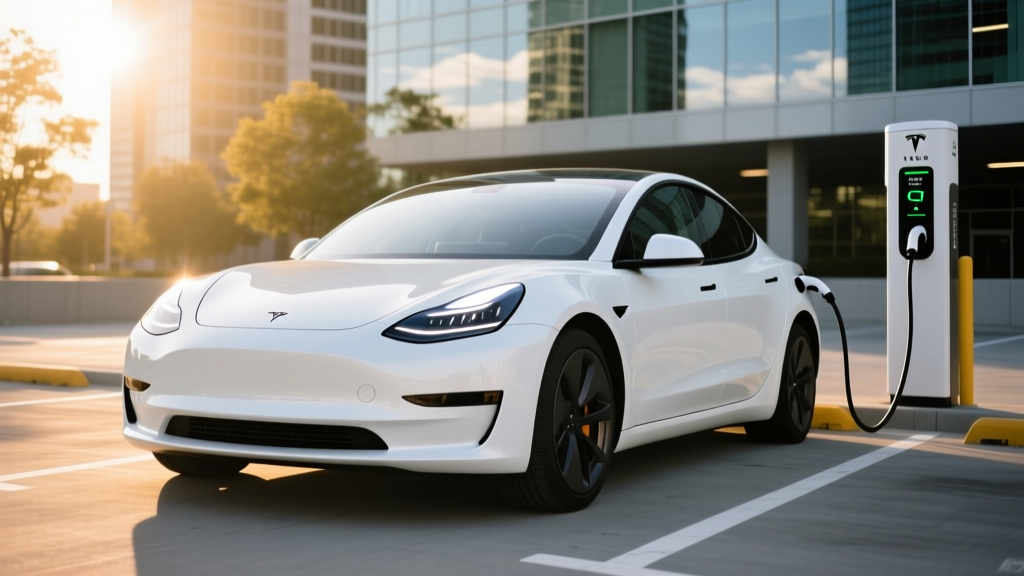
Charging curve reality: The 250 kW peak only sustains from roughly 10% to 35% state of charge. From 35–60%, expect ~150–180 kW. Above 80%, the rate drops sharply to under 50 kW to protect the NMC battery. This is why Tesla and most EV experts recommend charging to 80% for daily use and only going to 100% when you need full range for a trip. Preconditioning the battery (navigating to a Supercharger triggers this automatically) is essential for achieving peak charge rates — without it, cold-soaked batteries may charge at under 100 kW initially.
With the North American Charging Standard (NACS) now adopted by Ford, GM, Rivian, Volvo, and others, Tesla Superchargers are opening to non-Tesla EVs. This increases station congestion at popular corridors but also validates Tesla's connector as the industry standard.
Pricing, Trims, and Federal Tax Credit Eligibility
| Trim | MSRP | §30D Credit Eligible? | Effective Price* |
|---|---|---|---|
| Long Range RWD | $42,990 | Yes (if sourcing rules met) | ~$35,490 |
| Long Range AWD | $44,990 | Yes (if sourcing rules met) | ~$37,490 |
| Performance AWD | $48,990 | Yes (under $80K SUV cap) | ~$41,490 |
*Effective price assumes full $7,500 §30D credit applied at point of sale. Eligibility depends on multiple factors — see checklist below.
- MSRP cap: Vehicle must be under $80,000 (SUV classification) — all Model Y trims qualify.
- Buyer income cap: Modified AGI must not exceed $150,000 (single), $225,000 (head of household), or $300,000 (joint). See IRS §30D guidelines.
- Battery sourcing: At least 60% of battery component value must be manufactured or assembled in North America, and a percentage of critical minerals must be sourced from the US or FTA partners. Tesla's Fremont and Austin-built Model Y has historically qualified, but sourcing requirements tighten annually. Verify current eligibility at fueleconomy.gov before purchasing.
- Point-of-sale transfer: As of 2024+, you can transfer the credit to the dealer at purchase, reducing your out-of-pocket cost immediately rather than waiting for tax filing.
Driver Assistance: Tesla Autopilot vs. Openpilot
This is the crux of why comma AI enthusiasts search for Tesla integration. Here's a head-to-head comparison of what each system offers in 2026:
| Feature | Tesla Autopilot / FSD | Openpilot (comma 3X) |
|---|---|---|
| SAE Level | Level 2 | Level 2 |
| Supported Vehicles | Tesla only | 275+ models (Toyota, Honda, Hyundai, VW, Subaru, etc.) |
| Hardware Cost | Included (Autopilot) / $8,000 (FSD) | $1,250 (comma 3X) + car harness |
| Lane Centering Quality | Strong, vision-based | Excellent on supported cars, often smoother than OEM |
| Stop-and-Go | Yes, with traffic-aware cruise | Yes, with longitudinal control on supported cars |
| Driver Monitoring | Cabin camera (wheel torque on older) | IR eye-tracking camera (very strict) |
| Open Source | No | Yes (MIT license) |
| Tesla Compatible? | N/A (native) | No — not supported |
The practical takeaway: if Openpilot's superior lane-centering smoothness and open-source transparency are priorities, you'd want a supported vehicle (a 2026 Toyota RAV4 Hybrid, Hyundai Ioniq 5, or Honda Accord, for instance) rather than a Tesla. If you're committed to the Tesla ecosystem, Autopilot and FSD are your only options.
Ownership Experience: What Daily Life Looks Like
Cargo and space: The 2026 Model Y offers 30.2 cubic feet behind the rear seats and 72.1 cubic feet with them folded — competitive with a midsize SUV like the Honda CR-V. The front trunk (frunk) adds ~4.1 cubic feet for charging cables or a small bag. Rear legroom at 36.0 inches is adequate for adults but tighter than a Hyundai Ioniq 5 (39.4 inches).
Efficiency: At 122 MPGe combined (28 kWh/100mi), the Model Y is one of the most efficient electric SUVs on the market. At the national average electricity rate of ~$0.17/kWh, that's roughly $4.76 per 100 miles — compared to $12–15 per 100 miles in a comparable gas SUV at $3.50/gallon. Home charging is where the economics shine; public DC fast charging at $0.35–0.50/kWh narrows the gap considerably.
Warranty: Tesla covers the battery and drive units for 8 years or 120,000 miles (whichever comes first) with a minimum 70% capacity retention threshold. The basic vehicle warranty is 4 years / 50,000 miles. This is competitive with the industry, though some competitors like Hyundai offer 10-year/100,000-mile battery coverage.
Insurance: Expect higher-than-average insurance premiums on the Model Y — typically 20–40% more than a comparable gas SUV, driven by expensive body-panel repairs, aluminum construction, and high sensor-replacement costs after collisions. Get quotes before purchasing.
Pros, Cons, and the Verdict
Pros
- Best-in-class Supercharger network (17,000+ stalls in North America)
- Strong efficiency at 122 MPGe combined
- 320-mile EPA range covers most commutes and road trips
- OTA updates add features post-purchase
- Qualifies for up to $7,500 federal credit (verify sourcing)
- Spacious cargo area with flat load floor
Cons
- No native Comma AI / Openpilot support
- Rear legroom tight for tall passengers (36.0 in)
- Panel gaps and paint quality inconsistent vs. legacy OEMs
- No Apple CarPlay or Android Auto
- FSD ($8,000 add-on) still Level 2 despite the name
- Insurance premiums run 20–40% above average
- Regenerative braking is strong but not fully one-pedal (no creep mode stop-hold in all conditions)
Who Should Buy the 2026 Tesla Model Y?
Choose the Model Y if: You value the Supercharger network for road trips, want strong range and efficiency in a compact SUV, prefer OTA software updates, and plan to use Tesla's native Autopilot for highway driving.
Choose a competitor (Ioniq 5, EV6, RAV4 EV) if: You want Comma AI Openpilot support, prefer Apple CarPlay, need more rear-seat legroom, or want a traditional dealer service network. The Hyundai Ioniq 5 and Kia EV6 both support Openpilot via the comma 3X and offer 800V charging architectures that outpace the Model Y's 400V system.
Frequently Asked Questions
Can I install a comma 3X in my 2026 Tesla Model Y?
You can mount the comma 3X on your windshield for dashcam and data-logging purposes, but it cannot control steering, braking, or acceleration in any Tesla. Openpilot does not support Tesla vehicles, and no safe, warranty-preserving method exists to enable it. Attempting CAN bus interception will void your warranty and could disable critical safety systems.
What is the real-world highway range of the 2026 Model Y?
Expect ~265–285 miles at sustained highway speeds of 70–75 mph in moderate temperatures. In cold weather (below 30°F), plan for ~220–240 miles. These figures assume you're using the heat pump and not towing. The EPA's 320-mile rating reflects a mixed city/highway cycle that favors stop-and-go regenerative braking.
How fast does the Model Y charge at home and on the road?
At home with a Tesla Wall Connector on a 60-amp circuit, you get 11.5 kW (44 miles per hour of charging) — a full charge overnight in about 8 hours. On V3 Superchargers, peak rate is 250 kW with a 10–80% charge in approximately 25 minutes, though the charge curve tapers significantly above 80%.
Does the 2026 Tesla Model Y qualify for the $7,500 federal tax credit?
All Model Y trims fall under the $80,000 SUV MSRP cap. However, you must also meet buyer income limits ($150K single / $300K joint) and the vehicle must satisfy battery component and critical mineral sourcing requirements, which tighten each year. Check fueleconomy.gov for the most current VIN-level eligibility before purchasing.
Is Tesla FSD worth the $8,000 cost?
For most buyers, no. FSD (Supervised) remains a Level 2 system that requires constant driver attention. It handles highway lane changes and some city intersections, but performance is inconsistent in construction zones, heavy rain, and unmapped areas. The $8,000 cost (or $99/month subscription) rarely pays for itself in convenience. Standard Autopilot, included with every Tesla, already provides competent lane centering and adaptive cruise control.
What's a better car for Comma AI Openpilot?
The best-supported Openpilot vehicles in 2026 include the Toyota RAV4 Prime, Hyundai Ioniq 5, Kia EV6, Honda Accord, and Subaru Outback. These vehicles have open CAN bus architectures that allow the comma 3X to safely control steering and longitudinal dynamics. The Hyundai Ioniq 5 is a particularly strong alternative to the Model Y if you want Openpilot plus 800V ultra-fast charging capability.