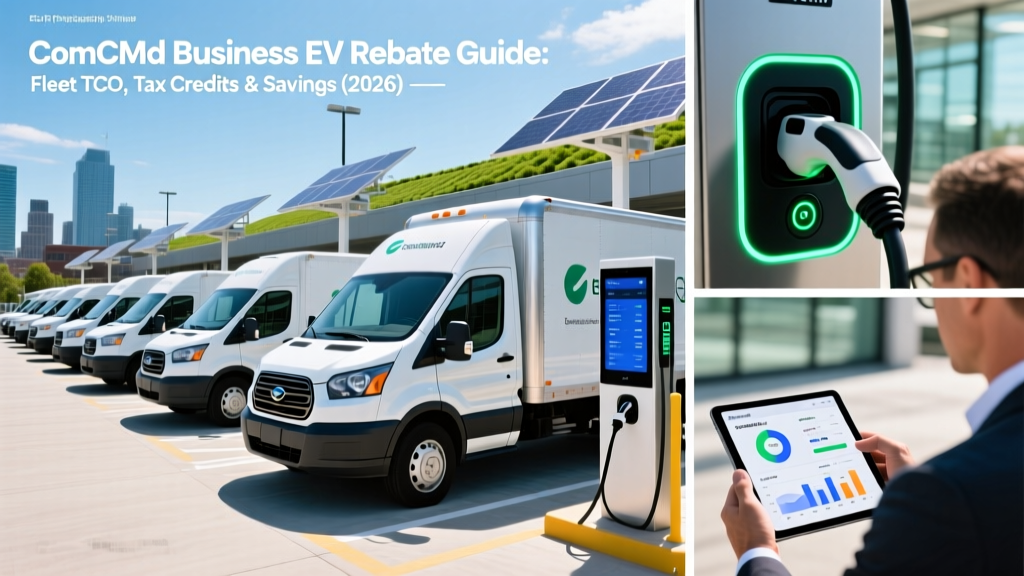
Commercial fleet operators in northern Illinois sit in one of the most incentive-dense EV corridors in the country. Between the ComEd business EV rebate, the federal §30D commercial clean vehicle credit, and Illinois state rebates, a qualifying business can stack thousands in upfront savings on each electric vehicle added to a fleet. But stacking incentives only matters if the underlying total cost of ownership (TCO) actually pencils out.
This guide breaks down the real math behind commercial EV ownership in 2026 — from the ComEd Make-Ready program and per-vehicle rebates, to the IRS commercial credit, to the $/mile operating cost versus a gas fleet baseline. Every figure below uses current-year rules and published utility tariffs.
ComEd Business EV Rebate: What's Available in 2026
ComEd (Commonwealth Edison), the primary electric utility serving Chicago and northern Illinois, offers several incentive layers for businesses adding EVs to their fleets. These programs are designed to reduce both the vehicle acquisition cost and the charging infrastructure buildout.
- Make-Ready Program: Covers up to 100% of electrical infrastructure costs (wiring, panels, conduit) for qualifying commercial EV charger installations — up to $6,500 per Level 2 port and up to $40,000+ per DC fast charging port, depending on site requirements.
- Fleet EV Rebate: Per-vehicle rebates for businesses that purchase or lease eligible EVs. Amounts vary by vehicle class (light-duty, medium-duty, heavy-duty) and program year. Light-duty fleet vehicles have historically qualified for rebates in the $2,500–$4,000 range per vehicle, subject to availability and program caps.
- Off-Peak Charging Rate (RTS-P): ComEd's Residential Time-of-Day and commercial rate structures offer significantly lower per-kWh pricing during overnight hours (typically 11 PM – 6 AM), which can cut fleet charging costs by 40–60% compared to standard commercial rates.
- Fleet Assessment: ComEd provides free or subsidized fleet electrification feasibility studies for commercial customers evaluating EV adoption.
Program terms, funding caps, and eligibility requirements change annually. Verify current availability at ComEd's official business EV incentives page.
For a 10-vehicle light-duty fleet, the Make-Ready program alone can eliminate $40,000–$65,000 in electrical infrastructure costs. Combined with per-vehicle rebates, the upfront delta between an EV fleet and a gas fleet narrows substantially before federal credits enter the picture.
Federal Commercial Clean Vehicle Credit (§45W)
Businesses don't claim the consumer §30D credit — instead, they qualify for the §45W Commercial Clean Vehicle Credit, which has different rules. This is a critical distinction that many fleet buyers get wrong.
- Credit amount: Up to $7,500 for vehicles under 14,000 lbs GVWR; up to $40,000 for vehicles at or above 14,000 lbs GVWR.
- Calculation: The credit equals the lesser of 15% of the vehicle's basis (30% for battery-electric) or the incremental cost of the EV over a comparable gas vehicle.
- No MSRP cap: Unlike the consumer §30D credit, §45W has no manufacturer's suggested retail price ceiling.
- No buyer income cap: Business income limits do not apply — this is a commercial credit.
- Battery sourcing: The critical-mineral and battery-component requirements that constrain the consumer credit do not apply to §45W in the same way, though domestic-content rules may affect the credit percentage. Consult a tax professional for current-year applicability.
- No per-manufacturer cap: The old 200,000-vehicle phaseout per manufacturer (which previously eliminated Tesla and GM) does not apply under current law.
- Transferability: Under §45W, the credit can be transferred to the seller (the dealer) in exchange for a point-of-sale price reduction, effective for vehicles placed in service after 2023.
- Qualified vehicles: Must be purchased for use or lease to others in a trade or business — personal-use vehicles don't qualify under this section.
For a fleet of Ford E-Transit vans (GVWR under 14,000 lbs), each vehicle could qualify for up to $7,500. For a Class 4 electric box truck like the BrightDrop Zevo 600 (GVWR well over 14,000 lbs), the credit can reach $40,000 per unit. These figures stack with ComEd rebates, making the combined incentive package among the most generous in the Midwest.
Source: IRS Commercial Clean Vehicle Credit (§45W)
5-Year Total Cost of Ownership: EV Fleet vs. Gas Fleet
The incentive stack reduces acquisition cost, but the real fleet decision hinges on operating expenses over the vehicle's service life. Below is a 5-year TCO comparison for a light-duty commercial vehicle — modeled on a Chevrolet Equinox EV 2LT (fleet-friendly crossover, ~$33,000 base MSRP) versus a comparable gasoline Chevrolet Equinox LT (~$28,600 MSRP). Both are driven 15,000 miles/year in a mixed city/highway commercial pattern in the Chicago metro area.
| Cost Category | EV (Equinox EV 2LT) | Gas (Equinox LT AWD) | 5-Year Delta |
|---|---|---|---|
| Purchase Price (MSRP) | $34,900 | $28,600 | +$6,300 (EV) |
| ComEd Fleet Rebate | –$3,000 (est.) | $0 | –$3,000 (EV savings) |
| §45W Federal Credit | –$7,500 | $0 | –$7,500 (EV savings) |
| Net Acquisition Cost | $24,400 | $28,600 | –$4,200 (EV cheaper) |
| Fuel/Energy (5 yr / 75,000 mi) | $4,500 (at $0.12/kWh avg, 3.2 mi/kWh) | $10,714 (at $3.50/gal, 28 MPG combined) | –$6,214 (EV savings) |
| Maintenance (5 yr) | $1,800 | $3,750 | –$1,950 (EV savings) |
| Insurance (5 yr) | $11,250 ($2,250/yr avg) | $9,000 ($1,800/yr avg) | +$2,250 (EV higher) |
| Depreciation (est. 5 yr) | $12,200 (50% of net) | $14,300 (50% of purchase) | –$2,100 (EV lower, from lower basis) |
| 5-Year TCO (Net) | $35,950 | $47,764 | –$11,814 (EV savings) |
The EV fleet vehicle costs roughly $11,800 less over 5 years in this scenario, driven primarily by the incentive-reduced acquisition cost and the fuel savings. The key variable: if ComEd's Make-Ready program covers your charger installation, you avoid the $3,000–$8,000 per-port infrastructure cost that would otherwise shift this equation.
Charging Cost vs. Gasoline: The Per-Mile Math
| Metric | EV (ComEd Off-Peak Rate) | EV (ComEd Standard Rate) | Gas Vehicle (28 MPG) |
|---|---|---|---|
| Energy/Fuel Price | $0.07/kWh (off-peak) | $0.14/kWh (standard) | $3.50/gallon |
| Efficiency | 3.2 mi/kWh (EPA ~105 MPGe) | 3.2 mi/kWh | 28 MPG combined |
| Cost per mile | $0.022 | $0.044 | $0.125 |
| Cost per 15,000 mi/yr | $330 | $660 | $1,875 |
At ComEd's off-peak commercial rate, an EV fleet vehicle costs 2.2 cents per mile to fuel — roughly one-sixth the cost of a 28 MPG gasoline vehicle at $3.50/gallon. Even at standard commercial rates, the EV is less than half the fuel cost. For a 10-vehicle fleet each driving 15,000 miles annually, off-peak charging saves approximately $15,450 per year in fuel alone.
Efficiency data from fueleconomy.gov (EPA). Electricity rates from ComEd's published commercial tariff schedule. Gas prices reflect Chicago metro average (EIA).
Maintenance Savings: Where EVs Actually Win Long-Term
| Maintenance Item | EV (5-Year Cost) | Gas Vehicle (5-Year Cost) | Why the Difference |
|---|---|---|---|
| Oil Changes | $0 | $750 (15 changes × $50) | No engine = no oil |
| Transmission Fluid | $0 | $200 | EVs use single-speed reduction gear |
| Brake Pads/Rotors | $200 | $800 | Regen braking reduces wear by 60–80% |
| Spark Plugs/Ignition | $0 | $300 | No combustion system |
| Coolant/Exhaust | $150 | $500 | Simpler thermal system, no catalytic converter |
| Tires | $1,200 | $1,000 | EVs are heavier; tires wear ~15–20% faster |
| Cabin Air Filter + Wipers | $250 | $200 | Same for both |
| Total (5 yr / 75,000 mi) | $1,800 | $3,750 | $1,950 EV savings |
EVs eliminate nearly every scheduled maintenance item associated with internal combustion engines. The one cost that's higher for EVs: tires. The additional vehicle weight (a Chevrolet Equinox EV weighs roughly 4,600 lbs versus ~3,500 lbs for the gas version) and instant torque delivery accelerate tire wear. Budget for one extra tire set over 75,000 miles compared to the gas equivalent.
For fleet managers, the maintenance advantage compounds in another way: reduced vehicle downtime. Fewer scheduled service visits mean more days on the road generating revenue. For a commercial delivery or service fleet, this operational availability can be worth more than the direct parts-and-labor savings.
Insurance Cost Reality: The EV Premium
Commercial EV insurance runs 15–30% higher than equivalent gas vehicles, and fleet operators should budget for this honestly. The reasons are structural, not temporary:
- Higher repair costs: EV battery packs, power electronics, and specialized high-voltage components are expensive to replace after collision damage. A minor rear-end collision that would cost $2,000 to repair on a gas vehicle can total an EV if the battery enclosure is compromised.
- Specialized labor: Fewer body shops have the certifications and equipment to perform high-voltage-safe repairs, reducing insurer repair-network options and pushing costs upward.
- Higher vehicle values: Even after incentives, the insurable value of an EV starts from a higher MSRP, which increases collision and comprehensive premiums.
- Claims data maturity: Insurers are still building actuarial models for EVs. Until claims data matures across millions of vehicle-years, carriers price conservatively.
For a commercial fleet policy, expect to pay approximately $2,000–$2,500/year per EV versus $1,600–$1,900 for the gas equivalent. On a 10-vehicle fleet, that's $4,000–$6,000 in additional annual insurance cost. This is real money, but in the TCO model above, it's more than offset by fuel and maintenance savings.
Mitigation strategies: Some commercial insurers now offer EV-specific fleet policies. Bundling charger coverage, telematics-based discounts, and garage-kept overnight storage can reduce premiums by 5–15%.
EV Depreciation and Resale Value Trends
Depreciation has been the most volatile variable in EV ownership economics. After a turbulent 2023–2024 period where Tesla price cuts cascaded through used EV values, the market has stabilized considerably by 2026. Here's the current landscape:
- 5-year depreciation for mainstream EVs: 45–55% of original MSRP (before incentives). This is broadly in line with mainstream gas vehicles at 40–50%.
- Incentive basis effect: Because your net acquisition cost is much lower after stacking ComEd rebates and §45W credits, your depreciation on a dollar basis is also lower. You depreciate from $24,400 net cost, not from $34,900 MSRP.
- Battery health is the key variable: A commercial EV with verified battery State of Health (SoH) above 85% at 75,000 miles will command a significant premium over one with degraded capacity. Most 2026-model-year EVs use LFP (lithium iron phosphate) chemistry in their base trims, which degrades more slowly than NMC (nickel manganese cobalt) — a real advantage for fleet resale.
- Fleet maintenance records matter: Commercial EVs with documented service history and no battery-warranty claims sell at the top of the used range.
For fleet operators, the practical strategy is to plan vehicle retirement around the 5-year / 75,000-mile mark, before battery degradation becomes a buyer concern and while the vehicle still commands reasonable wholesale value. The federal §45W credit applies to each new vehicle purchase, so cycling fleet vehicles on a regular schedule lets you capture the credit repeatedly.
Stacking Incentives: A Commercial Fleet Scenario
Here's how the full incentive stack works for a hypothetical 5-vehicle fleet of Ford E-Transit cargo vans (2026 model year, 126-mile EPA range, 68 kWh usable battery, peak 115 kW DC fast charging, ~$47,000 MSRP each) deployed in the Chicago suburbs:
| ComEd Fleet EV Rebate (est.) | –$3,500 |
| §45W Federal Credit (30% of basis, cap $7,500) | –$7,500 |
| Illinois state EV rebate (if available) | –$2,500 |
| Total Incentives Per Vehicle | –$13,500 |
| Net Vehicle Cost | $33,500 |
Plus: ComEd Make-Ready covers charger installation infrastructure costs, saving an estimated $5,000–$8,000 per Level 2 port.
For 5 vans, total incentives reach $67,500 in direct vehicle rebates and credits, plus potentially $25,000–$40,000 in covered infrastructure. The E-Transit's limited 126-mile EPA range (expect ~95–105 miles in real-world urban delivery use with cargo and climate load) makes it best suited for last-mile and route-defined applications where overnight depot charging covers daily needs.
Practical Steps to Claim the ComEd Business EV Rebate
- Contact ComEd's business EV team before purchasing vehicles or installing chargers. Many rebate programs require pre-approval, and applying after the fact can disqualify your project.
- Request a fleet electrification assessment. ComEd offers this at no cost and it will identify your optimal charger count, location, and rate schedule.
- Apply for the Make-Ready program to cover electrical infrastructure. This is often the highest-value ComEd incentive for fleets, as it eliminates the most unpredictable cost (your building's electrical capacity).
- Coordinate with your tax professional on §45W credit timing. The credit is claimed in the tax year the vehicle is placed in service, and the point-of-sale transfer option means you can apply the credit as a purchase-price reduction rather than waiting for a tax refund.
- Enroll in ComEd's off-peak rate schedule for depot charging. Overnight charging at $0.07/kWh versus daytime at $0.14/kWh can double your fuel savings.
- Document everything. Keep purchase orders, incentive approval letters, charging electricity bills, and maintenance records — all essential for resale value and tax compliance.
Frequently Asked Questions
How much does it really cost to own an EV over 5 years for a commercial fleet?
Based on our TCO model for a light-duty EV fleet vehicle in the ComEd service territory, the 5-year total cost is approximately $35,950 per vehicle after stacking ComEd rebates and the §45W federal credit — compared to $47,764 for a comparable gas vehicle. The EV saves roughly $11,800 over 5 years, driven by lower net acquisition cost, $6,200 in fuel savings, and $1,950 in maintenance savings, partially offset by $2,250 in higher insurance premiums.
Do I qualify for the federal commercial EV tax credit?
The §45W Commercial Clean Vehicle Credit is available to businesses that purchase qualifying EVs for use in a trade or business. There is no MSRP cap, no buyer income limit, and no per-manufacturer phaseout. The credit is up to $7,500 for vehicles under 14,000 lbs GVWR and up to $40,000 for heavier vehicles. It can be transferred to the dealer for a point-of-sale price reduction. Consult a tax professional to confirm eligibility for your specific business structure and vehicle.
How much do I save on fuel and maintenance with an EV fleet?
At ComEd's off-peak rate (~$0.07/kWh), fuel cost drops to about $0.022 per mile — saving roughly $1,545 per vehicle per year versus a 28 MPG gas vehicle at $3.50/gallon. Maintenance savings average $390 per vehicle per year, driven by eliminated oil changes, reduced brake wear from regenerative braking, and no ignition or exhaust system service. Combined, fuel and maintenance savings total approximately $1,935 per vehicle annually.
Are EVs more expensive to insure for a commercial fleet?
Yes, typically 15–30% more expensive per vehicle. Expect $2,000–$2,500/year per EV versus $1,600–$1,900 for a gas equivalent. The premium reflects higher repair costs (especially battery-related), specialized labor requirements, and higher insurable values. For a 10-vehicle fleet, plan for $4,000–$6,000 in additional annual insurance cost — which is offset by fuel savings alone in most scenarios.
How well do EVs hold their value?
Mainstream EVs depreciate 45–55% of MSRP over 5 years, roughly in line with gas vehicles. However, because fleet EVs are acquired at a much lower net cost after incentives, the actual dollar depreciation is smaller. Battery chemistry matters: LFP batteries (used in many 2026 base-trim EVs) degrade more slowly than NMC, which helps resale value. Maintaining service records and monitoring battery SoH are the best strategies to maximize residual value.
Can I combine the ComEd rebate with the federal §45W credit?
Yes. ComEd utility rebates, the federal §45W commercial credit, and any available Illinois state incentives can be stacked. They are issued by different entities and do not reduce each other. The ComEd rebate is applied at the utility level, the §45W credit is claimed on your federal tax return (or transferred at point of sale), and state rebates are processed separately.
What if my building doesn't have enough electrical capacity for fleet chargers?
This is where the ComEd Make-Ready program is most valuable. It covers the cost of upgrading electrical infrastructure — including panel upgrades, new service drops, conduit runs, and wiring — up to program limits. For many commercial buildings, this eliminates the single largest barrier to depot charging. Contact ComEd before purchasing vehicles to get a site assessment.
This article reflects program terms, tax rules, and pricing as of early 2026. ComEd rebate availability, federal tax credit rules under §45W, and Illinois state incentives are subject to legislative and regulatory change. Consult ComEd directly, a licensed electrician, and a qualified tax professional before making fleet purchasing decisions. Sources: IRS §45W, fueleconomy.gov, ComEd Business EV Programs.