Quick Verdict: The Tesla All-Wheel Drive SUV That Still Sets the Pace
The 2026 Tesla Model Y Long Range All-Wheel Drive remains the benchmark compact electric SUV for buyers who need year-round traction, strong range, and access to the most reliable DC fast-charging network in North America. With an EPA-estimated 320 miles of range, a dual-motor all-wheel-drive powertrain producing 384 horsepower, and peak DC fast-charging at 250 kW, the Model Y AWD balances daily practicality with road-trip readiness better than nearly every rival in its class.
But the compact EV SUV segment has matured considerably. The Hyundai Ioniq 5, Ford Mustang Mach-E, and Chevrolet Equinox EV all offer compelling alternatives with competitive range and pricing. This review breaks down exactly what the Model Y All-Wheel Drive delivers — and where it falls short — so you can decide if it's the right electrified vehicle for your garage.
EPA-estimated range: 320 miles (Long Range AWD). In mixed highway driving at 70-75 mph, expect approximately 265-285 miles before needing a charge. In freezing temperatures (below 32°F), range can drop to 220-250 miles due to battery thermal losses and cabin heating demands. City driving with regenerative braking recovers energy and can push real-world range closer to or slightly above the EPA estimate.
Range, Battery, and Efficiency: The Numbers Behind the Tesla All-Wheel Drive
The 2026 Model Y Long Range AWD uses a 78.1 kWh usable lithium-ion battery pack with NMC (nickel manganese cobalt) chemistry. Tesla does not publish exact cell-level specs, but teardown analyses and supplier data confirm a 2170-format cylindrical cell configuration, which offers a strong balance of energy density and thermal management compared to the prismatic cells used in some competitors.
NMC chemistry delivers higher energy density than LFP (lithium iron phosphate), which is why Tesla reserves LFP for the Standard Range RWD variant. The trade-off: NMC batteries benefit from keeping state of charge (SoC) between 20-80% for daily use to minimize long-term degradation, while LFP packs can be charged to 100% regularly without accelerated wear.
| Specification | Value |
|---|---|
| EPA Range | 320 miles |
| Battery (usable) | 78.1 kWh, NMC chemistry |
| Drivetrain | Dual-motor all-wheel drive |
| Horsepower | 384 hp (combined) |
| 0-60 mph | 4.8 seconds |
| EPA Efficiency | 117 MPGe combined (29 kWh/100 mi) |
| Max DC Fast Charge | 250 kW (peak) |
| 10-80% DC Charge Time | ~25 minutes |
| Level 2 Home Charge Rate | 11.5 kW (~37 mi/hr) |
| Cargo Volume (rear seats up) | 30.2 cu ft |
| Cargo Volume (rear seats folded) | 72.0 cu ft |
| Rear Legroom | 41.6 inches |
| Base MSRP | $48,590 (incl. destination) |
| Battery Warranty | 8 years / 120,000 miles |
Efficiency is a Tesla strong suit. At 117 MPGe combined (29 kWh per 100 miles), the Model Y AWD sips electrons more sparingly than the heavier Ford Mustang Mach-E Extended Range AWD (101 MPGe) and is competitive with the Hyundai Ioniq 5 AWD (113 MPGe). This efficiency translates directly to lower charging costs and more miles per kWh at the charger. According to fueleconomy.gov, the Model Y Long Range AWD costs approximately $550 per year in electricity at 15,000 miles of mixed driving — roughly one-third the fuel cost of a comparable gasoline compact SUV.
Charging Speed: DC Fast Charging and Home Level 2 Breakdown
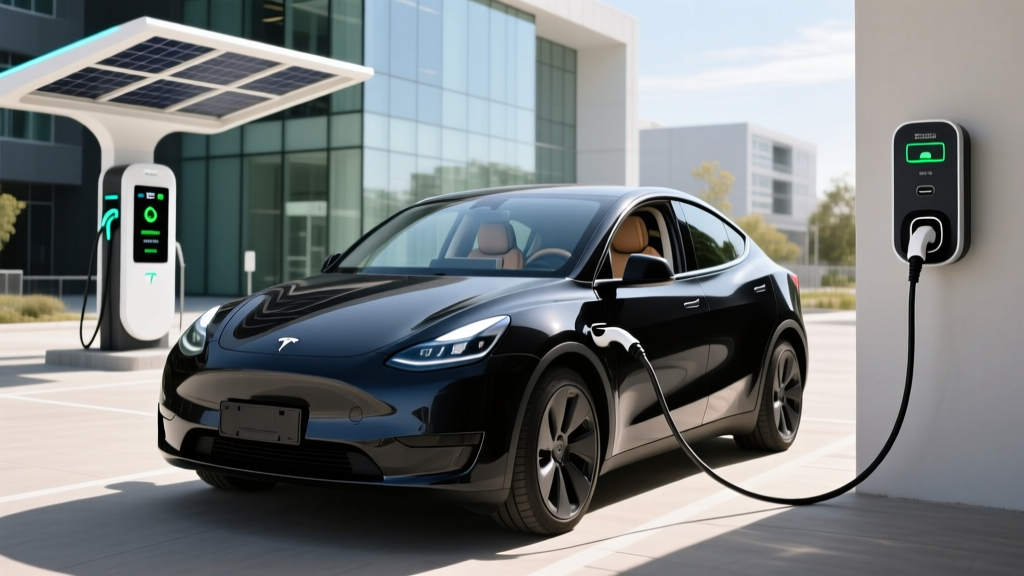
Charging speed is where the Tesla ecosystem continues to exert a real advantage. The Model Y Long Range AWD accepts a peak 250 kW at V3 and V4 Tesla Superchargers, which now use the NACS (North American Charging Standard) connector natively — no adapter required.
However, peak kW is not sustained kW. The Model Y's charge curve is aggressive at low SoC but tapers noticeably above 60%. Here's what to actually expect:
| Charging Method | Max Power | Speed / Time |
|---|---|---|
| DC Fast Charge (Supercharger V3/V4) | 250 kW peak | 10-80% in ~25 min; ~175 mi in 15 min |
| DC Fast Charge (CCS adapter, Electrify America) | ~150-175 kW typical | 10-80% in ~32-38 min |
| Level 2 Home (Tesla Wall Connector, 48A) | 11.5 kW | ~37 miles of range per hour |
| Level 2 Public (48A) | 11.5 kW | ~37 mi/hr |
| Level 1 (120V standard outlet) | ~1.4 kW | ~3-4 mi/hr (emergency/trickle only) |
At a V3 Supercharger, you'll see rates above 200 kW from 10-30% SoC, dropping to roughly 100-120 kW by 60%, and further tapering to under 50 kW above 80%. This is why Tesla's onboard navigation preconditions the battery when a Supercharger is set as your destination — arriving with a warm battery unlocks the full charge curve. Skip preconditioning and your peak rate may drop to 150 kW or less, especially in cold weather.
For home charging, the Tesla Wall Connector at 48 amps on a 60-amp circuit delivers 11.5 kW, adding roughly 37 miles per hour of charging. An overnight session (8-10 hours) easily replenishes a full day's driving. Installation costs typically range from $800-$2,000 depending on panel capacity and run length — a licensed electrician should evaluate whether your panel needs a 200-amp upgrade, which can add $1,500-$3,000.
Performance and Drivetrain: Dual-Motor All-Wheel Drive in Practice
The dual-motor AWD system pairs a permanent-magnet synchronous motor on the rear axle with an induction motor up front. This combination allows the front motor to disconnect entirely during light-load cruising, reducing parasitic drag and boosting efficiency — a clever engineering choice that most competitors don't replicate.
The result: 384 combined horsepower and a 4.8-second 0-60 mph time. That's genuinely quick for a family SUV, and the instant torque delivery makes highway merging and passing effortless. The AWD system provides confident traction in rain and light snow, with torque vectoring that adjusts front-to-rear power distribution in milliseconds.
For buyers who want maximum performance, the Model Y Performance AWD variant drops the 0-60 to 3.5 seconds and adds track-tuned suspension, but sacrifices roughly 20 miles of EPA range and costs significantly more. For most buyers, the Long Range AWD strikes the better balance.
Pricing, Trims, and Federal Tax Credit Eligibility
The 2026 Model Y lineup is streamlined. Here's how the pricing breaks down:
| Trim | MSRP (incl. destination) | Est. After §30D Credit* |
|---|---|---|
| Standard Range RWD | $44,990 | ~$37,490 |
| Long Range AWD | $48,590 | ~$41,090 |
| Long Range AWD (w/ Enhanced Autopilot) | $56,590 | ~$49,090 |
| Performance AWD | $53,590 | ~$46,090 |
*Federal tax credit estimates assume full eligibility. Actual credit depends on IRS §30D requirements.
The §30D federal EV tax credit can reduce your effective purchase price by up to $7,500, but eligibility is not automatic. Per IRS guidelines, you must meet all of the following:
- MSRP cap: The vehicle's MSRP must not exceed $80,000 for SUVs — all Model Y trims qualify.
- Buyer income cap: Modified adjusted gross income (MAGI) must be ≤ $300,000 (joint filers), ≤ $225,000 (head of household), or ≤ $150,000 (single).
- Battery sourcing: A percentage of critical minerals and battery components must be sourced from the U.S. or free-trade-agreement countries. Tesla has significantly shifted its supply chain to meet these thresholds, but the exact qualifying amount ($3,750 for minerals + $3,750 for components = $7,500 max) can change as sourcing rules tighten annually. Verify current-year eligibility on the IRS clean vehicle credit page before purchase.
- Point-of-sale transfer: As of 2024, you can transfer the credit to the dealer at purchase, reducing your out-of-pocket cost immediately rather than waiting for a tax refund.
Consult a tax professional to confirm your personal eligibility. State and local incentives vary and may stack on top of the federal credit — check your state energy office or AFDC incentive database for details.
Interior, Tech, and Driver Assistance
The Model Y's interior follows Tesla's minimalist philosophy: a single 15.4-inch center touchscreen handles navigation, media, climate, and vehicle settings. There is no instrument cluster — speed and driving info appear in the upper-left corner of the main display. The 2025-2026 refresh (internally dubbed "Juniper") added ambient lighting, ventilated front seats, a rear-seat touchscreen, and improved sound insulation, addressing long-standing complaints about cabin noise and spartan rear-seat amenities.
Standout tech features:
- Over-the-air (OTA) software updates that add features post-purchase
- Tesla Supercharger network — 6,500+ stations and 30,000+ stalls in North America, consistently rated highest for reliability
- Sentry Mode dashcam recording and remote monitoring via app
- Heat pump standard — significantly reduces cold-weather range loss compared to resistive heating
- Power liftgate with 30.2 cu ft cargo space (72.0 cu ft with rear seats folded)
Driver assistance — an important clarification: Tesla's Autopilot (standard) and Full Self-Driving (Supervised) are SAE Level 2 driver-assist systems. This means the driver must remain fully engaged, hands on the wheel (or applying torque), and eyes on the road at all times. FSD (Supervised) adds automatic city-street navigation, traffic light recognition, and lane changes, but it is not autonomous driving. Only Level 4 services like Waymo operate without a human driver in geofenced areas. Treat FSD as an advanced convenience feature, not a replacement for attentive driving.
Tesla Autopilot and FSD (Supervised) require continuous driver supervision. They may not detect stationary emergency vehicles, construction zones, or complex merging scenarios. NHTSA has issued multiple investigations into Autopilot-related incidents. Never use these systems while distracted, fatigued, or impaired.
Warranty and Long-Term Battery Health
Tesla covers the Model Y's battery and drive unit for 8 years or 120,000 miles (whichever comes first), with a guaranteed minimum 70% capacity retention over that period. The basic vehicle limited warranty is 4 years / 50,000 miles.
Real-world data from Tesla's annual Impact Reports and third-party fleet analyses suggest NMC packs in the Model Y typically lose 8-12% capacity over the first 100,000 miles, with degradation slowing significantly after the initial break-in period. To maximize longevity:
- Set daily charge limit to 80% (Tesla's infotainment makes this easy)
- Avoid frequent DC fast charging when Level 2 is available
- Use preconditioning in cold weather before charging or driving
- Avoid leaving the vehicle at 100% SoC for extended periods
Battery replacement out of warranty is costly — industry estimates place a Model Y pack replacement at $12,000-$16,000 including labor, though most packs outlast the vehicle itself based on current degradation data.
Who Should Buy the Tesla Model Y All-Wheel Drive?
- You need reliable all-weather traction for snow, rain, or mountain commuting
- You road-trip frequently and want the lowest-friction DC fast-charging experience (Supercharger network)
- You value OTA updates and a tech-forward ownership experience
- You want strong cargo capacity (72 cu ft) without stepping up to a larger, more expensive SUV
- You prefer a traditional dealership experience with in-person service (Hyundai Ioniq 5, Ford Mach-E)
- You want a more premium interior with physical buttons (BMW iX, Genesis GV60)
- You need more than 330 miles of EPA range (consider the Lucid Gravity or upcoming extended-range variants)
- Touchscreen-only controls frustrate you — the Model Y has virtually no physical buttons
- 320-mile EPA range with strong real-world efficiency (117 MPGe)
- 250 kW peak DC fast charging on the most reliable network
- Dual-motor AWD with 4.8-sec 0-60 and confident all-weather traction
- Spacious 72 cu ft cargo area with flat load floor
- Heat pump standard for better cold-weather range retention
- OTA updates continuously improve the vehicle post-purchase
- Touchscreen-only interface — no physical buttons for climate or volume
- Ride quality is firm; road noise improved but still present on rough surfaces
- Service center availability varies by region; mobile service can have long wait times
- FSD (Supervised) is expensive ($8,000 or $99/mo) and still requires full driver attention
- NMC battery requires 80% daily charge limit for optimal longevity
Frequently Asked Questions
What is the real-world range of the Tesla Model Y All-Wheel Drive?
The EPA rates the 2026 Model Y Long Range AWD at 320 miles. In real-world highway driving at 70-75 mph, expect 265-285 miles. In freezing temperatures, range can drop to 220-250 miles. City driving with regenerative braking often matches or slightly exceeds the EPA figure.
How fast does the Model Y AWD charge at home and on the road?
On a Tesla V3/V4 Supercharger, the Model Y AWD peaks at 250 kW and charges from 10-80% in approximately 25 minutes. At home on a Level 2 Tesla Wall Connector (48A / 11.5 kW), it adds about 37 miles of range per hour, fully replenishing overnight.
Does the Tesla Model Y qualify for the $7,500 federal EV tax credit?
The Model Y qualifies for up to $7,500 under IRS §30D, provided the buyer meets income caps ($300K joint / $150K single) and the vehicle meets battery-sourcing requirements, which tighten annually. All trims fall under the $80,000 SUV MSRP cap. The credit can be transferred at point of sale. Verify current-year eligibility on irs.gov before purchasing.
Is the Tesla Model Y AWD worth buying over the Hyundai Ioniq 5 or Ford Mach-E?
The Model Y AWD wins on charging network reliability (Supercharger), efficiency (117 MPGe vs. 113 MPGe for Ioniq 5 AWD), and cargo space (72 vs. 59.3 cu ft for Ioniq 5). The Ioniq 5 offers 800V architecture with faster 10-80% charging on compatible chargers (~18 min at 350 kW), a more distinctive design, and physical buttons. The Mach-E offers a sportier driving feel and Ford dealership service access. Test-drive all three before deciding.
What are the biggest drawbacks of the Model Y AWD?
The touchscreen-only interior frustrates some drivers. Ride quality is firm compared to luxury competitors. Service center wait times can be long in some regions. FSD (Supervised) costs extra and is not autonomous driving. The NMC battery benefits from an 80% daily charge limit, which slightly reduces usable daily range versus LFP competitors.
How long will the Model Y battery last?
Tesla warranties the battery for 8 years / 120,000 miles with a minimum 70% capacity retention guarantee. Real-world fleet data shows typical degradation of 8-12% over 100,000 miles, with the curve flattening afterward. Many Model Y packs are projected to last 200,000+ miles before reaching 70% state of health.