The Short Answer on Chinese Electric Trucks
As of 2026, you cannot easily buy a consumer-grade Chinese electric truck in the United States. Heavy 25% Section 301 tariffs (raised to 100% on EVs in 2024 and maintained through 2026), combined with separate 2.5% standard auto import duties, effectively double the sticker price of any Chinese-made EV. Consumer models like the BYD Shark PHEV pickup are not officially sold stateside. However, Chinese electric commercial trucks—particularly from BYD Commercial—do operate in US fleet applications, sold through US-based dealerships and upfitters. If you're a private buyer looking for an electric pickup, your realistic options remain the Ford F-150 Lightning, Rivian R1T, Chevrolet Silverado EV, and Tesla Cybertruck. If you're a fleet manager, Chinese-built Class 6-8 electric trucks are available but come with tariff-inflated pricing and parts-supply considerations.
Why Chinese Electric Trucks Aren't on US Dealer Lots
The US market for Chinese electric trucks faces three structural barriers that have only hardened through 2026:
- 100% EV tariff under Section 301: Enacted in 2024 and upheld through the current trade policy framework, this tariff applies to all Chinese-manufactured electric vehicles, including light-duty pickups and commercial trucks. A Chinese electric truck with a $40,000 factory price becomes $80,000+ before shipping, dealer markup, or compliance modifications.
- FMVSS compliance: Every vehicle sold in the US must meet Federal Motor Vehicle Safety Standards. Chinese-market trucks are built to GB (Guobiao) standards, which differ significantly in crash structures, lighting, mirror requirements, and restraint systems. Re-engineering a Chinese truck platform for US compliance is a multi-million-dollar investment that no Chinese OEM has committed to for the consumer pickup segment.
- Dealership and service networks: Even if imported, Chinese EV makers lack the US dealer franchise infrastructure required in most states. Tesla's direct-sales model is an exception that required years of legal battles; new entrants face the same hurdles.
The result: Chinese EV brands like BYD, NIO, Xpeng, and Li Auto focus on markets where they face lower tariff barriers—Southeast Asia, Latin America, the Middle East, and Europe (though the EU imposed its own countervailing duties in late 2024).
Chinese Electric Trucks Available to US Fleet Buyers
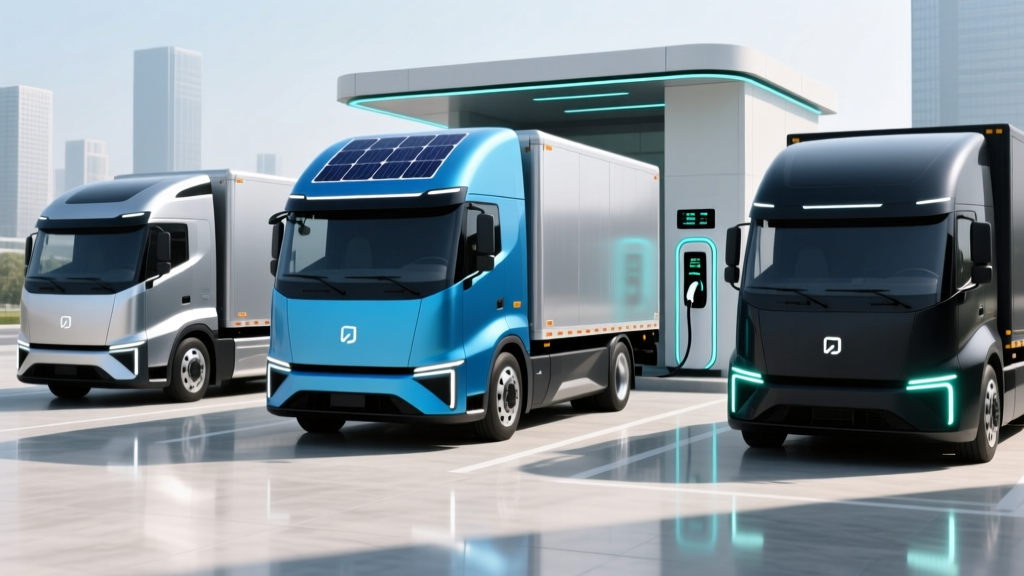
Commercial fleet operators have a narrower but real path to Chinese-built electric trucks. BYD is the primary player, having established a Lancaster, California manufacturing and assembly presence (though scaled back from earlier plans) and a network of US commercial vehicle dealers.
| Model | Class | Battery (kWh) | EPA Est. Range | Peak DC Charge | Approx. US Price |
|---|---|---|---|---|---|
| BYD 8F (Class 8 Semi) | 8 | 486 kWh (LFP) | ~150 mi (loaded) | ~180 kW | $350,000–$420,000 |
| BYD 6F (Class 6 Box Truck) | 6 | 281 kWh (LFP) | ~150 mi | ~150 kW | $180,000–$230,000 |
| BYD T8 (Class 8 Cab Chassis) | 8 | 360 kWh (LFP) | ~120 mi (vocational) | ~150 kW | $290,000–$350,000 |
Key observations for fleet buyers:
- LFP chemistry dominates: BYD uses its proprietary Blade Battery (lithium iron phosphate) across its commercial lineup. LFP offers superior cycle life (3,000+ full cycles to 80% State of Health) and thermal stability compared to NMC, but at the cost of lower energy density—meaning heavier packs for the same range.
- Range is modest: 120–150 miles real-world is typical for loaded Class 6-8 operations. This works for drayage, last-mile delivery, and refuse routes with depot charging, but not for long-haul trucking.
- Tariff impact is absorbed differently: Commercial fleet buyers can leverage IRA §45W Commercial Clean Vehicle Credits (up to $40,000 for vehicles over 14,000 lbs GVWR) and state incentive programs (particularly in California via CARB's Advanced Clean Trucks framework) to partially offset tariff-inflated pricing.
Chinese Electric Trucks vs US Alternatives: Cost Comparison
For fleet managers weighing a Chinese-built electric truck against a US-made competitor, the total cost of ownership (TCO) picture is nuanced. Here's how a Class 6 electric box truck compares to a diesel equivalent over 5 years of typical urban delivery use (50,000 miles/year):
| Cost Category | BYD 6F (Electric, Chinese-Built) | Freightliner eM2 106 (Electric, US-Built) | International MV607 (Diesel) |
|---|---|---|---|
| Purchase Price (after incentives) | $140,000 | $135,000 | $95,000 |
| Fuel/Energy (250K mi) | $18,750 | $18,750 | $62,500 |
| Maintenance (250K mi) | $8,000 | $8,000 | $22,000 |
| Depot Charger Install | $25,000 | $25,000 | $0 |
| Insurance (5 yr) | $17,500 | $17,000 | $14,000 |
| 5-Year Total | $209,250 | $203,750 | $193,500 |
The electric options—whether Chinese or US-built—achieve TCO parity or advantage over diesel primarily through fuel and maintenance savings, but only when fleet routes are predictable and depot charging is feasible. The BYD 6F's tariff-inflated purchase price erodes its otherwise competitive positioning against the US-built Freightliner eM2, which benefits from domestic manufacturing and avoids the Section 301 tariff entirely.
What About Consumer Chinese Electric Pickups?
Social media and automotive press frequently feature Chinese electric pickups that generate US buyer interest:
- BYD Shark (PHEV pickup): A plug-in hybrid midsize truck with ~60 miles of electric-only range and a 1.5L turbo range-extender. It's priced from approximately $30,000 USD-equivalent in markets like Mexico and Australia, generating intense US enthusiasm. However, BYD has confirmed no US launch plans, citing the 100% tariff barrier. Even if imported, the post-tariff price would exceed $60,000—eliminating its value proposition against the Ford Maverick Hybrid ($28,000–$40,000) and Ford F-150 PowerBoost.
- GWM Poer EV: Great Wall Motors' electric pickup concept remains in limited-market testing. No US homologation program exists.
- Radar RD6 (Geely subsidiary): Sold in select Asian and Middle Eastern markets with a ~340-mile CLTC range (expect ~250 miles EPA-equivalent). No US presence.
The common thread: attractive specs and pricing that evaporate once tariffs, compliance re-engineering, and dealer-network costs are applied.
Real-World Ownership Considerations for Fleet Buyers
If you're a fleet manager seriously evaluating a Chinese-built electric truck, these operational factors matter as much as the sticker price:
Depot Charging Infrastructure
Class 6-8 electric trucks require dedicated depot charging. A single 150 kW DC fast charger costs $80,000–$150,000 installed (including electrical service upgrades, trenching, and utility coordination). For a 10-truck fleet, plan $500,000–$1.2M in charging infrastructure before the first truck arrives. Utility demand charges can add $2,000–$8,000/month depending on your rate structure and peak draw.
Parts and Service Availability
BYD maintains a US parts warehouse and certified technician program, but the network is thin compared to Freightliner, Volvo, or PACCAR. Fleet managers report 2–4 week lead times on proprietary components (inverters, BMS modules) versus 2–5 days for domestic OEM equivalents. This matters for uptime-critical operations.
Cold-Weather Range Loss
LFP batteries suffer more capacity loss in cold temperatures than NMC—typically 25–35% range reduction at 20°F versus 15–25% for NMC. For a BYD 6F rated at 150 miles, expect ~100–110 miles of usable range in a Chicago or Minneapolis winter. Fleets in Sun Belt states see minimal seasonal variation.
Resale Value Uncertainty
There is no established secondary market for used Chinese-built electric trucks in the US. Depreciation projections are speculative. By contrast, US-built electric commercial trucks from established OEMs have emerging resale data. Fleet financial officers should model conservative 5-year residual values (20–30% of purchase price) for Chinese platforms.
Decision Framework: Should You Buy a Chinese Electric Truck?
If you are a private consumer wanting an electric pickup → Chinese trucks are not a viable option due to tariffs and lack of US sales channels. Choose the Ford F-150 Lightning (EPA 230–320 mi, from $54,995), Rivian R1T (EPA 270–420 mi, from $69,900), Chevrolet Silverado EV (EPA 380–492 mi, from $57,000), or Tesla Cybertruck (EPA 318–340 mi, from $79,990). If you want a midsize PHEV pickup, the Ford Maverick Hybrid remains the only widely available option.
If you are a fleet manager with predictable sub-150-mile daily routes and depot charging → A Chinese-built BYD commercial truck may be competitive, especially with §45W credits and state incentives. Request quotes from both BYD and US-based competitors (Freightliner eM2, Volvo VNR Electric, Tesla Semi) and compare on a per-mile TCO basis over your expected ownership period.
If your fleet operates long-haul, cold-climate, or high-uptime routes → Prioritize US-built electric trucks from OEMs with established service networks. The tariff premium on Chinese trucks does not buy you a range or reliability advantage in these demanding applications.
If you are considering grey-market import of a Chinese consumer EV → The EPA and NHTSA require full federalization for any vehicle driven on public roads. The Show or Display exemption applies only to historically significant vehicles, not current-production trucks. Importing a BYD Shark for street use is not legally feasible for a private buyer. See NHTSA import guidelines for details.
Common Misconceptions About Chinese Electric Trucks
| Myth | Fact |
|---|---|
| "Chinese EVs are cheap and low quality" | BYD's Blade Battery (LFP) passes nail-penetration tests without thermal runaway. BYD is the world's largest EV manufacturer by volume. Build quality in 2026 models is competitive with Korean and Japanese OEMs, though US-specific validation is lacking. |
| "I can import a BYD Shark through a third party" | Grey-market imports must pass FMVSS compliance, EPA emissions certification (even for EVs), and DOT bonding requirements. Cost of federalization for a single vehicle typically exceeds $50,000, with no guarantee of approval. It is not a practical path. |
| "The 100% tariff will be repealed soon" | Section 301 tariffs on Chinese EVs enjoy bipartisan support and are tied to broader trade and national-security policy. No legislative repeal effort is active as of 2026. Plan purchasing decisions assuming current tariff levels persist. |
| "Chinese trucks have no warranty support in the US" | BYD Commercial offers a 5-year/600,000-mile battery warranty on US-sold Class 6-8 trucks, backed by a US-based parts and service team. Coverage is real but the service network is limited to ~30 certified locations nationwide. |
| "Chinese EV batteries degrade faster" | LFP chemistry used by BYD typically shows less degradation than NMC over equivalent cycles. Independent testing shows BYD Blade cells retaining 90%+ capacity after 1,500 cycles. The concern is not chemistry—it's long-term parts availability if the US entity restructures. |
Tax Credits and Incentives: What Actually Applies
For consumer EV buyers, the federal §30D tax credit (up to $7,500) applies only to vehicles purchased from a manufacturer with a US sales presence and meeting IRS battery-sourcing and critical-mineral requirements. No Chinese-manufactured consumer vehicle currently qualifies. The MSRP caps ($55,000 for sedans, $80,000 for trucks/SUVs) and buyer income limits ($150K single / $300K joint AGI) further narrow eligibility even for US-built vehicles.
For commercial fleet buyers, the §45W Commercial Clean Vehicle Credit offers up to $40,000 for electric trucks over 14,000 lbs GVWR (or 30% of the vehicle's basis, whichever is less). This credit has no manufacturer-origin restriction, meaning a Chinese-built BYD truck purchased by a US fleet can qualify—provided the fleet has sufficient tax liability to claim it. State-level incentives vary; California's HVIP (Hybrid and Zero-Emission Truck and Bus Voucher Incentive Project) offers up to $120,000 per Class 8 electric truck regardless of country of origin, subject to funding availability.
The Bottom Line for 2026
Chinese electric trucks represent a genuine engineering achievement—BYD's commercial EV platforms are proven in millions of fleet miles globally. But for US buyers, the 100% tariff wall makes them economically uncompetitive for consumer use and only marginally viable for commercial fleets with strong incentive stacking. The practical path forward:
- Consumer pickup buyers: Look to Ford, Rivian, GM, and Tesla. If the BYD Shark's concept appeals to you, watch for US OEM responses in the midsize PHEV truck segment—Ford and Stellantis are both developing competitors.
- Fleet buyers: Include BYD in your RFP process for depot-based, short-haul operations, but benchmark against Freightliner, Volvo, and Tesla on a fully-loaded TCO basis including charging infrastructure, service contract, and residual value assumptions.
- Policy watchers: Chinese OEMs are actively exploring Mexico-based manufacturing to potentially access the USMCA trade zone. A Chinese EV built in Mexico could theoretically enter the US with lower tariffs, but rules-of-origin requirements and political pushback make this uncertain through 2028.
Frequently Asked Questions
Can I personally import a BYD Shark pickup to the US?
Not for road use. The BYD Shark has not been federalized for US sale, and individual importation requires NHTSA and EPA compliance certification that costs $50,000+ per vehicle with no guarantee of approval. It is not a realistic option for private buyers.
Why is the tariff on Chinese EVs 100%?
The Biden administration raised Section 301 tariffs on Chinese EVs from 25% to 100% in 2024, citing unfair trade practices, forced technology transfer, and state subsidies that artificially lower Chinese EV prices. This tariff level has been maintained through 2026 under subsequent trade policy reviews.
Are BYD commercial electric trucks reliable?
BYD's commercial EV platforms have accumulated billions of fleet miles globally, primarily in China and Europe. US fleet operators report competitive uptime, though parts lead times (2–4 weeks for proprietary components) are longer than domestic OEM equivalents. The LFP Blade Battery chemistry is among the most durable in the industry, with demonstrated 90%+ capacity retention after 1,500 full charge cycles.
Will Chinese EV brands enter the US market eventually?
BYD, NIO, and other Chinese OEMs have publicly stated interest in US market entry, but the 100% tariff makes direct import economically unviable. The most likely entry strategy is manufacturing in a USMCA-partner country (Mexico), though political opposition and rules-of-origin scrutiny may block this path through at least 2028.
What's the best electric truck I can actually buy in the US today?
For full-size: the Chevrolet Silverado EV 4WT (EPA 492 mi, from $57,000) offers the longest range; the Ford F-150 Lightning (EPA 230–320 mi, from $54,995) has the broadest trim selection and widest dealer network. For premium/lifestyle: the Rivian R1T (EPA 270–420 mi, from $69,900) leads in off-road capability and build quality. For commercial Class 8: the Tesla Semi (EPA 500 mi estimated, ~$250,000) and Freightliner eCascadia (EPA 230 mi, ~$300,000+) are the primary US-built options.