The Short Answer on Chinese Electric SUVs in the US
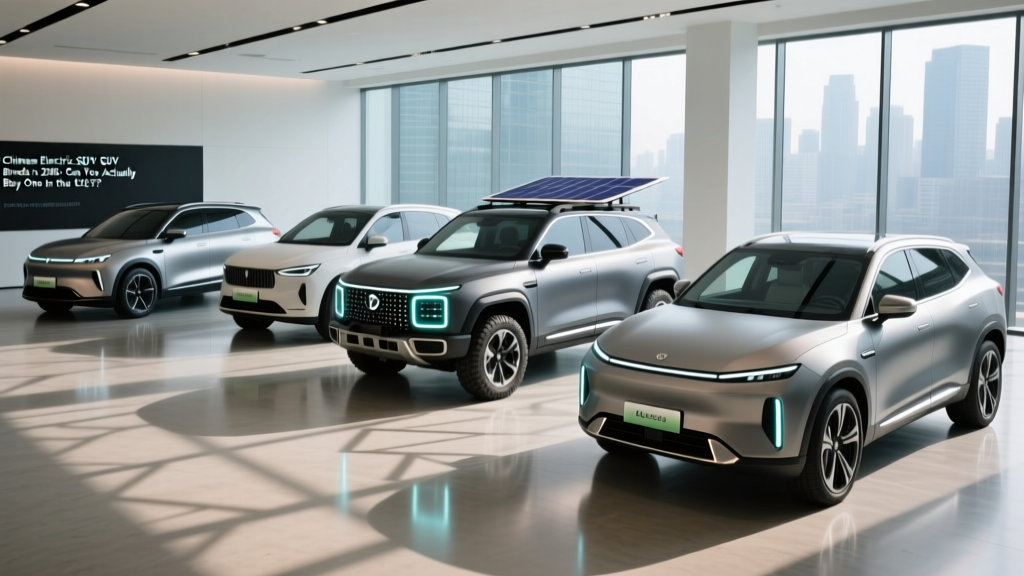
As of 2026, no Chinese-made electric SUV is officially sold through authorized dealer networks in the United States. Brands like BYD, NIO, Xpeng, and Li Auto dominate headlines with aggressive global expansion and compelling specs, but a combination of 100%+ import tariffs on Chinese-built EVs, national-security review processes, and the absence of US dealer infrastructure means American buyers cannot walk into a showroom and purchase one. If you're researching a Chinese electric SUV because you want a long-range, tech-heavy electric utility vehicle at a lower price point, your realistic options are: (1) wait for potential future market entries that would require US-spec compliance and tariff resolution, or (2) look at comparable non-Chinese EVs already available stateside that deliver similar range and feature sets.
Why Chinese EV Brands Aren't on American Roads Yet
China produces more electric vehicles than any other nation, and its domestic brands have rapidly closed the gap with legacy automakers on battery technology, software integration, and build quality. BYD alone sold over 4 million electrified vehicles globally in 2025. Yet the US market remains effectively walled off for several concrete reasons:
- Section 301 tariffs: The US imposes a 100% tariff on Chinese-built electric vehicles (raised from 25% in 2024). A $35,000 BYD Sealion 7 effectively becomes a $70,000 vehicle before shipping, compliance, and dealer markup — eliminating the price advantage entirely.
- Connected-vehicle ban: A 2024 Commerce Department rule prohibits the sale of vehicles containing Chinese- or Russian-made connected-vehicle hardware and software, effective for model year 2027 and later. Chinese EVs rely heavily on proprietary software stacks, making compliance a fundamental engineering challenge.
- No dealer or service network: Even if tariffs were waived, these brands would need to establish NHTSA compliance, crash-test US-spec vehicles, build a parts and service infrastructure, and navigate 50-state dealer franchise laws — a multi-year, billion-dollar undertaking.
- Federal tax credit exclusion: The IRS §30D clean vehicle credit explicitly requires that the vehicle not contain battery components from a "foreign entity of concern" (FEOC), which includes Chinese manufacturers. Any Chinese-built EV would be ineligible for the up-to-$7,500 credit regardless of other qualifications.
What These Brands Offer (And Why They Generate Search Interest)
The search volume around Chinese electric SUVs isn't accidental. These vehicles offer genuinely impressive specifications in markets where they're available. Here's what the leading contenders deliver in Europe, Southeast Asia, and Latin America as of 2026:
| Model | Battery (kWh) | WLTP Range | DC Fast Charge (Peak kW) | 0-100 km/h | Approx. Global MSRP |
|---|---|---|---|---|---|
| BYD Sealion 7 | 82.5 (LFP Blade) | 502 km (312 mi) | 230 kW | 6.7 sec | ~€48,000 (EU) |
| NIO EL6 (ES6) | 75 / 100 / 150 (swappable) | 490–900 km | 127 kW (75 kWh pack) | 4.5 sec | ~€55,000 (EU) |
| Xpeng G9 | 98 (NMC) | 570 km (354 mi) | 300 kW (800V arch.) | 6.2 sec | ~€52,000 (EU) |
| Li Auto L7 (EREV) | 42.8 (NMC) + 1.5L range extender | 210 km EV + 1,100 km total | 75 kW | 5.3 sec | Not sold in EU/US |
| Zeekr 7X | 75 / 100 (NMC/LFP) | 480–700 km | 340 kW (800V) | 5.8 sec | ~€46,000 (EU) |
Note: WLTP range figures are typically 10–15% higher than EPA estimates for the same vehicle. A 502 km WLTP rating would likely translate to roughly 260–280 EPA miles if certified for the US market. Source: Manufacturer European spec sheets.
Real-World Range Reality Check
The Xpeng G9's 354-mile WLTP figure sounds competitive with a Tesla Model Y Long Range (EPA 310 miles). But WLTP testing is less demanding than the EPA cycle. Expect a US-certified G9 to sticker around 290–310 EPA miles, and real-world highway driving at 75 mph to yield approximately 240–260 miles in moderate temperatures, dropping to 200–220 miles in sub-freezing conditions without a heat pump — or 230–245 miles with one.
Cost Comparison: What a Chinese EV Would Cost vs. Available Alternatives
Let's model what a hypothetical BYD Sealion 7 would cost an American buyer if it were imported today under current tariff rules, compared to vehicles US buyers can actually purchase:
| Cost Factor | BYD Sealion 7 (Hypothetical US Import) | Tesla Model Y LR (2026) | Hyundai Ioniq 5 SEL (2026) |
|---|---|---|---|
| Base MSRP | ~$35,000 (global) | $46,630 | $46,650 |
| Import Tariff (100%) | +$35,000 | $0 (US-built) | $0 (US-built) |
| Shipping & Compliance | ~$4,000 | $0 | $0 |
| Effective Sticker Price | ~$74,000 | $46,630 | $46,650 |
| §30D Tax Credit Eligible? | No (FEOC + tariff) | Up to $7,500 | Up to $7,500 |
| Net Cost After Credit | ~$74,000 | ~$39,130 | ~$39,150 |
| EPA Range (Est.) | ~265 mi (est.) | 310 mi | 310 mi |
| Charging Network Access | None (no US presence) | Tesla Supercharger | NACS / Supercharger access |
The tariff math is devastating. Even a vehicle with a compelling $35,000 global price becomes nearly double the cost of a US-built competitor that qualifies for the federal clean vehicle credit under IRS §30D. The credit itself has income caps ($150K single / $300K joint filers), MSRP caps ($80K for SUVs), and strict battery-sourcing requirements that exclude FEOC-manufactured components.
EV vs. Gas SUV: What US Buyers Actually Spend Over 5 Years
Since the Chinese electric SUV isn't a realistic purchase, here's the ownership math for the alternatives American buyers are actually cross-shopping — a Tesla Model Y, a Hyundai Ioniq 5, and the Toyota RAV4 (gas) as a baseline:
| 5-Year Cost Category | Tesla Model Y LR | Hyundai Ioniq 5 SEL | Toyota RAV4 LE (Gas) |
|---|---|---|---|
| Purchase Price (after credit) | $39,130 | $39,150 | $30,500 |
| Fuel / Electricity (60K mi) | $3,600 (home L2, $0.14/kWh avg) | $3,900 | $7,200 (28 MPG, $3.36/gal) |
| Maintenance (5 yr) | $1,200 | $1,400 | $3,800 |
| Insurance (5 yr avg) | $9,500 | $8,200 | $6,800 |
| Est. Depreciation | $16,000 | $15,500 | $11,000 |
| Total 5-Year Cost | $69,430 | $68,150 | $59,300 |
| Cost Per Mile | $1.16 | $1.14 | $0.99 |
Assumptions: 12,000 miles/year, 80% home Level 2 charging, national average electricity at $0.14/kWh (per EIA data), EPA combined MPG for RAV4. Insurance premiums are higher for EVs due to repair costs and parts pricing. Actual costs vary by state, utility rate, and driving profile.
The EVs cost roughly $9,000–$10,000 more over five years, driven primarily by higher insurance premiums and steeper depreciation. However, the gap narrows significantly if you have access to cheap overnight electricity (under $0.10/kWh in many utility districts), drive more than 12,000 miles annually, or live in a state with additional EV incentives (such as California's CVRP or Colorado's state tax credit).
Real-World Ownership Considerations Before You Buy Any EV
Whether you were drawn to a Chinese electric SUV or are pivoting to a stateside alternative, these practical factors determine whether EV ownership works for you:
Home Charging Access Is the Single Biggest Variable
EVs shine when you charge at home overnight. A Level 2 home charger (240V, 32–48 amps) adds 25–37 miles of range per hour of charging and costs $500–$2,000 installed, depending on whether your electrical panel needs an upgrade. If you live in an apartment, rely on street parking, or lack a dedicated garage circuit, public charging becomes your primary refueling method — and that costs $0.30–$0.50/kWh at DC fast chargers, roughly doubling your "fuel" cost and adding time inconvenience.
Cold Climate Means Real Range Loss
Lithium-ion batteries lose 20–35% of their rated range in sustained sub-30°F weather. A 310-mile EPA-rated SUV may deliver only 210–240 miles in a Minnesota January. Heat pumps (standard on most 2026 EVs) mitigate cabin heating draw but don't eliminate the physics. If you live in the upper Midwest or Northeast, budget for this loss and prioritize vehicles with larger batteries or heat-pump-equipped thermal management systems.
Your Driving Pattern Matters More Than Range
If 90% of your driving is a 30-mile daily commute with home charging, a 250-mile-range EV is perfectly adequate. Range only becomes critical for road trips — and with DC fast charging at 150–250 kW available along most interstate corridors (via Electrify America, EVgo, and the expanding Tesla Supercharger network with NACS adapters), a 20-minute stop every 200 miles is manageable. The real friction point is reliability: non-Tesla public chargers still experience 15–20% downtime rates in some networks.
Common Misconceptions About Chinese EVs and the US Market
| Myth | Fact |
|---|---|
| "Chinese EVs are cheap and low quality" | BYD, NIO, and Xpeng vehicles earn competitive Euro NCAP safety ratings and feature LFP Blade batteries with strong thermal stability. Build quality in 2026 models rivals Korean and Japanese brands. The "cheap" perception is outdated. |
| "They'll be in the US any year now" | BYD has stated publicly it has no timeline for US passenger vehicle sales. The 100% tariff and connected-vehicle ban make entry economically unviable without building a US or Mexico factory — which itself faces political scrutiny. |
| "I can import one privately" | Federal law requires all vehicles driven on public roads to meet FMVSS (Federal Motor Vehicle Safety Standards) and EPA emissions certification. Chinese-market vehicles are not built to these standards. Importing one for road use is effectively impossible without manufacturer cooperation. |
| "BYD batteries are in US cars already" | The §30D FEOC rules (effective 2024 for battery components, 2025 for critical minerals) specifically restrict BYD and CATL battery sourcing. Automakers have restructured supply chains to comply. Source: IRS §30D guidance. |
| "Chinese EVs charge faster than everything else" | The Xpeng G9 and Zeekr 7X use 800V architectures enabling 300+ kW peak charge rates — genuinely impressive. But sustained charge curves matter more: many taper sharply above 60% SoC. Tesla's 250 kW V3 Superchargers deliver more consistent 10–80% times due to superior thermal management and charge-curve optimization. |
Decision Framework: What to Buy Instead in 2026
If You Wanted a Chinese Electric SUV, Here's Your Pivot
- If price was your main draw ($35K–$45K): Look at the Chevrolet Equinox EV (EPA 319 mi, ~$33,600 after credit) or the Hyundai Ioniq 5 (EPA 310 mi, ~$39,150 after credit). Both are US-built, credit-eligible, and serviceable nationwide.
- If tech and software impressed you: The Tesla Model Y remains the benchmark for OTA updates, Supercharger access, and integrated software. The Rivian R2 (launching 2026) promises a tech-forward compact SUV at ~$45,000.
- If you wanted battery-swap flexibility (NIO): No US equivalent exists. Your closest option is prioritizing vehicles with the fastest DC charging — the Hyundai Ioniq 5/6 and Kia EV6/GT on their E-GMP platform deliver 10–80% in approximately 18 minutes at a 350 kW charger.
- If you wanted an EREV (Li Auto): Consider the BMW X5 xDrive50e PHEV (38 miles electric-only + gas engine) or wait for the Ram 1500 REV with its optional range-extender configuration.
- If you're willing to wait: BYD has established a factory in Thailand, is building in Hungary and Brazil, and has hinted at a Mexico facility. A North American entry is plausible by 2029–2030, but tariff and regulatory environments could shift in either direction.
Frequently Asked Questions
Can I buy a BYD, NIO, or Xpeng vehicle in the United States in 2026?
No. None of these brands sell passenger vehicles through authorized US dealers. A 100% tariff on Chinese-built EVs, the connected-vehicle hardware/software ban, and the absence of NHTSA/FMVSS certification make purchase effectively impossible for American consumers.
Why are Chinese electric SUVs so much cheaper in other countries?
Chinese EVs benefit from lower domestic manufacturing costs, government subsidies in China, and aggressive pricing to gain market share in Europe and Southeast Asia. A BYD Sealion 7 at ~€48,000 in Europe has no tariff burden there (though the EU imposed its own countervailing duties of up to 35.3% on Chinese EVs in late 2024). The US 100% tariff is the most aggressive globally.
Will the tariff on Chinese EVs ever be reduced?
Tariff policy is subject to executive action and trade negotiations. As of 2026, the 100% rate remains in effect and has bipartisan support. Any reduction would likely require concessions in broader US-China trade talks. Monitor the Office of the US Trade Representative for policy changes.
Do Chinese EV batteries pose a safety risk?
BYD's LFP Blade battery has demonstrated strong thermal stability in nail-penetration and crush tests, with lower thermal-runaway risk than many NMC chemistries. CATL and other Chinese battery makers supply cells to Tesla (for some markets), BMW, and other global brands. The safety concern is less about the cells themselves and more about software/data governance under the connected-vehicle rule.
What's the best US-available electric SUV under $40,000 after incentives?
The Chevrolet Equinox EV 3LT (EPA 319 mi, ~$33,600 after the $7,500 credit) and the Tesla Model Y Long Range (~$39,130 after credit) offer the strongest range-per-dollar ratios in 2026. The Hyundai Ioniq 5 SEL (~$39,150 after credit) adds 800V-class fast charging and a more distinctive design. All three are built in US plants, ensuring parts availability and service infrastructure.
If Chinese EVs enter the US market, will they undercut domestic brands?
Under current tariff structures, no. Even with a 50% tariff reduction, the effective price would remain higher than US-built competitors that qualify for the §30D credit. Only a US or near-shore (Mexico/Canada) factory could make the economics work — and any such investment would take 3–5 years from announcement to production.