Quick Answer: Are Chinese EV Brands Available in the US?
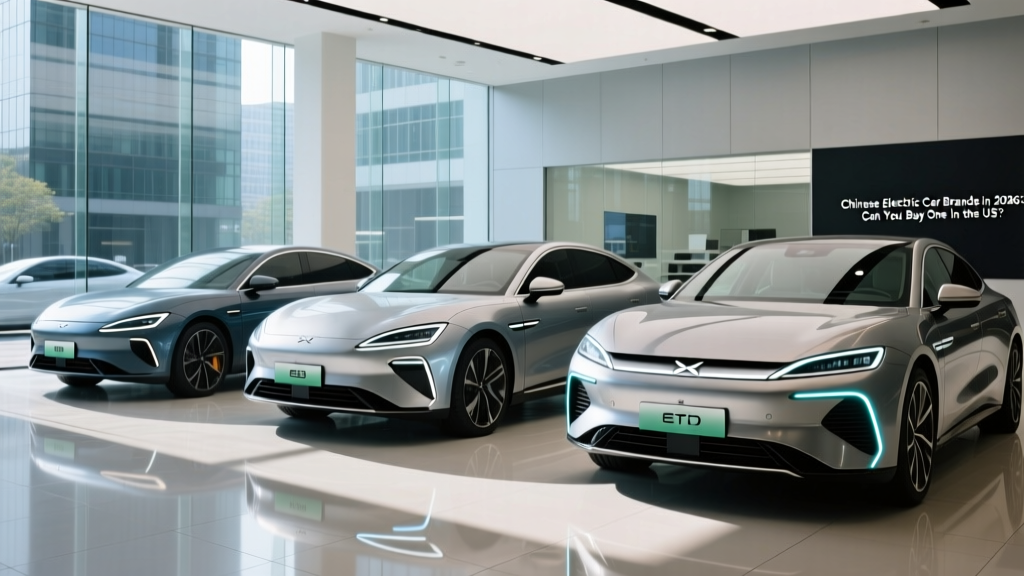
As of 2026, no mainstream Chinese electric car brand sells vehicles directly to US consumers. The US imposes a 100% tariff on Chinese-made EVs (raised from 25% in 2024), effectively doubling the price of any imported Chinese electric vehicle and making them commercially unviable. Brands like BYD, NIO, Xpeng, Li Auto, Zeekr, and MG — which collectively dominate China's domestic market and are expanding aggressively into Europe, Southeast Asia, and Latin America — have no US dealer networks, no EPA-certified models, and no announced plans for American launches under current trade policy.
If you're a US buyer researching Chinese EVs out of curiosity, comparison shopping, or future-proofing your knowledge, this guide covers the brands worth watching, why they're locked out, what they'd cost if tariffs changed, and what you should buy instead right now.
Why Chinese EVs Are Priced Out of America
The barrier isn't quality or technology — it's trade policy. Here's the tariff stack that blocks Chinese EVs from US showrooms:
| Tariff / Duty | Rate (2026) | Applies To |
|---|---|---|
| Standard auto import duty | 2.5% | All imported vehicles |
| Section 301 tariff on Chinese EVs | 100% | Battery electric vehicles from China (raised May 2024) |
| Section 301 tariff on EV batteries | 25% | Lithium-ion battery cells and packs |
| Section 301 tariff on battery minerals | 25% | Graphite, certain critical minerals from China |
The practical math: A BYD Seal that retails for roughly $38,000 in China would face approximately $39,000 in combined tariffs and duties, pushing its landed US cost above $77,000 — well above a Tesla Model 3 Long Range (EPA 363 miles, starting at $42,490 in 2026) or a Hyundai Ioniq 6 (EPA 361 miles, $39,000).
Even if a Chinese OEM built a US assembly plant (as BYD has done with its Lancaster, CA electric bus facility), the battery cells and modules — which represent 30-40% of a BEV's cost — would still face 25% tariffs unless sourced from non-Chinese suppliers. Combined with the IRS §30D tax credit's battery-sourcing and critical-mineral requirements (which explicitly exclude "foreign entities of concern," a category that includes Chinese battery manufacturers like CATL and BYD), a Chinese-assembled-in-the-US EV would likely fail to qualify for the $7,500 federal credit anyway.
The Major Chinese EV Brands: Specs, Pricing, and Global Reach
These are the manufacturers that US buyers most frequently search for. Pricing shown is for their home market or European export market — not US-available pricing, since none are sold stateside.
BYD (Build Your Dreams)
The world's largest EV manufacturer by volume (surpassing Tesla in Q4 2023 for pure BEVs). BYD makes its own Blade Battery (LFP chemistry) and sells across every price tier.
- BYD Dolphin: 44.9 kWh LFP battery, ~265 mi WLTP (~220 mi EPA-equivalent), 95 HP, 0-62 mph in 12.3s. China price: ~¥100,000 (~$14,000). Europe price: ~€30,000 (~$32,000).
- BYD Seal: 82.5 kWh LFP Blade Battery, ~355 mi WLTP (~295 mi EPA-equivalent), 313 HP (RWD) or 530 HP (AWD Performance), 0-62 mph in 3.8s (AWD). Europe price: ~€45,000 (~$48,000).
- BYD Atto 3 (Yuan Plus): 60.5 kWh LFP, ~260 mi WLTP, 204 HP. Exported to Australia, Europe, SE Asia, Latin America.
- DC fast charging: BYD's LFP Blade packs typically peak at 80-120 kW (varies by model), 10-80% in ~35-40 minutes. Slower than comparable Hyundai/Kia 800V architectures.
- US presence: Electric buses only (Lancaster, CA factory). No passenger vehicle plans announced.
NIO
Premium Chinese EV maker known for battery-swap stations (swap a depleted pack for a full one in ~3 minutes) and a subscription-based BaaS (Battery as a Service) model that lowers purchase price.
- NIO ET7 sedan: 75 kWh (NMC) or 100 kWh pack, ~335 mi WLTP (~280 mi EPA-est.), 644 HP (dual motor), 0-62 mph in 3.8s. China: ~¥378,000 (~$52,000).
- NIO EL6 (ES6): Mid-size SUV, 75/100 kWh, ~310 mi WLTP. Europe price: ~€55,000 (~$59,000).
- Battery swap: 23+ swap stations in Europe (Norway, Germany, Netherlands). 1,800+ in China. Not feasible under current US infrastructure.
- US plans: NIO has stated publicly that US entry is "not imminent" due to tariff environment.
Xpeng
Tech-focused brand emphasizing ADAS (its XNGP system is one of the most capable Level 2 systems in China) and 800V fast-charging architecture.
- Xpeng G6: 87.5 kWh (NMC), ~280 mi WLTP (~235 mi EPA-est.), 296 HP RWD, 800V architecture enabling peak 280 kW DC fast charging (10-80% in ~20 min). Europe: ~€45,000.
- Xpeng P7+ sedan: Announced late 2024, 76.3 kWh LFP option, ~380 mi CLTC (~290 mi EPA-est.). China: ~¥186,000 (~$26,000).
- US presence: None. Xpeng has explored European expansion but has no US timeline.
Zeekr (Geely Group)
Geely's premium EV brand, sharing SEA (Sustainable Experience Architecture) with the Volvo EX30 and Polestar 4.
- Zeekr 001: 100 kWh NMC, ~340 mi WLTP, 544 HP (dual motor), 0-62 mph in 3.8s. Notable for shooting-brake wagon design.
- Zeekr X: Compact crossover sharing platform with Volvo EX30. 69 kWh NMC, ~275 mi WLTP. Europe: ~€40,000.
- US angle: Geely owns Volvo and Polestar, which DO sell in the US. However, Zeekr-badged vehicles face the same 100% tariff. Volvo's US-built EX30 variants (from the Ridgeville, SC plant) sidestep this.
Li Auto and Others
Li Auto primarily builds EREVs (extended-range EVs with a gasoline generator), not pure BEVs. The Li L9 SUV offers ~110 mi electric-only range from a 44.5 kWh pack plus a 1.5L turbo range extender. China-only; no export plans.
MG (SAIC Motor): The MG4 EV is a strong-selling budget hatchback in Europe (51 kWh LFP, ~215 mi WLTP, ~€25,000), but SAIC has confirmed no US entry under current tariffs. MG is also subject to EU anti-subsidy tariffs of up to 35.3% (on top of the standard 10%).
What US Buyers Should Consider Instead
If the specs and pricing of Chinese EVs appeal to you — particularly the value proposition of a BYD Seal or Dolphin at $25,000-$40,000 — here are the US-available alternatives that match or beat them on key metrics, with real ownership data.
| Metric | BYD Seal (Europe, not US) | Tesla Model 3 LR (US) | Hyundai Ioniq 6 SEL (US) |
|---|---|---|---|
| Base MSRP | ~$48,000 (€45k) | $42,490 | $39,000 |
| EPA Range | N/A (est. ~295 mi) | 363 mi | 361 mi |
| Battery | 82.5 kWh LFP | 75 kWh (est.) NMC | 77.4 kWh NMC |
| Peak DC Charge | ~150 kW | ~250 kW | ~240 kW (800V) |
| 10-80% DC Time | ~35 min | ~25 min | ~18 min |
| 0-60 mph | 5.9s (RWD) | 4.2s | 5.1s |
| Federal Tax Credit | $0 (not available) | Up to $7,500* | Up to $7,500* |
| Warranty (batt./PT) | 8 yr / 160k km | 8 yr / 120k mi | 10 yr / 100k mi |
* §30D credit eligibility depends on MSRP caps, buyer income limits, and battery-sourcing requirements. Verify current-year rules at IRS.gov.
The Hyundai Ioniq 6 undercuts the BYD Seal on price, delivers more EPA range, charges significantly faster (800V architecture vs. BYD's ~400V), and comes with a 10-year/100,000-mile battery warranty — the longest in the US market. The Tesla Model 3 offers the Supercharger network advantage and stronger ADAS capability (FSD Supervised, still SAE Level 2, requiring full driver engagement).
Real-World Ownership Costs: EV vs. Gas Comparison
Whether you're considering a future Chinese EV import or a current US-available model, the ownership math vs. a gas car follows the same framework. Here's a 5-year total cost of ownership (TCO) comparison using a typical EV at $40,000 (post-credit) vs. a comparable gas sedan at $30,000:
| Cost Category (5 yr / 75,000 mi) | EV ($40k, home-charged) | Gas Sedan ($30k, 30 MPG) |
|---|---|---|
| Purchase price (after credit) | $32,500 | $30,000 |
| Fuel / energy | $3,750 (at $0.15/kWh, 3.5 mi/kWh) | $8,750 (at $3.50/gal, 30 MPG) |
| Maintenance | $1,200 (cabin filter, tires, fluid top-off) | $3,800 (oil, brakes, belts, plugs) |
| Insurance (avg.) | $7,500 (~$1,500/yr, typically 15-25% higher) | $6,000 (~$1,200/yr) |
| Depreciation (est.) | $14,000 (43% over 5 yr) | $12,000 (40% over 5 yr) |
| 5-Year Total | $58,950 | $60,550 |
Assumptions: 15,000 mi/yr, $0.15/kWh home electricity (national avg.), $3.50/gal regular unleaded. Public DC fast charging at $0.35-$0.45/kWh would increase EV fuel cost by ~$1,500-$2,500 if used exclusively. Source: fueleconomy.gov and AAA Your Driving Costs 2025.
Key takeaway: The EV breaks even around year 3-4 when purchased with a federal tax credit, primarily through fuel and maintenance savings. Without the credit (or without home charging access), the payback extends to 5-7 years.
Common Misconceptions About Chinese EVs
| Myth | Fact |
|---|---|
| "Chinese EVs are low quality." | BYD's Seal scored 5 stars in Euro NCAP (2023). NIO's ET7 achieved 5 stars. Build quality on premium Chinese EVs is competitive with European rivals. Budget models vary more. |
| "They'll flood the US market soon." | The 100% tariff makes this economically impossible without a policy reversal or a US-built factory with non-Chinese battery supply — both multi-year, multi-billion-dollar undertakings with no confirmed timelines. |
| "I can import one myself." | EPA and NHTSA certification is required for any vehicle driven on US roads. The "25-year import rule" applies only to vintage vehicles. A private import of a new Chinese EV would not pass federalization. |
| "Chinese batteries degrade faster." | BYD's LFP Blade Battery demonstrates comparable cycle life to CATL and Panasonic LFP cells — typically 85-90% capacity retention after 1,000 full charge cycles (~250,000+ miles). No credible evidence of systemic degradation issues. |
| "If tariffs drop, I should wait." | Tariff policy is unlikely to reverse before 2028 at the earliest. Waiting means missing current US-available models with improving range, falling prices, and active §30D credit eligibility that sunsets or changes annually. |
First-Time EV Buyer Decision Framework
Whether you were drawn here by Chinese EV pricing or you're simply ready to go electric, use this framework to choose the right vehicle for your situation:
- If you have home charging (Level 2, 240V): A BEV is your best value. Look at the Tesla Model 3 ($42,490, 363 mi), Hyundai Ioniq 6 ($39,000, 361 mi), or Chevrolet Equinox EV ($33,600, 315 mi). Home charging at $0.12-$0.18/kWh delivers fuel costs of 4-5 cents/mile vs. 12-15 cents/mile for gas.
- If you rely on public charging only: Prioritize fast-charging capability (800V architecture: Hyundai/Kia/Genesis) and Supercharger access (Tesla, or Ford/GM/Rivian via NACS adapter). Expect fuel costs of 10-14 cents/mile — still cheaper than gas but erases much of the EV savings advantage.
- If you drive 200+ miles daily or frequently tow: Consider a PHEV like the Toyota RAV4 Prime (42 mi electric, 38 MPG combined gas) or a large-battery BEV like the Ford F-150 Lightning Extended Range (320 mi EPA, 131 MPGe). Cold weather and highway speeds reduce real-world range by 20-35%.
- If budget is the primary concern: The used EV market offers strong value. A 2023 Tesla Model 3 RWD runs $25,000-$28,000 and may qualify for the $4,000 used EV credit (§25E) if purchased from a dealer, subject to income limits and the $25,000 price cap.
- If you specifically want a Chinese EV: You cannot buy one in the US in 2026. Monitor trade policy changes, but do not delay an EV purchase in anticipation of Chinese brand entry — it is years away at minimum.
What Chinese EV Brands Mean for the Future US Market
Even though you can't buy a BYD or NIO in America today, their global expansion matters for US buyers in two ways:
1. Pricing pressure on global competitors. BYD's sub-$30,000 EVs in Europe force Volkswagen, Stellantis, and Renault to cut costs and accelerate affordable EV launches. This pressure eventually reaches the US market as global OEMs restructure their EV lineups for competitiveness. The Chevrolet Equinox EV at $33,600 and the upcoming next-gen Tesla Model 2 (announced, targeting ~$25,000) are partly responses to this dynamic.
2. Battery technology leadership. BYD's Blade Battery (LFP), CATL's Shenxing (LFP with 4C charging), and Gotion High-Voltage's LMFP cells are pushing the frontier on cost-per-kWh and safety. These technologies will reach US-market vehicles through licensed manufacturing (e.g., Ford's partnership with CATL for LFP cells at its Marshall, MI plant) even if Chinese-branded cars never arrive.
For now, US buyers have strong domestic, Korean, Japanese, and European EV options that match or exceed Chinese models on range, charging speed, and warranty — often at competitive prices once the §30D tax credit is applied.
Frequently Asked Questions
Can I buy a BYD vehicle in the United States?
No. BYD sells only electric buses in the US (manufactured in Lancaster, CA). Its passenger vehicles — including the Dolphin, Seal, Atto 3, and Han — are not EPA-certified and face a 100% import tariff that doubles their price. BYD has not announced any US passenger vehicle plans.
Are Chinese EVs safe?
Premium Chinese EVs have earned top safety ratings in their target markets. The BYD Seal and NIO ET7 both received 5-star Euro NCAP ratings. However, no Chinese EV has been crash-tested by NHTSA or IIHS for the US market, since none are sold here. Safety equivalence to US-market vehicles is likely but unverified by American testing bodies.
Will Chinese EV tariffs be reduced in the future?
There are no announced plans to reduce the 100% Section 301 tariff on Chinese EVs. Trade policy is subject to change with new administrations, but bipartisan concern about Chinese manufacturing subsidies and IP practices makes near-term tariff reduction unlikely. Any policy shift would take 1-2 years to translate into actual US vehicle availability.
Why are Chinese EVs so much cheaper than American EVs?
Three primary factors: (1) China's battery supply chain is vertically integrated domestically, with LFP cell costs at $50-$70/kWh vs. $80-$100/kWh for NMC cells sourced outside China. (2) Chinese OEMs benefit from government subsidies, cheap industrial land, and lower labor costs. (3) The domestic Chinese market's scale (8+ million EVs sold in 2024) drives massive economies of scale. These cost advantages are real but are offset in the US by tariffs, shipping, and compliance costs.
What's the cheapest EV I can buy in the US right now?
The 2026 Chevrolet Equinox EV LT starts at $33,600 (EPA 315 mi range, 85 kWh NMC battery). After the $7,500 §30D federal credit (if eligible), the effective price drops to $26,100 — close to what a BYD Atto 3 would cost if imported tariff-free. The Nissan Leaf S starts at $28,140 but offers only 149 mi of EPA range and uses the aging CHAdeMO DC charging standard.
Should I wait for Chinese EV brands to enter the US?
No. Chinese brand entry is not expected before 2028-2030 at the earliest, and even then, tariff-adjusted pricing would likely be comparable to existing US-market options. Current EV technology, charging infrastructure, and tax incentives make 2026 a strong year to buy. Waiting risks missing the current §30D credit (which has evolving sourcing requirements) and the continued expansion of the Supercharger/NACS network.