Quick Answer: Should US Buyers Consider a China Electric Loader?
As of 2026, China-manufactured electric wheel loaders (from brands like XCMG, LiuGong, SANY, and SDLG) are widely available in global markets but face significant barriers for US fleet buyers: no established dealer/service network, 25% Section 301 tariffs on Chinese heavy machinery, no EPA/CARB emissions certification pathway for off-road equipment, and no federal §30D tax credit eligibility for non-road commercial vehicles. While these machines offer 40-60% lower operating costs versus diesel equivalents in markets where they're supported, US buyers should treat imports as high-risk unless purchasing through a US-based distributor with domestic parts and service commitments. For most US operations, domestically supported electric loaders from Caterpillar, Volvo CE, or John Deere (or diesel equivalents with aftertreatment) remain the pragmatic choice in 2026.
What Is a China Electric Loader and Who Makes Them?
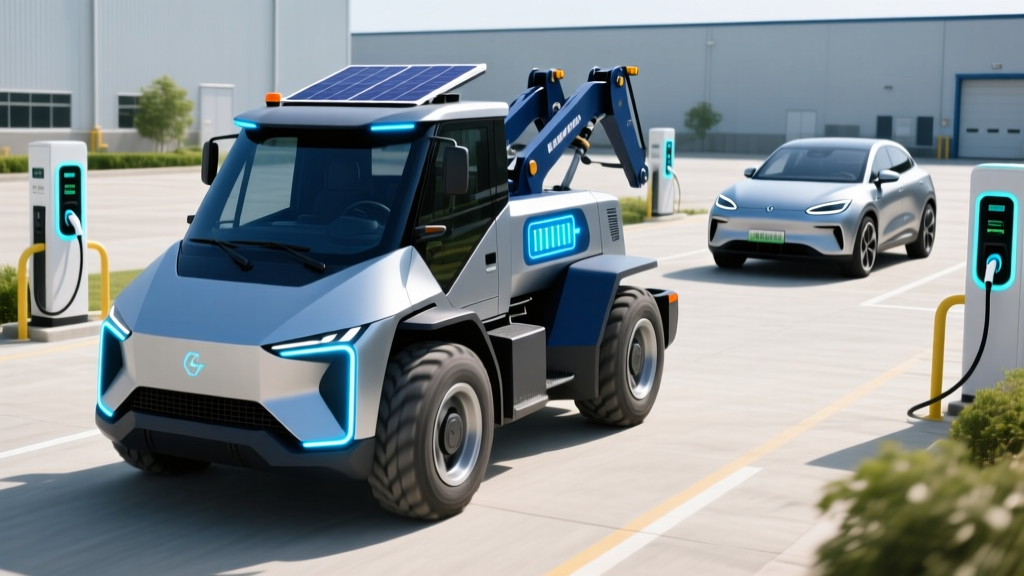
China produces the world's largest volume of battery-electric wheel loaders, with major manufacturers including:
- XCMG — XC968-EV, XC958-EV series (5-6 ton class)
- LiuGong — 856H Electric, 870H Electric
- SANY — SW956E, SW966E electric loaders
- SDLG (Volvo subsidiary) — L956Hev
- Lonking — CDM856E electric variant
These machines typically use lithium iron phosphate (LFP) battery packs ranging from 282 kWh to 423 kWh, paired with dual electric motors producing 150-220 kW (200-295 HP) of continuous power. They're designed for quarry, port, mining, and material-handling applications where duty cycles are predictable and on-site charging infrastructure can be installed.
In China's domestic market, these loaders have gained significant market share — Off-Highway Research estimates China's electric loader penetration exceeded 35% of new wheel loader sales in 2025, driven by government subsidies and lower electricity costs. However, the US market operates under fundamentally different regulatory and support conditions.
Specs and Numbers: China Electric Loader vs. Diesel Equivalent
Here's how a representative Chinese electric wheel loader (XCMG XC968-EV class) compares to a comparable diesel machine (e.g., Caterpillar 966 or Volvo L120H) in the 5-6 ton operating capacity class:
| Specification | China Electric Loader (XCMG XC968-EV class) | Diesel Equivalent (Cat 966 class) |
|---|---|---|
| Battery / Engine | 282-350 kWh LFP pack | 7.0-9.3L turbo diesel, ~250 HP |
| Power Output | 170-200 kW (228-268 HP) electric motors | 185-210 kW (248-282 HP) |
| Operating Weight | 17,500-19,000 kg | 18,500-21,000 kg |
| Bucket Capacity | 3.0-3.5 m³ | 3.0-4.0 m³ |
| Runtime (typical duty cycle) | 4-6 hours before recharge needed | 10-14 hours per tank |
| Recharge / Refuel Time | 1.5-2.5 hours (DC fast charge, 150-200 kW) | 10-15 minutes (diesel fill) |
| Energy/Fuel Cost per Hour | $8-15 (at $0.10-0.15/kWh industrial rate) | $30-50 (at $4.00-5.00/gal diesel) |
| Base Price (FOB China) | $140,000-$200,000 | $280,000-$380,000 (US delivered) |
| US Delivered Price (with tariff) | $200,000-$280,000 (est. with 25% + shipping) | $280,000-$380,000 |
| Maintenance Cost / Year | $3,000-$6,000 (no engine oil, filters, DEF) | $12,000-$18,000 |
Key takeaway: The electric loader's per-hour energy cost is roughly 50-65% lower than diesel, and annual maintenance savings run $8,000-$12,000. However, the US-delivered price advantage narrows significantly after tariffs, shipping ($15,000-$25,000 per unit via RoRo vessel), and import duties.
Real-World Ownership Considerations for US Buyers
Charging Infrastructure
Electric wheel loaders require dedicated DC fast-charging stations at 150-250 kW to recharge within a shift break. This is not a plug-and-play proposition:
- Electrical service: A single 200 kW DC charger draws roughly the same peak power as 15-20 residential homes. Most industrial sites need a dedicated transformer upgrade ($50,000-$150,000) and potentially a medium-voltage service connection.
- Charger cost: Heavy-duty DC fast chargers rated for industrial environments run $80,000-$180,000 per unit installed.
- Charging protocol: Chinese loaders often use GB/T charging connectors (China's national standard) rather than CCS1 or NACS. Adapters exist but add complexity and potential failure points in dusty, high-vibration environments.
Climate and Battery Performance
LFP batteries — standard in most Chinese electric loaders — offer excellent cycle life (3,000-5,000 cycles to 80% capacity) and thermal stability, but they lose 15-25% usable capacity in sub-freezing temperatures. For operations in Minnesota, Montana, or New England winters, expect runtime to drop from 5 hours to 3.5-4 hours unless the machine is stored in a heated building and preconditioned before use.
Parts, Service, and Downtime Risk
This is the single largest concern for US buyers. Unlike Caterpillar, Deere, or Volvo CE — which guarantee parts availability within 24-48 hours across North America — Chinese loader brands have no established US parts depots or certified technician networks for their electric drivetrains. A failed inverter, BMS module, or motor controller could mean weeks of downtime while components ship from Shanghai or Xuzhou.
Regulatory and Certification Barriers
Off-road diesel equipment in the US must meet EPA Tier 4 emissions standards. While electric machines produce zero tailpipe emissions, there's no formal "certification" process for electric off-road equipment — and more critically, imported Chinese heavy machinery faces 25% Section 301 tariffs under current US trade policy (as of 2026). There is no federal purchase incentive analogous to the §30D tax credit for off-road commercial equipment.
Cost Breakdown: 5-Year Total Cost of Ownership
| Cost Category (5 Years, 10,000 hrs) | China Electric Loader (US Import) | Diesel Loader (Cat/Volvo/Deere) |
|---|---|---|
| Purchase Price (US delivered) | $240,000 (est.) | $330,000 |
| Energy / Fuel | $55,000 (at $0.12/kWh) | $175,000 (at $4.50/gal) |
| Maintenance | $20,000 | $75,000 |
| Charging Infrastructure (amortized) | $40,000 | $0 |
| Insurance | $18,000 (higher due to import risk) | $15,000 |
| Battery Replacement Reserve | $35,000 (if out of warranty at 5 yrs) | $0 |
| Resale Value (Year 5) | -$40,000 (uncertain market) | -$120,000 |
| Net 5-Year Cost | $368,000 | $475,000 |
The electric loader shows roughly $107,000 in 5-year savings — but this assumes no major drivetrain failures, acceptable resale value (highly uncertain for unsupported Chinese imports), and reliable charging infrastructure. If a single major component failure causes 2+ weeks of downtime at $2,000/day in lost productivity, that alone erases $28,000+ of the savings gap.
Common Misconceptions About China Electric Loaders
| Myth | Fact |
|---|---|
| "They qualify for the $7,500 federal EV tax credit" | The §30D credit applies to on-road light-duty vehicles under 14,000 lbs GVWR. Off-road wheel loaders do not qualify. Some state-level incentive programs for zero-emission off-road equipment exist (notably California's CORE program), but these typically require CARB-approved models. |
| "Electric loaders can run a full 8-10 hour shift" | Real-world runtime under heavy digging/loading duty cycles is 4-6 hours on current 282-350 kWh packs. Battery-swap systems (offered by XCMG and SANY) can extend effective uptime but require $200,000+ swap stations and spare battery packs. |
| "LFP batteries last forever" | LFP cells offer 3,000-5,000 full cycles to 80% SoH — excellent, but at 2 cycles/day (opportunity charging), that's 4-7 years before capacity drops below 80% and runtime becomes operationally limiting. |
| "I can just import one directly from Alibaba" | US Customs requires EPA import declarations, DOT compliance (if road-capable), tariff payments, and a licensed customs broker. Without an established US importer of record, the machine can be held at port indefinitely. |
| "It's zero emissions" | Zero tailpipe emissions, yes. But grid electricity in coal-heavy regions (e.g., Wyoming, West Virginia) still carries upstream carbon intensity. For ESG reporting, Scope 2 emissions from grid electricity must be calculated. |
Decision Framework: Is a China Electric Loader Right for Your Operation?
Choose a China Electric Loader If:
- You operate in a market with an established Chinese-brand dealer that stocks parts and employs trained electric-drivetrain technicians (currently limited to select Canadian, Australian, and Southeast Asian markets — not the US).
- Your duty cycle is predictable and light-to-moderate (e.g., stockpiling, truck loading at a port) where 4-5 hours of runtime per charge is sufficient.
- You have on-site electrical capacity for 150-200 kW DC charging, or can invest in the infrastructure upgrade.
- You're willing to accept higher downtime risk and self-source replacement components internationally.
- Total 5-year cost savings of ~$100K outweigh the operational risk of limited support.
Choose a Domestically Supported Diesel or Electric Loader If:
- You operate in the United States and need guaranteed parts availability within 48 hours.
- Your operation runs 2+ shifts per day and cannot tolerate 1.5-2 hour charging stops.
- You need financing — US equipment lenders are hesitant to finance unsupported Chinese imports with uncertain resale values.
- You want access to state-level clean equipment incentives (e.g., California CORE, which requires CARB verification).
- You prioritize resale value — established brands hold 35-50% of purchase price at 5 years; unsupported imports may sell for 15-25%.
What First-Time EV Equipment Buyers Should Know
If you're evaluating electric heavy equipment for the first time, keep these principles in mind:
- kWh is your fuel tank. A 300 kWh battery pack at a 50 kW average draw gives you roughly 6 hours of runtime — just like a 100-gallon diesel tank at 17 gal/hr gives you ~6 hours. Do the math for your specific duty cycle.
- kW is your refill speed. A 150 kW DC charger refills a 300 kWh pack from 20-80% in roughly 72 minutes. A 50 kW charger takes 3.6 hours for the same range. Specify charging infrastructure to match your operational tempo.
- LFP vs. NMC matters. LFP (used in most Chinese loaders) trades lower energy density for longer cycle life and better thermal safety. NMC (used in some Western electric equipment) offers more energy in less weight but degrades faster under high-temperature, high-cycle use.
- Cold weather is real. Plan for 20-25% runtime loss below freezing. Heated battery enclosures and indoor storage mitigate this but add cost.
- Support infrastructure is the product. The machine is only as good as the parts, service, and charging ecosystem behind it. In the US, that ecosystem overwhelmingly favors established Western brands as of 2026.
Frequently Asked Questions
Can I legally import a China electric loader into the United States?
Yes, but it requires a licensed customs broker, payment of 25% Section 301 tariffs (as of 2026), EPA import documentation, and compliance with any applicable OSHA rollover-protection (ROPS/FOPS) standards. The process is feasible but adds 15-30% to the FOB price and carries regulatory risk if standards aren't met.
Do Chinese electric loaders use standard charging connectors?
Most use GB/T 20234 connectors (China's national DC fast-charging standard), not CCS1 or NACS. CCS-to-GB/T adapters exist from third-party suppliers ($2,000-$5,000) but introduce a point of failure in harsh environments. Specify connector requirements before ordering.
What's the battery warranty on Chinese electric loaders?
Typical warranties are 5 years or 10,000 operating hours, with guaranteed capacity retention of 70-80% — but enforcement of that warranty from the US, without a local dealer, is uncertain. Replacement LFP packs for a 5-ton-class loader cost $30,000-$55,000 (cell cost only, plus labor and shipping).
Are there any US-based companies selling Chinese electric loaders with domestic support?
A handful of importers and rebadgers have emerged, but none have achieved the dealer-network density of Caterpillar, Deere, or Volvo CE as of early 2026. SDLG, a Volvo Construction Equipment subsidiary, offers the closest thing to a "Chinese-built, Western-supported" loader — but their US electric-loader availability remains limited. Verify parts inventory and service commitments in writing before purchasing.
How does electric loader efficiency compare to diesel in real-world conditions?
Electric drivetrains convert 85-90% of battery energy to hydraulic/mechanical work, versus 30-40% thermal efficiency for diesel engines. This is why the per-hour energy cost is dramatically lower even when electricity prices are moderate. However, electric loaders lose this advantage during extended idle or low-load periods where diesel engines can shut off entirely, while electric systems still draw parasitic power for climate control and electronics.