The Short Answer for Families Eyeing Their First EV
If your household has watched kids graduate from 6V ride-on cars to 24V Power Wheels, you already understand the basic EV value proposition: instant torque, quiet operation, and zero tailpipe emissions. Scaling that up to a full-size family EV in 2026 means spending roughly $36,000–$58,000 before incentives, gaining 270–340 miles of EPA range, and paying $0.10–$0.16 per kWh at home versus $3.20–$4.10 per gallon for gasoline. A typical family driving 12,000 miles/year saves $900–$1,400 annually on fuel alone, with maintenance savings adding another $400–$600/year. The catch: you need reliable Level 2 home charging (a $500–$2,000 install) and must plan road trips around DC fast-charger availability. If your daily driving stays under 80 miles round-trip and you can charge at home, an EV almost always beats a gas equivalent on 5-year total cost of ownership.
Why Families Who Bought Children's Electric Toys Are Ready for a Real EV
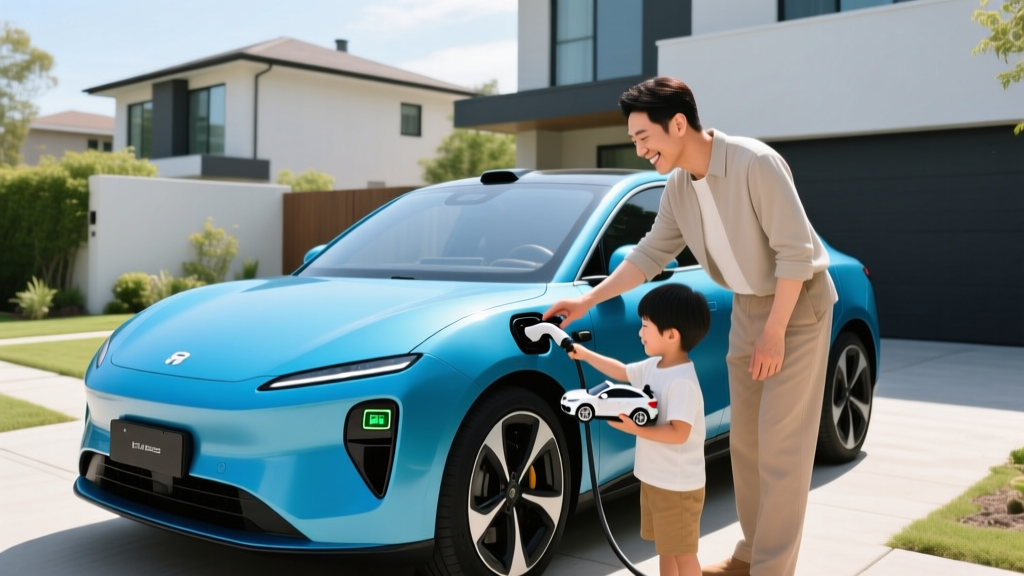
The ride-on toy market has exploded — kids as young as two now pilot licensed mini-Teslas and junior Jeeps with working headlights and Bluetooth speakers. Those childrens electric toys operate on the same fundamental architecture as a Hyundai Ioniq 5 or Tesla Model Y: a lithium-based battery pack, an electric motor, and a single-speed reduction gear. The difference is scale.
A 24V Power Wheels battery stores roughly 0.3 kWh of energy. A 2026 Hyundai Ioniq 5 stores 84 kWh usable in its Long Range variant — approximately 280 times more. That toy peaks at maybe 0.1 kW of motor output; the Ioniq 5 pushes 320 hp (239 kW) on AWD trims. Yet the ownership lessons translate directly: you learned to manage State of Charge (SoC), plan around charging time, and accept that cold weather reduces range.
The real question for families isn't whether EV technology works — your kids' ride-ons proved that years ago. It's whether the economics, infrastructure, and daily logistics make sense for your specific household.
EV vs. Gas vs. Hybrid: The Family Cost Comparison
Let's put three realistic 2026 family vehicles head-to-head: the Hyundai Ioniq 5 SEL AWD (BEV), the Toyota RAV4 Hybrid XLE (HEV), and the Toyota RAV4 LE AWD (gas-only baseline). All seat five, offer comparable cargo space, and sit in the $35,000–$50,000 MSRP range.
| Metric | Hyundai Ioniq 5 SEL AWD (BEV) | Toyota RAV4 Hybrid XLE (HEV) | Toyota RAV4 LE AWD (Gas) |
|---|---|---|---|
| Base MSRP | $47,400 | $35,075 | $32,275 |
| Federal Tax Credit (§30D) | Up to $7,500 (see eligibility below) | $0 | $0 |
| Effective Price After Credit | ~$39,900 | $35,075 | $32,275 |
| EPA Efficiency | 110 MPGe combined | 39 MPG combined | 28 MPG combined |
| EPA Range / Tank Range | 290 mi (EPA) | 522 mi (14.5-gal tank) | 406 mi (14.5-gal tank) |
| Annual Fuel/Energy Cost (12k mi) | ~$540 (home L2 @ $0.14/kWh) | ~$1,110 (@ $3.60/gal) | ~$1,540 (@ $3.60/gal) |
| Annual Maintenance Estimate | ~$300 | ~$650 | ~$850 |
| Estimated Insurance (Annual) | ~$2,100 | ~$1,550 | ~$1,450 |
| 5-Year Total Fuel + Maint. | ~$4,200 | ~$8,800 | ~$11,950 |
Sources: fueleconomy.gov, manufacturer MSRP sheets. Electricity cost based on U.S. average residential rate of ~$0.16/kWh (EIA, 2025). Gas prices reflect 2026 national average estimates. Tax credit eligibility varies — see §30D section below.
The Ioniq 5 costs roughly $7,600 more upfront after the tax credit, but recovers that gap within 5–6 years through fuel and maintenance savings alone. If you hold the vehicle 8+ years, the EV wins decisively. If you trade every 3 years, the hybrid's lower purchase price may matter more.
Real-World Range and Charging: What the EPA Sticker Doesn't Tell You
The Ioniq 5's EPA-rated 290 miles assumes a mix of city and highway driving at moderate temperatures. In practice, families should plan around these adjustments:
- Mild weather, mixed driving: ~270–285 mi
- Highway-only at 75 mph: ~245–260 mi (aerodynamic drag dominates above 65 mph)
- Cold weather (below 30°F), cabin heat: ~200–230 mi (a 20–30% reduction is typical for NMC packs without aggressive heat-pump preconditioning)
- Mountain driving, loaded with cargo: ~230–250 mi
Charging speed is where many first-time buyers get tripped up. The Ioniq 5 supports a peak DC fast-charge rate of ~238 kW on its 800V architecture, achieving a 10–80% charge in approximately 18 minutes at a compatible 350 kW station. But that peak rate only holds between roughly 10% and 55% SoC. Above 80%, the charge curve tapers sharply — going from 80% to 100% can take an additional 25–30 minutes. This is why road-trip strategy means charging to 80% and moving on, not waiting for a full battery.
| Level | Power (kW) | Miles Added/Hour | Typical Cost | Best For |
|---|---|---|---|---|
| Level 1 (120V outlet) | 1.4 kW | ~4 mi/hr | $0.14–$0.16/kWh (home) | Overnight top-up, PHEVs |
| Level 2 (240V home/public) | 7.2–11.5 kW | 25–40 mi/hr | $0.14–$0.20/kWh | Daily home charging |
| DC Fast Charge (public) | 50–350 kW | 150–600+ mi/hr (peak) | $0.30–$0.55/kWh | Road trips, quick top-ups |
For a family driving 35–40 miles round-trip daily, a Level 2 home charger fully replenishes the battery overnight in 8–10 hours, meaning you start every morning with a full "tank." Public DC fast charging should be reserved for road trips — it costs roughly 3–4× more per kWh than home charging and repeated exclusive use of DCFC can marginally accelerate battery degradation over many years.
Breaking Down the Real Costs of EV Ownership
First-time EV buyers often fixate on MSRP while underestimating the infrastructure and insurance picture. Here's a realistic 5-year cost breakdown for the Ioniq 5 SEL AWD driven 12,000 miles/year:
| Category | Year 1 | Years 2–5 (Annual Avg.) | 5-Year Total |
|---|---|---|---|
| Vehicle Purchase (after $7,500 credit) | $39,900 | — | $39,900 |
| Home Level 2 Charger Install | $1,200 | — | $1,200 |
| Electricity (home + public) | $540 | $580 | $2,860 |
| Insurance | $2,100 | $1,950 | $9,900 |
| Maintenance (tires, wipers, cabin filter, fluid top-offs) | $250 | $320 | $1,530 |
| Depreciation (estimated) | — | — | ~$18,000 |
| 5-Year Total (excl. depreciation) | ~$55,390 |
Key cost factors families overlook:
- Insurance premiums run 20–40% higher for EVs than comparable gas cars, driven by higher repair costs and battery replacement risk. Get quotes before purchasing.
- Tire wear accelerates 15–25% on EVs due to instant torque and heavier curb weight (the Ioniq 5 AWD weighs ~4,600 lbs vs. ~3,700 lbs for a RAV4 gas). Budget for replacement tires every 30,000–40,000 miles instead of 50,000+.
- Home electrical panel upgrades may be needed if your panel is at or near capacity. A 200-amp panel typically handles a 48-amp Level 2 charger, but older 100-amp panels may require a $1,500–$3,000 upgrade.
- Registration fees in some states now include an EV surcharge ($50–$200/year) to offset lost gas-tax revenue.
Federal Tax Credit Eligibility: The §30D Rules You Need to Know
The IRS §30D Clean Vehicle Credit offers up to $7,500 for qualifying new EVs, but eligibility is far from universal. For 2026, the rules include:
- MSRP caps: Vans, SUVs, and trucks must be under $80,000; sedans under $55,000.
- Buyer income caps: Modified AGI must not exceed $300,000 (joint), $225,000 (head of household), or $150,000 (single).
- Battery sourcing: Increasing percentages of critical minerals and battery components must be sourced from the U.S. or free-trade-agreement partners. These thresholds tighten annually, disqualifying some models that qualified in prior years.
- Final assembly: Vehicle must undergo final assembly in North America.
- Point-of-sale transfer: Buyers can transfer the credit to the dealer at purchase, reducing the sale price directly rather than waiting for a tax refund.
- One credit per vehicle, one per taxpayer: You cannot claim the credit more than once per 3-year period for new vehicles.
The Ioniq 5, assembled at Hyundai's Metaplant in Georgia, qualifies for at least partial credit in 2026, but the exact amount ($3,750 or $7,500) depends on whether the battery's critical minerals and components meet that year's sourcing thresholds. Always verify current eligibility on fueleconomy.gov before signing a purchase agreement — the qualified-vehicle list updates regularly.
Common EV Misconceptions, Addressed with Data
| Myth | Fact (with data) |
|---|---|
| "EV batteries need replacing every few years." | Modern NMC and LFP packs are warrantied for 8 years/100,000 miles (10 years/150,000 in CARB states). Real-world degradation data shows most packs retain 85–92% capacity after 100,000 miles. Full replacement costs $8,000–$18,000 but is rarely needed within the first decade. |
| "You'll get stranded — chargers are everywhere unreliable." | The U.S. now has over 70,000 public charging ports (AFDC, 2025). Tesla's Supercharger network — now open to NACS-equipped non-Tesla EVs — maintains 99.5%+ uptime. Plan road trips with apps like A Better Routeplanner, and you'll rarely encounter gaps in populated corridors. |
| "EVs are worse for the environment because of electricity generation." | Even on the most coal-heavy U.S. grids, an EV produces 50–70% fewer lifecycle emissions than a comparable gas car over 150,000 miles (Union of Concerned Scientists). On cleaner grids (Pacific Northwest, Northeast), the reduction exceeds 75%. |
| "Home charging is too expensive to install." | A standard Level 2 (240V, 48-amp) home charger installation averages $500–$2,000 if your panel has capacity. Utility rebates of $250–$1,000 are common. That install pays for itself within 12–24 months through fuel savings vs. gas. |
| "EVs can't handle cold weather or family road trips." | Cold reduces range 20–30%, but preconditioning (warming the battery while plugged in) recovers much of that loss. A 290-mile EPA EV still delivers ~210+ miles in freezing temps — enough for most 3-hour driving stretches between fast-charge stops. |
Your Decision Framework: Should Your Family Go EV, Hybrid, or Stick with Gas?
- You can install a Level 2 charger at home (garage, driveway, or dedicated parking spot)
- Your daily driving is under 80 miles round-trip, with road trips 4–6 times per year
- You plan to keep the vehicle 5+ years to recoup the higher purchase price
- You qualify for the §30D tax credit (reducing effective cost by up to $7,500)
- You want the lowest per-mile fuel cost and minimal scheduled maintenance
- You lack reliable home charging access (apartment, street parking, no dedicated outlet)
- You frequently drive 300+ miles in rural areas with sparse charging infrastructure
- You want EV-like fuel savings (~39 MPG) with zero range anxiety and zero behavior change
- You plan to trade vehicles every 3–4 years
- Your annual mileage is under 6,000 miles — fuel savings won't offset any EV premium
- You tow heavy loads regularly (5,000+ lbs), where EV range drops 40–50% under load
- Your budget is firmly under $30,000 and you need a new vehicle (the used EV market offers better options at that price)
First-Time EV Buyer FAQ
Can I charge an EV with a regular household outlet?
Yes — that's Level 1 charging at 120V, delivering about 1.4 kW or roughly 4 miles of range per hour. For a family driving 35 miles/day, an overnight Level 1 session (10 hours) adds ~40 miles, which barely covers daily use. It works as a stopgap, but a 240V Level 2 install is strongly recommended for any BEV owner.
How long do EV batteries actually last?
Federal law mandates that EV battery warranties cover at least 8 years/100,000 miles with a minimum 70% capacity retention threshold. In CARB states (California, New York, and others), that extends to 10 years/150,000 miles. Real-world fleet data from Tesla, Hyundai, and others shows median degradation of roughly 8–15% over 100,000 miles, with LFP chemistry packs often outperforming NMC in cycle longevity.
Is my kids' experience with children's electric toys relevant to owning a real EV?
Surprisingly, yes. Children's ride-on toys teach the core concepts: monitoring battery level, understanding that heavier loads and hills reduce runtime, and planning for charge time. Those same principles scale directly to a full-size EV — just with far more range, faster charging, and dramatically better thermal management.
What happens if the battery fails out of warranty?
Full battery replacement in 2026 costs $8,000–$18,000 depending on the pack size and chemistry. However, catastrophic failure is rare — most degradation is gradual. Some shops now offer module-level repair (replacing individual degraded cells or modules for $2,000–$5,000) rather than full-pack replacement. Third-party battery refurbishment services are also emerging as the first-generation EV fleet ages.
Do I need a special electric rate from my utility?
Many utilities offer time-of-use (TOU) plans that charge significantly less for electricity during off-peak hours (typically 10 PM–6 AM). Charging overnight on a TOU plan can drop your effective rate to $0.06–$0.10/kWh, cutting annual fuel costs to $300–$400 for 12,000 miles of driving. Contact your utility before purchasing to ask about EV-specific rate plans.