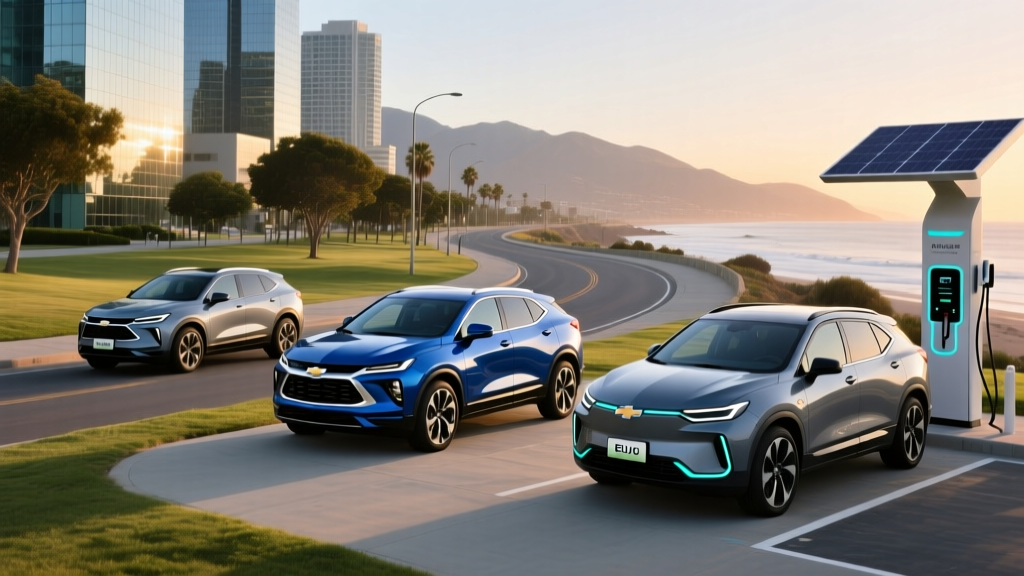
Quick Answer: Which Chevy Electric SUV Fits You?
If you're shopping for a Chevy SUV electric model in 2026, you have three main options: the Equinox EV (best value, ~315 miles EPA range, starts ~$33,600), the Blazer EV (midsize performance, ~324 miles EPA, starts ~$44,600), or the Bolt EUV (budget pick, ~247 miles EPA, starts ~$28,900). All three qualify for varying levels of the federal §30D tax credit depending on your income, the vehicle's MSRP, and battery-sourcing compliance. For most buyers, the Equinox EV 3LT offers the best combination of range, price, and practicality.
The 2026 Chevy Electric SUV Lineup at a Glance
Chevrolet has committed heavily to electrification, and its SUV lineup now spans three distinct segments. Each model targets a different buyer profile, from budget-conscious commuters to families wanting more space and power. Here's how the specs stack up across the current lineup.
| Spec | 2026 Bolt EUV | 2026 Equinox EV | 2026 Blazer EV |
|---|---|---|---|
| EPA Range | 247 mi | 315 mi (3LT FWD) | 324 mi (2LT RWD) |
| Battery (usable kWh) | 65 kWh (NMC) | 85 kWh (NMC) | 102 kWh (NMC) |
| Peak DC Fast Charge | 55 kW | 150 kW | 190 kW |
| 10–80% DCFC Time | ~55 min | ~30 min | ~28 min |
| Level 2 Rate | 11.5 kW | 11.5 kW (19.2 kW opt.) | 11.5 kW (19.2 kW opt.) |
| Horsepower | 200 hp | 213 hp (FWD) / 288 hp (AWD) | 288 hp (RWD) / 340 hp (AWD) |
| 0–60 mph | ~7.3 sec | ~7.9 sec (FWD) / 5.9 sec (AWD) | ~6.5 sec (RWD) / 5.4 sec (AWD) |
| Base MSRP | $28,900 | $33,600 | $44,600 |
| Battery Warranty | 8 yr / 100,000 mi | 8 yr / 100,000 mi | 8 yr / 100,000 mi |
| Cargo (rear seats up) | 16.3 cu ft | 26.4 cu ft | 25.5 cu ft |
Sources: Chevrolet Equinox EV Configurator, EPA fueleconomy.gov.
Real-World Range: What to Actually Expect
EPA estimates are a starting point, not a guarantee. Every Chevy SUV electric model will deliver less range under certain real-world conditions, and understanding these variables is critical for trip planning.
Range Reality Check
Equinox EV 3LT (EPA 315 mi): Expect ~260–280 miles on a highway-heavy road trip at 70 mph. In freezing temperatures (below 32°F), plan for 200–230 miles. The heat pump on AWD trims helps mitigate cold-weather losses compared to resistive heating.
Blazer EV 2LT RWD (EPA 324 mi): Highway cruising yields ~270–290 miles. Cold weather drops this to ~220–250 miles. The larger 102 kWh battery provides a bigger buffer, but the heavier vehicle mass works against efficiency.
Bolt EUV (EPA 247 mi): Highway driving nets ~195–215 miles. Cold weather can push this down to 160–180 miles. The smaller battery means less margin for error on longer trips.
Why the gap? EV efficiency drops at sustained highway speeds due to aerodynamic drag, which scales with the square of velocity. Cold temperatures increase battery internal resistance and require energy for cabin heating. The Equinox and Blazer EVs use GM's Ultium platform with more advanced thermal management than the older Bolt EUV architecture, which helps preserve range and charging speed in extreme temperatures.
Charging Speeds and What They Mean for Ownership
The single biggest difference between these three models is DC fast-charging capability — and it matters enormously for road trips.
| Charging Level | Bolt EUV | Equinox EV | Blazer EV |
|---|---|---|---|
| Level 1 (120V, 1.4 kW) | ~4 mi/hr | ~4 mi/hr | ~4 mi/hr |
| Level 2 (240V, 11.5 kW) | ~27 mi/hr | ~27 mi/hr | ~27 mi/hr |
| Level 2 (240V, 19.2 kW)* | N/A | ~42 mi/hr | ~42 mi/hr |
| DC Fast (peak kW) | 55 kW | 150 kW | 190 kW |
| DC mi added in 15 min | ~35 mi | ~90 mi | ~110 mi |
*19.2 kW Level 2 requires a 100-amp circuit and compatible home charger; most homes need a panel upgrade for this.
The Charging Curve Reality
Peak charge rates (150 kW, 190 kW) are not sustained across the entire session. The Equinox EV peaks at 150 kW between roughly 10–40% state of charge (SoC), then tapers to ~100 kW through 60%, and drops below 50 kW above 80%. The Blazer EV follows a similar curve but holds higher rates slightly longer due to its larger pack. The Bolt EUV's 55 kW peak is modest by 2026 standards, making it the weakest road-trip companion of the three — a 10–80% session takes nearly an hour versus roughly 30 minutes for the Ultium-based models.
For home charging, a standard Level 2 installation (240V, 48-amp circuit) delivers a full overnight charge for all three vehicles. Expect to pay $800–$2,500 for a quality Level 2 home charger installation, depending on whether your electrical panel needs an upgrade. Homes with older 100-amp panels may need a $1,500–$3,000 panel upgrade to support a 48-amp EV circuit.
EV vs Gas: The Cost Comparison That Matters
Let's compare the Equinox EV against its gas counterpart, the Equinox 1.5T AWD, over a realistic 5-year / 75,000-mile ownership period.
| Cost Category | Equinox EV 2LT AWD | Equinox Gas AWD |
|---|---|---|
| Base MSRP | $38,600 | $31,900 |
| Est. Federal Tax Credit (§30D) | Up to $7,500* | $0 |
| Effective Purchase Price | ~$31,100 | $31,900 |
| Energy/Fuel (75,000 mi) | ~$3,200 (home charging) | ~$9,400 (28 MPG avg, $3.50/gal) |
| Maintenance (5 yr) | ~$1,800 | ~$4,200 |
| Insurance (5 yr avg) | ~$9,500 | ~$7,800 |
| 5-Year Total Cost | ~$45,600 | ~$53,300 |
*§30D credit eligibility depends on buyer income caps ($150K single / $300K joint), MSRP caps ($80K for SUVs), and battery critical-mineral sourcing rules. Verify at IRS.gov and confirm point-of-sale transfer availability with your dealer.
The Equinox EV saves roughly $7,700 over five years despite higher insurance premiums, primarily through fuel and maintenance savings. The break-even point typically arrives around year 2–3 if you charge mostly at home. If you rely entirely on public DC fast charging (at $0.35–$0.50/kWh), fuel savings shrink significantly, and the payback period extends.
Federal Tax Credit: What You Actually Qualify For
The §30D clean vehicle credit is not a guaranteed $7,500 for every buyer. For 2026, the rules include several gates:
- Income caps: Modified AGI must not exceed $150,000 (single), $225,000 (head of household), or $300,000 (married filing jointly).
- MSRP caps: SUVs must have an MSRP at or below $80,000. All three Chevy electric SUVs clear this easily.
- Battery sourcing: The credit is split into two halves — $3,750 for critical-minerals sourcing and $3,750 for battery-component manufacturing. Sourcing requirements tighten annually. Check the latest eligibility at fueleconomy.gov.
- Point-of-sale transfer: As of 2024, you can transfer the credit to the dealer at purchase, reducing your out-of-pocket cost immediately rather than waiting for tax filing.
- One credit per VIN, one per taxpayer: You can claim the credit once every three years for a new EV purchase.
The Bolt EUV and Equinox EV have historically qualified for the full or partial credit due to their battery supply chains. The Blazer EV's eligibility has fluctuated with sourcing-rule changes. Always confirm current status before signing a purchase agreement.
Common Misconceptions About Chevy Electric SUVs
| Myth | Fact |
|---|---|
| "EV batteries need replacing every few years." | GM's Ultium batteries carry an 8-year/100,000-mile warranty guaranteeing at least 70% capacity retention. Real-world data from earlier GM EVs shows ~10–12% degradation after 100,000 miles. |
| "You can't road-trip in a Chevy EV." | The Equinox and Blazer EVs use the NACS connector (starting 2025 model year), granting access to Tesla's Supercharger network — over 25,000 stalls nationwide. The Bolt EUV uses CCS but can use a NACS adapter. |
| "EVs cost more to insure." | Partially true. EV insurance averages 15–25% higher than gas equivalents due to higher repair costs and battery replacement risk. Shop quotes before purchasing. |
| "Charging takes too long." | Home Level 2 charging replenishes all three models overnight (8–10 hours from empty). DC fast charging adds 90–110 miles in 15 minutes on the Equinox/Blazer — enough for a road-trip restroom break. |
| "The Bolt EUV is the same as the newer Ultium models." | The Bolt EUV uses an older BEV2 platform with slower charging (55 kW peak vs 150–190 kW) and less advanced thermal management. It's a budget pick, not a tech equal. |
Who Should Buy Which Chevy Electric SUV?
Decision Framework
Choose the Bolt EUV if: Your budget is under $30,000, your daily commute is under 80 miles round-trip, you have reliable home charging, and you rarely take road trips over 200 miles. It's the most affordable entry point but the slowest to charge on the highway.
Choose the Equinox EV if: You want the best value-to-range ratio, you need practical cargo space for a family, you take occasional road trips, and you want access to the Supercharger network via NACS. The 3LT FWD at ~$35,000 after potential tax credits is the sweet spot.
Choose the Blazer EV if: You want more power (up to 340 hp AWD), a larger battery for extended range, sportier styling, and don't mind paying $10,000+ more than the Equinox. It's best for buyers who prioritize performance and presence over value.
First-Time EV Buyer Essentials
If this is your first electric vehicle, here's what the brochures won't tell you:
Home charging is non-negotiable for most owners. Public charging works for road trips, but 80–90% of EV charging happens at home. If you live in an apartment without charging access or can't install a Level 2 charger, an EV will be significantly less convenient. Confirm your charging situation before buying.
Preconditioning matters. All three Chevy EVs let you precondition the battery via the app before arriving at a DC fast charger. This warms the battery to optimal temperature and can cut 5–10 minutes off your charging session — especially important in cold weather.
Regenerative braking changes how you drive. The Equinox and Blazer EVs offer one-pedal driving modes that let you decelerate by lifting off the accelerator. It reduces brake wear to the point where brake pads can last 100,000+ miles.
Cargo space is real, but the "frunk" isn't guaranteed. The Equinox EV has a small front trunk (frunk), while the Blazer EV's frunk is model-dependent. The Bolt EUV has no frunk. Don't assume front storage — check the specific trim.
Frequently Asked Questions
Do all Chevy electric SUVs qualify for the $7,500 tax credit?
No. Eligibility depends on your income, the vehicle's battery-sourcing compliance, and MSRP caps. The Bolt EUV and Equinox EV have generally qualified for the full or partial credit, but the Blazer EV's eligibility has varied. Always check IRS.gov and fueleconomy.gov for current status before purchasing.
How long does it take to charge a Chevy electric SUV at home?
On a standard Level 2 charger (240V, 48 amps / 11.5 kW), the Equinox EV takes about 8 hours from empty to full, the Blazer EV about 10 hours, and the Bolt EUV about 6.5 hours. Most owners plug in overnight and wake up to a full battery daily.
Can I tow with a Chevy electric SUV?
The Equinox EV is rated for up to 1,500 lbs when properly equipped. The Blazer EV can tow up to 1,500 lbs as well. The Bolt EUV is not rated for towing. Keep in mind that towing significantly reduces range — expect a 30–50% reduction depending on trailer weight and aerodynamics.
Which Chevy electric SUV charges the fastest?
The Blazer EV peaks at 190 kW on DC fast chargers, followed by the Equinox EV at 150 kW. The Bolt EUV maxes out at 55 kW — substantially slower. For frequent road-trippers, the Ultium-platform models (Equinox and Blazer) are clearly superior.
What connector do Chevy electric SUVs use?
Starting with the 2025 model year, the Equinox EV and Blazer EV use the NACS (Tesla-style) connector natively, granting direct access to Tesla Superchargers. The Bolt EUV still uses CCS1 but can connect to NACS chargers using a GM-provided adapter.
How much does it cost to replace the battery?
Out-of-warranty Ultium battery replacement is estimated at $12,000–$18,000 depending on the pack size, though most owners will never need this. GM's 8-year/100,000-mile warranty covers defects and capacity loss below 70%. Industry data shows modern NMC packs retaining 85–90% capacity at 100,000 miles under normal use.