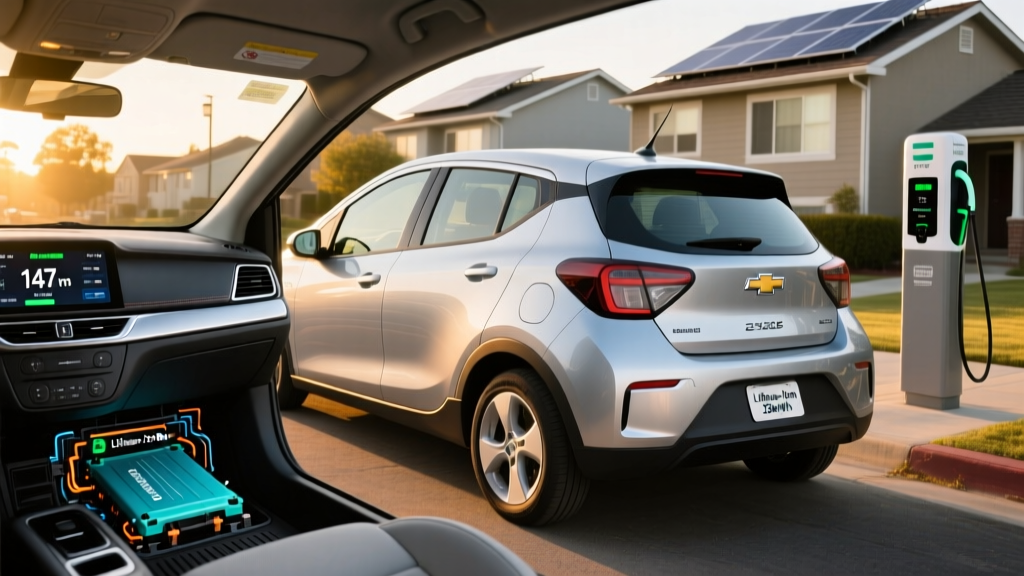
The Chevrolet Spark EV was discontinued after the 2016 model year, so in 2026 every example on the road is a used vehicle between 10 and 13 years old. It remains one of the cheapest ways to get into a battery-electric car: clean examples typically sell for $5,000–$9,000 depending on mileage and battery health. With an EPA-rated 82 miles of range (2014–2015) or 82 miles (2016 with the smaller LG Chem pack), the Spark EV is strictly a city commuter and errand runner — not a road-trip car. If you have home charging, a short commute, and a second vehicle for longer trips, it can still be a remarkably economical daily driver.
Spark EV Specs at a Glance
| Specification | 2014–2015 (A123 Pack) | 2016 (LG Chem Pack) |
|---|---|---|
| EPA Range | 82 miles | 82 miles |
| Battery Capacity (usable) | ~19 kWh (A123 NMC) | ~18.4 kWh (LG Chem NMC) |
| EPA Efficiency | 119 MPGe | 119 MPGe |
| Motor Output | 140 hp / 400 lb-ft torque | 140 hp / 400 lb-ft torque |
| 0–60 mph | ~7.2 seconds | ~7.2 seconds |
| DC Fast Charge (CCS) | 50 kW peak | 50 kW peak |
| Level 2 Charge Rate | 3.3 kW (onboard charger) | 3.3 kW (onboard charger) |
| 10–80% DCFC Time | ~20 minutes | ~20 minutes |
| Connector | CCS1 (SAE Combo) | CCS1 (SAE Combo) |
| Original MSRP (before incentives) | ~$27,000 | ~$26,000 |
| 2026 Used Price Range | $5,000–$8,000 | $6,000–$9,000 |
| Battery Warranty (original) | 8 yr / 100,000 mi | 8 yr / 100,000 mi |
Sources: EPA fueleconomy.gov, Chevrolet Spark EV owner manuals.
Real-World Range: What 82 EPA Miles Actually Means in 2026
The Spark EV's 82-mile EPA sticker was respectable in 2014. In 2026, it's the car's single biggest limitation — and it will almost certainly be less than 82 miles in a decade-old vehicle.
• Ideal conditions (city driving, 50–75°F, flat terrain): 65–75 miles
• Highway (65–70 mph sustained): 50–60 miles
• Cold weather (below 32°F, heater on): 40–55 miles
• Worst case (cold + highway + hills): 35–45 miles
Battery degradation is the key variable. NMC chemistry cells from this era typically lose 15–25% of original capacity over 10 years, depending on climate, charging habits, and how often the pack was held at 100% State of Charge (SoC). A Spark EV that lived in Arizona and was regularly charged to full may show 30%+ degradation. One garaged in Oregon and charged to 80% daily may retain 80%+ of its original capacity.
Before buying, insist on a battery health check. Ask the seller or a Chevy dealer to pull the State of Health (SoH) reading via the vehicle's onboard diagnostics. Some owners use OBD-II dongles with apps like LeafSpy-equivalent tools to read cell voltage spread and capacity estimates. If SoH is below 75%, budget for reduced range or negotiate the price down significantly.
Charging the Spark EV: Speeds, Connectors, and Home Setup
The Spark EV uses a CCS1 connector for both Level 2 AC charging and DC fast charging. As the industry shifts toward NACS (Tesla's connector standard), CCS1 remains widely supported at Electrify America, EVgo, and most non-Tesla public networks in 2026, though some newer installations prioritize NACS stalls.
| Charging Level | Power (kW) | Miles Added per Hour | Full Charge Time |
|---|---|---|---|
| Level 1 (120V household outlet) | ~1.2 kW | ~4–5 miles/hr | ~17–20 hours |
| Level 2 (240V, 16A) | 3.3 kW (car-limited) | ~12–14 miles/hr | ~6–7 hours |
| DC Fast Charge (CCS) | 50 kW peak | ~150+ miles/hr (to 80%) | 10–80% in ~20 min |
Critical detail: The Spark EV's onboard AC charger is limited to 3.3 kW. Even if you install a 48-amp (11.5 kW) Level 2 home charger, the car will only draw 3.3 kW. This means overnight charging is perfectly adequate — a standard 240V/16A circuit will fully replenish the pack while you sleep. Don't overspend on a high-amperage EVSE for this car.
The 50 kW DC fast-charging capability was excellent for 2014 and remains usable today. The charge curve is relatively flat from 10% to roughly 80%, then tapers sharply. Expect 10–80% in about 20 minutes at a functioning 50 kW CCS station. However, 50 kW is slow by 2026 standards — a modern Hyundai Ioniq 5 peaks at 240 kW — so the Spark EV is not a practical road-trip vehicle.
Spark EV vs. Gas Car: The Real Cost Comparison
The strongest argument for a used Spark EV in 2026 is operating cost. Let's compare it against a typical used gas subcompact (e.g., a 2016 Chevrolet Spark with a 1.4L engine rated at ~30 MPG combined) over a year of 8,000 miles of city commuting.
| Cost Category | Spark EV | Gas Spark (30 MPG) |
|---|---|---|
| Annual Fuel/Energy | $230 (home charging at $0.14/kWh) | $930 (gas at $3.50/gal) |
| Annual Maintenance | $100–$200 (cabin filter, wipers, tires) | $500–$800 (oil, filters, brakes, belts) |
| Insurance (avg.) | $900–$1,200/yr | $900–$1,200/yr |
| Annual Operating Total | ~$1,230–$1,530 | ~$2,330–$2,930 |
| 5-Year Operating Total | ~$6,150–$7,650 | ~$11,650–$14,650 |
At the national average electricity rate of roughly $0.14/kWh (EIA data), the Spark EV's 28 kWh/100mi efficiency translates to about $0.039 per mile on home charging. The gas Spark at 30 MPG and $3.50/gallon costs $0.117 per mile. That's a three-to-one energy cost advantage for the EV.
Purchase price context: A 2016 gas Spark might sell for $6,000–$9,000 used — comparable to the Spark EV. So the EV doesn't carry a meaningful purchase premium on the used market, making the operating savings pure advantage from day one.
The catch: If you cannot charge at home and must rely on public DC fast charging at $0.35–$0.50/kWh, your per-mile cost jumps to $0.10–$0.14/mile — nearly matching gasoline. Home charging access is essential to the Spark EV's value proposition.
Battery Longevity and Replacement: The Elephant in the Room
The Spark EV's original 8-year/100,000-mile battery warranty has expired on all 2014–2015 models and is expiring or has expired on 2016 models as of 2024–2026. This means you are buying a 10–12-year-old EV with no remaining factory battery coverage unless an extended warranty was purchased separately.
What does replacement cost? A new OEM replacement pack from GM is difficult to source and can cost $5,000–$8,000+ — potentially exceeding the car's value. The more realistic path for a degraded Spark EV battery is:
- Used/salvage pack: $1,500–$3,000 from a wrecked Spark EV, plus $500–$1,000 installation labor at an independent EV shop.
- Cell-level repair: Some specialist shops can identify and replace individual degraded modules for $800–$2,000.
- Accept the degradation: If SoH is 75–80%, you still have 55–65 real-world city miles — adequate for a short commute.
GM's NMC cells from this era have proven reasonably durable. Data aggregated by Spark EV owners on forums shows typical 10-year degradation in the 15–25% range for temperate-climate cars. Hot-climate cars (Phoenix, Las Vegas, central Texas) tend to degrade faster, especially if regularly fast-charged or held at 100% SoC for extended periods.
Common Misconceptions About the Spark EV
| Myth | Fact |
|---|---|
| "It can't go on the highway." | It can — the Spark EV is electronically limited to ~90 mph and is stable at 70 mph. But highway driving at 70+ mph cuts range by 30–40% compared to city driving due to aerodynamic drag. Reserve it for roads under 60 mph for best efficiency. |
| "The battery will need replacing immediately." | Not necessarily. Many 10-year-old Spark EVs retain 75–85% SoH. Always verify before purchase, but degradation is gradual, not a cliff. |
| "CCS chargers are going away." | While NACS is becoming the dominant standard, CCS1 infrastructure remains widespread in 2026, and adapters (NACS-to-CCS) are available for $150–$250 if needed for future Tesla Supercharger access. |
| "It qualifies for the federal tax credit." | The Spark EV does NOT qualify for the new-vehicle §30D credit (it's no longer sold new). It may qualify for the used clean vehicle credit (up to $4,000 or 30% of sale price, whichever is less) if the sale price is $25,000 or less, the buyer meets income caps, and the vehicle is purchased through a licensed dealer. At typical Spark EV prices ($5K–$9K), the credit would be 30% of the sale price — roughly $1,500–$2,700. |
| "It's too slow for real driving." | With 400 lb-ft of instant torque and a 0–60 time of ~7.2 seconds, the Spark EV was one of the quickest cars in its price class. It feels punchy and responsive around town. |
Who Should (and Shouldn't) Buy a Spark EV in 2026
✅ Buy it if:
• Your daily round-trip commute is under 40 miles
• You have access to Level 2 home charging (240V garage or driveway)
• You already own or have access to a gas/hybrid vehicle for longer trips
• You want the lowest possible per-mile transportation cost
• You live in a mild climate (Pacific Northwest, coastal California, Southeast)
• You're comfortable buying a 10-year-old used car and budgeting for eventual battery repair
❌ Skip it if:
• Your commute exceeds 35 miles one-way
• You live in an apartment with no charging access and must rely on public chargers
• You need a sole vehicle for all driving needs including road trips
• You live in an extreme cold climate (Minnesota, North Dakota, Montana) where winter range could drop below 40 miles
• You want modern ADAS features (the Spark EV has no lane-keep, no adaptive cruise, basic ABS/stability only)
• You want a vehicle with remaining factory battery warranty
Ownership Costs: 5-Year Projection
Here's a realistic five-year ownership projection for a Spark EV purchased in 2026 at $7,000, driven 8,000 miles/year with home charging:
| Category | 5-Year Cost | Notes |
|---|---|---|
| Purchase Price | $7,000 | 2015–2016 model, ~60K miles |
| Used EV Tax Credit | –$2,100 | 30% of $7,000 (if eligible per IRS §25E) |
| Home Level 2 Charger Install | $500–$1,200 | Basic 16A EVSE + outlet; no panel upgrade needed for most homes |
| Electricity (5 yrs) | $1,150 | 40,000 mi × $0.039/mi |
| Insurance (5 yrs) | $5,000 | ~$1,000/yr avg. |
| Maintenance (5 yrs) | $750 | Tires, cabin filter, wipers, brake fluid |
| Battery Repair Reserve | $0–$2,500 | Budget for possible module repair; may not be needed |
| Net 5-Year Cost | $12,300–$15,050 | Effective cost per mile: $0.31–$0.38 |
Compare this to a used gas subcompact at the same purchase price: expect $4,650 in fuel alone over five years, plus $3,000+ in maintenance, yielding a 5-year total closer to $17,000–$20,000. The Spark EV saves roughly $3,000–$5,000 over five years even with a battery repair reserve factored in.
Frequently Asked Questions
Can I use a Tesla Supercharger with the Chevy Spark EV?
Not directly. The Spark EV uses a CCS1 connector, while Tesla Superchargers use NACS. In 2026, some Tesla Supercharger stations have opened to non-Tesla EVs via the Tesla app, but only at stalls equipped with a built-in CCS cable (Magic Dock). Alternatively, you can purchase a NACS-to-CCS adapter (~$150–$250) for use at standard Supercharger stalls that support non-Tesla vehicles. Availability varies by region.
Is the Spark EV safe?
The Spark EV was not crash-tested by the NHTSA or IIHS in its production years. It includes standard ABS, stability control, and 10 airbags. By 2026 standards, it lacks modern ADAS features like automatic emergency braking, lane-departure warning, or blind-spot monitoring. It is safe for low-speed city driving but offers less active safety technology than any new vehicle sold today.
How do I check the battery health before buying?
Ask a Chevrolet dealer to run a battery diagnostic and provide the State of Health (SoH) percentage. Alternatively, use an OBD-II scanner compatible with GM EV protocols to read battery data. Key metrics: SoH percentage (aim for 75%+), individual cell voltage spread (should be under 0.1V across all cells when at rest), and total charge cycles. A full charge/discharge test by a qualified EV technician is the most thorough method.
Does the Spark EV have regenerative braking?
Yes. The Spark EV features regenerative braking with a "Low" gear mode that increases regen aggressiveness for near-one-pedal driving in city traffic. In "Low" mode, lifting off the accelerator provides significant deceleration, though you'll still need the friction brake for complete stops. The regenerative system also helps extend brake pad life — many Spark EV owners report original brake pads at 80,000+ miles.
What's the best model year to buy?
The 2016 model year is generally preferred. It uses a lighter, more energy-dense LG Chem battery pack (smaller physical size but the same 82-mile EPA range), resulting in slightly better efficiency and a marginally lighter car. The 2014–2015 A123 Systems pack is heavier but has shown good longevity in temperate climates. Either is acceptable if battery SoH checks out. Avoid any 2014 model that shows signs of battery cooling system issues (check for coolant leaks near the battery tray).
Is it worth installing a Level 2 charger at home for this car?
Yes — but keep it simple. Because the Spark EV's onboard charger is limited to 3.3 kW, a basic 240V/16A Level 2 EVSE ($200–$350 for the unit) is all you need. Total installation cost with an electrician is typically $500–$1,200 if your electrical panel has spare capacity. You don't need a 48-amp hardwired unit. A NEMA 14-50 outlet with a portable EVSE gives you flexibility and keeps costs low.