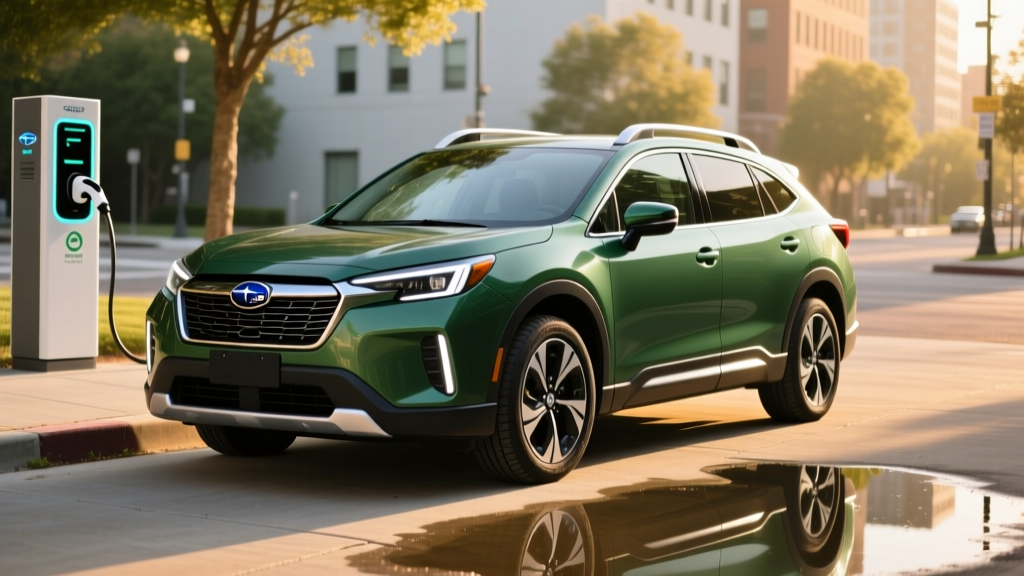
The 2026 Subaru Solterra: A Lease-Driven Value Proposition
For EV shoppers eyeing the compact electric SUV segment, the 2026 Subaru Solterra presents an unusual case: a vehicle whose strongest financial argument often comes not from buying, but from leasing. Thanks to Subaru's aggressive lease incentives — including a pass-through of the $7,500 federal EV credit as a capitalized-cost reduction — the Solterra's monthly payments have become competitive with far less capable gas-powered crossovers. But beyond the deal itself, how does this co-developed twin of the Toyota bZ4X actually perform as a daily electric vehicle?
We've analyzed the 2026 Solterra's specs, real-world range behavior, charging performance, and total cost picture to help you decide whether this is the right EV for your garage — or whether competitors offer more substance for the money.
Range, Efficiency, and the Real-World Reality Check
The 2026 Subaru Solterra carries a 72.8 kWh lithium-ion battery pack (NMC chemistry), with approximately 64.0 kWh usable after accounting for the buffer Subaru engineers in to protect long-term cell health. The EPA rates the Solterra at 227 miles in its top-efficiency trim (Premium, FWD-equivalent configuration), while the more common dual-motor AWD Touring drops to roughly 222 miles EPA.
- Mild-weather city/suburban mix: 210–225 miles achievable with moderate regen use
- Highway driving at 70–75 mph: Expect 185–200 miles — the Solterra's boxy shape and AWD drivetrain exact a toll at sustained speed
- Cold weather (below 32°F): Range drops to 150–175 miles, especially without preconditioning; the Solterra lacks a heat pump on base trims, relying on resistive cabin heating
- Mountain/towing scenarios: Significant consumption spikes; plan for 140–160 miles between charges under load
Efficiency lands at 102 MPGe combined (approximately 33 kWh/100 miles), per fueleconomy.gov. That's mid-pack for the segment — the Hyundai Ioniq 5 and Tesla Model Y both extract more miles per kWh thanks to more aerodynamic profiles and available heat-pump systems.
Charging Speed: DC Fast and Home Level 2
Subaru addressed one of the original Solterra's biggest criticisms — sluggish DC charging — by upgrading the 2026 model's thermal management and charge curve. The result is a peak rate of 150 kW on DC fast chargers, with a 10–80% charge time of approximately 35 minutes. That's improved from the ~55-minute 10–80% times seen on 2023–2024 models, though it still trails rivals like the Ioniq 5 (18 minutes at 240 kW) and the Kia EV6 (18 minutes).
| Charging Level | Power / Rate | Time / Miles Added |
|---|---|---|
| Level 1 (120V household) | ~1.4 kW | ~3–4 miles per hour |
| Level 2 (240V home, 32A) | 7.7 kW | ~23–25 miles per hour; full charge in ~9 hours |
| Level 2 (240V home, 48A) | 11.5 kW (vehicle-limited to ~9.6 kW) | ~28–30 miles per hour; full charge in ~7.5 hours |
| DC Fast Charge (peak) | 150 kW | 10–80% in ~35 minutes |
| DC Fast Charge (sustained avg) | ~90–100 kW | Expect taper above 60% SoC |
Charging curve note: The Solterra's 150 kW peak is not sustained. Real-world DC sessions show the rate holding near peak only between roughly 15–45% state of charge, then tapering progressively. On a 350 kW Electrify America or Tesla Supercharger (via NACS adapter, now standard on 2026 models), you'll spend most of your session at 80–110 kW. Plan road trips around 30-minute stops rather than 20-minute dashes.
Performance, Drivetrain, and the Subaru DNA
The 2026 Solterra comes exclusively with Subaru's Symmetrical All-Wheel Drive — a dual-motor setup producing 215 horsepower and 248 lb-ft of torque. The 0–60 mph time clocks in at 6.5 seconds, which is adequate for merging and passing but won't win any stoplight sprints against the 320-hp Ioniq 5 AWD or the Model Y Long Range.
| Specification | 2026 Subaru Solterra (AWD Touring) |
|---|---|
| EPA Range | 222 miles (227 mi, Premium FWD-config) |
| Battery Capacity | 72.8 kWh total / ~64.0 kWh usable (NMC) |
| Horsepower | 215 hp |
| Torque | 248 lb-ft |
| 0–60 mph | 6.5 seconds |
| Drivetrain | Dual-motor AWD |
| Max DC Charge Rate | 150 kW |
| 10–80% DC Charge Time | ~35 minutes |
| Level 2 Onboard Charger | ~9.6 kW (vehicle-limited) |
| Efficiency | 102 MPGe / 33 kWh/100mi |
| Ground Clearance | 8.3 inches |
| Towing Capacity | 2,000 lbs (braked) |
| Cargo Volume (rear seats up) | 23.8 cu ft |
| Cargo Volume (rear seats folded) | 56.9 cu ft |
| Rear Legroom | 35.7 inches |
| Battery Warranty | 8 years / 100,000 miles (70% capacity retention) |
| Base MSRP (Premium) | $39,995 |
| As-Tested (Touring w/ options) | ~$47,500 |
Where the Solterra earns its Subaru badge is off-pavement. With 8.3 inches of ground clearance, X-MODE traction management, and Hill Descent Control, it's genuinely more capable on snow, mud, and forest roads than nearly any competitor in the segment. If your EV needs to double as a light adventure rig, the Solterra occupies a niche the Model Y and EV6 simply don't address.
Lease Deal Breakdown: Pricing, Credits, and Monthly Costs
The 2026 Solterra's pricing starts at $39,995 for the Premium trim and climbs to $45,495 for the Touring. Add destination and options, and a well-equipped Touring lands near $47,500.
Here's where the lease story gets compelling. Under the IRS's commercial clean vehicle credit rules (IRC §45W), lessors can claim the $7,500 credit and pass it directly to lessees as a capitalized-cost reduction — without the buyer income caps, MSRP caps, or battery-sourcing requirements that apply to the §30D purchase credit. Subaru has consistently passed this through, making the Solterra one of the more accessible EVs to lease regardless of your income or the vehicle's battery provenance.
| Scenario | Premium Trim | Touring Trim |
|---|---|---|
| Base MSRP | $39,995 | $45,495 |
| Destination + typical options | +$1,500 | +$2,000 |
| Gross capitalized cost | $41,495 | $47,495 |
| $7,500 lease credit applied | –$7,500 | –$7,500 |
| Adjusted cap cost | $33,995 | $39,995 |
| Est. monthly lease (36 mo, $3,500 down, 5.5% MF) | ~$399–$449 | ~$479–$529 |
Note: Lease terms, money factors, and residual values vary by region and dealer. Confirm exact terms with your local Subaru dealer. The $7,500 pass-through is at the lessor's discretion — always verify it appears as a cap-cost reduction in writing.
Federal Tax Credit for Purchase: §30D Eligibility
If you prefer to buy rather than lease, the Solterra's §30D eligibility is more complicated. The purchase credit requires:
- Buyer AGI below $150,000 (single) / $300,000 (joint)
- Vehicle MSRP below $80,000 (SUVs — Solterra qualifies)
- Battery components and critical minerals meeting phased-in sourcing thresholds for 2026
- Point-of-sale transfer available through registered dealers
Consult IRS.gov §30D guidance and a tax professional before relying on the purchase credit — battery-sourcing rules tighten annually.
Tech, Safety, and Daily Livability
The 2026 Solterra runs Subaru's updated 12.3-inch Starlink infotainment system with wireless Apple CarPlay and Android Auto, integrated navigation with EV-aware route planning (it factors in charging stops and battery preconditioning), and over-the-air update capability. The digital gauge cluster is a compact 7-inch unit — functional but undersized compared to competitors' sweeping displays.
Subaru's EyeSight driver-assist suite is standard and includes adaptive cruise control with lane centering, pre-collision braking, lane-keep assist, and reverse automatic braking. This is SAE Level 2 driver assistance — it does not replace an attentive driver, and there is no hands-free highway driving system comparable to GM's Super Cruise or Ford's BlueCruise.
Cargo space measures 23.8 cubic feet behind the rear seats and 56.9 cubic feet with them folded. There is no front trunk (frunk). Rear-seat legroom at 35.7 inches is adequate for adults but tighter than the Ioniq 5's 39.4 inches. The Solterra does offer a 2,000-pound towing rating — modest, but enough for a small utility trailer or a pair of dirt bikes, and more than most EV rivals at this price.
How It Stacks Up Against Key Competitors
| Spec | 2026 Subaru Solterra AWD | 2026 Hyundai Ioniq 5 AWD | 2026 Tesla Model Y LR AWD | 2026 Toyota bZ4X AWD |
|---|---|---|---|---|
| EPA Range | 222 mi | 290 mi | 330 mi | 222 mi |
| Battery (usable) | ~64 kWh | ~77.4 kWh | ~75 kWh | ~64 kWh |
| DC Fast Charge (peak) | 150 kW | 240 kW | 250 kW | 150 kW |
| 10–80% Time | ~35 min | ~18 min | ~25 min | ~35 min |
| 0–60 mph | 6.5 sec | 5.1 sec | 4.8 sec | 6.5 sec |
| Horsepower | 215 hp | 320 hp | 384 hp | 215 hp |
| Ground Clearance | 8.3 in | 6.1 in | 6.6 in | 8.1 in |
| Cargo (seats up) | 23.8 cu ft | 27.2 cu ft | 30.2 cu ft | 27.7 cu ft |
| Starting MSRP | $39,995 | $45,500 | $46,630 | $39,595 |
| Heat Pump | Optional/Limited | Standard | Standard | Standard |
The Solterra's weaknesses relative to the Ioniq 5 and Model Y are clear: less range, slower charging, less power, and less cargo space. Its advantages are equally clear: genuine off-road credibility, higher ground clearance, Subaru's safety reputation, and — crucially — a lease deal that undercuts both on monthly cost after the $7,500 credit.
Pros and Cons at a Glance
- Strong lease value with $7,500 credit pass-through
- Class-leading 8.3" ground clearance and genuine AWD capability
- Standard X-MODE, Hill Descent Control, and 2,000-lb tow rating
- Comprehensive EyeSight safety suite standard
- Improved 150 kW DC charging over prior model years
- 8-year/100,000-mile battery warranty
- NACS port standard for 2026 — Supercharger access native
- 222-mile EPA range trails most segment rivals by 60+ miles
- 35-minute 10–80% charge time lags Ioniq 5/EV6 significantly
- No frunk; cargo volume below average for the class
- No heat pump on base trims hurts cold-weather range
- Modest 215 hp feels underpowered for the price
- Infotainment learning curve; no native phone-as-key on lower trims
- No hands-free Level 2+ highway driving option
Who the Solterra Is Actually For
The 2026 Subaru Solterra makes the most sense for a specific buyer profile: outdoor-oriented households who need AWD and ground clearance for snow, trailheads, and unpaved roads, whose daily driving stays under 180 miles, and who can charge at home overnight. If you live in the Mountain West, Pacific Northwest, or New England — places where Subaru already dominates — the Solterra slots into an existing lifestyle better than a lower-slung Ioniq 5 or Model Y.
It's a less compelling choice for high-mile commuters, frequent road trippers who need 300+ mile range and 20-minute charging, or families who need maximum cargo and rear-seat space. Those buyers should cross-shop the Ioniq 5, Model Y, or even the Kia EV9 for three-row needs.
Frequently Asked Questions
What is the real-world range of the 2026 Subaru Solterra?
Expect 185–210 miles in mixed real-world driving, depending on temperature and highway speeds. The EPA rates it at 222–227 miles, but sustained 70+ mph highway driving and cold weather significantly reduce that figure. In winter conditions below freezing, plan for 150–175 miles per charge unless you precondition the battery while plugged in.
How fast does the Solterra charge at home and on the road?
On a Level 2 home charger (240V), the Solterra adds roughly 25–30 miles of range per hour, fully charging overnight in 7.5–9 hours. On DC fast chargers, it peaks at 150 kW and charges from 10–80% in approximately 35 minutes. That's adequate for road trips but slower than the segment's best (Ioniq 5 at 18 minutes).
How much does the Solterra cost after tax credits?
Through a Subaru lease, the $7,500 federal credit is typically applied as a cap-cost reduction, bringing a Premium trim to roughly $33,995 adjusted cap cost and monthly payments in the $399–$449 range. For purchase, §30D credit eligibility depends on your income, the vehicle's battery sourcing compliance, and MSRP caps — consult IRS guidance and your tax advisor.
Does the 2026 Solterra qualify for the $7,500 federal EV tax credit?
For leases: yes, the lessor claims the commercial credit (§45W) and typically passes the $7,500 to you — no income or sourcing restrictions. For purchases: eligibility under §30D depends on your AGI (under $300k joint), the MSRP cap (under $80k for SUVs — Solterra qualifies), and annual battery-sourcing requirements that tighten each year. Always verify current rules at IRS.gov.
Is the Solterra worth it versus the Ioniq 5 or Model Y?
If your priority is range, charging speed, interior space, or performance, the Ioniq 5 and Model Y are objectively better EVs. If your priority is off-road capability, ground clearance, winter drivability, Subaru's dealer network, and the lowest monthly lease payment after incentives, the Solterra occupies a defensible niche. It's a lifestyle choice as much as a spec-sheet decision.
Does the 2026 Solterra have a heat pump?
The heat pump is available but not standard across all trims for 2026. Without it, cold-weather range loss is more pronounced than competitors that include a heat pump as standard equipment. Confirm heat pump inclusion on your specific trim before purchasing or leasing, especially if you live in a cold climate.
What is the battery warranty on the Solterra?
Subaru provides an 8-year/100,000-mile battery warranty covering defects and excessive capacity loss below 70% of original capacity. This is standard for the segment and matches most competitors. Subaru's battery degradation data is still maturing given the Solterra's 2023 launch, but early owner reports and the shared Toyota platform suggest typical NMC degradation curves of 5–8% over the first 3 years.