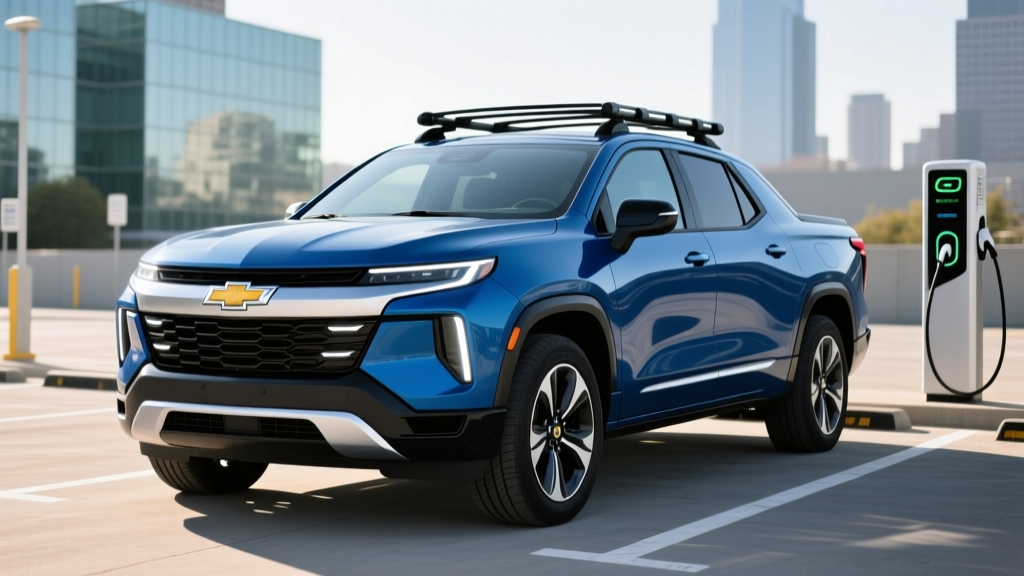
Why Chevy Silverado EV Weight Matters More Than You Think
When General Motors re-engineered the Silverado as a ground-up electric truck on the Ultium platform, physics became the headline. The Chevy Silverado EV weight — ranging from roughly 8,700 lbs for the 4WT Work Truck to over 9,600 lbs for a fully optioned RST — is the single most consequential spec on the window sticker. It dictates how far the truck can travel per kilowatt-hour, how quickly tires wear, how much distance you need to stop, and whether a Level 2 home charger can replenish the pack overnight.
Unlike a gas truck where weight mostly affects fuel economy, an EV's mass interacts with everything from regenerative braking efficiency to thermal management demands. In this review, we'll unpack the Silverado EV's weight across trims, connect it to real-world range and charging behavior, and help you decide whether this 9,000-lb electric pickup earns a spot in your driveway.
Silverado EV Curb Weight by Trim: The Numbers
GM has published curb weights for the Silverado EV lineup that confirm what the Ultium platform's massive battery packs suggest: this is a heavy vehicle, even by full-size truck standards. For comparison, a gas-powered 2026 Silverado 1500 crew cab weighs between 4,700 and 5,400 lbs depending on configuration — the EV nearly doubles that.
| Trim | Battery Pack | Curb Weight (lbs) | GVWR (lbs) |
|---|---|---|---|
| 4WT (Work Truck) | ~200 kWh (usable) | ~8,700 | ~9,600 |
| 3WT (Work Truck) | ~200 kWh (usable) | ~8,900 | ~10,000 |
| LT (Fleet/Consumer) | ~200 kWh (usable) | ~9,100 | ~10,000 |
| RST (First Edition / Range) | ~200 kWh (usable) | ~9,400–9,600 | ~10,500 |
| Trail Boss | ~200 kWh (usable) | ~9,200 | ~10,200 |
The weight disparity stems from two factors: the 24-module, double-stacked Ultium battery pack contributing roughly 2,900 lbs alone, and the reinforced BT1 platform structure designed to protect that pack and support up to 10,000 lbs of towing capacity on the Work Truck trims. If weight is a primary concern — say, for garage floor loading limits or bridge restrictions on rural routes — the 4WT is the lightest entry point, though still enormously heavy.
Range, Efficiency, and the Weight Penalty
EPA Estimated: 390 miles (RST Range, 200 kWh pack)
Real-World Highway (70 mph, 75°F): ~290–320 miles
Real-World Cold Weather (30°F, mixed driving): ~240–270 miles
Real-World Towing (5,000-lb trailer): ~150–180 miles
Heavy vehicles lose efficiency disproportionately at highway speeds due to aerodynamic drag. The Silverado EV's boxy profile and 9,000+ lb mass compound this. Cold temperatures reduce battery chemical efficiency and increase cabin heating demands — expect 25–35% range reduction in freezing conditions, consistent with other large EVs.
The top-spec RST with the 200 kWh usable battery (NMC chemistry — nickel manganese cobalt, chosen for energy density over the LFP chemistry found in some Tesla and Ford competitors) earns an EPA-estimated 390 miles of range. The WT trims with the same pack size but different aerodynamics and tire configurations land around 370–380 miles EPA.
Efficiency lands at approximately 50–53 MPGe combined, or roughly 65–68 kWh per 100 miles. To put that in perspective, the Rivian R1T with its smaller ~128 kWh pack achieves around 70 MPGe combined, and the Ford F-150 Lightning (extended range, 131 kWh usable) sits at approximately 66 MPGe. The Silverado EV's lower MPGe is a direct consequence of its weight and frontal area — more mass requires more energy to accelerate, and more energy is dissipated as heat during braking (though regen recovers a portion).
For context on how weight affects daily ownership: if you commute 40 miles round-trip in mixed conditions, you'll consume roughly 26–28 kWh per day. That's easily replenished overnight on a Level 2 home charger. But on a 300-mile highway road trip, plan for one DC fast-charge stop — and understand that the truck's weight means it won't achieve the 390-mile sticker figure at sustained 75+ mph speeds.
Charging Speed: DC Fast, Level 2, and What Weight Means for Your Panel
The Silverado EV supports a peak DC fast-charge rate of 350 kW on compatible CCS/NACS stations — among the fastest in the electric truck segment. However, peak rate is not sustained rate. The charge curve tapers significantly above 80% state of charge to protect the battery cells, and the pack's enormous capacity means even at peak power, you're moving a lot of electrons.
| Charging Level | Power / Rate | Time / Miles Added |
|---|---|---|
| Level 1 (120V household) | ~1.4 kW | ~3–4 miles per hour |
| Level 2 (240V, 48A) | 11.5 kW | ~28–30 miles per hour |
| Level 2 (240V, 80A — max onboard) | 19.2 kW | ~48–50 miles per hour |
| DC Fast Charge (peak) | 350 kW (CCS/NACS) | 10–80% in ~30–35 minutes |
| DC Fast Charge (sustained avg.) | ~200–250 kW avg (10–80%) | ~100 miles in ~15 minutes |
A critical ownership note: fully charging the 200 kWh pack from 10% to 100% on a standard 48-amp Level 2 home charger takes approximately 16–18 hours. This is a consequence of the truck's weight-driven battery size. If you regularly deplete the pack below 30%, you'll want the available 19.2 kW onboard charger (80A circuit, requiring a 100A dedicated breaker) to make overnight replenishment practical. That installation can cost $1,500–$3,000+ depending on your electrical panel capacity — consult a licensed electrician to assess whether a panel upgrade to 200A or 400A service is needed.
Preconditioning the battery before arriving at a DC fast charger is essential. The Silverado EV's navigation-based preconditioning warms the pack to optimal temperature, enabling the truck to hit its peak 350 kW rate. Without preconditioning — especially in cold weather — you may see peak rates closer to 150–180 kW, adding 10–15 minutes to your stop.
Performance: Towing, Payload, and 0–60 in a 9,500-lb Truck
The Silverado EV's dual-motor AWD powertrain produces up to 754 horsepower and 785 lb-ft of torque in the RST with Wide Open Watts mode engaged. That delivers a 0–60 mph time of approximately 4.5 seconds — remarkable for a vehicle that weighs as much as two Honda Civics. Electric motors provide instant torque regardless of mass, so the acceleration feels genuinely urgent, even if the laws of physics catch up in the corners.
For the Work Truck trims, output is lower at 510 hp and 615 lb-ft (4WT dual-motor) or 664 hp (3WT), with 0–60 times in the 5.5–6.0 second range.
Towing and payload are where weight becomes an asset rather than a liability:
- Max towing (4WT/3WT with Max Tow package): 10,000 lbs
- Max towing (RST): 10,000 lbs (with available trailering equipment)
- Payload capacity: 1,200–1,800 lbs depending on trim and configuration
- Bed length: 5'11" standard with Multi-Flex Midgate deployed extends to 9'3" (RST) or 10'10" with tailgate down
The 4WT's commercial focus includes a front trunk (frunk) with a lockable, weather-sealed compartment — approximately 10.7 cu ft of secure storage — and the available Multi-Flex Midgate lets you pass through items from the bed into the cabin. Interior passenger space is generous: 44.5 inches of front legroom and 43.4 inches of rear legroom in the crew-cab configuration, with 67.4 cu ft of passenger volume.
Driving dynamics reflect the mass: body roll is noticeable in corners, the brake pedal requires firm pressure to slow 9,500 lbs, and tire wear will be accelerated compared to lighter vehicles. Budget for tire replacement every 25,000–35,000 miles with the heavy-duty all-season rubber GM spec'd for this application.
Pricing, Tax Credits, and Total Cost
The Silverado EV lineup spans a wide price range, from fleet-oriented Work Trucks to the premium RST:
| Trim | Base MSRP | §30D Tax Credit Eligible? | Effective Price (with credit) |
|---|---|---|---|
| 4WT | ~$55,000 | Yes (under $80K truck cap) | ~$47,500* |
| 3WT | ~$63,000 | Yes | ~$55,500* |
| LT | ~$70,000 | Yes | ~$62,500* |
| RST (Range) | ~$87,000 | No (exceeds $80K MSRP cap for trucks) | $87,000 |
| Trail Boss | ~$78,000 | Yes (under $80K cap) | ~$70,500* |
*Effective price assumes full $7,500 IRS §30D credit eligibility. Buyer must meet income caps ($150K single / $300K joint MAGI), and the vehicle must satisfy critical-mineral and battery-component sourcing requirements. Point-of-sale transfer is available at participating dealers. Always verify current-year eligibility with your tax professional — rules change frequently.
The RST's $87,000 MSRP places it above the $80,000 MSRP cap that IRS §30D sets for trucks, vans, and SUVs (the cap is $55,000 for sedans). This means RST buyers will not qualify for the federal credit unless they structure the purchase to include the destination charge separately or the manufacturer adjusts pricing. The Work Truck and Trail Boss trims fall under the cap and are typically eligible, though battery-sourcing requirements can disqualify specific build months — always confirm with the dealer at time of purchase.
Ownership economics: At a national average electricity rate of $0.16/kWh and 67 kWh/100 mi, the Silverado EV costs approximately $10.72 per 100 miles to fuel. A comparable gas Silverado 1500 at 19 MPG combined and $3.40/gallon costs $17.89 per 100 miles. Over 15,000 miles per year, that's roughly $1,076 in annual fuel savings — meaningful but not transformative given the Silverado EV's higher purchase price. Insurance premiums run 15–25% higher than the gas equivalent due to repair costs and vehicle value.
Warranty, Tech, and Daily Livability
Chevrolet backs the Silverado EV's battery and powertrain with an 8-year / 100,000-mile limited warranty, with a guaranteed capacity retention threshold of 60% over that period. The bumper-to-bumper warranty is 3 years / 36,000 miles. For fleet buyers, GM offers commercial-specific service programs and mobile service availability in major metro areas.
The infotainment system centers on a 17.7-inch diagonal touchscreen (RST/LT) running Google Built-In with native Google Maps, Assistant, and Play Store apps. The Work Truck trims use an 11-inch screen. Wireless Apple CarPlay and Android Auto are standard across all trims. The available Super Cruise — GM's Level 2 hands-free driver-assistance system — operates on over 750,000 miles of mapped highways in the US and Canada, with automatic lane changes and trailer-compatible guidance when properly calibrated.
Super Cruise is an SAE Level 2 driver-assistance system. The driver must remain attentive, keep eyes on the road (monitored by an infrared camera), and be prepared to take over immediately. It does not navigate unmapped roads, handle construction zones reliably, or operate in all weather conditions. It is not autonomous driving.
Notable drawbacks include the sheer physical footprint (the Silverado EV is over 233 inches long and 83 inches wide — it will not fit in many standard parking garages), the weight-driven tire wear and braking distances, and the 16+ hour Level 2 charge time that makes apartment/condo living without dedicated charging impractical. The eTrunk (front trunk) is smaller than the F-150 Lightning's Mega Power Frunk, and the rear-seat under-floor storage, while useful, doesn't compensate for the absence of a traditional under-seat compartment.
Silverado EV vs. the Competition
The electric truck market gives buyers real alternatives, each with different weight-to-capability trade-offs:
| Spec | Chevy Silverado EV (RST) | Ford F-150 Lightning (Ext. Range) | Rivian R1T (Max Pack) | Tesla Cybertruck (Cyberbeast) |
|---|---|---|---|---|
| Curb Weight | ~9,500 lbs | ~6,500 lbs | ~7,150 lbs | ~6,850 lbs |
| EPA Range | 390 mi | 320 mi | 410 mi | 320 mi |
| Battery (usable) | ~200 kWh | 131 kWh | 149 kWh | ~123 kWh |
| Max DC Charge | 350 kW | 150 kW | 220 kW | 250 kW |
| 0–60 mph | 4.5 sec | ~5.0 sec | ~3.5 sec | 2.6 sec |
| Max Tow | 10,000 lbs | 10,000 lbs | 11,000 lbs | 11,000 lbs |
| Base MSRP | ~$87,000 | ~$74,000 | ~$99,000 | ~$99,990 |
The Silverado EV is the heaviest truck in this comparison by a wide margin — roughly 2,500–3,000 lbs more than the F-150 Lightning. That weight buys you the largest battery and longest EPA range, but it comes at the cost of efficiency (lowest MPGe), charging duration (larger pack takes longer even at higher kW), and tire/brake wear. The F-150 Lightning is the pragmatic fleet and consumer choice if your daily range needs stay under 250 miles. The Rivian R1T offers superior off-road capability and a more refined interior at a premium. The Cybertruck prioritizes performance and stainless-steel durability over traditional truck utility.
Who Should Buy the Chevy Silverado EV?
- You need maximum EPA range in an electric truck (390 mi) and rarely tow at max capacity
- You're a fleet operator who values the 4WT's commercial features, frunk, and Midgate
- You want Super Cruise for long highway commutes with trailer compatibility
- Your daily driving is under 100 miles and you can install a high-amperage Level 2 charger at home
- Garage weight limits, parking structures, or bridge restrictions are a concern
- You need a truck that charges quickly from a standard 48A home circuit (the 200 kWh pack is a liability here)
- You prioritize efficiency (MPGe) over absolute range
- You need the RST's features but require the $7,500 federal tax credit (MSRP cap disqualifies it)
Frequently Asked Questions
What is the real-world range of the Chevy Silverado EV?
The EPA estimates 390 miles for the RST Range trim and 370–380 miles for WT trims. In real-world highway driving at 70–75 mph, expect 290–320 miles. In cold weather (below freezing), plan for 240–270 miles. When towing a 5,000-lb trailer, range drops to approximately 150–180 miles.
How fast does the Silverado EV charge?
On a 350 kW DC fast charger, the Silverado EV charges from 10% to 80% in approximately 30–35 minutes with preconditioning. On a home Level 2 charger at 19.2 kW (80A), it adds about 50 miles per hour, requiring roughly 10–12 hours for a 10–80% charge. On a standard 48A Level 2 circuit, expect 16–18 hours for a near-full charge due to the 200 kWh pack size.
Does the Chevy Silverado EV qualify for the federal EV tax credit?
The 4WT, 3WT, LT, and Trail Boss trims are priced below the $80,000 MSRP cap for trucks and are generally eligible for the full $7,500 §30D credit, provided the buyer meets income caps ($150K single / $300K joint) and the vehicle satisfies battery-sourcing requirements. The RST at ~$87,000 exceeds the cap and does not qualify. Always verify with the IRS or a tax professional before purchasing.
Why is the Chevy Silverado EV so heavy?
The Silverado EV weighs 8,700–9,600 lbs primarily because of its 200 kWh Ultium battery pack (approximately 2,900 lbs alone) and the reinforced BT1 platform structure needed to protect the pack, support 10,000-lb towing, and meet crash-safety standards for a full-size truck. The weight is a deliberate trade-off: more battery mass enables the 390-mile EPA range that distinguishes it from lighter competitors.
Is the Silverado EV worth buying vs. the F-150 Lightning or Rivian R1T?
It depends on your priorities. If maximum range (390 mi EPA) and commercial features (Midgate, large frunk, Super Cruise) are paramount, the Silverado EV leads. If you want a lighter, more efficient truck with adequate 320-mile range and a lower price, the F-150 Lightning is the pragmatic choice. If off-road capability and premium interior matter most, the Rivian R1T excels despite its higher price. The Silverado EV's weight is its defining characteristic — it delivers range at the cost of efficiency and charging convenience.