Quick Answer: California Electric Car HOV Lane Access in 2026
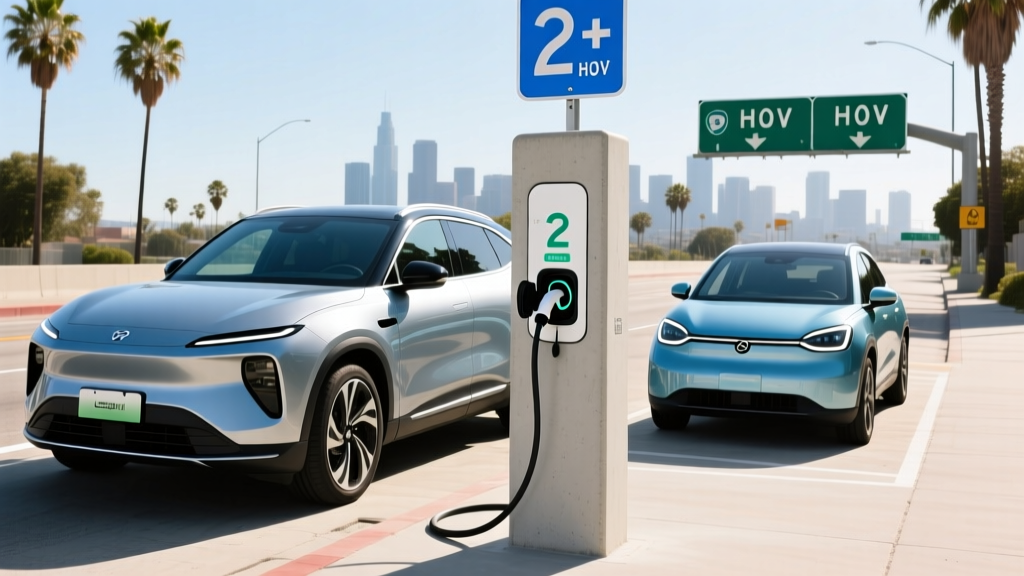
California's Clean Air Vehicle (CAV) decal program lets qualifying electric vehicles use carpool (HOV) lanes with a single occupant. As of 2026, new EVs purchased on or after January 1, 2024 receive decals valid through September 30, 2027. To qualify, the vehicle must meet California's strict zero-emission or enhanced AT-PZEV standards, and the buyer's household income must not exceed $175,000 (single filer), $250,000 (head of household), or $300,000 (joint filer) if applying for the income-based CAV decal (which is available for used EVs and certain lower-priced new EVs). Standard CAV decals for new full-ZEV purchases have no income cap. Apply through the California DMV CAV decal portal — processing typically takes 4–6 weeks.
How the California HOV Sticker Program Works for EV Owners
For California commuters stuck in gridlock on the 405, 101, 10, or 880, HOV lane access isn't a luxury — it's worth an estimated 20–40 minutes per round trip during peak hours. The CAV decal program has been one of the state's most effective tools for driving EV adoption, and understanding the current rules is essential before you buy.
There are effectively two paths to HOV lane access with an EV in California:
- Standard CAV Decal (White/Green): Available to purchasers of new qualifying zero-emission vehicles (BEVs, FCEVs) and qualifying PHEVs. No income limit. The decal is tied to the vehicle, not the owner — meaning if you buy a used EV that already has a valid decal, it transfers.
- Income-Based CAV Decal: Available to buyers whose household income falls below the thresholds mentioned above. This pathway can be used for certain qualifying used EVs and new vehicles that meet the criteria.
The program is administered jointly by the California DMV and the California Air Resources Board (CARB). CARB maintains the official list of eligible vehicles, which is updated as new models receive certification. If you're cross-shopping, always verify the specific model year and trim on CARB's list before signing a purchase agreement — not every electrified vehicle qualifies.
Which 2026 EVs Qualify for California HOV Lane Decals?
As of the 2026 model year, virtually every battery-electric vehicle (BEV) and fuel-cell electric vehicle (FCEV) sold new in California qualifies for a CAV decal. Plug-in hybrids (PHEVs) must meet the Enhanced AT-PZEV standard, which requires a minimum electric-only range and emissions threshold. Here's a snapshot of popular qualifying models with their key specs:
| Vehicle | Type | EPA Range | Battery (kWh) | Peak DC Charge | 10–80% Time | Base MSRP |
|---|---|---|---|---|---|---|
| Tesla Model 3 LR | BEV | 363 mi | 75 (NMC) | 250 kW | ~25 min | $42,490 |
| Tesla Model Y LR | BEV | 330 mi | 75 (NMC) | 250 kW | ~25 min | $44,990 |
| Hyundai Ioniq 5 (Std Range) | BEV | 245 mi | 58 (NMC) | 175 kW | ~24 min | $42,600 |
| Hyundai Ioniq 6 SEL | BEV | 305 mi | 77.4 (NMC) | 240 kW | ~18 min | $43,600 |
| Chevrolet Equinox EV 2LT | BEV | 319 mi | 85 (NMC) | 190 kW | ~30 min | $34,900 |
| Ford Mustang Mach-E Select | BEV | 250 mi | 72 (LFP) | 150 kW | ~33 min | $39,995 |
| Toyota bZ4X XLE | BEV | 252 mi | 71.4 (NMC) | 150 kW | ~30 min | $38,465 |
| Toyota Prius Prime (PHEV) | PHEV | 44 mi EV / 52 MPG | 13.6 (Li-ion) | N/A (L2 only) | ~4 hr (L2) | $33,445 |
Real-World Range Note: EPA figures assume mixed driving at moderate temperatures. On a 75°F California highway at 70 mph, expect roughly 85–92% of EPA range from most BEVs. In colder mountain passes (Tehachapi, Grapevine) or sustained 80+ mph driving, plan for 70–80% of sticker range. LFP batteries (like the Mach-E Select) handle 100% daily charging better than NMC but typically offer slightly less energy density.
Critical caveat for PHEV buyers: Not every plug-in hybrid qualifies. The vehicle must be on CARB's approved list. Most current PHEVs with 20+ miles of EV range make the cut, but always verify before relying on HOV access in your commute math.
The Real Value of HOV Lane Access: Time and Cost Savings
Let's put concrete numbers on what a California electric car HOV decal is actually worth to a daily commuter.
| Metric | EV + HOV Lane | Gas Car (General Lanes) |
|---|---|---|
| Daily round-trip commute (30 mi) | ~35 minutes | ~65 minutes |
| Annual commute time (250 workdays) | ~146 hours | ~271 hours |
| Time saved per year | ~125 hours (≈5 full days) | |
| Annual fuel/energy cost (30 mi/day) | $548 (home L2 @ $0.18/kWh) | $1,688 ($3.85/gal, 28 MPG avg) |
| Annual maintenance | ~$350 | ~$950 |
| Total annual operating cost | $898 | $2,638 |
| Annual savings (EV vs gas) | ~$1,740 | |
The time savings alone — 125 hours per year — have significant economic value. At even $30/hour (California's median hourly wage), that's $3,750 in reclaimed productivity or personal time annually. Combined with fuel and maintenance savings, the HOV decal effectively adds $5,000–$5,500 in annual value for a regular commuter.
Over a 3-year ownership period before the current decal expires (September 2027), that's potentially $15,000–$16,500 in combined savings — a substantial offset against an EV's higher purchase price.
Federal Tax Credit + California HOV: Stacking the Incentives
The HOV decal is one piece of the financial puzzle. Stack it with federal and state incentives, and the economics shift dramatically.
2026 Federal §30D Tax Credit Requirements
- Credit amount: Up to $7,500 ($3,750 for critical minerals + $3,750 for battery components)
- Buyer income cap: $150,000 (single) / $225,000 (head of household) / $300,000 (joint) — note these are lower than the CA CAV income-based decal thresholds
- Vehicle MSRP cap: $55,000 for sedans; $80,000 for SUVs, trucks, vans
- Battery sourcing: Critical minerals and battery components must meet phased-in domestic/free-trade-partner sourcing requirements per IRS §30D rules
- Point-of-sale transfer: You can transfer the credit to the dealer at purchase to reduce your out-of-pocket cost immediately
For a qualifying vehicle like the 2026 Chevrolet Equinox EV 2LT ($34,900 MSRP), a buyer who meets all §30D requirements could apply the full $7,500 at point of sale, bringing the effective price to roughly $27,400 — competitive with a well-equipped gas compact SUV, and that's before factoring in HOV lane access and ongoing fuel savings.
California-specific note: The state's Clean Vehicle Rebate Project (CVRP) has historically offered up to $2,000 for income-qualified buyers, but funding availability fluctuates. Check the California Energy Commission for current rebate status before counting on it in your budget.
EV vs. Gas vs. PHEV: Which Maximizes HOV Lane Value?
| Factor | BEV (e.g., Ioniq 6) | PHEV (e.g., Prius Prime) | Gas (e.g., Civic) |
|---|---|---|---|
| HOV lane eligible? | ✅ Yes | ✅ Yes (if on CARB list) | ❌ No (unless 3+ occupants) |
| Daily commute time | ~35 min | ~35 min | ~65 min |
| Daily energy/fuel cost | $1.10 (home charge) | $0.85 (EV portion) + gas | $4.15 |
| Annual operating cost | ~$898 | ~$1,050 | ~$2,638 |
| Home charging needed? | Yes (strongly recommended) | Helpful but not critical | N/A |
| Upfront price premium vs. gas | +$5,000–$12,000 | +$2,000–$5,000 | Baseline |
| Best for | Home-charging commuters | Apartment dwellers, mixed drivers | Low-mileage, no HOV need |
The data makes the case clear: if your primary motivation is HOV lane access, both BEVs and qualifying PHEVs deliver identical commute-time benefits. The decision comes down to your charging situation and daily mileage.
Common HOV Decal Misconceptions — Fact-Checked
| Myth | Fact |
|---|---|
| "Any hybrid gets HOV access" | Only qualifying PHEVs on CARB's approved list. Standard hybrids (HEVs) like the regular Prius do not qualify. |
| "The decal stays with me if I sell the car" | Decals are vehicle-specific. They transfer to the new owner when the car is sold. You cannot move a decal to a different vehicle. |
| "HOV decals are unlimited/permanent" | Decals have expiration dates. Vehicles purchased new in 2024+ get decals valid through September 30, 2027. Previous vintage decals have already expired or will expire soon. |
| "I can use HOV lanes anywhere in California" | HOV lane rules vary by freeway and county. Some express lanes (e.g., 91 Express Lanes, I-15 in San Diego) require a FasTrak transponder even with a CAV decal, though you may receive a discounted toll rate. |
| "Used EVs can't get decals" | Used EVs that already have an active, unexpired decal transfer that decal to the new owner. However, a used EV that never had a decal or whose decal expired generally cannot get a new one. |
| "The federal tax credit and HOV decal have the same income limits" | They have different income caps. The federal §30D credit caps at $150K single / $300K joint. The CA income-based CAV decal caps higher at $175K / $300K. The standard CAV decal for new ZEVs has no income limit. |
Real-World Ownership: What First-Time California EV Buyers Must Know
HOV lane access is compelling, but it shouldn't be the only factor in your purchase. Here's what the actual ownership experience looks like in California.
Home Charging Is the Make-or-Break Factor
California has the nation's densest public charging network — over 14,000 DC fast-charging ports statewide as of 2025 — but the economics and convenience of EV ownership depend heavily on home Level 2 charging.
- Level 1 (120V standard outlet): Adds ~3–5 miles of range per hour. Adequate only for PHEVs or BEVs driven under 30 miles/day with overnight parking.
- Level 2 (240V, 32–48A): Adds 25–44 miles per hour. Fully recharges most BEVs overnight. Installation costs $800–$2,500 if your electrical panel has capacity; $2,500–$5,000+ if a panel upgrade (100A → 200A) is needed.
- Apartment/condo dwellers: California's "Right to Charge" law (Civil Code §4745) prevents HOAs from unreasonably blocking charger installation, but you'll still pay for the equipment and electrical work in your parking space.
If you cannot install home charging and rely exclusively on public DC fast charging, your per-mile energy cost roughly doubles (to ~$0.06–$0.10/mile depending on network pricing) and you'll spend 2–3 hours per week at chargers. The HOV time savings remain, but the ownership experience degrades significantly.
California Climate: An EV Advantage
Unlike cold-weather states where EVs can lose 20–30% of range in winter, California's climate is ideal for battery efficiency. In coastal and valley regions (LA, SF, San Diego, Sacramento), real-world range typically tracks within 5–10% of EPA estimates year-round. Even in hotter inland areas (Central Valley summers), modern thermal management systems in 2026 BEVs keep battery temperatures controlled, though sustained 100°F+ heat can reduce range by 5–8% and slightly slow DC fast-charging speeds.
Insurance Costs: Budget for the Premium
EV insurance in California runs 15–25% higher than comparable gas vehicles, driven by higher repair costs (specialized body shops, battery replacement risk, ADAS sensor calibration). Budget an additional $300–$600/year compared to insuring a gas equivalent. Shop quotes from EV-friendly insurers (Geico, Progressive, and State Farm tend to be competitive for mainstream EVs; Tesla Insurance is an option for Tesla owners).
Decision Framework: Should You Buy an EV for California HOV Access?
If-Then: Is an EV for HOV Access Right for You?
Choose a BEV if:
- You have (or can install) home Level 2 charging
- Your daily round-trip commute is under 150 miles
- You want maximum fuel savings ($1,500–$1,800/year vs. gas)
- You qualify for the $7,500 federal tax credit (check IRS sourcing rules for your target model)
- You plan to keep the vehicle 4+ years to recoup the purchase premium
Choose a qualifying PHEV if:
- You rent or live somewhere without reliable home charging
- You regularly take road trips exceeding 300+ miles where charging infrastructure is sparse
- You want HOV access with a lower upfront premium ($2,000–$5,000 over a gas equivalent vs. $5,000–$12,000 for a BEV)
- Your daily commute is within the PHEV's EV range (25–44 miles for most 2026 models)
Stick with gas (or wait) if:
- You cannot access any form of regular charging (home, workplace, or reliable public)
- Your budget is strictly under $25,000 and you don't qualify for the used-EV tax credit (§25E, up to $4,000)
- Your commute doesn't involve congested HOV-eligible freeways — the decal's value is near zero if you don't drive carpool routes
How to Apply for Your California CAV Decal: Step-by-Step
- Verify vehicle eligibility: Check the CARB eligible vehicle list for your exact model year and trim before purchasing.
- Purchase or lease the vehicle: The decal application requires a California registration. Dealer delivery and registration typically take 2–4 weeks.
- Apply online at the DMV CAV portal: You'll need your vehicle registration, VIN, and personal information. The application fee is $22 (as of 2025–2026).
- Wait for processing: Current processing time is 4–6 weeks. The DMV mails the decals and a CAV identification card.
- Affix decals and carry the card: Place the decals on your vehicle's rear quarter panels as instructed. Keep the ID card in the vehicle — CHP may request it during traffic stops.
- Note your expiration date: Set a calendar reminder. Driving in HOV lanes with an expired decal is a traffic violation (typically a $490 fine).
Frequently Asked Questions
Can I get a California HOV decal for a used electric car?
Only if the used EV already has a valid, unexpired CAV decal from a previous owner. The decal transfers with the vehicle. However, you cannot apply for a new decal on a used EV that never had one or whose decal has expired. When shopping used EVs, ask the seller or dealer to confirm decal status and expiration date — it significantly affects the vehicle's value in California.
Does a Tesla qualify for the California HOV decal?
Yes. All current Tesla models (Model 3, Model Y, Model S, Model X, Cybertruck) are zero-emission vehicles that qualify for the standard CAV decal with no income restriction. Tesla vehicles purchased new in 2024 or later receive decals valid through September 30, 2027.
What happens when my HOV decal expires?
You lose single-occupant HOV lane access immediately upon expiration. There is currently no renewal or extension mechanism — the California legislature would need to pass new legislation to extend the program. Plan your purchase timing accordingly: buying earlier in the program window gives you more years of HOV access before the expiration date.
Do I still need a FasTrak transponder with a CAV decal?
On standard HOV lanes, no — the CAV decal alone grants access. However, on express lanes (toll lanes like the 91 Express Lanes, I-10/I-110 Metro ExpressLanes, I-15 in San Diego), you still need a FasTrak Flex transponder set to the "2+" or "3+" position. CAV decal holders typically receive a discounted toll rate or free passage on some express lanes, but the transponder is required for the system to recognize you.
Is HOV access worth the EV price premium alone?
For a daily commuter spending 60+ minutes in traffic, the math is compelling: ~$5,000/year in combined time value and operating savings, totaling $15,000+ over three years. If the EV's price premium (after tax credits) is under $10,000 versus your gas alternative, HOV access alone can justify the switch. But if you work remotely most days or don't commute on HOV-eligible freeways, the decal's value drops to near zero — base your decision on fuel savings, driving experience, and environmental priorities instead.