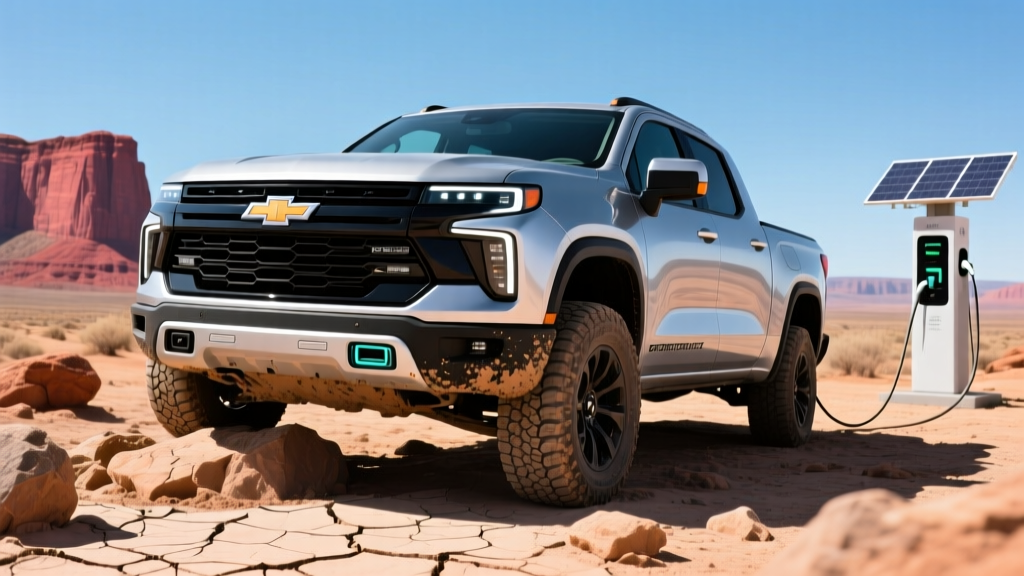
The 2026 Chevy Silverado EV Trail Boss occupies a narrow but compelling space: a full-size electric pickup with genuine off-road hardware, built on GM's Ultium platform. Unlike the range-topping Silverado EV RST with its 440-mile EPA sticker, the Trail Boss prioritizes ground clearance, all-terrain capability, and a more accessible price point over maximum range. After spending time with the specs, cross-referencing EPA data, and mapping out real-world ownership scenarios, here is what buyers need to know before putting down a deposit.
2026 Silverado EV Trail Boss: Key Specifications at a Glance
| Specification | Value |
|---|---|
| EPA Estimated Range | ~360 miles (est.) |
| Battery Capacity | ~200 kWh usable (NMC, Ultium platform) |
| Drivetrain | Dual-motor AWD (e4WD) |
| Horsepower | ~645 hp (est.) |
| 0–60 mph | ~4.5 seconds (est.) |
| Max DC Fast Charge | 200 kW (peak) |
| 10–80% DC Charge Time | ~45 minutes |
| Level 2 Home Charging | 11.5 kW (~30 mi/hr) |
| Towing Capacity | 10,000 lbs (est.) |
| Bed Length | 5 ft 11 in (Multi-Flex Midgate) |
| Base MSRP (Trail Boss) | ~$78,000 (est.) |
| Battery/Powertrain Warranty | 8 years / 100,000 miles |
Note: The Trail Boss trim for the Silverado EV was announced as part of GM's expanded EV truck lineup. Some specifications above are based on GM's preliminary disclosures and Ultium platform data for similarly configured models. Final EPA certification figures may vary. Always confirm with your dealer before purchasing.
Range and Efficiency: EPA Sticker vs. Real-World Expectations
Real-World Expectation: Plan for approximately 280–310 miles on sustained highway driving at 70–75 mph. In cold weather (below 32°F), expect a 20–30% reduction, bringing usable range to roughly 250–290 miles. City and mixed driving with regenerative braking engaged will get you closer to the EPA number, potentially exceeding 340 miles in mild conditions.
The Silverado EV Trail Boss uses a large Ultium battery pack with nickel-manganese-cobalt (NMC) chemistry. GM has not published an exact usable kWh figure for the Trail Boss specifically, but the platform's large-pack configuration provides approximately 200 kWh of usable energy — comparable to the RST variant. The trade-off for off-road tires, increased ride height, and the Trail Boss's heavier suspension hardware is a modest range penalty versus the more aero-optimized RST.
Efficiency for a truck of this size and weight typically lands in the 48–52 MPGe range (combined), or roughly 48–55 kWh per 100 miles. For context, that's significantly less efficient than a sedan like the Tesla Model 3 (~132 MPGe) but competitive with the Ford F-150 Lightning and Rivian R1T. Towing will crush efficiency — expect 2.0–2.5 kWh/mile (the equivalent of 25–30 MPGe) when pulling a 7,000-lb trailer, cutting effective range to roughly 150–180 miles.
Charging Speed: DC Fast Charging and Home Level 2
Charging speed is where full-size EV trucks live or die for road-trip viability. The Silverado EV Trail Boss supports up to 200 kW peak DC fast charging via its CCS connector (with NACS adapter compatibility for Tesla Supercharger access as GM transitions its network).
| Charging Level | Power (kW) | Speed / Time |
|---|---|---|
| Level 1 (120V standard outlet) | ~1.4 kW | ~3–4 miles per hour |
| Level 2 (240V home, 48A) | 11.5 kW | ~30 miles per hour (~17 hr full charge) |
| DC Fast Charge (peak) | 200 kW | 10–80% in ~45 minutes |
| DC Fast Charge (sustained avg.) | ~130–150 kW | Real-world average on 350-kW stations |
A critical reality check on DC fast charging: the 200 kW figure is a peak, not a sustained rate. Like all large-battery EVs, the Silverado EV's charge curve tapers significantly above 80% state of charge to protect the NMC cells. In practice, on a 350-kW Electrify America or EVgo stall, you'll see 180–200 kW between 10–40% SoC, tapering to 80–100 kW by 60%, and dropping below 50 kW past 80%. The 10–80% time of roughly 45 minutes is competitive with the F-150 Lightning (which peaks at ~170 kW on extended-range models) but slower than the Rivian R1T's latest architecture.
For home charging, the 11.5 kW onboard charger means a full overnight replenishment on a Level 2 wall connector. Budget roughly $800–$2,000 for a professional Level 2 installation (240V/60A circuit) depending on your panel capacity. Homes with older 100A electrical panels may need a $2,000–$4,000 panel upgrade to support simultaneous high-draw appliances alongside EV charging — factor this into your total purchase cost.
Performance, Drivetrain, and Off-Road Capability
The Trail Boss badge on a Silverado has always meant off-road intent, and the EV version carries that forward with a dual-motor all-wheel-drive system GM calls e4WD. Estimated output sits around 645 horsepower, delivering a 0–60 mph time in the 4.5-second range — remarkably quick for a truck with a solid rear axle equivalent and all-terrain rubber.
Off-road hardware includes:
- Factory lift (approximately 2 inches over standard Silverado EV ride height)
- 35-inch all-terrain tires on 18-inch wheels
- Underbody skid plates (front, transfer case, battery enclosure)
- Electronically locking rear differential
- Terrain-select modes including a dedicated off-road and crawl mode
- Increased approach, departure, and breakover angles vs. WT and RST trims
The Ultium platform's low-slung battery pack gives the Silverado EV a naturally low center of gravity, which helps stability on side-slope trails. However, the truck's sheer weight — likely north of 9,000 lbs curb weight — is a physics limitation no software can fully overcome on technical rock-crawling terrain. The Trail Boss is best understood as a high-speed desert and forest-road runner, not a Rubicon-class crawler.
Towing capacity is estimated at 10,000 lbs with the Max Trailering package. Integrated trailer brake control and GM's Advanced Trailering System with camera integration come standard. Regenerative braking while towing is aggressive enough to significantly reduce brake wear on downhill grades — a genuine advantage over gas trucks.
Pricing, Trims, and Federal Tax Credit Eligibility
| Trim / Configuration | Est. MSRP | Potential §30D Credit | Effective Price |
|---|---|---|---|
| Silverado EV Trail Boss (base) | ~$78,000 | Up to $7,500* | ~$70,500 |
| Trail Boss w/ Premium Package | ~$85,000 | Up to $7,500* | ~$77,500 |
| Trail Boss w/ Max Trailering | ~$82,000 | Up to $7,500* | ~$74,500 |
*Federal §30D tax credit eligibility is not guaranteed. The IRS enforces multiple requirements that buyers must individually satisfy:
- MSRP Cap: Trucks/vans/SUVs must have an MSRP at or below $80,000. The base Trail Boss should qualify; loaded configurations may exceed the cap.
- Buyer Income Limits: Modified adjusted gross income (MAGI) must not exceed $150,000 (single), $225,000 (head of household), or $300,000 (joint filers).
- Battery Component Sourcing: A percentage of battery components must be manufactured or assembled in North America, and critical minerals must meet sourcing thresholds. GM's Ultium batteries are assembled in the U.S. (Lansing, MI and Spring Hill, TN plants), which positions the Silverado EV favorably — but exact compliance depends on model year and supply chain shifts.
- Point-of-Sale Transfer: As of 2024, buyers can transfer the credit to the dealer at purchase, reducing the purchase price directly rather than waiting for a tax refund.
Always verify current eligibility on IRS.gov's clean vehicle credit page before purchasing. Rules have changed annually since the Inflation Reduction Act, and battery-sourcing requirements tighten each year. Consult a tax professional for your specific situation.
Interior, Cargo, and Technology
The Silverado EV Trail Boss uses GM's newest truck interior architecture, anchored by a 17.7-inch diagonal infotainment touchscreen running Google Built-In (Google Maps, Google Assistant, Play Store apps). A 11-inch digital driver cluster complements the central display. Wireless Apple CarPlay and Android Auto are standard, along with wireless phone charging.
The party trick remains the Multi-Flex Midgate — a partition between the cab and bed that folds down to extend the effective load floor from roughly 5'11" to over 9 feet with the tailgate closed, or 10+ feet with the Multi-Flex tailgate open. This makes the Silverado EV surprisingly practical for hauling lumber, kayaks, or ladders despite the shorter bed.
Passenger space is generous, consistent with full-size crew-cab dimensions:
- Front legroom: ~44.5 inches
- Rear legroom: ~43.4 inches
- Bed volume: ~62 cu ft (bed only, midgate up)
- eTrunk (front trunk): ~10.2 cu ft — lockable, weather-sealed, with a 120V outlet
Driver-assistance technology includes GM's Super Cruise on compatible mapped roads — a hands-off, eyes-on Level 2 system that remains one of the most refined highway assistants available. Per IIHS and SAE classification standards, Super Cruise is a Level 2 system: the driver must remain attentive and ready to take over at all times. It is not autonomous driving. The Trail Boss also includes GM's standard Safety Assist suite (automatic emergency braking, lane-keep assist, following distance indicator, front pedestrian braking).
Pros, Cons, and Who Should Buy the Trail Boss
Pros
- Genuine off-road hardware (35s, skid plates, locking rear diff, factory lift)
- Multi-Flex Midgate offers unmatched bed flexibility in the EV truck segment
- 200-kW DC fast charging with NACS/Supercharger adapter access
- Super Cruise hands-free highway driving on 400,000+ miles of mapped roads
- Massive eTrunk with 120V power for job-site or campsite use
- Low center of gravity improves on-road handling vs. gas Silverado
- Strong estimated towing capacity (10,000 lbs) with integrated trailer tech
Cons
- High starting price (~$78,000) may exceed $80K §30D MSRP cap when optioned
- ~360-mile EPA range drops to ~250–290 miles in cold weather
- Heavy curb weight (~9,000+ lbs) limits efficiency and tire longevity
- Towing cuts range roughly in half — not ideal for long-distance trailer haulers
- Large footprint makes tight trail navigation and urban parking challenging
- 45-minute 10–80% charge time lags behind newer 800V architectures
- No LFP battery option — NMC requires more careful long-term SoC management
Who the Trail Boss Is For
Choose the Silverado EV Trail Boss if: You need a full-size truck for weekend off-road adventures, job-site duty, or rural property maintenance, and you can charge at home. The Midgate, eTrunk, and Super Cruise make it uniquely versatile for active lifestyles. You value American-built battery sourcing and GM's dealer network for service.
Look elsewhere if: You primarily need a long-distance towing rig (range drops too sharply), you lack home charging access (relying on public DC charging with a 200-kWh battery is expensive and time-consuming), or you need maximum efficiency over capability. The Rivian R1T offers more refined off-road tech in a smaller package, and the F-150 Lightning remains a strong value play if you don't need the Midgate.
Warranty, Battery Longevity, and Ownership Costs
GM backs the Silverado EV's battery and powertrain with an 8-year / 100,000-mile limited warranty, with a capacity retention threshold of 70% — meaning GM will repair or replace the battery if it degrades below 70% of original capacity within the warranty period. This is standard for the segment and matches Ford and Rivian's coverage.
NMC battery chemistry, as used in the Ultium platform, typically sees 10–15% degradation over the first 100,000 miles based on data from GM's existing Ultium vehicles and industry-wide NMC cell studies. To maximize longevity:
- Avoid routinely charging to 100% — set daily limits to 80–90%
- Minimize repeated DC fast charging in extreme heat without preconditioning
- Use the truck's built-in battery preconditioning feature before fast-charging sessions
- Avoid leaving the truck at very low SoC (below 10%) for extended periods
Estimated 5-year total cost of ownership will be heavily dependent on your electricity rate and whether you qualify for the §30D credit. At a national average of $0.16/kWh, charging the ~200-kWh battery from empty costs roughly $32 at home — equivalent to about $35–$45 in gasoline for a comparable gas Silverado achieving 19 MPG combined. Insurance premiums for the Silverado EV tend to run 15–25% higher than the gas equivalent, according to industry data, due to higher repair costs and parts pricing.
Frequently Asked Questions
What is the real-world range of the Chevy Silverado EV Trail Boss?
With an estimated EPA rating of ~360 miles, real-world highway driving at 70+ mph will yield approximately 280–310 miles. In freezing temperatures, expect 250–290 miles. Towing a trailer will cut range roughly in half to around 150–180 miles depending on weight and terrain.
How fast does the Silverado EV Trail Boss charge?
On a DC fast charger, it peaks at 200 kW and charges from 10–80% in approximately 45 minutes. At home on a Level 2 (240V, 48A) charger, it adds roughly 30 miles of range per hour, requiring about 17 hours for a full charge from empty.
Does the Silverado EV Trail Boss qualify for the $7,500 federal tax credit?
It likely qualifies at the base MSRP (~$78,000, under the $80,000 truck cap), provided the buyer meets IRS income limits ($150K single / $300K joint) and GM's battery sourcing satisfies the current-year critical mineral and component requirements. Always check IRS.gov before purchasing, as rules tighten annually.
Is the Silverado EV Trail Boss worth buying over the F-150 Lightning or Rivian R1T?
The Trail Boss wins on bed versatility (Midgate), Super Cruise highway driving, and GM's massive dealer network. The F-150 Lightning is typically more affordable and has a proven track record since 2022. The Rivian R1T offers superior on-road refinement and a quad-motor option for off-road enthusiasts, but at a higher price and with fewer service centers. Your choice depends on whether Midgate utility and Super Cruise matter more than price (Ford) or refinement (Rivian).
Can the Silverado EV Trail Boss tow a travel trailer long distances?
It can tow up to an estimated 10,000 lbs, but towing severely impacts range — plan on 150–180 miles between charges with a heavy trailer. For long-distance towing, you'll need a well-planned route with reliable DC fast chargers. Most EV truck owners find towing practical for local and regional trips but challenging for cross-country hauls.
What is the battery warranty on the Silverado EV?
GM provides an 8-year / 100,000-mile battery and powertrain warranty with a 70% capacity retention threshold. If the battery degrades below 70% of its original capacity within the warranty period, GM will repair or replace it.
Sources: EPA fuel economy data at fueleconomy.gov; IRS clean vehicle credit rules at irs.gov; GM Silverado EV specifications via Chevrolet's official pressroom. All specifications are based on the latest available data as of publication and may be updated by the manufacturer. Confirm final specs with your dealer.