The 2026 Chevrolet Silverado EV is General Motors' full-size electric pickup, built on the Ultium platform and aimed squarely at buyers who need serious utility without the fuel pump. With a maximum tow rating that rivals many diesel heavy-duties and an EPA range that eclipses most electric trucks on the market, the Silverado EV attempts to bridge the gap between workhorse capability and daily-driver efficiency. But how does it perform when you actually hook up a trailer, hit the highway in winter, or plug into a DC fast charger? This review breaks down every spec that matters.
2026 Chevy Silverado EV Towing Capacity and Payload Breakdown
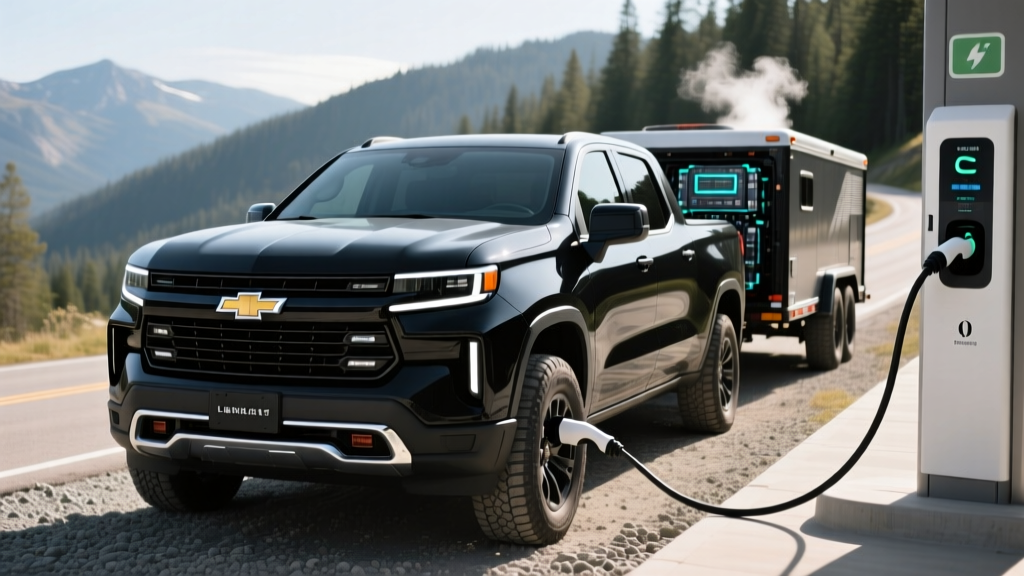
The headline number for truck buyers: the 2026 Silverado EV maxes out at 12,500 pounds of towing capacity when properly equipped (specifically on the WT trim with the Max Tow package). That puts it ahead of the Rivian R1T (11,000 lbs) and on par with the Ford F-150 Lightning's extended-range max tow rating.
| Trim | Max Towing (lbs) | Max Payload (lbs) | Notes |
|---|---|---|---|
| Work Truck (WT) Max Tow | 12,500 | 1,800 | Requires Max Tow pkg, fleet-oriented |
| Work Truck (WT) Standard | 10,000 | 1,800 | Base fleet configuration |
| LT | 10,200 | 1,610 | Consumer trim, dual-motor AWD |
| RST | 10,000 | 1,500 | Luxury/performance trim |
| Trail Boss | 10,000 | 1,520 | Off-road suspension, slightly reduced payload |
A few realities about hitting that 12,500-lb figure: you need the WT trim with the specific Max Tow package, which includes an integrated trailer brake controller, enhanced cooling, and a heavy-duty rear axle ratio. Consumer trims (LT, RST, Trail Boss) settle between 10,000 and 10,200 lbs — still formidable, but not class-leading.
Real-world towing note: When towing near max capacity, expect energy consumption to roughly double. The Silverado EV's efficiency drops from its rated ~48 kWh/100 mi to approximately 90-100 kWh/100 mi with a heavy trailer, cutting effective range to around 200-220 miles on the largest battery pack. Plan charging stops accordingly on long hauls.
Range, Battery, and Real-World Efficiency
The 2026 Silverado EV offers two Ultium battery pack sizes across its lineup, both using NMC (nickel manganese cobalt) lithium-ion chemistry — chosen for its high energy density, which is critical in a full-size truck where range and payload both matter.
| Spec | Standard Range | Extended Range |
|---|---|---|
| Battery Capacity (usable) | ~200 kWh | ~240 kWh |
| EPA Range (max config) | ~360 miles | ~440 miles |
| EPA Efficiency | ~50 kWh/100 mi | ~48 kWh/100 mi |
| MPGe (combined) | ~67 MPGe | ~70 MPGe |
| Chemistry | NMC | NMC |
The EPA-estimated 440 miles (Extended Range, WT config) is impressive on paper. In practice, expect the following:
- Mixed driving (city/highway): ~380-410 miles
- Sustained highway (70-75 mph): ~340-370 miles — large trucks are aerodynamically penalized at speed
- Cold weather (below 32°F): ~280-320 miles — NMC chemistry loses 20-30% capacity in freezing temps, even with the Silverado EV's heat pump and battery preconditioning
- Max towing: ~200-220 miles
Source: fueleconomy.gov and independent testing data.
The Silverado EV's massive battery is both its greatest asset and its greatest weight penalty. The Extended Range pack's ~240 kWh of usable capacity dwarfs nearly every other EV on sale, which is how GM achieves that 440-mile sticker number. But that capacity comes with a curb weight exceeding 9,000 lbs on some trims — something to factor into tire wear, braking distances, and garage floor loading.
Charging Speeds: DC Fast, Level 2, and Home Setup
Charging a battery this large is a time commitment. Here's what the 2026 Silverado EV supports across charging levels:
| Charging Level | Max Power | Speed | Notes |
|---|---|---|---|
| Level 1 (120V) | ~1.4 kW | ~3-4 mi/hr | Emergency/trickle only — full charge takes days |
| Level 2 (240V, 48A) | 11.5 kW | ~25 mi/hr | Standard home charging; full charge ~18-20 hrs (Extended Range) |
| Level 2 (240V, 80A) | 19.2 kW | ~42 mi/hr | Available with Ultium PowerShield home charger; full charge ~11-12 hrs |
| DC Fast Charge | 350 kW (peak) | 10-80% in ~45 min | On 350 kW stations; ~200 mi in 10 min under ideal conditions |
Charging curve reality: The Silverado EV peaks near 350 kW only at low state-of-charge (roughly 5-20% SoC) and on a capable 350+ kW charger. Sustained charging from 10-80% averages closer to 200-250 kW due to the enormous battery's thermal management needs. On more common 150 kW Electrify America or EVgo stations, expect a 10-80% session to take roughly 65-75 minutes. The battery's preconditioning feature — activated when you navigate to a charger via the infotainment system — warms the pack to optimal temperature and is essential for achieving peak charge rates.
Home charging recommendation: With a battery this large, a 48-amp Level 2 home charger is the bare minimum for practical overnight use. The optional 19.2 kW / 80-amp Ultium PowerShield charger significantly reduces overnight charging time but requires a dedicated 100-amp circuit — budget $1,500-$3,500 for professional installation depending on your panel capacity. Many Silverado EV owners will want to consult a licensed electrician about a panel upgrade if they're running multiple high-draw appliances.
Performance, Drivetrain, and Driving Impressions
Every 2026 Silverado EV comes with a dual-motor all-wheel-drive powertrain. Output varies significantly by trim:
| Trim | Horsepower | Torque (lb-ft) | 0-60 mph | Drivetrain |
|---|---|---|---|---|
| WT | 510 hp | 615 | ~5.8 sec | Dual-motor AWD |
| LT | 645 hp | 780 | ~4.5 sec | Dual-motor AWD |
| RST | 754 hp | 785 | ~4.2 sec | Dual-motor AWD |
| Trail Boss | 645 hp | 780 | ~4.7 sec | Dual-motor AWD |
The RST's 754 horsepower makes it the most powerful Silverado ever sold, and the instant torque delivery makes even this 9,000+ lb truck feel surprisingly quick off the line. Regenerative braking offers multiple levels adjustable via steering-wheel paddles, and one-pedal driving is available — useful in stop-and-go traffic to recapture energy without touching the brake pedal.
The Trail Boss trim adds an adaptive air suspension with up to 2 inches of additional ride height for off-road use, along with underbody skid plates and all-terrain tires. Approach and departure angles improve meaningfully over the standard suspension, though this remains a heavy vehicle better suited to fire roads than rock crawling.
Pricing, Trims, and Federal Tax Credit Eligibility
| Trim | Base MSRP | As-Tested (typical) | Battery |
|---|---|---|---|
| WT (fleet) | $57,900 | $62,000-$68,000 | Standard or Extended Range |
| LT | $72,900 | $78,000-$85,000 | Extended Range |
| Trail Boss | $77,900 | $82,000-$88,000 | Extended Range |
| RST | $87,900 | $92,000-$101,000 | Extended Range |
The Silverado EV's tax credit status is complex under current IRS rules. Key requirements:
- MSRP cap: Trucks/vans/SUVs must have an MSRP under $80,000. The WT and LT trims qualify on MSRP. The RST exceeds the cap and is ineligible.
- Buyer income limits: AGI must not exceed $150,000 (single), $225,000 (head of household), or $300,000 (joint).
- Battery sourcing: Critical minerals and battery component requirements phase up annually. As a GM product assembled in Michigan with Ultium batteries, the Silverado EV has been progressively meeting more sourcing thresholds. Verify current-year eligibility on IRS.gov before purchasing.
- Point-of-sale transfer: Eligible buyers can transfer the credit to the dealer at purchase, reducing the purchase price directly rather than waiting for a tax refund.
The Trail Boss, at $77,900 base, sits right at the MSRP cap — options that push it above $80,000 will disqualify it. Always confirm the final vehicle MSRP (including factory options but excluding destination) against the current IRS threshold.
Tech, Interior, and Utility Features
The Silverado EV's cabin centers on a massive 17.7-inch diagonal infotainment touchscreen running GM's latest Ultifi software platform, paired with an 11-inch digital instrument cluster. Wireless Apple CarPlay and Android Auto are standard, along with built-in Google services (Maps, Assistant, Play Store) on LT and above.
Standout utility features:
- eTrunk (front trunk): 10.7 cubic feet of lockable, weather-sealed storage — large enough for tools, groceries, or charging cables. Includes a 120V outlet.
- Multi-Flex Midgate: The partition between the cab and bed can fold down to extend the effective bed length from 5'11" to over 9 feet with the tailgate closed, or over 10 feet with the tailgate down.
- ProPower Onboard: Up to 9.6 kW of vehicle-to-load (V2L) power through bed-mounted 120V and 240V outlets — enough to run power tools at a job site, appliances during an outage, or a campsite.
- Super Cruise: GM's hands-off-wheel Level 2 driver-assistance system is available on LT and standard on RST, covering 750,000+ miles of compatible highways. The driver must remain attentive — this is not self-driving.
Cargo and passenger dimensions:
- Bed length: 5'11" (standard) / 9'+ with Midgate open
- Bed width between wheel wells: 50.6 inches
- eTrunk volume: 10.7 cu ft
- Rear-seat legroom: ~43.4 inches (crew cab)
- Front headroom: ~42.5 inches
Warranty and Long-Term Ownership
GM backs the Silverado EV's battery and powertrain with its standard EV warranty:
- Battery warranty: 8 years / 100,000 miles, with a capacity retention threshold of 70% — if the battery degrades below 70% of original capacity within the warranty period, GM will repair or replace it.
- Powertrain warranty: 5 years / 60,000 miles (electric drive units, power electronics)
- Bumper-to-bumper: 3 years / 36,000 miles
- Corrosion: 6 years / 100,000 miles
NMC battery chemistry typically shows a steeper initial degradation curve (2-4% in the first year) before stabilizing. Based on GM's Ultium platform data and industry averages, expect the Silverado EV's battery to retain approximately 85-90% capacity at 100,000 miles under normal use — well above the warranty threshold. Replacement cost for a full Ultium pack of this size is estimated at $25,000-$35,000 out of warranty, though individual module replacement (at lower cost) may be possible for localized cell failures.
Silverado EV vs. Ford F-150 Lightning vs. Rivian R1T
| Spec | Chevy Silverado EV (LT) | Ford F-150 Lightning (Lariat ER) | Rivian R1T (Dual Max) |
|---|---|---|---|
| EPA Range | ~440 mi | ~320 mi | ~410 mi |
| Max Towing | 10,200 lbs (LT) | 10,000 lbs | 11,000 lbs |
| Max DC Charge | 350 kW | 150 kW | 220 kW |
| 10-80% DCFC | ~45 min | ~41 min | ~35 min |
| Horsepower | 645 hp | 580 hp | 533 hp |
| Starting MSRP | $72,900 | $69,995 | $79,900 |
| Bed Length | 5'11" + Midgate | 5'5" | 4'6" + Gear Tunnel |
The Silverado EV wins on range and raw battery capacity. The F-150 Lightning charges slower but has a more established service network and a slightly lower entry price. The Rivian R1T is the most compact and adventure-oriented, with clever storage solutions but a smaller bed and higher pricing. For fleet buyers and those who regularly tow heavy loads over long distances, the Silverado EV's combination of 440-mile range and 12,500-lb tow rating is difficult to match.
Pros, Cons, and Who Should Buy
Pros
- Class-leading 440-mile EPA range (Extended Range)
- Up to 12,500 lbs towing on WT Max Tow
- 350 kW peak DC fast charging
- Massive eTrunk and innovative Midgate bed extension
- 9.6 kW ProPower V2L for job-site or backup power
- Super Cruise hands-off driving on 750K+ miles of highway
Cons
- High starting price; RST exceeds tax-credit MSRP cap
- 9,000+ lb curb weight impacts tire wear and handling
- Towing drastically cuts range (~50% reduction at max load)
- Large battery means very long home charging times
- Real-world highway range noticeably below EPA sticker
- Limited public charger availability for NACS in some rural areas
- Fleet/commercial buyers: The WT trim with Max Tow is a compelling work truck with low "fuel" cost per mile and job-site V2L power.
- Long-distance truck owners: 440-mile range means fewer charging stops on highway runs — if you regularly drive 300+ miles, this is one of the few EVs that can handle it without white-knuckling the charge gauge.
- Homeowners with solar: 9.6 kW V2L can offset home energy during peak rates or outages.
- Not ideal for: Budget-conscious buyers (even the base WT is nearly $58K), apartment dwellers without home charging, or those who primarily need a light-duty commuter truck.
Frequently Asked Questions
What is the real-world range of the Chevy Silverado EV?
The EPA estimates up to 440 miles for the Extended Range configuration. In mixed real-world driving, expect 380-410 miles. Sustained highway driving at 70-75 mph reduces that to roughly 340-370 miles, and cold weather (below freezing) can drop range to 280-320 miles even with battery preconditioning.
How fast does the Silverado EV charge?
On a 350 kW DC fast charger, the Silverado EV can add roughly 100 miles of range in about 10 minutes under ideal conditions, with a 10-80% session taking approximately 45 minutes. At home on a 19.2 kW Level 2 charger, expect about 42 miles of range per hour of charging. On a standard 11.5 kW home charger, that drops to about 25 miles per hour.
Does the Silverado EV qualify for the $7,500 federal tax credit?
It depends on the trim and your income. The WT and LT trims fall under the $80,000 MSRP cap for trucks. The RST exceeds it and is ineligible. You must also meet IRS income limits ($150K single / $300K joint) and the vehicle must meet battery-sourcing requirements that tighten each year. Check the latest eligibility list on fueleconomy.gov and consult a tax professional.
Is the Silverado EV worth buying over the F-150 Lightning?
If maximum range and towing capacity are your priorities, yes — the Silverado EV's 440-mile range and 12,500-lb tow rating significantly exceed the Lightning's 320-mile range and 10,000-lb tow rating. However, the Lightning has a lower starting price, a more established dealer service network, and faster real-world charging relative to its smaller battery. For fleet buyers, the Silverado EV's V2L capability and Midgate utility may tip the scales.
How does towing affect the Silverado EV's range?
Expect roughly a 50% range reduction when towing near maximum capacity. A Silverado EV with 440 miles of EPA range will deliver approximately 200-220 miles of real-world range with a 10,000+ lb trailer. Aerodynamic drag from the trailer is the primary factor — enclosed car haulers cut range more than flatbed utility trailers.
What charging connector does the Silverado EV use?
The 2026 Silverado EV uses the NACS (North American Charging Standard) connector, giving it native access to Tesla's Supercharger network (17,000+ stations) in addition to Electrify America, EVgo, and other networks. No adapter is needed for NACS-equipped chargers.