Quick Answer: The Chevy S10 EV Explained
The Chevy S10 EV was a battery-electric compact pickup produced by General Motors from 1997 to 1998, with roughly 500 units built and leased primarily in California. It delivered an EPA-estimated 95 miles of range on its nickel-metal hydride (NiMH) battery pack — or about 45 miles on the earlier lead-acid version — with a 114 hp AC electric motor. GM discontinued the S10 EV when it scaled back its EV1-era electric vehicle program. The truck is not available for purchase today, but its engineering legacy directly influenced modern electric pickups like the Chevrolet Silverado EV and GMC Sierra EV.
If you've been searching for information on the Chevy S10 EV, you've likely stumbled onto one of the most fascinating footnotes in electric vehicle history. Long before the Ford F-150 Lightning or the Rivian R1T, General Motors built a real, production electric pickup truck — and it worked. Understanding what the S10 EV offered, why it failed, and what it predicted about today's EV market gives you a sharper lens for evaluating the electric trucks you can actually buy in 2026.
What Was the Chevy S10 EV?
The S10 EV was based on GM's popular S10 compact pickup, the gas-powered workhorse that sold millions through the 1980s and 1990s. But instead of a four-cylinder or V6 engine, the S10 EV packed an electric drivetrain beneath the hood and a battery array between the frame rails.
GM produced the S10 EV in two distinct battery configurations:
- Lead-acid battery (1997): Delivered approximately 45 miles of range with a 1,620-pound battery pack. Top speed was electronically limited to 70 mph.
- NiMH battery (1997–1998): Upgraded to a nickel-metal hydride pack that roughly doubled range to 95 miles EPA-estimated, while cutting battery weight to about 960 pounds.
The truck used a three-phase AC induction motor producing 114 horsepower and 140 lb-ft of torque — respectable figures for a compact truck in that era, and a configuration nearly identical to what Tesla would adopt a decade later in the original Roadster and Model S.
| Specification | Lead-Acid Version | NiMH Version |
|---|---|---|
| EPA Range | ~45 miles | ~95 miles |
| Battery Chemistry | Lead-Acid | Nickel-Metal Hydride |
| Battery Weight | ~1,620 lbs | ~960 lbs |
| Motor Type | 3-Phase AC Induction | 3-Phase AC Induction |
| Horsepower | 114 hp | 114 hp |
| Torque | 140 lb-ft | 140 lb-ft |
| 0–60 mph | ~17 seconds | ~13 seconds |
| Top Speed | 70 mph (limited) | 70 mph (limited) |
| Charging (Level 2, 240V) | ~6.5 hours | ~6.5 hours |
| Cargo Bed Length | 4.5 feet (short bed) | 4.5 feet (short bed) |
| Units Produced | ~500 total (both versions) | |
| Availability | Lease only, California market | |
Range, Charging, and the Limits of 1990s Battery Tech
Ninety-five miles of EPA range sounds quaint by 2026 standards — the Chevrolet Silverado EV 4WT offers an EPA-estimated 440 miles on its Ultium platform — but the S10 EV's range was genuinely practical for its intended use case: urban and suburban fleet duty, short-haul deliveries, and commuter driving in Southern California.
Charging happened via a Magne Charge paddle inductive connector (the same system used by the EV1) or, on later units, a conductive plug. At 240V Level 2, a full charge took roughly 6.5 hours. There was no DC fast charging infrastructure to speak of — the concept simply didn't exist outside of laboratory prototypes.
Real-World Range Reality Then vs. Now
S10 EV (1998): 95 miles EPA; expect ~75–80 miles in mixed driving, ~55–60 miles at sustained highway speeds or in cold weather. Lead-acid versions delivered roughly half that.
Silverado EV 4WT (2026): 440 miles EPA; expect ~350–380 miles highway, with cold-weather reduction to ~310–340 miles.
The gap illustrates 28 years of battery chemistry advancement — from NiMH at ~80 Wh/kg energy density to modern NMC cells exceeding 250 Wh/kg.
The S10 EV also lacked regenerative braking in any meaningful sense. Modern EVs recover 15–30% of kinetic energy during deceleration, extending real-world range and reducing brake wear. The S10 EV's braking system was conventional, missing an efficiency opportunity that every EV sold today exploits.
Chevy S10 EV vs. Gas S10: A 1998 Cost Comparison
Understanding the economics of the S10 EV requires comparing it to the gas-powered S10 it was based on. Even in the late 1990s, the cost calculus looked surprisingly familiar to today's EV-versus-gas debates.
| Factor | S10 EV (NiMH) | S10 Gas (2.2L I4) |
|---|---|---|
| MSRP / Lease Equivalent | ~$35,000 (lease ~$499/mo) | ~$14,000 purchase |
| Fuel / Energy Cost (per mile, 1998) | ~$0.03/mile (CA electricity) | ~$0.08/mile ($1.10/gal gas, 22 MPG) |
| Annual Fuel Cost (12,000 mi) | ~$360 | ~$960 |
| Oil Changes / Year | 0 | 3–4 |
| Smog Checks | Exempt | Required (CA) |
| Range | ~95 miles | ~350 miles |
| Refuel / Recharge Time | ~6.5 hours | ~5 minutes |
| Payload Capacity | ~950 lbs (reduced by battery) | ~1,400 lbs |
The energy cost advantage was real: the S10 EV cost roughly 60% less per mile to "fuel" than its gas counterpart. Maintenance savings were significant too — no oil, no spark plugs, no exhaust system, no transmission fluid. These are the same advantages EV owners cite today, and the math has only improved as electricity rates have remained relatively stable while gas prices climbed from $1.10/gallon in 1998 to a national average above $3.50 in 2026.
But the limitations were equally real: one-third the range, 78x longer refueling time, a higher effective monthly cost via lease, and reduced payload. These trade-offs — range, refueling speed, upfront cost, utility compromise — are the exact same variables modern EV buyers weigh. The S10 EV was proving the EV value proposition, and its constraints, a generation early.
Why GM Killed the S10 EV (and What Happened Next)
The S10 EV's cancellation in 1998 wasn't a sudden decision. It was part of GM's broader retreat from its first-generation electric vehicle program, which also included the iconic EV1 coupe. Several factors converged:
- Battery cost: NiMH packs were extraordinarily expensive — estimated at $10,000–$15,000 per vehicle in 1998 dollars. GM was losing money on every S10 EV lease.
- Limited market: California's Zero Emission Vehicle (ZEV) mandate, which had driven automakers to produce EVs, was weakened after industry lobbying. Without regulatory pressure, GM saw no business case.
- Oil prices: At $12–$15 per barrel in the late 1990s, gasoline was cheap. Consumer demand for electric vehicles was negligible outside a small enthusiast community.
- Technology ceiling: NiMH chemistry was approaching its energy-density limits. Lithium-ion, which would eventually solve the cost and range equation, was still years away from automotive-grade production.
GM recalled most leased S10 EVs and EV1s and crushed the majority — a decision that sparked outrage and became the subject of the 2006 documentary Who Killed the Electric Car? A small number of S10 EVs were sold to private owners or donated to museums and universities, and a handful still exist in collector hands today.
Lessons for Modern EV Buyers: What the S10 EV Got Right
Looking back from 2026, the S10 EV was remarkably prescient in several ways that directly inform today's EV purchase decisions:
1. Electric Motors Are Inherently Better for Trucks
The S10 EV's instant torque delivery (140 lb-ft from 0 RPM) made it feel quicker off the line than its gas counterpart, despite the 0–60 time of 13 seconds. Modern electric trucks exploit this fully: the Silverado EV delivers up to 780 hp and a 0–60 time under 4.5 seconds. Electric motors eliminate the torque-converter lag and gear-hunt that plague gas trucks under load.
2. Home Charging Is the Core Value Proposition
S10 EV lessees charged at home overnight, waking to a "full tank" every morning. This remains the single biggest ownership satisfaction factor in modern EV surveys. According to fueleconomy.gov, over 80% of EV charging happens at home. If you can install a Level 2 charger, the daily convenience advantage over gas is substantial.
3. Battery Chemistry Determines Everything
The jump from lead-acid to NiMH doubled the S10 EV's range while cutting battery weight by 40%. Today's chemistry choice — typically LFP (lithium iron phosphate) versus NMC (nickel manganese cobalt) — similarly defines the range, cost, longevity, and charging behavior of modern EVs. LFP offers longer cycle life and lower cost but less energy density; NMC delivers more range per kilogram but degrades faster if regularly charged to 100%.
4. Total Cost of Ownership Favors EVs Over Time
The S10 EV's lower per-mile energy cost and near-zero drivetrain maintenance predicted the TCO advantage that modern EVs deliver. A 2026 analysis by the U.S. Department of Energy estimates EVs save an average of $0.06–$0.10 per mile in fuel and maintenance compared to equivalent gas vehicles — savings that compound to $3,000–$5,000 over five years of typical driving.
| Myth | Fact |
|---|---|
| "Electric trucks can't do real work" | The S10 EV hauled ~950 lbs; the 2026 Silverado EV tows up to 12,500 lbs with a full bed payload. |
| "EV batteries won't last" | Modern EV batteries carry 8-year/100,000-mile federal warranties. Data shows average degradation of 10–15% over 200,000 miles for NMC, and under 10% for LFP. |
| "There's nowhere to charge" | As of 2026, the U.S. has over 70,000 public charging stations with 200,000+ ports, plus home charging for those with garage access. |
| "EVs are worse in cold weather" | Range drops 15–30% in freezing temps (real, not a myth), but EVs start reliably in any cold and heat pumps have cut cabin-heating energy draw by 50%+. |
Decision Framework: Should You Buy a Modern Electric Truck?
You can't buy an S10 EV, but you can buy its spiritual successors. Here's a practical framework for deciding whether a 2026 electric pickup fits your life:
Choose an Electric Truck If:
- You have home charging access (garage, driveway, or employer-provided) — this is the single biggest predictor of EV satisfaction.
- Your daily driving is under 200 miles round-trip — covers 90%+ of American commutes and leaves range buffer for errands.
- You value low operating costs — electricity at $0.13/kWh national average vs. gas at $3.50+/gallon saves $1,500–$2,500/year for a 15,000-mile driver.
- You need instant torque for towing or hauling — electric motors deliver peak torque at 0 RPM with no gear shift delay.
- You plan to own the vehicle 5+ years — the TCO crossover point where EV savings offset higher purchase price typically lands at year 3–5, aided by the federal §30D tax credit (up to $7,500, subject to MSRP caps, income limits, and battery sourcing requirements).
Stick With Gas or Hybrid If:
- You regularly drive 300+ miles between stops in areas with sparse DC fast charging infrastructure.
- You lack home charging and rely on street parking — public-only charging adds time, cost, and unpredictability.
- You tow heavy loads in extreme cold — towing can cut EV range by 40–50%, and cold weather stacks on top of that.
- Your budget is strictly under $35,000 — the cheapest new electric trucks in 2026 still start above $50,000 before incentives.
Where the S10 EV's Legacy Lives On
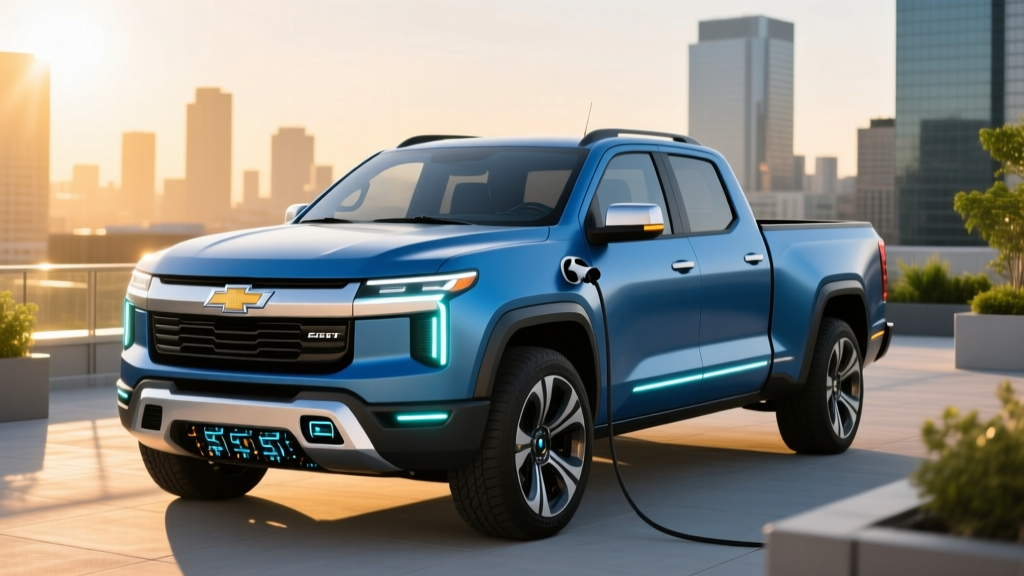
GM didn't abandon electric trucks — it just took a 25-year detour. The 2026 Chevrolet Silverado EV, built on the Ultium platform, is the direct descendant of the S10 EV's engineering philosophy: body-on-frame electric propulsion, home-chargeable, lower operating cost, instant torque.
The differences, of course, are vast. The Silverado EV offers:
- 440 miles of EPA range (vs. 95)
- 200 kW DC fast charging, 10–80% in ~30 minutes (vs. no fast charging)
- Up to 780 hp (vs. 114)
- 12,500-lb towing capacity (vs. unlisted, likely ~2,000 lbs)
- NMC lithium-ion chemistry with active thermal management (vs. passively cooled NiMH)
- Starting MSRP around $55,000 (vs. ~$35,000 lease equivalent in 1998 dollars, roughly $68,000 adjusted for inflation)
The S10 EV proved the concept. The Silverado EV — along with the Ford F-150 Lightning, Rivian R1T, and GMC Sierra EV — proved the market. If you're researching electric trucks today, the S10 EV's story is a reminder that the technology has been viable for decades; what changed was battery cost, energy density, and the charging infrastructure to support long-distance driving.
Frequently Asked Questions
Can I still buy a Chevy S10 EV?
Not from any dealer. GM produced approximately 500 S10 EVs between 1997 and 1998, most of which were leased and subsequently recalled and crushed. A small number survived in private hands, museums, and university fleets. Finding one today would require a specialty collector auction, and it would not be practical as a daily driver given its 95-mile range and aging NiMH battery.
How much would a Chevy S10 EV cost today?
On the rare occasions one surfaces for sale, expect prices in the $15,000–$30,000+ range depending on condition, battery health, and provenance — comparable to other collectible EV1-era vehicles. Battery replacement, if even possible given parts scarcity, would likely exceed the vehicle's value.
What modern Chevy truck is closest to the S10 EV?
The Chevrolet Silverado EV is the spiritual successor, though it's a full-size truck rather than a compact. For a closer size analog, watch for GM's future compact EV truck plans — the Colorado segment could eventually receive an electric variant, though none has been announced for 2026.
Did the S10 EV qualify for any tax incentives?
In 1998, the federal EV tax credit as we know it today (§30D) did not exist. Some California state incentives and utility rebates were available. Today's IRS §30D clean vehicle credit offers up to $7,500 for qualifying new EVs, subject to MSRP caps ($80,000 for trucks), buyer income limits ($300,000 joint / $150,000 individual), and strict battery component and critical mineral sourcing requirements. Always verify current eligibility on irs.gov or consult a tax professional.
Why did GM crush the S10 EV and EV1?
GM cited insufficient consumer demand, high battery replacement costs, and the weakening of California's ZEV mandate. Critics argued that GM undermined its own EV program by limiting marketing, restricting lease terms, and refusing to sell vehicles outright. The full story remains contested, but the practical result was that GM exited the EV market until the Chevrolet Volt (2010) and Bolt EV (2017) marked its return.
How does the S10 EV's efficiency compare to modern EVs?
The S10 EV achieved roughly 1.8–2.2 miles per kWh, depending on the battery version and driving conditions. Modern electric trucks like the Ford F-150 Lightning achieve about 2.0–2.3 mi/kWh (roughly 48–50 kWh/100mi), and sedans like the Tesla Model 3 reach 4.0+ mi/kWh. The efficiency gap is modest — the real gains have come from battery energy density, charging speed, and total range.