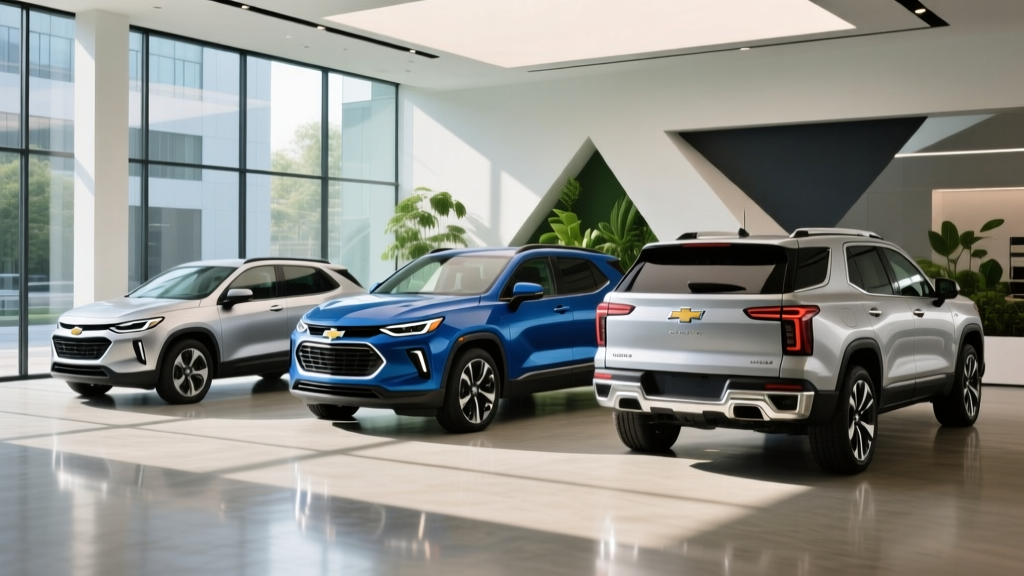
If you're researching a Chevy EV car in 2026, you're choosing from three production models: the Equinox EV (compact crossover, EPA range up to 319 miles, starting ~$33,600), the Blazer EV (midsize crossover, EPA range up to 324 miles, starting ~$44,600), and the Silverado EV (full-size truck, EPA range up to 440 miles, starting ~$57,900). All three use GM's Ultium battery platform with NMC chemistry and support DC fast charging up to 190 kW (Equinox/Blazer) or 350 kW (Silverado). Federal §30D tax credit eligibility varies by trim, battery sourcing, and your income — check the details below before you buy.
The 2026 Chevy EV Lineup at a Glance
Chevrolet has consolidated its electric portfolio around the Ultium platform. The Bolt EV and EUV were discontinued after 2023, leaving the Equinox EV as the entry point. Here's how the three current models compare on paper:
| Spec | Equinox EV | Blazer EV | Silverado EV |
|---|---|---|---|
| EPA Range (max) | 319 mi | 324 mi | 440 mi |
| Battery (usable) | ~85 kWh | ~102 kWh | ~200 kWh (Max Range) |
| Chemistry | NMC | NMC | NMC |
| Peak DC Fast Charge | 190 kW | 190 kW | 350 kW |
| 10–80% Charge Time | ~34 min | ~34 min | ~20 min (350 kW stall) |
| Level 2 Rate | 11.5 kW | 11.5 kW | 11.5 kW (19.2 kW opt.) |
| Horsepower (max AWD) | 288 hp | 557 hp (SS) | 754 hp (4WT) |
| 0–60 mph | ~7.6 sec (FWD) | ~3.8 sec (SS) | ~4.5 sec (4WT) |
| Base MSRP | ~$33,600 | ~$44,600 | ~$57,900 |
| Battery Warranty | 8 yr / 100k mi | 8 yr / 100k mi | 8 yr / 100k mi |
Sources: fueleconomy.gov, Chevrolet EV Configurator. Real-world range varies — see section below.
Real-World Range vs. EPA Sticker: What to Actually Expect
EPA vs. Reality: The Equinox EV 3RS with the largest battery is rated at 319 miles EPA. In mixed highway driving at 70 mph and 65°F, expect ~265–285 miles. In cold weather (below 30°F), plan for 200–240 miles before needing a charger. The Blazer EV and Silverado EV follow similar patterns — subtract 10–15% for sustained highway speeds and 20–30% for freezing temperatures.
Why the gap? EPA tests include low-speed urban cycles where regenerative braking recovers energy. Highway driving at 75+ mph pushes aerodynamic drag up exponentially — a Blazer EV at 80 mph consumes roughly 25% more energy per mile than at 60 mph. Cold weather adds cabin heating load (even with the Equinox EV's heat pump) and increases battery internal resistance, slowing charge acceptance.
For the Silverado EV 4WT with the 200 kWh pack, the 440-mile EPA figure is impressive, but towing a 7,000-lb trailer will cut that to roughly 200–250 miles depending on terrain and speed. If you tow frequently, plan charging stops accordingly.
Charging Speed and the Curve Reality
GM rates the Equinox and Blazer EV at a peak of 190 kW on a DC fast charger. That peak only holds between roughly 10–30% state of charge (SoC). By 60% SoC, the rate tapers to ~120 kW, and above 80% it drops below 50 kW. This is why the 10–80% time is ~34 minutes — the final 20% can take nearly as long as the first 70%.
The Silverado EV's 350 kW peak (on compatible stalls like Electrify America's latest 350 kW dispensers) is more useful for the first 15 minutes, but the massive 200 kWh pack still requires ~20 minutes for a 10–80% session.
| Level | Power | Connector | Miles Added per Hour |
|---|---|---|---|
| Level 1 (120V) | ~1.4 kW | J1772 / NACS | ~3–5 mi/hr |
| Level 2 (240V, 48A) | 11.5 kW | J1772 / NACS | ~28–35 mi/hr |
| DC Fast (Equinox/Blazer) | Up to 190 kW | CCS / NACS* | ~150–180 mi in 15 min (peak) |
| DC Fast (Silverado) | Up to 350 kW | CCS / NACS* | ~200+ mi in 15 min (peak) |
*2026 Chevy EVs are transitioning to the NACS (Tesla-style) connector. Verify your model's port before purchasing a home charger. GM provides a CCS-to-NACS adapter for Supercharger access.
Chevy EV Car vs. Gas Equivalent: The Cost Math
Let's compare the Equinox EV 2LT (~$35,900 MSRP) against the gas Equinox LT AWD (~$31,500 MSRP) over 5 years and 75,000 miles:
| Category | Equinox EV 2LT | Gas Equinox LT AWD |
|---|---|---|
| Purchase Price (before credits) | $35,900 | $31,500 |
| Federal Tax Credit (§30D) | Up to $7,500* | $0 |
| Effective Purchase Price | $28,400 | $31,500 |
| Energy/Fuel (75k mi) | ~$3,200 (home charging avg.) | ~$7,900 (27 MPG, $3.20/gal) |
| Maintenance (5 yr) | ~$1,200 | ~$3,800 |
| Insurance (5 yr avg.) | ~$8,500 | ~$7,200 |
| 5-Year Total | ~$41,300 | ~$50,400 |
*§30D credit eligibility depends on your AGI, the vehicle's MSRP cap ($80k for SUVs/trucks), battery component and critical mineral sourcing, and point-of-sale transfer rules. See IRS §30D guidance for current-year details. Verify before purchasing.
The EV wins on operating costs by roughly $7,000 over 5 years, primarily from fuel and maintenance savings. However, insurance premiums run 15–20% higher for the Equinox EV in most states due to higher repair costs for battery-adjacent collision damage. If you lack home charging and rely entirely on DC fast charging at $0.35–0.50/kWh, your energy cost jumps to ~$6,500 over 5 years — narrowing the gap significantly.
Tax Credit Eligibility: The Fine Print
§30D Federal Clean Vehicle Credit Requirements (2026):
- Income cap: Modified AGI ≤ $150,000 (single) / $300,000 (joint)
- MSRP cap: ≤ $80,000 for SUVs and trucks (all three Chevy EVs qualify)
- Battery sourcing: Must meet escalating critical mineral and battery component percentages from US or FTA-trade partners — GM has been increasing domestic sourcing, but verify the specific trim/build
- Assembly: Vehicle must be assembled in North America (all three are — Spring Hill, TN and Factory ZERO, MI)
- Point-of-sale transfer: You can transfer the credit to the dealer for an immediate price reduction at purchase
The critical-mineral and battery-component thresholds tighten annually. A Blazer EV built in early 2026 may have different sourcing compliance than one built later in the year. Always confirm with your dealer and cross-reference the DOE's qualifying vehicle list before signing.
Common Misconceptions About Chevy EVs
| Myth | Fact |
|---|---|
| "The battery will need replacing in 5 years" | GM warranties the Ultium pack for 8 years/100,000 miles with a minimum 70% capacity retention threshold. Real-world degradation data from early Ultium vehicles shows ~5–8% loss over 3 years — on track to retain 85%+ at 100k miles. |
| "You can't road-trip an EV" | With 319–440 miles of range and 190–350 kW charging, the Equinox/Blazer/Silverado can cover 200+ miles between 20-minute DC fast-charge stops on major corridors. Rural routes require more planning. |
| "Charging takes too long" | A 10–80% DC fast-charge takes 20–34 minutes depending on the model and charger. Most owners do 80%+ of charging at home overnight (Level 2), waking to a full battery every morning. |
| "EVs are worse in the cold" | Range drops 20–30% in sub-freezing temps — real, but manageable. Preconditioning the battery while plugged in and using seat/steering wheel heaters (more efficient than cabin air) mitigates the loss. |
| "The Ultium platform had launch problems" | Early 2024 Blazer EV software issues were documented and addressed via OTA updates. 2025–2026 builds ship with more stable software. Still, verify current owner forums for any new TSBs. |
Who Should Buy Which Chevy EV Car?
Choose the Equinox EV if:
- You want the most affordable entry into a 300+ mile EV
- Your daily commute is under 80 miles round-trip
- You have Level 2 home charging (a 48A charger refills the ~85 kWh pack in ~8 hours)
- You prioritize efficiency over performance (288 hp is adequate, not thrilling)
Choose the Blazer EV if:
- You need midsize crossover space with available performance (SS trim: 557 hp, 0–60 in ~3.8 sec)
- You want a sportier driving experience with a longer wheelbase
- Budget is in the $45–55k range before credits
Choose the Silverado EV if:
- You need truck capability: 10,000-lb max towing, 4WT e4WD system, Multi-Flex tailgate
- 440-mile range is essential for your work routes or towing pattern
- You're budgeting $58k–$90k+ depending on trim and battery
- You can install a 19.2 kW Level 2 charger at home to manage the massive 200 kWh pack overnight
Consider a PHEV or gas vehicle instead if:
- You cannot install home charging and live in an area with sparse DC fast-charging infrastructure
- You regularly tow heavy loads over 300+ miles in cold weather
- Your budget is firmly under $30,000 — the used EV market or a Chevy Trax gas model may fit better
First-Time Chevy EV Buyer Checklist
- Confirm home charging feasibility: A Level 2 (240V, 48A) home charger costs $500–$800 for the unit plus $800–$2,500 for electrician installation. If your panel needs upgrading from 100A to 200A service, add $1,500–$3,000. Get a licensed electrician's quote before buying the car.
- Verify §30D eligibility: Check your AGI against the IRS caps, confirm the specific VIN's battery sourcing compliance, and decide whether to take the credit at tax time or transfer it at point of sale.
- Test the charging ecosystem: Download the myChevrolet app, Electrify America, and EVgo apps. Drive to a nearby DC fast charger and run a test session before a road trip.
- Understand the connector situation: 2026 models are in the CCS-to-NACS transition. Confirm whether your specific build has a CCS or NACS port and order the correct home charger and adapters.
- Factor insurance into your budget: Get quotes before purchasing — EV premiums average 15–20% higher than gas equivalents for the same model line.
- Precondition habit: Set scheduled departure times in the myChevrolet app so the battery warms to optimal temperature while plugged in, preserving range and improving charge acceptance.
Frequently Asked Questions
Is the Chevy Bolt EV still available in 2026?
No. The Bolt EV and Bolt EUV were discontinued after the 2023 model year. GM has announced a next-generation Bolt on the Ultium platform, but as of early 2026 it remains unreleased. The Equinox EV is currently the most affordable Chevy EV car you can buy new.
Can I charge a Chevy EV at a Tesla Supercharger?
Yes. GM provides a CCS-to-NACS adapter for vehicles equipped with CCS ports, enabling access to the Tesla Supercharger network (V3 stalls at 150 kW, V4 at up to 250 kW). Vehicles built with native NACS ports can plug directly. Verify adapter availability with your dealer at purchase.
What happens if my Ultium battery degrades past 70%?
If your battery's state of health drops below 70% within the 8-year/100,000-mile warranty window, GM is obligated to repair or replace it to bring capacity above that threshold. Out-of-warranty replacement costs are not yet well-established for Ultium packs, but industry estimates for a full pack replacement range from $12,000–$22,000 depending on the model and pack size.
How does the Equinox EV compare to a Hyundai Ioniq 5 or Tesla Model Y?
The Equinox EV undercuts both on price (~$33,600 vs. ~$42,000+ for Ioniq 5 and ~$44,000+ for Model Y base). However, the Ioniq 5 charges faster (800V architecture, 10–80% in ~18 min at 240 kW) and the Model Y has access to the full Supercharger network natively. The Equinox EV trades peak charge speed and ecosystem maturity for a significantly lower entry price.
Do Chevy EVs qualify for state incentives too?
Many states offer additional rebates or HOV lane access — for example, California's CVRP, Colorado's innovative motor vehicle credit, and various utility-company rebates. These vary by jurisdiction and change frequently. Check your state energy office and local utility for current programs.