The Quick Answer: Is the 2026 Chevy Equinox RS EV Worth It?
The 2026 Chevy Equinox EV RS (Rally Sport) is a sporty-trimmed compact electric SUV starting at $44,900 MSRP (before incentives) with an EPA-estimated 319 miles of range on its 85 kWh (usable) Ultium battery. It supports DC fast charging up to 150 kW (10–80% in roughly 30 minutes) and delivers 288 horsepower in front-wheel-drive form or 340 hp with eAWD. For buyers who want a mainstream EV crossover with standout styling and 300+ miles of range without stepping into luxury pricing, the RS trim hits a practical sweet spot — provided you can charge at home and don't routinely tow heavy loads.
Range, Battery, and Real-World Efficiency
The Equinox EV RS rides on GM's Ultium platform and uses an 85 kWh usable lithium-ion battery (NMC chemistry). The front-wheel-drive RS 2LT is rated by the EPA at 319 miles, while the eAWD variant drops to approximately 285 miles. Efficiency lands around 105 MPGe combined (FWD) per fueleconomy.gov.
Real-World Range vs. EPA Sticker
EPA Estimate: 319 miles (FWD) / 285 miles (eAWD)
Real-World Expectation: Expect 265–290 miles in mixed highway driving at 70–75 mph in moderate temperatures. In freezing weather (below 30°F), plan for 220–250 miles of usable range due to battery chemistry losses and cabin heating demand. The Equinox EV lacks a heat pump on some trims — confirm your build — as resistive heating increases cold-weather energy consumption by 15–25%.
| Spec | RS 2LT FWD | RS 2LT eAWD |
|---|---|---|
| EPA Range | 319 mi | ~285 mi |
| Battery (Usable) | 85 kWh (NMC) | 85 kWh (NMC) |
| Horsepower | 288 hp | 340 hp |
| Torque | 236 lb-ft | 355 lb-ft |
| 0–60 mph | ~7.8 sec | ~6.3 sec |
| Max DC Fast Charge | 150 kW | 150 kW |
| 10–80% DC Charge Time | ~30 min | ~30 min |
| Level 2 Charge Rate | 11.5 kW | 11.5 kW |
| MPGe (Combined) | ~105 MPGe | ~95 MPGe |
| Base MSRP | $44,900 | $47,800 |
| Battery Warranty | 8 yr / 100,000 mi | 8 yr / 100,000 mi |
Charging Speed and the 150 kW Reality
The Equinox EV RS peaks at 150 kW on DC fast chargers — competitive for the segment but not class-leading. Here's the nuance most spec sheets omit: peak kW is not sustained kW. The charge curve tapers significantly above 80% state of charge (SoC) to protect battery longevity. In practice:
- 10–80%: ~30 minutes at a 150+ kW station
- 80–100%: Add another 25–35 minutes (tapers to under 30 kW)
- 15-minute highway stop: Adds roughly 100–120 miles of range starting from 15% SoC
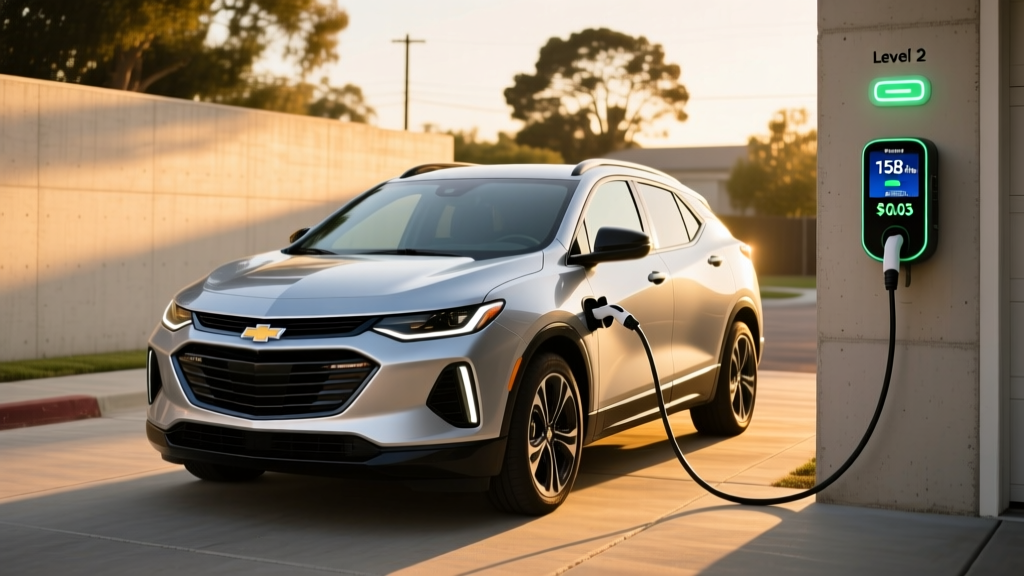
At home on a Level 2 (240V) charger at 11.5 kW, a full 0–100% charge takes roughly 8.5 hours — ideal for overnight replenishment. On a standard 120V outlet (Level 1), expect about 3–4 miles of range per hour, which is only practical for low-mileage days or topping off.
| Level | Power | Miles Added per Hour | Best For |
|---|---|---|---|
| Level 1 (120V) | ~1.4 kW | ~3–4 mi/hr | Overnight trickle, emergencies |
| Level 2 (240V) | 11.5 kW | ~34 mi/hr | Daily home charging |
| DC Fast Charge | Up to 150 kW | ~250+ mi/hr (peak) | Road trips, quick top-ups |
The Equinox EV uses the NACS (North American Charging Standard) connector on 2025+ models, granting native access to Tesla Supercharger stations — a significant infrastructure advantage over CCS-only vehicles. Verify connector type with your dealer, as early 2024 builds used CCS1.
Equinox EV RS vs. Gas Equinox: The Cost Breakdown
The gas-powered 2026 Chevy Equinox starts around $30,000 with a 1.5L turbo engine rated at 26 combined MPG. The EV RS commands a $14,900+ premium at the sticker — but the total cost of ownership (TCO) tells a different story over five years.
| Cost Category | EV RS FWD | Gas Equinox RS |
|---|---|---|
| Purchase Price (MSRP) | $44,900 | $33,500 |
| Est. Federal Tax Credit (§30D) | –$7,500* | $0 |
| Effective Purchase Price | $37,400 | $33,500 |
| Fuel / Electricity (5 yrs) | $3,750** | $10,125*** |
| Maintenance (5 yrs) | $1,500 | $3,800 |
| Insurance (5 yrs, avg) | $9,500 | $7,800 |
| Estimated Depreciation | $16,000 | $12,500 |
| Total 5-Year Cost | $68,150 | $67,725 |
*§30D credit eligibility depends on MSRP caps (SUVs: $80,000), buyer income limits ($150K single / $300K joint AGI), battery sourcing requirements, and point-of-sale transfer availability. Confirm at IRS.gov and with your tax professional.
**Based on $0.14/kWh national average home charging; public DC fast charging costs 2–3× more.
***Based on $3.35/gal and 26 MPG combined.
The TCO is remarkably close — often within $500 over five years. The EV wins decisively if you charge primarily at home on cheap electricity, drive more than 15,000 miles per year, or live in a state with additional rebates. The gas Equinox wins on lower upfront cost if you don't qualify for the federal credit or lack home charging access.
Real-World Ownership: What First-Time EV Buyers Must Know
Home Charging Is Non-Negotiable for Most Owners
Over 80% of EV charging happens at home. If you can install a Level 2 (240V, 40–48 amp) charger in your garage or driveway, the Equinox EV RS is a seamless daily driver — plug in at night, wake up to 300+ miles. A professional Level 2 installation typically costs $800–$2,500 depending on panel capacity and wiring distance. If your home has a 100-amp electrical panel, you may need a $1,500–$3,000 panel upgrade to 200 amps to support a dedicated EV circuit.
If you cannot charge at home (apartment, street parking), the Equinox EV's 319-mile range means you could visit a DC fast charger once a week — but this adds time cost and typically doubles or triples your per-mile energy expense compared to home charging.
Climate and Driving Pattern Considerations
- Cold climates (Upper Midwest, Northeast): Expect 20–30% range loss in sustained sub-freezing temperatures. A 319-mile EPA rating becomes ~230 miles in a Minnesota January. Garage parking and battery preconditioning help.
- Highway-dominant commutes: EV efficiency drops at sustained 75+ mph speeds. If 80% of your driving is interstate, plan for ~270 real-world miles rather than 319.
- City and suburban driving: This is where EVs shine. Regenerative braking recovers energy in stop-and-go traffic, and you'll often beat EPA estimates.
Maintenance Differences
The Equinox EV eliminates oil changes, transmission fluid, spark plugs, and exhaust system maintenance. You'll still replace tires (EVs wear tires 20–30% faster due to instant torque and heavier weight), cabin air filters, brake fluid, and wiper blades. Regenerative braking significantly extends brake pad life — many EV owners report original brake pads at 80,000+ miles.
Tax Credits, Incentives, and Pricing Reality
For 2026, the federal §30D Clean Vehicle Credit offers up to $7,500 for qualifying new EVs — but eligibility is not automatic. The Equinox EV is assembled in North America (Ramos Arizpe, Mexico, with US battery sourcing evolving), and credit qualification depends on critical-mineral and battery-component sourcing thresholds that tighten annually.
§30D Credit Checklist (2026)
- MSRP Cap: Vehicle must be under $80,000 (SUVs/vans/pickups) — Equinox EV qualifies ✓
- Buyer Income Cap: AGI ≤ $150,000 (single) / $225,000 (head of household) / $300,000 (joint) — verify your tax return
- Battery Sourcing: Critical minerals and battery components must meet escalating domestic/free-trade-partner thresholds — check fueleconomy.gov for current vehicle-by-vehicle status
- Point-of-Sale Transfer: You can transfer the credit to the dealer at purchase for an immediate price reduction, or claim it on your tax return
- One Credit Per VIN: The credit applies once per vehicle; used vehicles have a separate up-to-$4,000 credit under §25E
Many states layer additional incentives on top: California's CVRP, Colorado's $5,000 state credit, and various utility rebates for home charger installation. These vary by jurisdiction and change frequently — consult your state energy office and local utility.
Common Misconceptions About the Equinox EV RS
| Myth | Fact |
|---|---|
| "319 miles means I'll always get 319 miles" | EPA is a lab estimate. Real-world highway: ~265–290 mi. Cold weather: ~220–250 mi. City with regen: potentially 310+ mi. |
| "150 kW charging means it charges at 150 kW the whole time" | 150 kW is the peak rate (typically 15–40% SoC). The curve tapers to protect the battery. Average rate 10–80% is closer to 100–115 kW. |
| "The battery will need replacing in 5 years" | GM warranties the battery for 8 years/100,000 miles against degradation below 60% capacity. Industry data shows modern NMC batteries retaining 85–90% capacity at 100,000 miles. |
| "EVs are always cheaper to own" | Not always. Higher insurance premiums (~15–25% above gas equivalents), potential faster tire wear, and higher upfront cost can narrow savings. The math depends on your mileage, electricity rate, and credit eligibility. |
| "I don't need home charging — public stations are everywhere" | Public DC charging infrastructure is growing but remains unreliable in rural corridors and peak travel periods. Home charging delivers 80%+ of the EV ownership experience. |
Decision Framework: Should You Buy the Equinox EV RS?
Choose the Chevy Equinox EV RS If:
- You can install a Level 2 charger at home (garage or driveway with 240V access)
- You drive 12,000–20,000 miles per year in mixed city/highway conditions
- You qualify for the full $7,500 federal credit (bringing effective price to ~$37,400)
- You want a sporty-styled compact EV SUV without paying luxury-brand prices
- You value NACS connector access to the Tesla Supercharger network for road trips
- Your daily commute is under 100 miles round-trip (covers 95%+ of drivers)
Look Elsewhere If:
- You live in an apartment or lack reliable home charging access
- You regularly drive 300+ miles in a single day in cold weather (range buffer gets thin)
- You need to tow more than 1,500 lbs (the Equinox EV is not rated for heavy towing)
- You want the fastest DC charging in the segment — the Hyundai Ioniq 5 and Kia EV6 charge at 240+ kW on 800V architecture
- Your budget is firm at $30,000 and you don't qualify for incentives
How It Stacks Up: Compact EV SUV Competitors
| Model | EPA Range | Max DC Charge | Base MSRP | 0–60 mph |
|---|---|---|---|---|
| Chevy Equinox EV RS (FWD) | 319 mi | 150 kW | $44,900 | ~7.8 sec |
| Hyundai Ioniq 5 SEL (RWD) | 303 mi | 240 kW (800V) | $43,500 | ~7.4 sec |
| Kia EV6 Wind (RWD) | 310 mi | 240 kW (800V) | $44,500 | ~7.2 sec |
| VW ID.4 Pro S (RWD) | 291 mi | 175 kW | $44,000 | ~8.0 sec |
| Ford Mustang Mach-E Select (RWD) | 250 mi | 150 kW | $42,000 | ~6.8 sec |
The Equinox EV RS leads the segment in EPA range (319 miles) and offers competitive pricing. Its trade-off is a lower peak DC charge rate (150 kW vs. the Ioniq 5/EV6's 240 kW on 800V architecture), meaning road-trip charging stops take roughly 10–12 minutes longer per session. For buyers who charge at home 90% of the time, this is a minor concern. For frequent road-trippers covering 400+ miles in a day, the Hyundai/Kia pair's faster charging is a tangible advantage.
Frequently Asked Questions
Does the 2026 Chevy Equinox EV RS qualify for the $7,500 federal tax credit?
It may — but eligibility depends on your income, the vehicle's battery sourcing compliance for the current tax year, and MSRP caps. The Equinox EV's MSRP is well under the $80,000 SUV cap. Check the latest vehicle-by-vehicle qualification list at fueleconomy.gov and consult a tax professional before relying on the credit in your purchase decision.
How much does it cost to charge the Equinox EV RS at home?
At the US average residential rate of ~$0.14/kWh, a full 0–100% charge of the 85 kWh battery costs approximately $11.90 — delivering 319 EPA-rated miles. That's roughly $0.037 per mile, compared to ~$0.13 per mile for a 26 MPG gas Equinox at $3.35/gallon. Over 15,000 miles annually, home charging saves roughly $1,350–$1,500 per year in fuel costs.
What is the real-world highway range of the Equinox EV RS?
On a flat interstate at 70–75 mph in 60–80°F weather, expect approximately 265–290 miles from a full charge. Add headwinds, elevation gain, roof cargo, or temperatures below 40°F, and that number drops. On a road trip, plan to charge when you reach 15–20% SoC for battery health and charger availability buffer.
Can the Equinox EV RS use Tesla Superchargers?
Yes — 2025 and newer Equinox EV models are equipped with the NACS connector and can access Tesla Supercharger V3 and V4 stations natively. Earlier 2024 models with CCS1 connectors require a GM-approved adapter (included with some vehicles, available for purchase for others). Confirm your specific build's connector with the dealer.
How long will the Equinox EV battery last?
GM warranties the Ultium battery for 8 years or 100,000 miles against capacity loss below 60% of original. Real-world data from similar NMC batteries (Bolt EV, early Ultium models) suggests 85–92% capacity retention at 100,000 miles under normal use. To maximize longevity, avoid routinely charging to 100% or discharging below 10% — set your daily charge limit to 80% and reserve 100% for road trips.
Is the Equinox EV RS good in snow and winter conditions?
The eAWD variant provides strong traction in snow, with 340 hp and 355 lb-ft of torque distributed across both axles. The main winter concern is range: expect 20–30% range reduction in sustained sub-freezing temperatures. If your winter commute is under 80 miles round-trip, you'll be fine. For longer winter drives, plan charging stops more conservatively.
What's the insurance cost difference vs. the gas Equinox?
EV insurance premiums run 15–25% higher than gas equivalents on average due to higher repair costs (specialized labor, battery replacement risk). For the Equinox EV RS, expect annual premiums of $1,800–$2,200 depending on your state, driving record, and coverage level — roughly $300–$400 more per year than the gas Equinox. Shop quotes from multiple insurers; some offer EV-specific discounts.