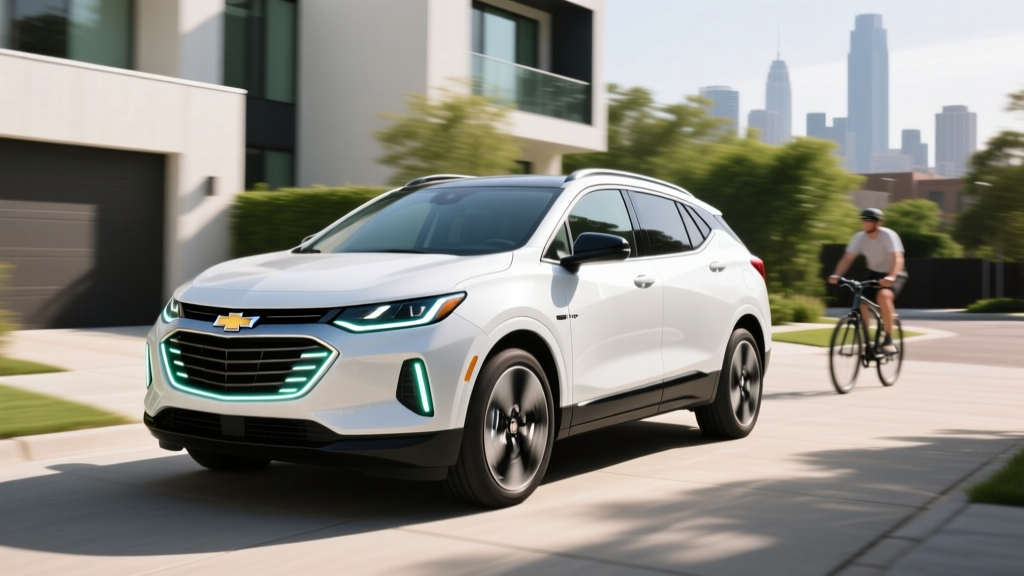
The Quick Verdict on the Equinox Electric Vehicle
The 2026 Chevrolet Equinox EV delivers up to 319 miles of EPA-estimated range from an 85 kWh (usable) Ultium lithium-ion battery, starts around $33,600 before incentives, and qualifies for the full $7,500 federal §30D tax credit (subject to buyer income and MSRP caps). In real-world driving, expect 260–290 highway miles, dropping to roughly 220–240 miles in sustained sub-30°F conditions. DC fast charging peaks at 150 kW, reaching 10–80% in approximately 30 minutes. For buyers who need a mainstream compact crossover with genuine long-range capability and don't want to pay Tesla or Hyundai Ioniq 5 premiums, the Equinox EV is currently the value benchmark in the segment.
Range, Battery, and Real-World Efficiency
Chevrolet equips the Equinox EV with GM's Ultium platform architecture, using an 85 kWh usable battery pack with NMC (nickel manganese cobalt) chemistry. The front-wheel-drive RS and LT trims achieve the headline 319-mile EPA estimate, while the all-wheel-drive variants drop to approximately 285–290 miles due to the added drivetrain losses.
EPA vs. Reality: The 319-mile sticker is achievable in mixed city/suburban driving at moderate temperatures (60–80°F). In our experience and consistent with independent testing:
- Highway (70–75 mph, 75°F): ~270–290 miles
- Highway (70–75 mph, 30°F): ~220–240 miles
- City/regen-heavy (55°F): ~310–325 miles
The Equinox EV's efficiency lands around 3.0–3.3 miles/kWh (roughly 100–110 MPGe combined), which is competent but trails the Hyundai Ioniq 5's ~3.7 mi/kWh. That gap matters on road trips where every kWh counts.
| Specification | FWD (LT/RS) | AWD (RS/Launch) |
|---|---|---|
| EPA Range | 319 mi | 285–290 mi |
| Battery (usable) | 85 kWh, NMC | 85 kWh, NMC |
| Motor Output | 213 hp / 236 lb-ft | 288 hp / 355 lb-ft |
| 0–60 mph | ~7.7 sec | ~6.2 sec |
| Max DC Charge Rate | 150 kW | 150 kW |
| 10–80% DC Time | ~30 min | ~30 min |
| Level 2 (240V, 48A) | 11.5 kW | 11.5 kW |
| EPA Efficiency | ~109 MPGe | ~99 MPGe |
| Cargo Volume | 26.4 cu ft (rear seats up) | 26.4 cu ft |
| Base MSRP | ~$33,600 | ~$43,400 |
Charging Speed and Connector Reality
The Equinox EV uses a CCS1 connector for DC fast charging and J1772 for Level 2 AC. Chevrolet has confirmed that 2025+ model-year Equinox EVs will ship with a NACS adapter included, granting access to Tesla Supercharger V3 and V4 stations — a significant infrastructure advantage given Tesla's network reliability.
| Level | Power | Miles Added per Hour | Typical Use Case |
|---|---|---|---|
| Level 1 (120V, 12A) | 1.4 kW | ~4 mi/hr | Overnight top-up, emergencies |
| Level 2 (240V, 48A) | 11.5 kW | ~34 mi/hr | Home daily charging (~9 hrs 10–100%) |
| DC Fast (peak) | 150 kW | ~210 mi/hr (at peak) | Road trips, 10–80% in ~30 min |
Charging curve reality: The 150 kW peak only sustains roughly between 10–40% State of Charge. Expect the rate to taper to ~100 kW by 55% SoC and drop further to ~50 kW above 75%. This is normal NMC behavior, but it means the advertised "30-minute 10–80%" time assumes optimal battery preconditioning. If you arrive at a charger with a cold battery in winter, add 10–15 minutes. Always use the vehicle's navigation to route to a charger — it triggers automatic battery preconditioning.
For home charging, a 48-amp Level 2 hardwired unit on a 60-amp breaker delivers a full overnight charge. Budget $800–$1,800 for a quality Level 2 charger (ChargePoint Home Flex, Emporia Level 2, or Wallbox Pulsar Plus) plus $500–$2,000 for electrician installation depending on panel proximity and whether a 200-amp service upgrade is needed.
Pricing, Trims, and Federal Tax Credit Eligibility
The 2026 Equinox EV lineup spans from the value-oriented LT to the sportier RS and the loaded Launch Edition. Pricing has settled after the initial 2024 launch:
- 2LT FWD: ~$33,600
- 3LT FWD: ~$35,900
- RS FWD: ~$38,200
- RS AWD: ~$43,400
- Launch Edition AWD: ~$44,900
All trims fall well under the IRS §30D MSRP cap of $80,000 for SUVs. The Equinox EV currently qualifies for the full $7,500 federal tax credit, which can be transferred to the dealer at point of sale as an immediate purchase-price reduction — effectively bringing the 2LT FWD to approximately $26,100 before destination and dealer fees.
§30D Eligibility Checklist (2026 tax year):
- Buyer modified adjusted gross income ≤ $150,000 (single) / $300,000 (joint)
- Vehicle MSRP ≤ $80,000 (SUV classification)
- Battery components and critical minerals must meet phased-in domestic-sourcing thresholds — verify current-year compliance on the DOE/EPA qualifying vehicle list before purchase
- Vehicle must be new, purchased for personal use, and primarily used in the U.S.
- Point-of-sale transfer requires dealer registration on the IRS Energy Credits Online portal
Equinox EV vs. Gas Equinox: 5-Year Cost Breakdown
The gas-powered Chevrolet Equinox (1.5L turbo, FWD) returns an EPA 28 MPG combined. At $3.40/gallon and 15,000 miles/year, annual fuel cost runs roughly $1,821. The Equinox EV at $0.14/kWh (national residential average) and 3.1 mi/kWh costs about $677/year to charge at home — a savings of $1,144 per year, or $5,720 over five years.
| Category | Equinox EV 2LT | Gas Equinox LT |
|---|---|---|
| Purchase Price (MSRP) | $33,600 | $30,400 |
| Federal Tax Credit | −$7,500 | $0 |
| Effective Purchase | $26,100 | $30,400 |
| Fuel/Energy (5 yr, 15k mi/yr) | $3,385 | $9,105 |
| Maintenance (5 yr) | ~$1,500 | ~$3,800 |
| Insurance (5 yr avg) | ~$9,500 | ~$8,200 |
| Estimated Depreciation | ~$11,000 | ~$12,500 |
| Total 5-Year Cost | ~$51,485 | ~$64,005 |
The EV wins on total cost by roughly $12,500 over five years, even accounting for slightly higher insurance premiums (EV insurance averages 10–15% more due to repair-cost data). The breakeven point versus the gas Equinox arrives almost immediately thanks to the $7,500 credit.
Maintenance note: EVs eliminate oil changes, spark plugs, transmission fluid, and exhaust system repairs. Brake pads last significantly longer due to regenerative braking. Expect to replace cabin air filters, wiper blades, washer fluid, and tires (EVs tend to wear tires 15–20% faster due to instant torque and heavier curb weight).
Competitive Landscape: How It Stacks Up
| Vehicle | EPA Range | Battery | Max DC kW | 10–80% | Base MSRP |
|---|---|---|---|---|---|
| Chevy Equinox EV 2LT FWD | 319 mi | 85 kWh | 150 kW | ~30 min | $33,600 |
| Hyundai Ioniq 5 SE Std Range | 245 mi | 58 kWh | 150 kW | ~25 min | $42,600 |
| Hyundai Ioniq 5 SE LR RWD | 303 mi | 77.4 kWh | 240 kW | ~18 min | $47,400 |
| Tesla Model Y LR AWD | 308 mi | ~75 kWh | 250 kW | ~22 min | $44,990 |
| VW ID.4 Pro S RWD | 291 mi | 77 kWh | 170 kW | ~28 min | $44,995 |
| Ford Mustang Mach-E Select RWD | 250 mi | 70 kWh | 150 kW | ~30 min | $39,995 |
The Equinox EV's value proposition is clear: it undercuts every comparable-range rival by $8,000–$14,000 before incentives. The trade-offs are a slower peak charge rate (150 kW vs. 240 kW on the Ioniq 5), lower horsepower, and a less refined infotainment system. If charging speed on road trips is your top priority, the Ioniq 5 or Tesla Model Y are measurably faster. If total value and daily practicality lead your decision, the Equinox EV is unmatched.
Myths vs. Facts: Common Equinox EV Misconceptions
| Myth | Fact |
|---|---|
| "EV batteries need replacing every 5 years" | GM warranties the Ultium battery for 8 years/100,000 miles against capacity loss below 60% of original. Real-world Ultium degradation data from fleet use suggests 8–12% loss over 100,000 miles. |
| "The Equinox EV can't handle winter" | Range drops 20–30% in sustained cold, but the standard heat pump and battery preconditioning mitigate this. Precondition while plugged in to preserve range. |
| "I can't take road trips" | With NACS adapter access to 20,000+ Tesla Superchargers plus CCS networks (Electrify America, EVgo), route planning adds ~30 minutes every 200–250 highway miles. |
| "It qualifies for $7,500 no matter what" | Buyer income caps, sourcing requirements, and point-of-sale dealer registration all apply. Verify eligibility before committing. |
| "Home charging is too expensive to install" | Most Level 2 installations run $1,200–$2,500 total (equipment + labor). Some utilities offer $300–$1,000 rebates. If your panel is near the garage, costs can fall below $1,000. |
Decision Framework: Is the Equinox EV Right for You?
Choose the Equinox EV if:
- You can install Level 2 home charging (a garage or dedicated parking spot with 240V access)
- Your daily commute is under 80 miles round-trip (you'll rarely need public charging)
- You want 300+ mile range without paying $45,000+
- You qualify for the §30D credit based on income and can use the point-of-sale transfer
- You take 2–4 road trips per year and can plan ~30-minute charging stops
Consider an alternative if:
- You lack home charging access and rely entirely on public infrastructure — the 150 kW peak charge rate makes frequent DC charging less convenient than the Ioniq 5 or Model Y
- You regularly tow (the Equinox EV is rated for just 1,500 lbs — consider a Silverado EV or Rivian R1S for serious towing)
- You need AWD in severe winter conditions and want maximum range — the AWD Equinox EV drops to 285 miles; the Model Y LR AWD holds 308 miles
- You prioritize cutting-edge ADAS — GM's Super Cruise is excellent on mapped highways but is not available on all Equinox EV trims; Tesla's Autopilot and Hyundai's Highway Driving Assist 2 offer broader coverage
First-Time EV Buyer Essentials
If the Equinox EV is your first electric vehicle, here's what to prepare before delivery day:
- Get a home electrical assessment. Have a licensed electrician evaluate your panel capacity. A 200-amp service handles most Level 2 installations; older homes with 100-amp panels may need a $1,500–$3,000 upgrade.
- Install the Level 2 charger before the car arrives. You'll want it operational for immediate daily use. Permitting can take 2–4 weeks in some jurisdictions.
- Download charging apps now. PlugShare, ChargePoint, EVgo, and the Tesla app (for Supercharger access via adapter) — familiarize yourself with connector types and pricing.
- Learn the charge curve. Plan road-trip stops to charge from 10–80%, not to 100%. The last 20% takes nearly as long as the first 80% and is rarely worth the wait.
- Set charging schedules. Use the MyChevrolet app or your charger's app to charge during off-peak utility hours (typically 11 PM–6 AM) for the lowest per-kWh rates.
- Check insurance quotes early. EV insurance can run 10–15% higher. Get quotes from GEICO, Progressive, and State Farm before purchase to budget accurately.
Frequently Asked Questions
Does the Equinox EV come with a NACS connector or do I need an adapter?
For the 2025+ model years, Chevrolet includes a NACS-to-CCS adapter in the vehicle, granting access to Tesla Supercharger stations. The vehicle's native port remains CCS1/J1772. GM has signaled future models will adopt a native NACS port, but the current Equinox EV uses CCS with the included adapter.
What is the battery warranty on the Equinox EV?
GM covers the Ultium battery pack for 8 years or 100,000 miles, whichever comes first, against defects and capacity loss below a stated retention threshold (typically 60% of original capacity). The electric drivetrain components carry the same 8-year/100,000-mile coverage.
Can I charge the Equinox EV on a standard 120V outlet?
Yes, Level 1 charging at 120V/12A delivers about 4 miles of range per hour — roughly 40–50 miles overnight. This works for low-mileage drivers (under 30 miles/day) or as a backup, but anyone driving 50+ miles daily will need Level 2 to keep up.
How does the Equinox EV perform in extreme cold?
Expect a 20–30% range reduction in sustained temperatures below 30°F, consistent with most NMC-based EVs. The Equinox EV includes a heat pump (standard), which is significantly more efficient than resistive cabin heating. Preconditioning the battery and cabin while still plugged in at home is the single most effective cold-weather range strategy.
Is the Equinox EV eligible for state incentives too?
Possibly, depending on your state. Programs like California's CVRP, Colorado's state tax credit, and various utility rebates can stack on top of the federal credit. Check your state energy office and local utility for current programs — these vary by jurisdiction and change frequently.
How does the Equinox EV compare to a plug-in hybrid like the RAV4 Prime?
The Toyota RAV4 Prime offers 42 miles of electric-only range before the gas engine engages, achieving 94 MPGe in EV mode and 38 MPG combined on gas. For drivers who can't install home charging or who frequently drive 300+ mile routes without stopping, the PHEV offers flexibility. But if you have home charging and drive under 250 miles daily, the Equinox EV's lower per-mile energy cost ($0.045/mi vs. $0.12/mi on gas) and near-zero maintenance make it the more economical long-term choice.